Su-Kam Case Study: Category Creation 1988–2019
How an unorganised Indian power-backup trade became a branded hardware category — seven published product families from Home UPS and Chic through 100 kVA Solar PCUs, solar hybrids, test jigs, and an e-rickshaw lab — plants in Gurugram and Baddi, and an export map into 90+ countries — before CIRP in 2018 treated 77 granted patents as a file rather than a programme.
1. Executive Summary & Industry Baseline
In 1998 Kunwer Sachdev shut a profitable Delhi cable-TV business and put ₹10,000 and a soldering iron into power backup. He had named the firm years earlier; the inverter company was Su-Kam Power Systems. The founding capital and the decision to leave cable are on the record in the founding essay and in the India Today profile of 18 December 2017.
The market he entered was not “energy storage” as a slide. It was an unorganised Indian trade. Local assemblers sold metal boxes that failed in humidity, voltage swing, and theft-prone neighbourhoods. Square-wave and modified-sine units were cheaper to build than grid-quality sine wave; they hummed in fans and stressed appliances. Wiring and components were often substandard. There was no national brand a household could point to the way it could point to a refrigerator. Sachdev’s published account of those years is that he spent nights in high theft-of-power areas to understand why inverters died — then forced a cleanup by competing on reliability rather than on a grey-market price.
The origin texture matters for a strategy class. Before inverters there was cable TV in Delhi — the same founder, the same Su-Kam name, a recognised local brand he later walked away from because household power cuts looked like the larger industry. That sequence is in the India Today feature and in the cable-TV origin essay. Students should not treat 1998 as a first startup. It was a category switch by someone who already knew dealers, cash collection, and field failure. The “unorganised sector” baseline is therefore not ignorance of business. It is a hardware market that had not yet been forced to organise around a brand, a sine-wave spec, and a service promise.
Category creation, in this case, is not a slogan. Su-Kam taught Indian homes that backup power could be a named product — later a “Home UPS,” combining inverter and UPS functions — and taught dealers that a warranty was something you could stand behind. The rest of the industry adopted the language. That claim is in the India Today feature and in the first-person product essays on this site. It is the baseline against which later technology and export moves should be judged.
By the time banks filed at the National Company Law Tribunal in 2018, the same founder’s public numbers for the going concern were: about 5,000 people at organisational scale, shipments into 90 countries, 77 granted patents, and a running manufacturer generating about ₹600 crore. Those figures are published in The Manufacturing Mirage, Part 1. This case stops the operating story in 2018, when Corporate Insolvency Resolution Process (CIRP) began and the founder’s operational role ended. It does not invent an NCLT case number, a jobs census, or a list of all 77 patent families.
An entrepreneur’s spirit is not bound to a corporate name. This case is the Su-Kam years (1988–2019). The wreckage after 2018 is a different assignment — The Manufacturing Mirage.
2. Hardware Category Creation: Seven Product Families, Not One Hero SKU
Hardware category creation in India in the 2000s was not software-defined. It was device physics, magnetics, firmware on a 16-bit chip, and a casing that would not electrocute a child on a wet floor. A teaching case that stops at DSP sine wave and Chic will miss the rest of the published continuum — high-capacity three-phase machines, lift-backup claims on the docket, solar PCUs, battery equalizers, factory test jigs, and an e-rickshaw motor lab. Those families are documented in product essays on this site and in the Innovation Archive. This section maps them. It does not invent a kVA census, a customer list, or a grant where the docket still says Pending.
- Residential Home UPS — MOSFET / DSP sine wave, Chic × GE Plastics, 90V charging, DT-6S.
- High-capacity / 3-phase — 5–100 kVA heavy inverters, Colossal 100 kVA Solar PCU, Power on Wheels, telecom grant, tractor inverter.
- Lift backup — a 2009 filing for elevator power backup (Pending). Not a shipped kVA table.
- Solar electronics — MPPT Patent 292773, Solarcon / Brainy PCU line, megawatt projects.
- Batteries & BMS — lead-acid BMS and equalizer filings; lithium BESS language after 2019 is a different era.
- Factory automation / ATS — Electroscopy, battery life-cycle tester, core-stacking grant, ATS filings (Pending).
- EV / mobility — e-rickshaw DC-motor lab; a 2009 charging-station filing (Pending).
2.1 Residential Home UPS and safety
India Today’s 2017 feature listed Su-Kam’s technical markers as MOSFET switching, microcontroller-based control, and DSP sine-wave output, plus the Home UPS combination of UPS and inverter. The sine-wave move mattered because Indian appliances were designed for the grid’s waveform. Cheap inverters used square or stepped waves because they were cheaper to manufacture. The origin essay on this site is India’s first sine-wave inverter and the birth of Home UPS: in 2002 the lab pushed DSP pure sine wave; in 2005 the founder named a “Home UPS” category (near-zero switchover; the industry, in that telling, copied the name within a year). Jagdeep Chauhan’s DSP essay is the people story behind that waveform. MOSFET as the transistor bet is in the inverter-beginning essay and in the later IGBT versus MOSFET note (MOSFET below about 1 kVA; IGBT for heavier industrial loads).
In 2003 Su-Kam launched Chic, the first plastic-body inverter in India (and, in the founder’s account, among the first anywhere). The trigger was safety: a metal chassis in a home, rain, and a child. Ordinary plastic would melt at inverter temperatures. The published design response — in the Chic essay and in the Su-Kam legacy essay — was threefold: change the internal circuitry, add a temperature cut-off if the unit was boxed without ventilation, and partner with GE Plastics on an engineering-grade PC-ABS compound rated to about 120°C, little used in Indian consumer power electronics at the time.
India Today later named the plastic-body inverter an Innovation of the Decade. Customers, in the founder’s telling, ran Chic units for the better part of twenty years. The follow-on design, the Fairy Queen locomotive-shaped inverter meant for bedrooms, failed commercially. Faculty should not skip that failure: category creation is a portfolio of bets, not a single SKU. YourStory’s 2015 profile independently records the GE Plastics conversation and the Chic award. This case treats those as corroboration of the primary essays, not as a second set of invented numbers.
Rural and export grids were not 230V. Falcon Plus 1100 is the published 90V story: an automatic voltage regulator and fuzzy-logic charging across an 85–290V window, still charging at 90V, with a six-stage charger and no extra stabiliser box. That is the low-voltage claim this case will teach — not an unpublished “Power Guard” SKU. Battery life is the other residential hinge: DT-6S (desulphation, soft start, bulk, absorption, equalization, float) and the companion UPS charging essay. High-frequency home hardware sits in Falcon HBU.
2.2 High-capacity three-phase inverters and online UPS
The home SKU was not the ceiling. The 10 kVA versus generator essay records heavy inverters from 5 kVA to 100 kVA — a silent indoor substitute for the diesel SKU dealers already sold — and treats India’s first sellable 5 kVA and 10 kVA inverters as a founder claim on that page. Three-phase industrial work is in Vikas Garg’s three-phase / solar PCU essay. IGBT, not MOSFET, is the switch for machinery, elevators as a load class, medical equipment, and data-centre UPS in the IGBT note — that is an application class, not a customer census.
Colossal 3P 100 kVA (2014, 360V-class IGBT-and-DSP Solar PCU) is the published factory machine: fourteen CNC machines in the product film; a demonstration truck the founder named Power on Wheels, loaded with the Solar PCU range for dealers and sites. The same family includes the Colossal overview, the 10 kVA single-phase Colossal, and Intelli S 40 kVA — double-conversion online UPS with a galvanic-isolation transformer, MPPT into the DC bus, and a founder note on that page that three-phase machines scaled to 80 kVA. Thermal proof for solar online UPS is the 30 kVA solar online UPS essay.
Rugged SKUs on the public record are specific, not IP-rated folklore. A Granted row in Section 4 is the heavy-duty three-phase inverter “particularly used for an application in the telecom industry” (2651/DEL/2007 / grant 275276). Tractor charging is in the 2012 Technovations deck: kisan inverters that store energy from a tractor alternator, and an Escorts FT45 inverter-tractor partnership in 2011 — not an unpublished IP67 spec sheet. Two 2007–2008 filings, an FPGA-based high-frequency three-phase inverter (906/DEL/2008) and a sine-wave line-interactive UPS with a bidirectional converter (2279/DEL/2007), remain Pending on the docket; this case does not teach them as grants.
2.3 Lift inverters and elevator backup
There is no dedicated lift-ERD product essay on this site, and this case will not invent 10–200 kVA ranges, high-rise client names, regenerative-braking integration, or an IoT monitoring SKU. What is on the docket is Power Backup System for a Lift/Elevator, application 1432/DEL/2009, filed 10 July 2009, assignee Su-Kam, status Pending — same teaching rule as the FPGA row: a filing is not a grant, and a grant is not a shipment census. The IGBT essay names elevators among industrial UPS loads. Later lift-backup filings (2020–2021) on the Innovation Archive sit in personal or Su-vastika eras; they are outside this case’s 1988–2019 operating window.
2.4 Commercial solar electronics and hybrid systems
The solar hinge is Indian Patent 292773 (application 940/DEL/2008, filed 10 April 2008, granted 9 February 2018): a DSP-based high-voltage MPPT charge controller, published as India’s first of that class in the MPPT essay. That page also records Solarcon as the hybrid line the MPPT stack later powered — converting an existing inverter-battery setup toward solar. PWM appears in the essays as the cheaper charge-controller alternative dealers had to compare, not as a second “India first” this case will mint; Solarscopy is the field tool that put MPPT versus PWM numbers on a counter.
Home and commercial PCUs on this site include Brainy Eco (solar-first hybrid Home UPS, circa 2010), Brainy S (buy backup now, add solar later — charge-sharing with Su-Kam’s own controller), Brainy Touch (colour touchscreen 2.5 kVA / 48V MPPT PCU, PC monitoring, before Wi-Fi was mainstream in that telling), and Brainy Hybrid GTI. Remote telemetry before consumer Wi-Fi is the IoT solar-monitoring essay (RS-232, Ethernet, GSM; a 100 kVA off-grid site log from January 2014).
Megawatt work is in The Solar Projects: SECI 2 MW, PEC Chandigarh 1 MW, Chennai Metro (2013, on-grid), UP village mini-grids (three 250 kW plants), and related institutional jobs. A separate essay, Assam Rifles diesel replacement, records 1.3 MW off-grid across 18 sites in five states (REIL as consolidating contractor). This case cites those pages; it does not invent a jobs or MW total beyond them.
2.5 Batteries, equalizers, and BMS — without minting a lithium SKU range
Vertical integration into chemistry is Section 4 (Baddi tubular gel). What Section 2 must add is electronics around the string. The Innovation Archive lists Su-Kam-era equalizer filings that are still Pending, including Inbuilt Equalizer for Battery Cells (97/DEL/2009). The battery life-cycle tester is the published instrument: constant-voltage / constant-current charge, controlled discharge, ampere-hour proof on a dealer counter. FAQ language on that page defines a battery equalizer as an active cell-balancing device — a definition, not a shipment census.
The lithium BMS essay states that Su-Kam built a BMS for lead-acid batteries about twelve years before that article; lithium-ion BESS and Su-vastika double-layer BMS belong to a later conversation (BBU technical paper). This case will not teach a 10–500 kVA LiFePO4 ESS catalogue, Bluetooth digital warranties, or a 2026 consumer lithium-versus-lead-acid buying guide as 1988–2019 operating SKUs.
2.6 Factory automation, diagnostic jigs, and ATS
The plant’s information system was not only firmware on the SKU. Electroscopy (Comparison Tool Kit) measured efficiency on the counter against cheap imports; Solarscopy did the same for charge controllers, batteries, and PCUs. The battery life-cycle tester sits in the same testing family.
On the docket, An Automated Testing System (1707/DEL/2008) is Pending, as are later filings for PCB functional testing (1268/DEL/2011) and a transformer test rig (1857/DEL/2011). What is Granted, and already in Section 4’s six-row table, is the electro-pneumatic core-stacking machine (Indian Patent 291664, 2048/DEL/2008). An automatic transformer-core welding machine (2266/DEL/2012) is another mechanical filing — Pending, not a grant. Faculty should treat ATS language as “the lab filed test-jig claims and shipped Electroscopy,” not as a certified ATS product catalogue.
2.7 EV infrastructure and drives
The e-rickshaw essay is the mobility record: a DC-motor lab on Su-Kam premises, solar-assisted range experiments, and a founder’s later observation that motors and driver cards in the category are still largely imported. This case will not upgrade that lab into a shipped BLDC e-rickshaw motor catalogue or a hybrid EV fast-charger SKU. A Battery Charging Station (2570/DEL/2009) is on the archive as Pending. Post-2019 IoT EV-backup filings are outside the operating window.
Those seven families still sit on the same six Granted teaching rows in Section 4 — failure detection, DSP online UPS, MPPT, telecom three-phase, core stacking, high-frequency lead-acid charger — plus Pending lift, ATS, and equalizer applications students must not promote to grants. The MPPT solar charge controller is the solar hinge already named; the rest of the continuum is why a case that only studies Chic mis-teaches the firm.
3. The Global Footprint: 90+ Emerging Markets
Su-Kam’s export claim, as published by the founder after 2017, is 90+ countries, with particular weight in power-deficit grids in Africa, the Middle East, and South-East Asia. The India Today snapshot of December 2017 said 70 countries — a magazine number at a point in time, not a contradiction to be “fixed.” This case uses 90+ as the later, tighter public figure and 70 as the 2017 press figure. It does not invent regional revenue shares or African/Middle-East percentage tables; Part 1 of The Manufacturing Mirage explicitly refuses those tables.
What can be taught is the product–market fit. An inverter designed for Indian voltage collapse, brownouts, and dealer service is not the same SKU as a European grid-tie toy. Emerging-market utilities, dealers, and approvals were a moat. The founder’s export memoir on this site records Su-Kam as the first Indian inverter company to earn the CE mark, and a founder who travelled to markets others treated as too hard. Distribution, in the memoir chapters, scaled from door-to-door selling toward hundreds of distributors and tens of thousands of dealers. This case does not treat those channel counts as a government census. They are the founder’s operating picture of how hardware reaches a town that still has eight-hour cuts.
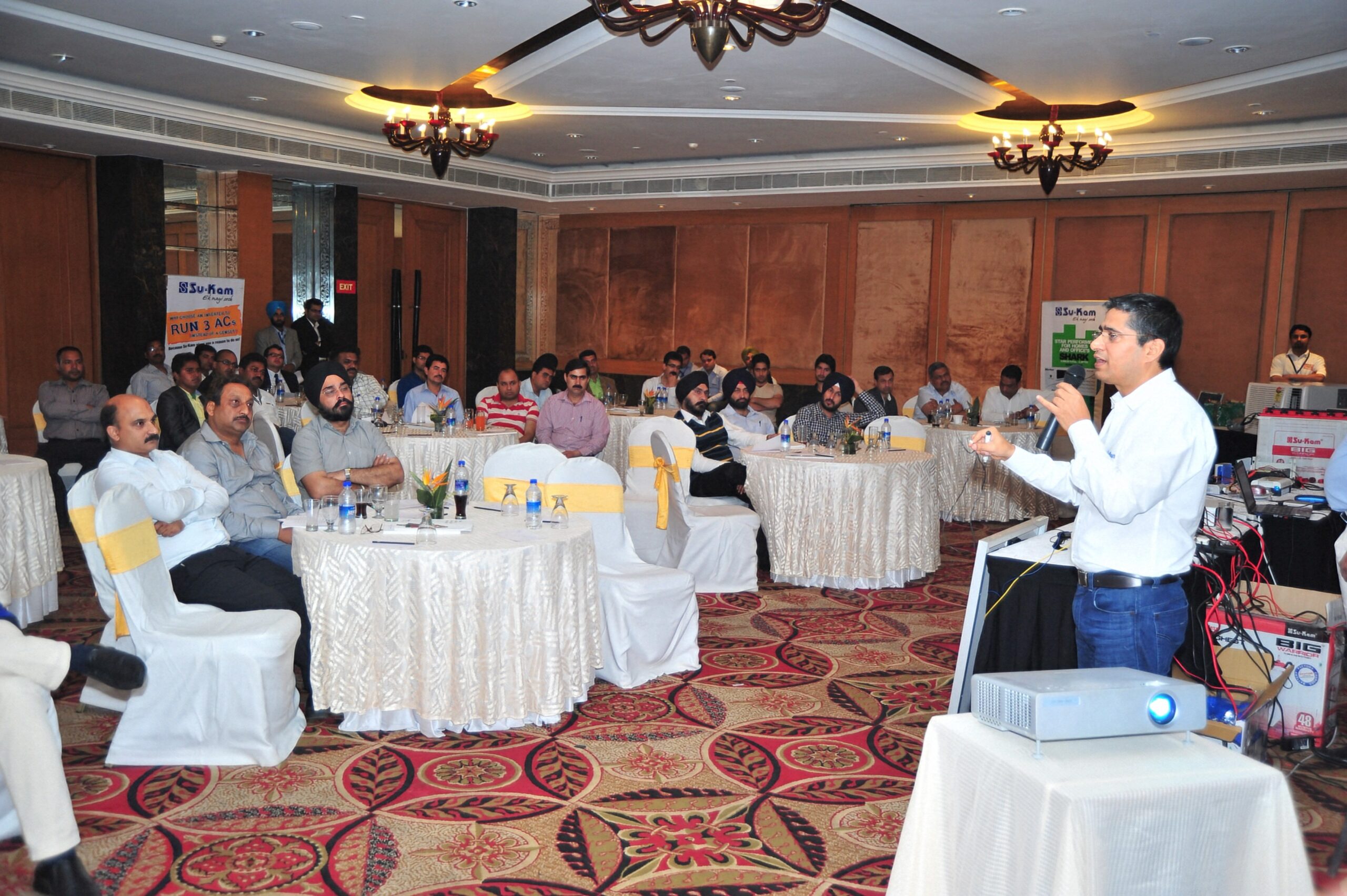
Export here is not a diversification footnote. It is the same MOSFET/DSP stack meeting a different utility. A bidirectional sine-wave UPS filing and an FPGA three-phase inverter filing are the kinds of claims you file when you are already selling into three-phase workshops and clinics, not only into a Delhi bedroom — and both of those applications are still Pending on the public docket. Faculty should pair this section with the patent table in Section 4: the 2007–2008 Delhi grants (and the 2004 charger grant) sit in the same years the company was pushing beyond a single domestic SKU. Do not invent an Africa-versus-Gulf revenue split; the honest statement is the map (90+ countries; Africa, Middle East, South-East Asia named) without a percentage pie.
The 2018–2024 sequel — Chinese inverter brands Growatt, Sungrow, Solis, Huawei, and Goodwe moving from a negligible Indian presence to majority share, with trade press linked from the Hybrid GTI essay — is outside the 1988–2019 operating window, but it is the exam question after the case: what happens to an export map when CIRP removes the people who could still ship it?
4. Operational Scaling & Vertical Integration: Udyog Vihar and Himachal
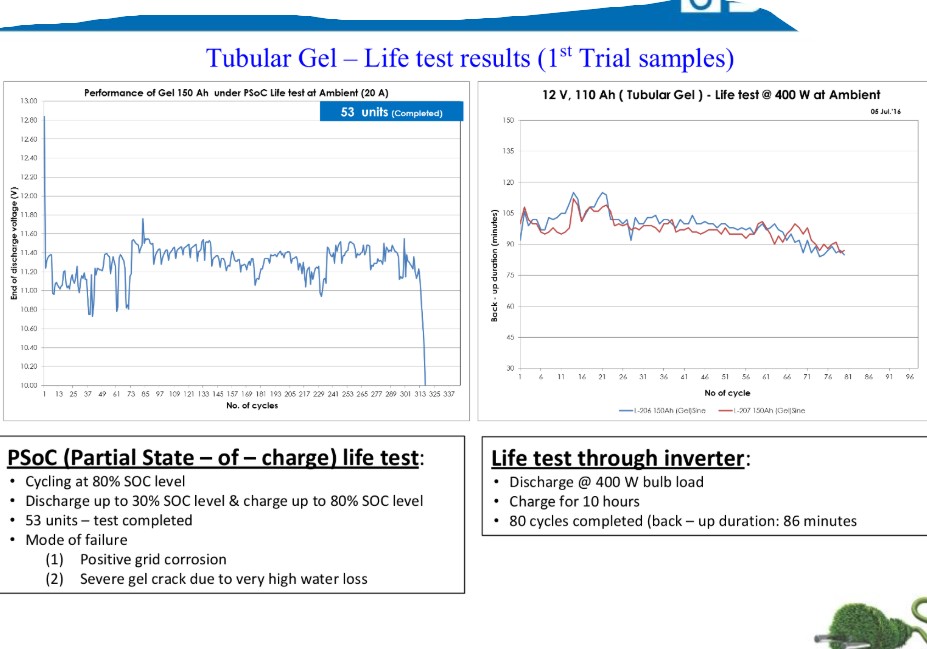
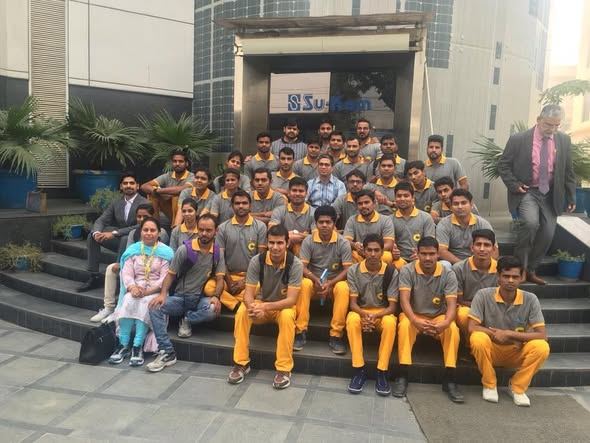
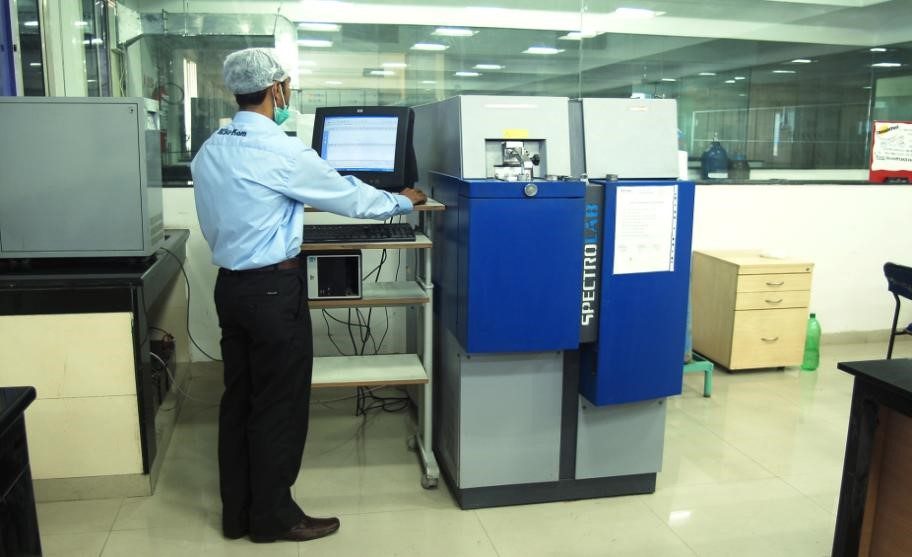
Su-Kam was not a trading desk with a logo. Plants ran. The operational base published on this site is Plot 54, Udyog Vihar Phase VI, Gurugram — headquarters and the primary inverter plant — supported by a battery manufacturing facility in Baddi, Himachal Pradesh, staffed for in-house testing. Vertical integration from power electronics to batteries is the operations lesson: when you cannot trust a vendor’s cycle life in Indian heat and deep discharge, you bring the chemistry inside. The Baddi tubular-gel work is told as a factory story on this site (find battery flaws in months, not years). Transformer vendors, casing shops, and PCB houses in the Gurugram–Baddi shed economy were the supplier book. This case will not invent a vendor census; it will say the ecosystem was real and Indian.
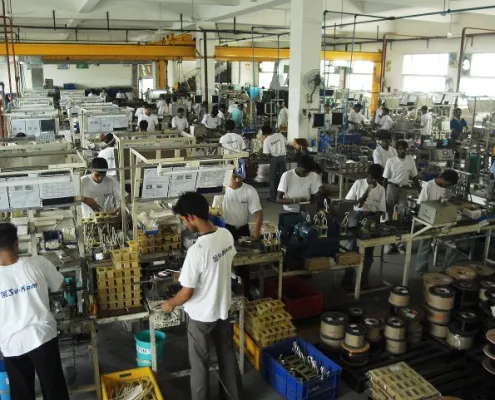
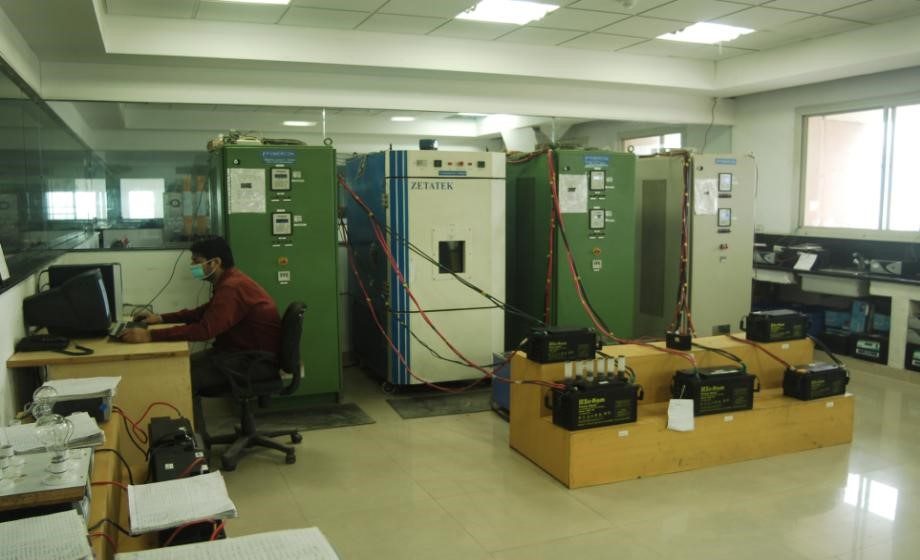
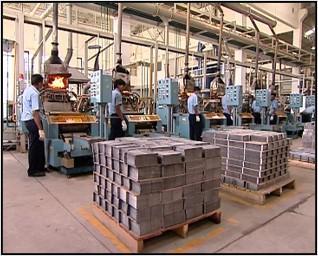
The India Today 2017 feature records 2006 investments from Reliance Power and Temasek Holdings, and honours including a Marico Foundation innovation award (2001–05). Those are magazine facts. They are not a valuation of the 2018 going concern. The going-concern number used in the later CIRP essays is about ₹600 crore of generation when the filing came — a stressed manufacturer asking for time, not a sick unit with a zero order book, in the founder’s telling. Lead banker delay (IDBI, eight months) and a consortium fracture (SBI filing after one month of default) are in Inside the CIRP. This case does not relitigate commercial wisdom. It asks operations students to notice the clock mismatch: CIRP is a legal calendar; a factory is a physical one.
ISO fights, export crates, night shifts, and firmware revision control are the unglamorous texture of indigenous R&D. Part 1 of The Manufacturing Mirage describes two hundred-plus products in the going company — not a single hero inverter. A teaching case that only studies Chic will miss the operations problem: variant explosion, spare parts, dealer training, and a battery chemistry that had to survive Indian heat. The patent lag is part of that texture: India Today recorded a high-frequency lead-acid charger filed in 2004 and granted in 2017, by which time the technology had aged. Hardware IP in India is slow. That is a policy variable, not a founder personality trait.
4.1 Six verified grants (not the 77)
The national figure is 77 granted patents in the going company. How they were filed is a separate essay. The table below is six Indian grants whose application numbers, filing dates, and grant numbers match the 102-row Innovation Archive (source: solarmanofindia.com/patents). Faculty must not present it as the portfolio. Patents did not vanish from a registry when CIRP began; the programme and the people did.
| Title | Technology | Application | Filed | Grant | Status |
|---|---|---|---|---|---|
| Automatic Failure Detection System for Single Phase Inverter/UPS | Power Electronics | 1743/DEL/2007 | 2007-08-16 | 274370 | Granted |
| DSP Controlled Triple Conversion Online UPS with Remote Monitoring | Power Electronics | 1785/DEL/2007 | 2007-08-21 | 284856 | Granted |
| MPPT Based Solar Charge Controller | Solar Systems | 940/DEL/2008 | 2008-04-10 | 292773 | Granted |
| A Heavy-Duty Three Phase Inverter Particularly Used for an Application in the Telecom Industry | Power Electronics | 2651/DEL/2007 | 2007-12-18 | 275276 | Granted |
| Electro-Pneumatically Operable Core Stacking Machine | Mechanical & Chassis | 2048/DEL/2008 | 2008-08-29 | 291664 | Granted |
| A High Frequency Lead Acid Battery Charger | Energy Storage & BESS | 2491/DEL/2004 | 2004-12-15 | 286639 | Granted |
Notice the mechanical grant (core stacking). Vertical integration is not only firmware. A plant that stacks transformer cores in-house is making a different make-or-buy choice than a brand that imports kits and applies stickers.
5. Pedagogical Takeaways & Discussion Questions
Takeaways
- Category creation in hardware is a continuum, not a hero SKU. MOSFET, sine wave, Home UPS, and Chic opened the home. Colossal 100 kVA, Power on Wheels, MPPT/Solarcon, Electroscopy, and a Pending lift-backup filing are the same firm. None of them is a “blitzscale” story.
- Industrial design can be a safety technology. Chic was PC-ABS and thermal cut-off, not a colour refresh. GE Plastics was a supply-chain partner, not a logo on a slide.
- Export of power electronics follows grid pain. 90+ countries, with Africa and the Middle East in the founder’s map, is a product designed for deficit — then a dealer who can service it.
- Vertical integration is an information system. Udyog Vihar electronics plus Baddi batteries shortened the feedback loop on field failures. CIRP later broke that loop; that is the sequel case.
- Patents are not a programme. Six grants illustrate 77. Files remain on a register after people leave. Do not teach “IP auction” as the Su-Kam story; the published wreckage is R&D dispersal and a founder barred by Section 29A from bidding for the company he had built.
Discussion questions (student)
- Was “Home UPS” a genuine new category or a rebrand of inverter-plus-charger? What evidence in the case would you demand in a board meeting?
- Map the Chic decision on a design–risk matrix: child safety, melt risk, GE Plastics compound, temperature sensor, dealer training. Where does most of the value sit?
- Why might a patent cluster (failure detection, DSP online UPS, telecom three-phase, MPPT, lead-acid charger, core-stacking machine) plus Pending lift-backup and ATS filings be a better signal of indigenous R&D than a single “hero” SKU? What do you do, as a case writer, with 906/DEL/2008, 2279/DEL/2007, and 1432/DEL/2009 still Pending?
- Section 2 names seven product families. If you taught only DSP sine wave and Chic, what operating facts would a Committee of Creditors in 2018 never see? Argue from the essays linked in 2.2–2.7, not from a slide.
- India Today (2017) said 70 export countries; later essays say 90+. How should a case writer handle two founder-consistent snapshots without inventing a regional mix?
- Compare make-or-buy: transformer cores and batteries in Himachal versus importing Chinese kits. What breaks first under a 180-day CIRP freeze — the register of patents, or the shed economy in Gurugram and Baddi?
- Section 29A made the founder ineligible to bid. If you were on the Committee of Creditors in 2018, what operating information would you have needed that a Resolution Professional’s first morning could not supply?
- After 2018, Chinese inverter brands took majority Indian share by 2024 (founder essays + linked trade press). Is that proof that Su-Kam would have held the market, or only proof that a going technology stack was taken off the field? Argue from the case, not from patriotism.
Instructor note (cut for student packs)
Suggested split: strategy class on Sections 1–3 (spend board time on the seven families in Section 2; do not let Chic eat the hour); operations class on Section 4; public-policy / IBC elective on questions 7–8 with Mirage Part 1 as overnight reading. CIRP cost figures published on this site — process spent ₹45 crore, COVID-period sale ₹49.50 crore, banks recovered about ₹8 crore — belong in the sequel, not as a 1988–2019 operating KPI. Do not assign invented NCLT numbers, lift kVA tables, or high-rise client lists. Teaching objective: students should leave able to separate (a) category creation and indigenous hardware, from (b) insolvency law’s effect on a living plant.
Sources (primary, on this site unless noted)
- Founding Su-Kam — ₹10,000
- Sine wave and Home UPS
- Chic, Fairy Queen, GE Plastics / PC-ABS
- Falcon Plus — 90V charging
- DT-6S six-stage charging
- 5–10 kVA versus diesel
- Colossal 100 kVA; Power on Wheels
- MPPT — Patent 292773 / Solarcon
- Solar projects — PEC, Chennai Metro, SECI
- Assam Rifles — 1.3 MW / 18 sites
- Electroscopy / Solarscopy
- E-rickshaw DC-motor lab
- Udyog Vihar Plot 54; Baddi, Himachal; Chic × GE Plastics
- How 77 patents were filed
- Innovation Archive (102 IPO rows from solarmanofindia.com/patents; six teaching grants in Section 4 are a subset)
- India Today, 18 December 2017 (70-country snapshot; MOSFET / DSP / Home UPS; Reliance–Temasek 2006)
- Manufacturing Mirage, Part 1 (77 patents, 90 countries, CIRP sequel)
- Hybrid GTI (post-2018 Chinese brand shift; trade press)
- YourStory, August 2015 (GE Plastics; Chic)
Word count is a teaching-case length, not a magazine feature. Photographs are from the Su-Kam quality and factory record already on this site. The live patent table is /innovation-archive/ — 102 public-docket rows, not 77 chemistries.
Related technical paper: India’s First Lead-Acid Battery Management System: The Su-Kam Battery Balancing Unit — Su-Kam’s early lead-acid Battery Balancing Unit (BBU / BMS), patent application 1899/DEL/2008.
id=”ks-bio” style=”max-width:880px;margin:36px auto 0;font-family:’Segoe UI’,-apple-system,BlinkMacSystemFont,Roboto,Helvetica,Arial,sans-serif;color:#1f2933″>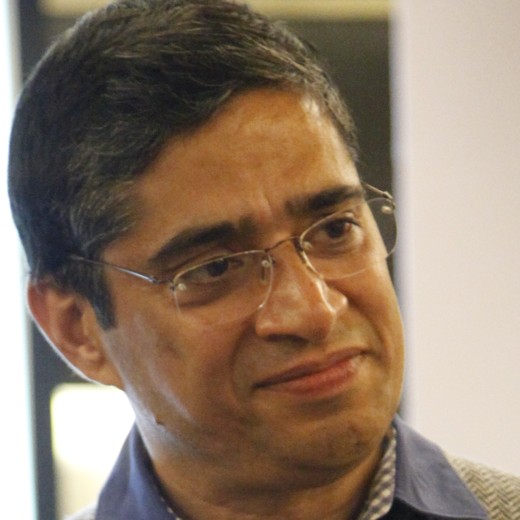
Kunwer Sachdev
Founder & MD, Su-Kam Power Systems (1988–2019) and Kunwwer.ai, mentor at Su-vastika — the “Inverter Man of India” and the “Solar Man of India.” Read his story →