Category & brand creation
How Kunwer Sachdev turned Rs 10,000 into India’s first branded inverter
People search for a founding myth that starts in a garage with an inverter on the bench. Mine doesn’t. It starts with a 1988 proprietorship, a soldering iron, and almost no capital — the Rs 10,000 kind of beginning later write-ups never stopped repeating, because that really was the scale of it. Ten years later, in 1998, that same stubborn workshop built what the Indian power-backup market had not organised yet: a first branded inverter India could actually trust. A name on the box. Protections inside. A company that would still be there if the box failed.
This is not a fifth origin chapter. The long versions already live on this site — cable, MOSFETs, plastic, sine wave. This is the companion arc those chapters sit inside: 1998 market chaos, the constraints we founded under, the first inverter R&D, the 2002 government stamp on our lab, the raid that was supposed to finish us, and the recovery that taught the market Su-Kam was a brand, not a stall.
01The inverter market I walked into in 1998
In 1998 an inverter in my own home kept dying. When the technician came, I asked how it worked. He looked at me and said I would not understand the technology.
That sentence did more for Indian power backup than any business plan I have ever written.
I carried the box to the factory, opened it, and found a jungle of loose wires on a cheap single-sided board — cruder than the satellite-receiver PCBs we were already stuffing for cable television. Two facts arrived together. The whole country was living with power cuts. And nobody had truly engineered the machine that was supposed to solve them.
Kolkata clones
Everyone copied the same transistor circuits, on single-sided boards, with two batteries. Sold like commodities. No name a neighbour could repeat.
A grey box and a prayer
Quality was not a category. Service was whoever had sold you the last one. If it burned, you bought another clone.
A branded machine
MOSFET, not transistor. One battery, not two. Protections you could point to with the lid open.
I refused to copy that design. I found the leap in an unexpected place: inverters built for Western recreational vehicles. Double-sided PCB. MOSFET technology. A single battery. Their truck dynamo did the charging; they didn’t even carry a charger. I decided to leapfrog the entire domestic market and build that class of machine for a country that lost power every evening.
02What Rs 10,000 actually meant as a constraint
Before I could bet on MOSFETs, I had already spent a decade learning what a rupee is worth when nobody will lend you a pedigree.
Su-Kam did not begin as an inverter company. In 1988 it was Su-Kam Cable TV System, a proprietorship. I wired hotels and multi-storeyed societies with a common antenna and a VCR, then pushed that signal into every room. When cable television exploded — one cassette serving a whole neighbourhood for a few rupees a month — the operators needed amplifiers, modulators, directional couplers. I stopped being only an installer and became a manufacturer. Small team. Soldering bench. An unreasonable belief that we could make the parts as well as anyone in the world.
That is the real meaning of the Rs 10,000 founding. Not a cute origin number. A constraint. There was no fund, no industrial house, no uncle in a ministry. If we wanted a spectrum analyzer, we bought the machine instead of a house. At a 1992 exhibition I picked up an analyzer cheap on the last day because nobody wanted to haul equipment home; customs held it three months at 200% duty, and I paid more than I could afford to free it. Later I bought an Anritsu that cost over twenty lakh — the price of a house in the India I was living in. I bought the instrument. My only religion was technology.
I carried catalogues out of Hong Kong and Singapore in my arms because I could not afford to check luggage, and because there was not a single Indian stall in those halls. We were a poor country in other people’s eyes. I wanted us to stand there anyway.
The cable years also taught me failure. I wired real, named places — Mandi House for Doordarshan, dish antennas and full cable systems at the PM House and across Air Force and Army stations — and ran my own network in the Air Force colony at Subroto Park, collecting from subscribers with my own money because I wanted a company, not a pile of parts. When I could not build the management to hold those networks, I sold them. I poured money into a Canadian digital set-top box years ahead of its time and watched inexperienced founders experiment it away. Even the wasted money pointed forward.
By the mid-1990s, big cable companies were buying operators and importing hardware. The Indian manufacturer’s monopoly was ending. I already knew we would have to change technology again. The inverter on my drawing board was not a pivot invented in a slide deck. It was the next product from a workshop that had only ever survived by organising a chaotic market.
The longer cable story — exhibitions, the analyzer, Subroto Park — is the cable-TV years before the inverters. This essay needs only one fact from that decade: we entered 1998 already used to building what India was told it could not build, with almost no capital and no permission.
03First inverter R&D: two years of exploding MOSFETs
Designing the first board was the easy part. It looked almost like a computer board, with connectors a small technician could replace. Making it stable was another story.
For almost two years it was hit and trial. One prototype at the factory, one in my house, rebuilt almost every day. A few days of testing, a new problem, solve it, face another. The MOSFETs kept exploding on the bench with a noise that frightened everyone around me. Sometimes we could not even tell which condition had killed the device. We had no oscilloscopes worth the name, no simulation software. Failure was the laboratory.
The first real breakthrough was not a prettier box. It was protection — so a fridge or a washing machine could not kill the inverter. Overload. Short circuit. Deep discharge. Reverse polarity. Once those held, there was no looking back.
I gave it a single battery when everyone else needed two. I made it half the size. I painted the chassis black when people warned me black was inauspicious. The market made that colour the industry norm.
I sold the first 500 myself. Telecallers working the Yellow Pages. My cable-TV dealers. My own friends. I opened the case in front of every customer and showed them the protections. We parked units in friends’ houses and at cable sites and watched real-world performance. When those 500 ran flawlessly for six months, I knew.
In 2000, against everyone’s advice, I shut the cable-TV business completely and bet the whole life of the company on the inverter. Big cable had already decided to import. Power backup was still a wide-open mess waiting for someone to organise it.
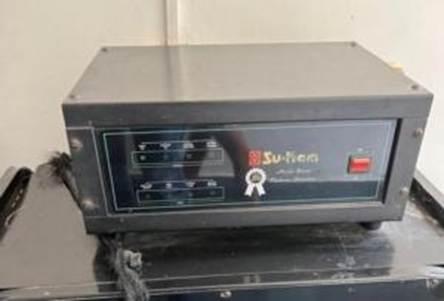
The blow-by-blow of those two years of MOSFET R&D — the RV board, the sleepless nights, the first metal chassis and the “befitting reply to power problems” brochure — is Part 2. What this companion piece has to say is simpler: the first branded inverter India got from us was not a sticker on a Kolkata clone. It was a product we had broken hundreds of times in our own lab until a family could run a fridge on it.
04The thing I am proudest of is not a product. It is a lab.
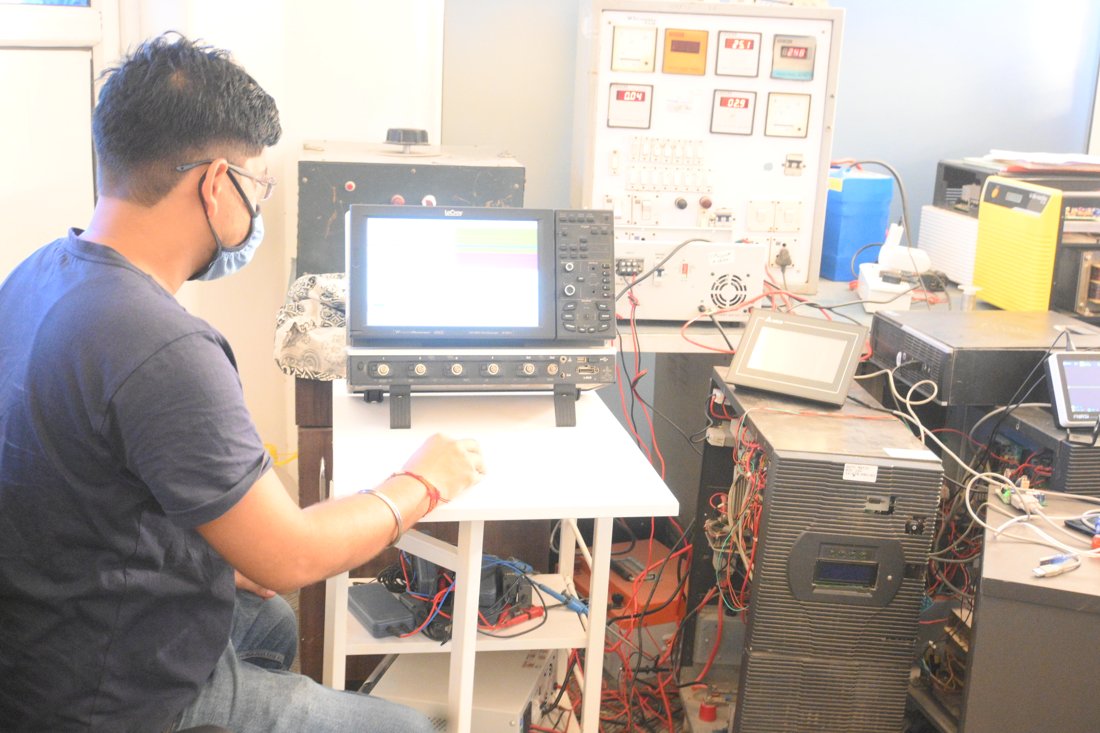
No one would hand me trained power-electronics engineers, because in this industry they simply did not exist. So I took raw graduates from ordinary colleges and made inventors of them, with one promise that terrified and freed them in equal measure: experiment, fail, and I will still protect your job.
In a country frightened of failure, I made failure safe, and invention came rushing in. I would set two teams racing at the same impossible problem just to see how far I could push them. Out of that fire, later, came India’s first sine wave inverter — DSP, conceived in my lab, under an obsession that would not accept that India couldn’t do it. Some of the young men in that room, Sanjeev Saini and Jagdeep Chauhan among them, went on to their own patents and companies. Nothing makes me prouder. But the lab was mine. The dare was mine. The stubbornness that would not let us fail was mine.
Fear of failure
Engineers were terrified of experimenting. I had to make blowing up a MOSFET a lesson, not a career-ending mistake.
Knowledge hoarding
Engineers would not share what they learned, fearing they would become replaceable. I had to break that.
Brain drain
I would invest years in a person and watch them leave for a multinational. Su-Kam became an unofficial training ground for the industry.
052002: DSIR puts a government stamp on a self-taught lab
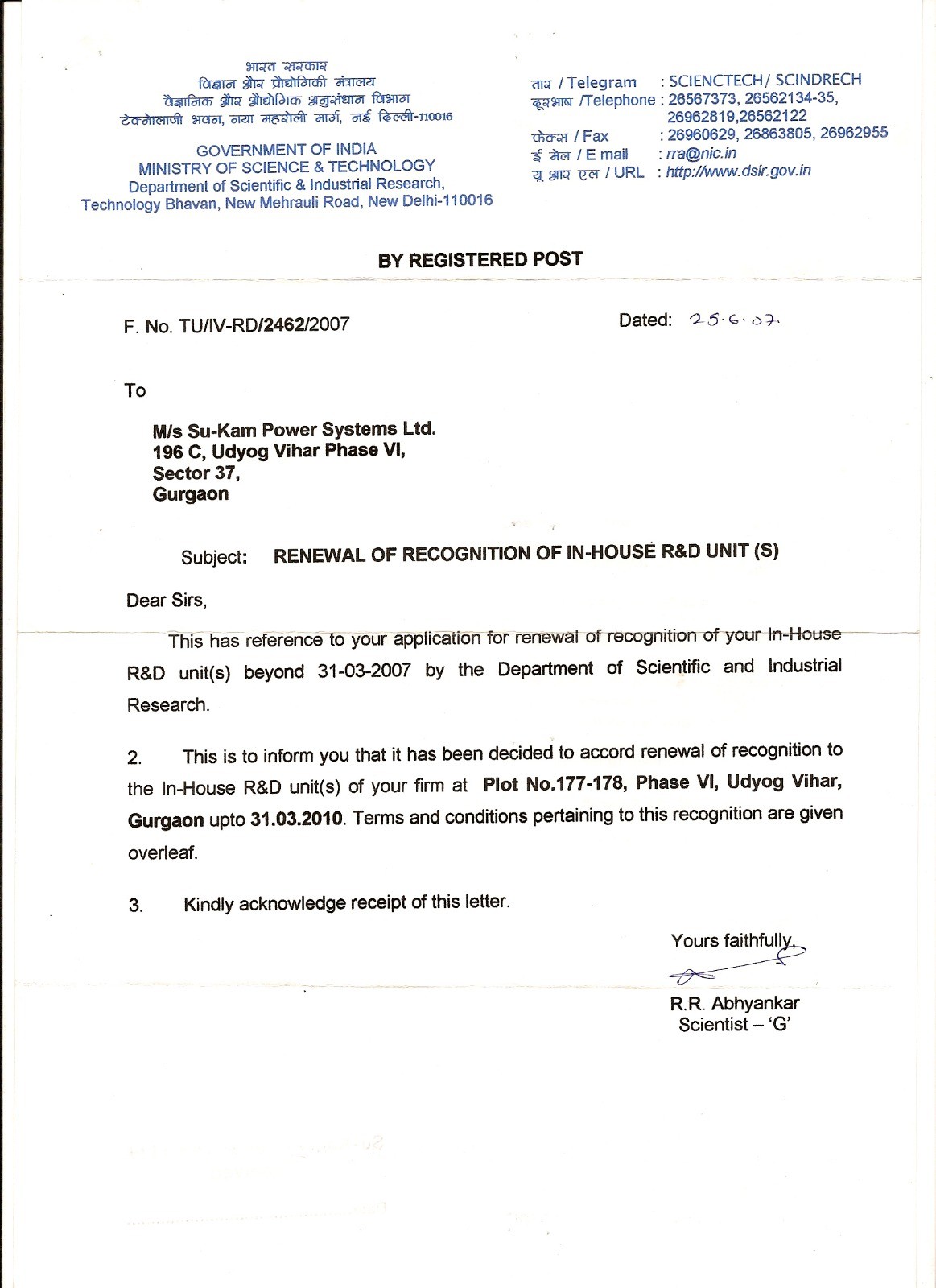
When I built Su-Kam’s R&D, almost nobody in our industry had such a thing. Power backup and solar were trades of assemblers and copycats, not laboratories. I was the first to build a real one.
In 2002 Su-Kam became the first company in India’s power-backup and solar industry to have its in-house R&D unit formally recognised by the Department of Scientific and Industrial Research (DSIR), under the Ministry of Science and Technology, Government of India. They do not grant that lightly. They examine your infrastructure, your engineers, your real contribution to indigenous technology, and decide whether your lab belongs beside the nation’s research institutions. Ours did.
For a self-taught man who had been told he would not understand the technology, that was the validation that mattered. Not a magazine title. A government letter that said the work was real.
06Brand trust, before anyone used that phrase
I had not fully understood how strong the name had become until the market started repeating it without me in the room.
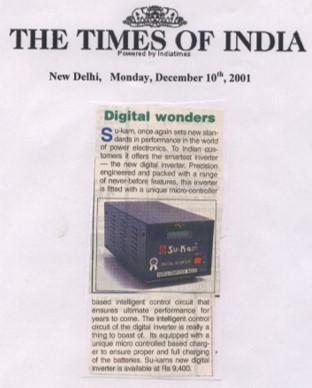
By December 2001, The Times of India was running us under “Digital Wonders”: a microcontroller-based digital inverter, intelligent charging, “the smartest inverter” on offer, at Rs 9,400. That is not a founder’s brochure line. That is a national newspaper telling a Delhi reader that a branded machine existed, at a price, with a brain on the board.
I had already been selling the idea with the lid open — Yellow Pages, dealers I trained myself, electricians who had previously only known clones. Opening the case was the brand. If you can show a customer the protection circuit, you are no longer selling a mystery box. You are selling an organisation.
Two books later put the same story into the entrepreneurship canon — Rashmi Bansal’s Connect the Dots, and Porus Munshi’s Making Breakthrough Innovation Happen, where Su-Kam’s R&D sat among eleven Indian stories of people who pulled off the impossible. I did not found a company so that I could be in a book. I founded it so a fridge in an Indian home would survive a cut. The books arrived because the product had already organised a market.
0715 August 2002: the raid that was supposed to finish us
The first time I learned how fragile it all was came in 2002.
The Excise department raided us — tipped off, we later understood, by a competitor. They seized our goods, froze the business overnight, and the rumour went out that Su-Kam had shut down. Half my trained workforce was poached. My CFO simply stopped coming.
I stood with the few who stayed. I had a brand the market already believed in, a lab the government had recognised, and a factory that could not legally move stock. On paper we were finished.
On 15 August 2002 I did the thing that sounds reckless and was, in the market, a masterstroke. I dropped our prices 50% and promised dealers we would compensate their old stock. It detonated. Within weeks we had three months of orders in advance, the cash to restart production, and competitors who could not follow us down.
Every time a crisis came for me, I rose higher. I have come to believe the crisis is the opportunity — you just have to be willing to fight your way out. Independence Day, 2002, is when India’s inverter market learned that Su-Kam was not a stall you could rumour out of existence. It was a brand with a lab, a dealer promise, and a founder who would cut his own margin in half rather than let a raid write the ending.
08What “first branded inverter India” actually means
I do not use that phrase as a slogan on a packaging panel. I use it as a description of work.
In 1998 the Indian inverter was unbranded chaos: transistor clones, two batteries, no protections worth the name, no company behind the warranty. We entered with Rs 10,000-era constraints and a cable-TV manufacturer’s stubbornness. We spent two years exploding MOSFETs until a single-battery machine could protect a home. We sold the first 500 ourselves with the lid open. We shut the old business in 2000 and put the whole company on that bet. In 2001 a national newspaper priced our digital inverter in public. In 2002 DSIR recognised the lab. In August 2002 a raid and a rumour tried to erase the name, and a 50% price cut plus a stock promise brought the dealers back.
That sequence is how a workshop becomes a brand. Not advertising. Organisation.
What came after — the plastic-body CHIC that India Today later called Innovation of the Decade, the Home UPS category, the factories, the patents — only exists because 1998–2002 taught customers, dealers, and a government department that Su-Kam would still be there on Monday.
If you want the chapters, they are already here. If you want the founding in one sitting, this is it: how Rs 10,000 and a wounded ego turned a failing household inverter into the first branded inverter India could point to, open, and trust.
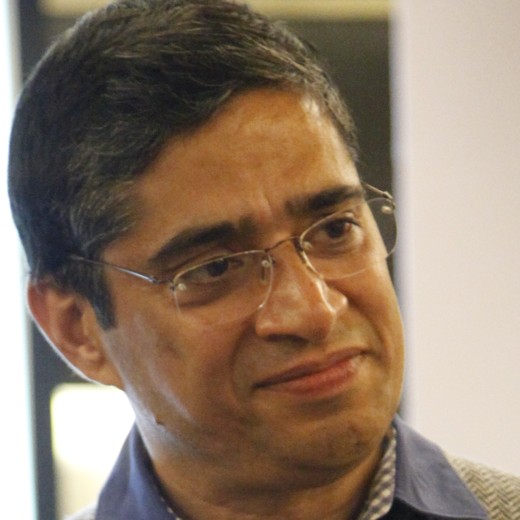
Founder of Su-Kam and Kunwwer.ai, and mentor at Su-vastika and several other companies — the “Inverter Man of India” and the “Solar Man of India.” Read his story →
The same founding arc is compressed in the Su-Kam category-creation case study.