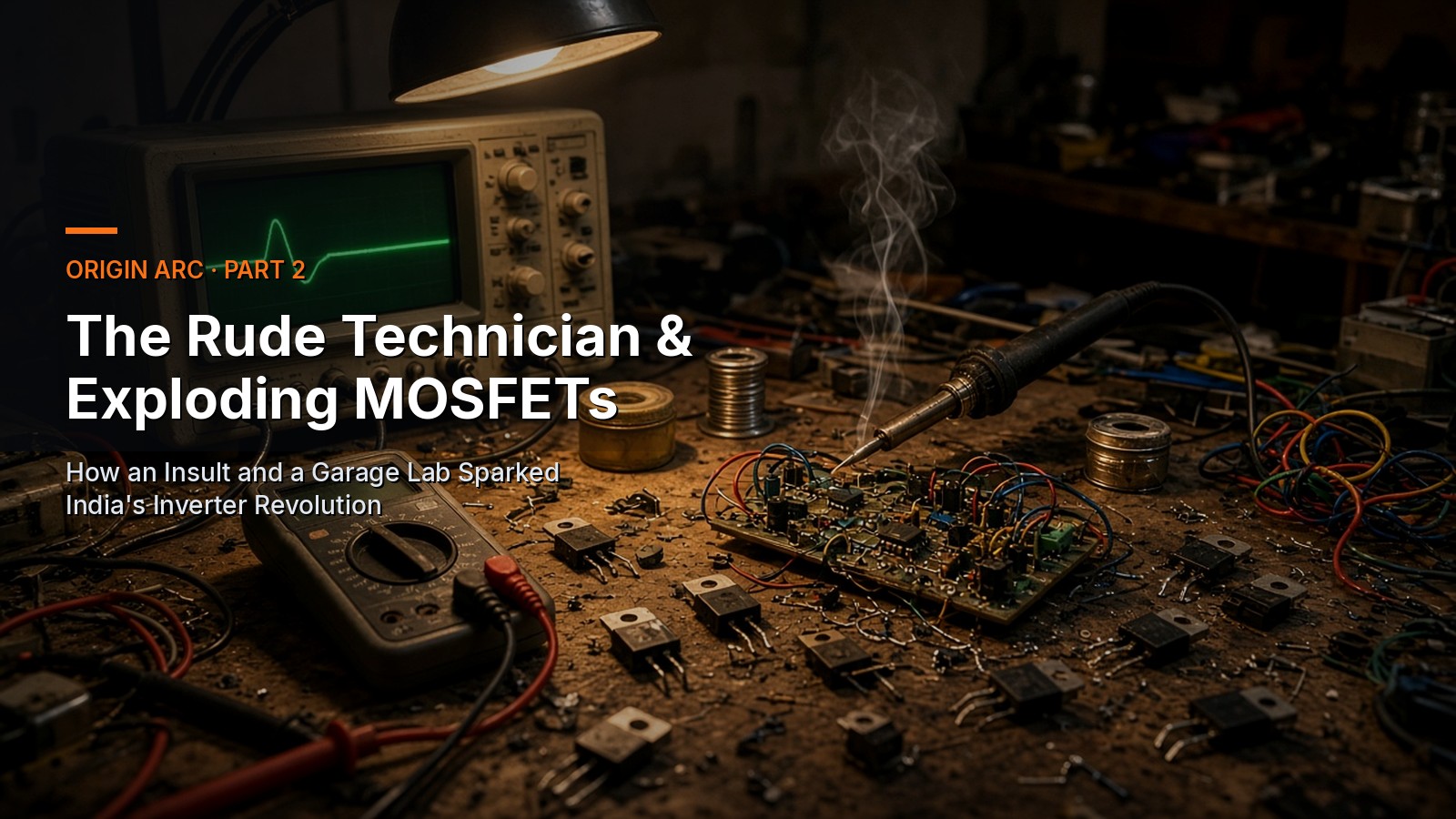
How an Insult and a Garage Lab Sparked India’s Inverter Revolution
“He was ignorant about the inverter he was repairing and commented that I would not understand this technology part — which hit my ego.” That one sentence from a service technician in 1998 changed everything.
I took the inverter to my factory, opened it, and saw a jungle of wires on an ordinary single-sided PCB. I was already making PCBs for sophisticated satellite receivers — and I realised there was an enormous opportunity here. Everyone in India was suffering from power cuts, and the inverters available were terrible.
The technician’s arrogance: “You won’t understand how it works.” That insult — not a business plan — is what made me open the box.
Rejecting clumsy bipolar transistors for high-frequency power MOSFETs, double-sided PCBs, and a single battery — a leapfrog bet against Kolkata’s entire market.
Blowing up hundreds of components in the garage until the circuit held. Two years. No simulators. Every explosion was tuition.
“The biggest breakthrough of my life did not start with a business plan. It started with an arrogant technician telling me I wouldn’t understand how my own inverter worked. That insult opened the box.”
01The RV inverter that opened my eyes
I started researching inverter technology worldwide. Kolkata ruled the Indian inverter market then — everyone used transistor-based circuits from there, on single-sided PCBs, with two batteries. Then I came across the inverters used in Recreational Vehicles (RVs) in the Western world. They didn’t even have a charger — the truck’s dynamo charged the battery — but the technology inside was completely different: double-sided PCB, MOSFET technology, single battery.
I decided to leapfrog India’s entire market and build on MOSFETs.

02Two years of exploding MOSFETs
The first board we designed was elementary — like a computer board with connectors any small technician could replace. Making it stable was another story entirely. It took almost two years of trial and error. One prototype ran at the factory, one at my home. A few days of testing, a new problem, solve it, face another. The MOSFETs kept blowing up — the noise was terrifying, people around me were scared, and sometimes we couldn’t even tell which condition caused the failure.
The perseverance that defined Su-Kam: every blown MOSFET was a lesson; every failure was data. We had no oscilloscopes, no simulation software — pure hands-on experimentation. Two years. Hundreds of blown MOSFETs. Countless sleepless nights. This is the part nobody tells you about Indian innovation — the unglamorous, scary, expensive part where you’re not sure if the next prototype will work or explode.
03The first Su-Kam inverter is born
After two years of R&D we had a stable, MOSFET-based, single-battery inverter — fundamentally different from anything in the Indian market, with protections nobody else offered: overload, short circuit, deep discharge, reverse polarity.
I sold the first ~500 units directly to consumers — opening the inverter in front of customers, explaining the features, demonstrating the protections. We installed units at friends’ houses and cable TV sites to watch real-world performance; every feedback loop made the product better.
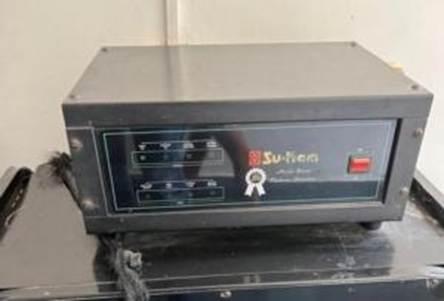
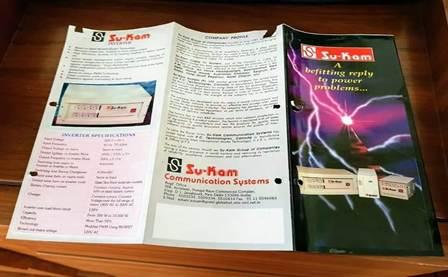
From direct sales to a dealer network: once I trusted the product, electricians and local electronics shops became our first dealers, and I personally trained them. By 2000 I made a decision many thought was crazy — I shut down the Cable TV business entirely. Big companies with imported hardware were taking cable over; inverters were a wide-open market waiting for someone to do it right.
04Setting up the R&D — the hardest challenge
Building the R&D team was harder than building the product. The challenges in India’s engineering culture were brutal:
Fear of failure
Engineers were terrified of experimenting — India’s education system punished failure. I had to make blowing up a MOSFET a learning experience, not a career-ending mistake.
Knowledge hoarding
Engineers wouldn’t share what they learned, fearing they’d become replaceable. I had to break this and build collaborative teams.
Brain drain
I’d invest years training engineers, and they’d leave for multinationals. Su-Kam became an unofficial training ground for the entire power-electronics industry.
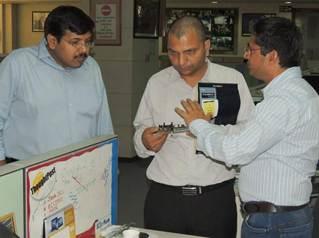
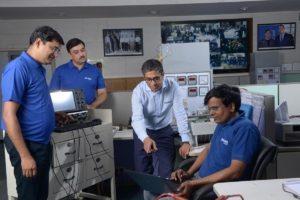
Two people became pillars of this R&D journey:
Jagdeep Chauhan
The man who invented India’s DSP sine wave inverter at Su-Kam. His breakthrough changed the entire Indian inverter industry.
Sanjeev Saini
The man who built Su-Kam’s mind — our CTO, who took the R&D from a scrappy lab to a world-class operation.
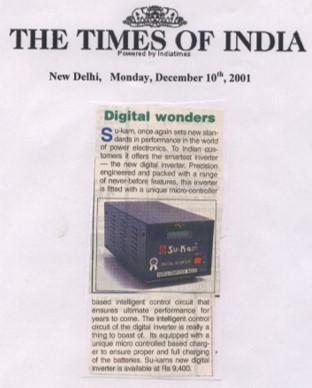
05“Digital Wonders” — The Times of India, 2001
06Featured in two landmark books
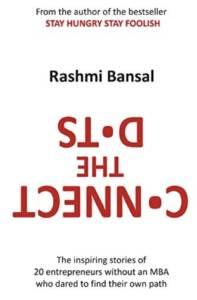
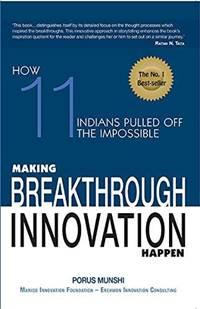
The Su-Kam innovation story was documented in two bestselling books on Indian entrepreneurship: Connect the Dots by Rashmi Bansal — 20 entrepreneurs without MBAs who dared to find their own path — and Making Breakthrough Innovation Happen by Porus Munshi — how 11 Indians pulled off the impossible.
What came next changed everything: a customer’s daughter got shocked by a metal inverter. That incident led me to create the world’s first plastic-body inverter — the innovation India Today called “Innovation of the Decade.” That story is Part 3 →
- My Story with Jagdeep Chauhan — the man who invented India’s sine wave inverter
- My Story with Sanjeev Saini — the man who built Su-Kam’s mind
- From a malfunctioning inverter to a national standard — the R&D story
- Su-Kam Power Systems — Wikipedia
- MOSFET technology — Wikipedia
- HarperCollins: Making Breakthrough Innovation Happen — the Su-Kam case study
- Goodreads: Connect the Dots by Rashmi Bansal — featuring Kunwer Sachdev
- Su-Kam Solar — YouTube channel
- Pioneer Timeline — four decades of firsts, at SolarManOfIndia.com
- Verification — documented proof of the firsts, at SolarManOfIndia.com
Founder of Su-Kam and Kunwwer.ai, and mentor at Su-vastika and several other companies — the “Inverter Man of India” and the “Solar Man of India.” Read his story →