The Electroscopy Story: How We Built a Lie-Detector for Inverters — and Won a Global Market
What inverter testing technology actually proved
Inverter testing technology — There are projects you take on because they make business sense. And then there are projects you take on because they refuse to let you sleep.
Electroscopy was the second kind.
The problem nobody wanted to name
Back in those days, the international power-backup market had a problem nobody in the industry was willing to call out loud. Chinese inverters and home UPSs were flooding shelves at prices Indian and other quality-focused manufacturers simply could not match. On a price tag alone, we were losing — and we were losing fast.
But here’s what the price tags didn’t tell you: the technology behind those low-cost products was nowhere near ours. Lower efficiency. Higher no-load consumption. Slower change-over times. Shorter actual backup. The customer was paying less today, but paying more every single month in higher electricity bills, faster battery wear, and worse appliance protection.
The trouble was — how do you prove that on a showroom floor?
A retailer’s word? Possibly biased. Online reviews? Often manipulated. BEE star ratings? Not always available, especially in international markets. A spec sheet? Customers’ eyes glaze over before the second row.
A customer standing in front of two inverters, one of ours and one cheap import, had no way to see the difference. And in a price-sensitive market, what you can’t see, you don’t pay for.
So we asked ourselves a different question: what if we could let the customer see it themselves, live, in front of their eyes, in under five minutes?
That question became Electroscopy.
Why the R&D team pushed back — and why they were right to
When I first floated the idea internally, our R&D team wasn’t convinced. And to be fair to them, they weren’t being negative — they were being honest.
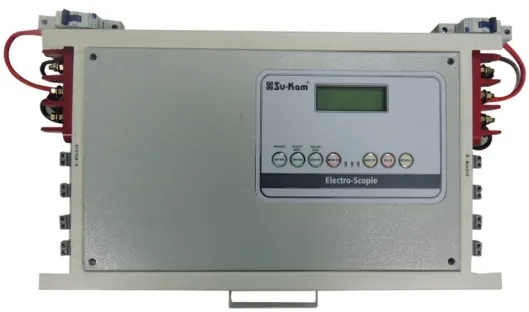
What I was asking for was effectively a complete piece of testing equipment. Not a feature on an inverter. Not a software dashboard. A standalone instrument that could simultaneously measure two power-backup systems in parallel and compare them across efficiency, change-over time, no-load consumption, backup duration, and cost-per-unit — and do it on something portable enough that a sales rep could carry it into a dealer’s shop.
That’s a lab-grade power analyzer in a 5-kilogram suitcase. Built to a price point a reseller could afford. With a UI a non-engineer could read.
The team’s resistance taught me something I’ve carried into every product project since: when your engineers push back on an ambitious idea, they are usually telling you the real cost of the dream. Your job as a leader isn’t to overrule them — it’s to absorb their objections, sharpen the brief, and come back with constraints they can solve inside.
Four iterations to a breakthrough
We didn’t get it right the first time. We didn’t get it right the second time either.
It took four full iterations before the prototype came close to what we had imagined. Each iteration killed assumptions we’d been carrying:
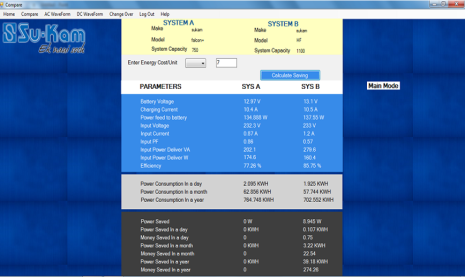
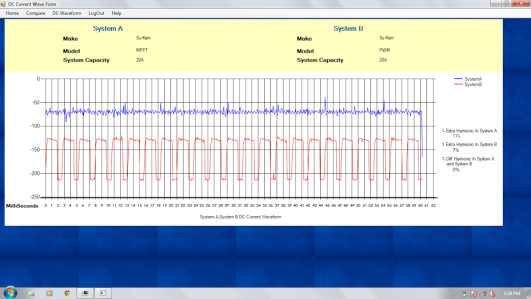
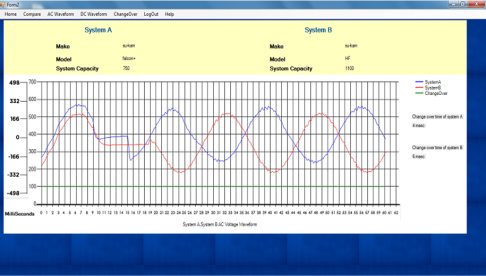
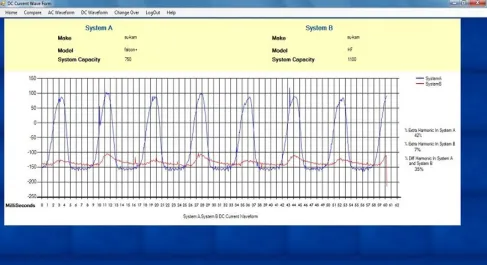
The first version was too sensitive to wiring quality, so we re-engineered it to work with normal copper or aluminum wire — no special probes needed. The next iteration was unstable across battery chemistries; we had to redesign the input handling. By the third version, the hardware was solid but the comparison data was a wall of numbers nobody wanted to read. So we built a USB-connected GUI for any PC or laptop, with a 16×4 LCD on the device itself for instant on-the-spot reads. By the fourth iteration, we had what we set out to build: a tool a reseller could open like a briefcase, hook to two inverters, and within minutes show a customer — live — which one was more efficient, which one saved more money, which one delivered longer backup, and which one had a faster change-over time.
We called it the Comparison Tool Kit (CTK), and we branded it Electroscopy — a sure way to measure efficiency. The metaphor wrote itself: a stethoscope for appliances. A specialist for a complete health check-up of any electronic device.
When R&D becomes a marketing weapon
Here is the part I want every founder, marketer, and sales leader to internalise.
Electroscopy was built by R&D. But it won in marketing and sales.
For the first time, our resellers stopped arguing about price. They started running demonstrations. A dealer would put a customer’s preferred cheap import next to ours, plug both into the Electroscopy CTK, and let the numbers speak. No persuasion. No spec-sheet shootout. No “trust me, sir.” Just two real products, measured in parallel, in real time, with the customer watching the live graph on a laptop screen.
The conversation shifted from “which one is cheaper?” to “which one actually saves me money?” — and once that shift happened, the cheap import lost. Every time.
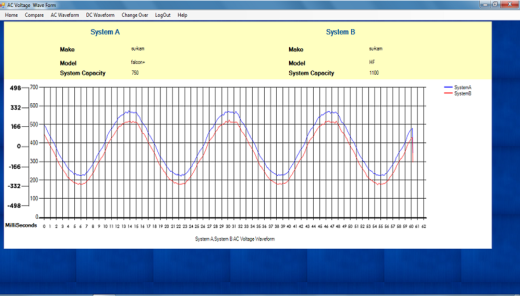
In national and international markets, this single instrument did more for our brand than any advertising campaign we’d run that year. Distributors who had never given us a serious meeting suddenly wanted exclusivity. International buyers who had walked away over price came back when they realised they could prove the technology gap to their own customers. A product that started as an R&D challenge became, almost by accident, the sharpest sales-enablement tool in our entire portfolio.
We later extended the same Comparison Kit philosophy to solar with Solarscopy — purpose-built to compare solar charge controllers, batteries, and solar PCUs (Power Conditioning Units) side by side. Solar was a category where customer confusion was even worse than inverters: charge-controller efficiency varies wildly between MPPT and PWM units, battery performance under solar charging cycles is not what a spec sheet suggests, and a solar PCU’s real-world conversion losses can quietly eat half the savings a customer expected. Solarscopy let installers and dealers prove, on the spot, which charge controller harvested more from the same panel, which battery held up better under solar duty cycles, and which PCU actually delivered the efficiency it promised. Same philosophy as Electroscopy — let the customer see it, don’t ask them to take your word for it.
What I’d tell anyone tackling a project like this
Three things, and I learned all of them the hard way.
First, the most powerful marketing claim is the one the customer can verify themselves. Anything else is noise in a market full of noise. If you can hand the buyer a tool — physical or digital — that lets them prove your claim with their own eyes, you have built a moat that no competitor’s price cut can cross.
Second, listen to your R&D team’s resistance before you try to overcome it. Their pushback is data. The four iterations we needed weren’t a delay — they were the actual project. If we’d shipped iteration one or two, Electroscopy would have failed in the field, and the brand cost would have been worse than the original problem.
Third, innovation isn’t always a new product. Sometimes it’s a new conversation. Electroscopy didn’t replace our inverters. It changed what people talked about when they walked into a store. That single shift — from price to verified performance — was worth more than any feature we could have added to the inverter itself.
We took on Electroscopy because the market was punishing us for being better. We finished it because we figured out how to make “better” something the customer could actually see.
That’s the part that mattered. That’s the part that built the brand.
🔗 Read the Full “My Story” Series

Founder of Su-Kam and Kunwwer.ai, and mentor at Su-vastika and several other companies — the “Inverter Man of India” and the “Solar Man of India.” Read his story →
24 products and instruments. This page is one of them. The others are here.
- Colossal overview
- Colossal 1P 10 kVA
- Colossal 3P 30 kVA
- Colossal 3P 40 kVA
- Colossal 3P 100 kVA
- Brainy Eco 1100
- Brainy Eco hybrid PCU
- Brainy Hybrid GTI
- Brainy S modular
- Brainy Touch PCU
- Intelli S 40 kVA
- Falcon HBU
- Falcon Plus 1100
- Chic plastic inverter
- DT-6S charging
- Solar online UPS
- Here — Electroscopy
- Battery life-cycle tester
- Lithium BMS
- Sun Way street light
- IoT solar monitoring
- Tubular gel battery
- Commercial solar / MPPT
- UPS charging
You must be logged in to post a comment.