Su-Kam Brainy Hybrid GTI: the grid-tie inverter that uses 100% of your solar — and still keeps the lights on
What a Hybrid Grid Tie Inverter actually does
The Hybrid Grid Tie Inverter was built for that trade-off. An on-grid system cuts your bill but dies in a power cut. An off-grid system gives you backup but wastes solar once the battery is full. We refused to accept that trade-off, so we built a machine that does both — a UPS, a Solar PCU and a grid-tie inverter in one intelligent box, with a brain that decides where every watt of sunshine should go.
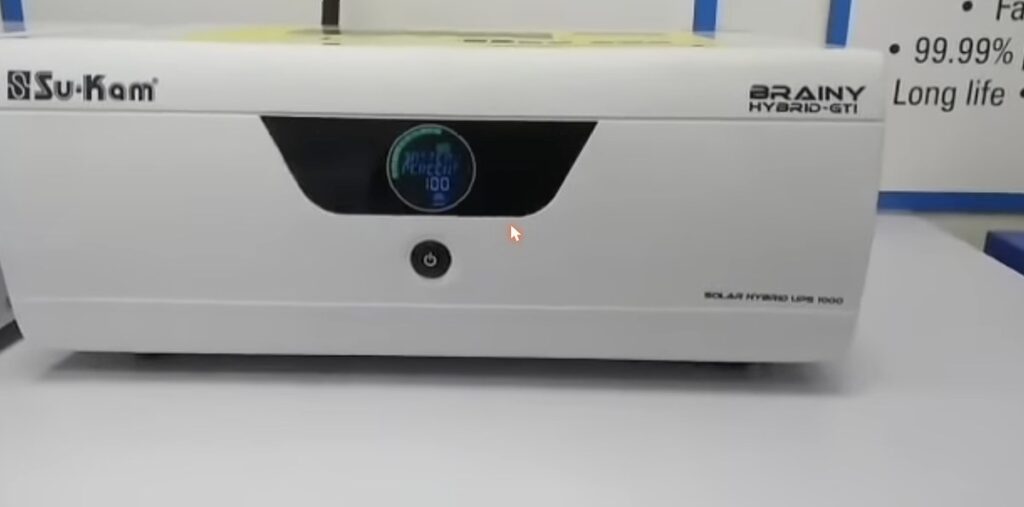
The film above is the single most-watched video on the entire Su-Kam channel — and there is a reason an inverter explainer crossed ninety thousand views. The Brainy Hybrid GTI answered the question every Indian solar buyer was quietly asking: if I put solar on my roof, what happens to my backup — and to all the power my panels make that I do not use?
1 Two old ways, and why each one fell short
Before this product, a buyer had to pick between two imperfect choices — and neither used solar to the full.
On-Grid (Grid-Tie)
Great for lowering the electricity bill by exporting solar. But it has no battery — so the instant the grid fails, it shuts down for safety, wasting daytime solar and leaving you with no backup.
No backupOff-Grid (Solar PCU)
Reliable battery backup. But once the battery is 100% full and the load is small, the surplus solar is simply wasted — and constant charge/discharge cycling wears the battery down over time.
Wastes surplusBrainy Hybrid GTI
A smart combination of both. It works with or without the grid, gives full battery backup, and uses 100% of your solar — nothing is wasted, nothing is left on the table.
Best of both2 One box doing the work of three
The Brainy Hybrid GTI is what happens when you put an online UPS, a Solar Power Conditioning Unit and a grid-tie inverter into a single intelligent machine. It is part of the same Su-Kam thinking that, in my own words to pv magazine, produced “an intelligent Solar Hybrid inverter which works as both off-grid and on-grid inverter” — and the same conviction behind what we believed was the world’s first Hybrid UPS.
3 The brain: a 3-tier solar priority
What makes it “Brainy” is how it decides where every watt of solar goes. It follows a strict three-tier priority the moment the sun is shining:
First: run the load
Solar power goes first to feed your active home or facility load — the appliances running right now.
Then: charge the battery
Any solar left over after the load is met is used to charge the connected battery bank, building your backup reserve.
Finally: export to the grid
If the load is fully met and the battery is completely charged, the remaining surplus is fed back into the grid through a net meter — so not a single unit of solar is wasted.
4 How it actually cuts your bill
When surplus solar is exported, it does real work immediately: it can support heavy appliances — an air conditioner, a refrigerator — that are running directly on the mains. The net meter only draws the remaining deficit from the grid after your solar contribution has been maximised. Under an active net-metering policy, every exported unit becomes a credit on your bill.
Solar that earns, not just saves
An ordinary setup only reduces what you draw. The Brainy Hybrid GTI does that and pushes your surplus back to the grid for a credit — so the system pays you back twice: once by cutting what you buy, and again by selling what you do not use.
5 A true UPS for sensitive electronics
Because there is an online UPS at its heart, the Brainy Hybrid GTI switches over with such a high-efficiency, near-seamless transfer that it is completely safe for the equipment that cannot tolerate even a flicker — servers, routers, modems, computers and printers — with no risk of data loss. That same intelligence shows up across the Brainy range: solar priority, intelligent charge-sharing, automatic temperature compensation (ATC) and powerful battery charging even at a low 90V.
- Runs servers & IT gear safely
- High-efficiency UPS switchover
- No data loss on transfer
- Intelligent charge-sharing
- Automatic Temperature Compensation
- Strong charging from low 90V
The wider Su-Kam grid-tie family was built for real Indian conditions too — engineered to keep working at very low input voltages and launched specifically to handle low voltage and erratic supply, with GSM remote monitoring so the system could be watched from anywhere in the world.
6 Why I built it for India
Net metering was only just arriving in India when we built this, and I said as much at the time: the slow progress of net metering in most states had dampened demand for pure on-grid systems. But I knew our market too well to sell a machine that died during a power cut — in most of India, backup is not a luxury, it is the whole point. So we refused to make people choose between bill savings and reliable backup. The Brainy Hybrid GTI gave them both, and wasted nothing in between.
“The product is a viable option not only for commercial establishments but also for home-owners if their state has an active net-metering policy and pays a good price to residents for feeding excess solar electricity back to the grid.”— Kunwer Sachdev, on the Su-Kam grid-tie launch (EQ Magazine, 2017)
7 India’s answer — tested the hard way, then stalled
I want to be honest about what this product really was. Solar that feeds the grid and stores power in a battery — the exact combination the whole world is talking about today, and that India now imports almost entirely from China — we had it, built and tested in India, years ago. This was our answer for India: grid-feed plus storage in one machine, designed for our broken grid, not Germany’s.
And we earned it the hard way. We did not ship it in volume on day one; we built and tested it in batches — well over a hundred units — sent them into real Indian homes and feeders, waited for the failure reports, and folded every single one back into the next revision. We kept the isolation transformer that the Chinese industry was busy abandoning, and we engineered it to lock onto a grid as low as the rural feeders we actually have, because our customers were never in Germany. We even field-tested it in Nigeria, on one of the most fragile grids on earth, and it held.
Then Su-Kam entered insolvency in 2018, and the project was stalled. The champion was gone, the export pipeline lost its planner, and the country quietly handed the market to China — which today holds a major and rising share of India’s inverter market. The technology was right. The timing, for the company, was not. You can see the company’s own history on Wikipedia.
Read the full story
I have written the whole painful account separately — the testing, the engineering choices, the first Indian grid-feed-plus-battery patent, and how India lost an industry it had a head start in: We Built India’s First Grid-Feed Hybrid Inverter in 2017 — Then We Lost the Indian Inverter Industry to China →
It is the same conviction that runs through the rest of our solar range — from the Colossal 30 KVA and 40 KVA three-phase Solar PCUs up to the 80 KVA — and the story of how we turned the humble inverter into a full solar power plant. For the technical background, see net metering and grid-tie solar inverters.
8 Putting one in: the installation
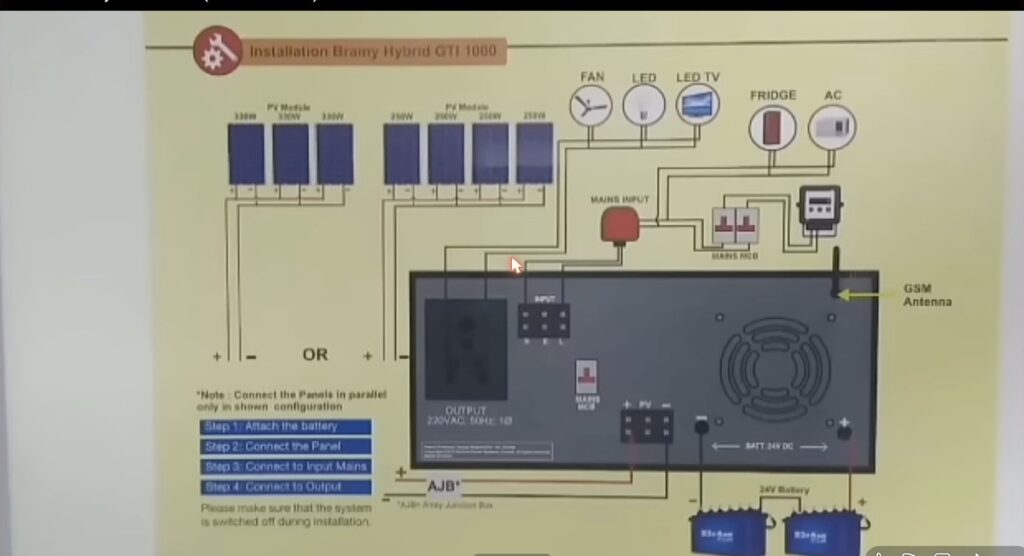
We also made it straightforward to install. Here is the step-by-step installation of the Su-Kam Hybrid Grid Tie Inverter 1000, start to finish.
The top panel carries a printed wiring diagram showing the exact order of connections. Switch the system fully off before making any connection — then it goes in four steps.
Battery bank — 24V configuration
Two 12V batteries (100–200 Ah) in series: jumper the first battery’s positive to the second’s negative, then connect the inverter’s red (+) wire to the free positive terminal and the black (−) wire to the free negative.
Mains input — grid integration
Wire the Line (L) and Neutral (N) ports on the back panel to your utility supply to enable grid-tied charging and net metering, then flip the integrated Mains MCB to the ON position.
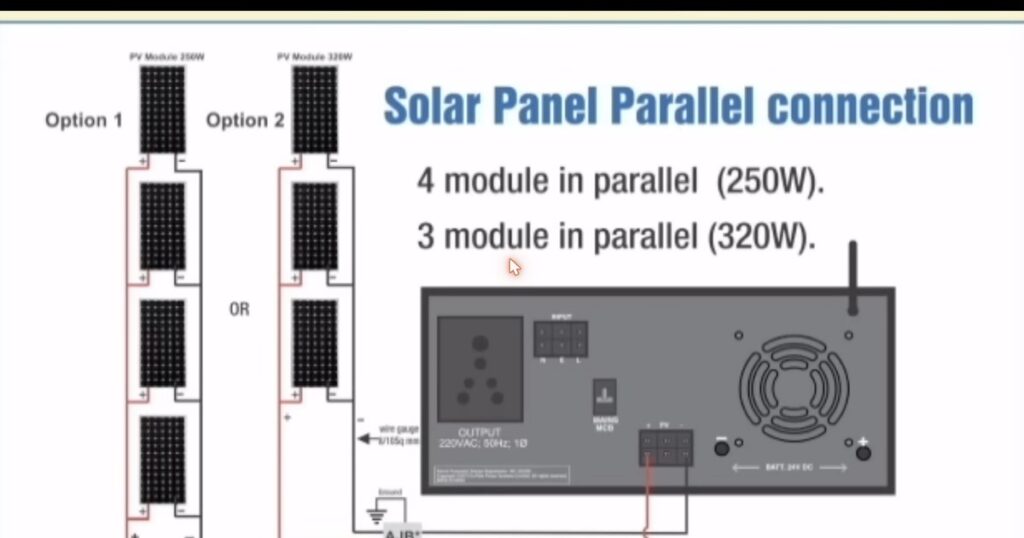
Solar array — 1 kW input
Wire the 1 kW array in parallel to keep voltage in safe bounds (Voc under 44V) — four 250W panels or three 320W panels in parallel. Route the array junction box red to PV (+) and black to PV (−).
Output load — powering devices
Plug your distribution lines into the output socket. The high-efficiency switchover runs IT loads (computers, printers, modems, servers) and non-IT loads (TVs, refrigerators, fans, lights) without interruption.
The front panel keeps it simple: a single on/off power switch and an LCD screen giving real-time operating parameters and generation metrics — load, solar, battery, and what is being fed back to the grid.
9 A note from me
Of all the films we ever put out, this is the one people watched the most — and I think that tells you something. It was never really a video about an inverter. It was about a promise: that going solar in India did not have to mean sitting in the dark during a power cut, and that not a single ray of sunshine on your roof should be wasted. We packed a UPS, a Solar PCU and a grid-tie inverter into one machine, and gave it a brain to decide what to do with every watt — because that is what an Indian home actually needed, not what was easiest to build.

Founder of Su-Kam and Kunwwer.ai, and mentor at Su-vastika and several other companies — the “Inverter Man of India” and the “Solar Man of India.” Read his story →
24 products and instruments. This page is one of them. The others are here.
- Colossal overview
- Colossal 1P 10 kVA
- Colossal 3P 30 kVA
- Colossal 3P 40 kVA
- Colossal 3P 100 kVA
- Brainy Eco 1100
- Brainy Eco hybrid PCU
- Here — Brainy Hybrid GTI
- Brainy S modular
- Brainy Touch PCU
- Intelli S 40 kVA
- Falcon HBU
- Falcon Plus 1100
- Chic plastic inverter
- DT-6S charging
- Solar online UPS
- Electroscopy
- Battery life-cycle tester
- Lithium BMS
- Sun Way street light
- IoT solar monitoring
- Tubular gel battery
- Commercial solar / MPPT
- UPS charging
You must be logged in to post a comment.