How We Built India’s First Solar Online UPS at Su-Kam — Making Double-Conversion Online UPS Energy Efficient
How this Solar Online UPS was proven at 30KVA
How We Built India’s First Solar Online UPS at Su-Kam
30KVA 360V (3P-3P) — The Innovation That Made Double-Conversion Online UPS Energy Efficient

Original R&D presentation by Deepak Kumar, Su-Kam Power Systems
The Problem I Wanted to Solve
I was recently cleaning my computer when I came across this old R&D presentation, and it brought back memories of a problem that had been bothering me for years.
Every Online UPS in India was a power guzzler. And I knew exactly why.
⚡ Understanding the Online UPS Problem
An Online UPS is not just any UPS — it uses double-conversion technology with a transformer. The incoming AC mains is first converted to DC, then converted back to AC for the load. The UPS creates its own waveform constantly, and there is zero switching time — the load never sees a break in power. This is why Online UPS systems are the standard for IT infrastructure, servers, data centers, hospitals, and sensitive industrial machinery.
But here’s the catch: because of this continuous double conversion, the Online UPS is always consuming electricity — even when mains power is perfectly fine. The conversion losses add up, especially in Indian transformer-based Online UPS systems which use heavy copper-wound transformers for galvanic isolation — crucial for India’s dirty power grid with its voltage fluctuations, surges, and harmonics.
Indian Transformer-Based vs Chinese High-Frequency Online UPS
Because of the higher power consumption of transformer-based Online UPS systems, Indian buyers started preferring Chinese high-frequency Online UPS units. These use triple-conversion topology without a transformer — making them lighter, cheaper, and slightly more efficient. But they sacrifice the galvanic isolation and ruggedness that Indian power conditions demand.
I didn’t want to compromise on the transformer-based architecture. Instead, I asked a different question: What if we could make the transformer-based Online UPS efficient by powering it with solar?
💡 The Breakthrough: MPPT Solar Charge Controller Inside an Online UPS
In 2015, at Su-Kam Power Systems, we did something nobody in India had done — we integrated an MPPT (Maximum Power Point Tracking) solar charge controller directly into a transformer-based Online UPS.
The genius of this design: the MPPT solar charge controller bypasses the main charger most of the time. Instead of the Online UPS drawing power from the grid to charge batteries and run the double conversion, the solar panels feed DC directly. The mains charger only kicks in when solar is insufficient.
The result? A transformer-based Online UPS with the reliability and isolation Indian conditions demand, but with dramatically reduced grid power consumption. We kept the ruggedness and eliminated the energy waste.
🎬 Watch: How Solar Online UPS Technology Works
📺 Online UPS Su-Kam Commercial | 📺 Su-Kam BrainyS Solar + Online UPS | 🔔 Su-Kam Solar Channel →
📅 The Development Journey
2015 — Developed India’s first Solar Online UPS by integrating an MPPT solar charge controller into a transformer-based double-conversion Online UPS.
First Units Deployed — Sold the first units and began collecting real-world performance data.
Every 3 Months: Technology Improvement — We improved the design every quarter based on field feedback and lab testing.
Rigorous R&D Testing — Our team, led by Deepak Kumar, subjected every iteration to 6+ hour thermal tests, efficiency measurements, and IGBT switching validation. The slides below are from those actual tests.
📊 R&D Thermal Test Report
The 30KVA unit was tested under continuous full load (34A per phase) for over 6.5 hours. Here is the actual thermal test data from our R&D lab:
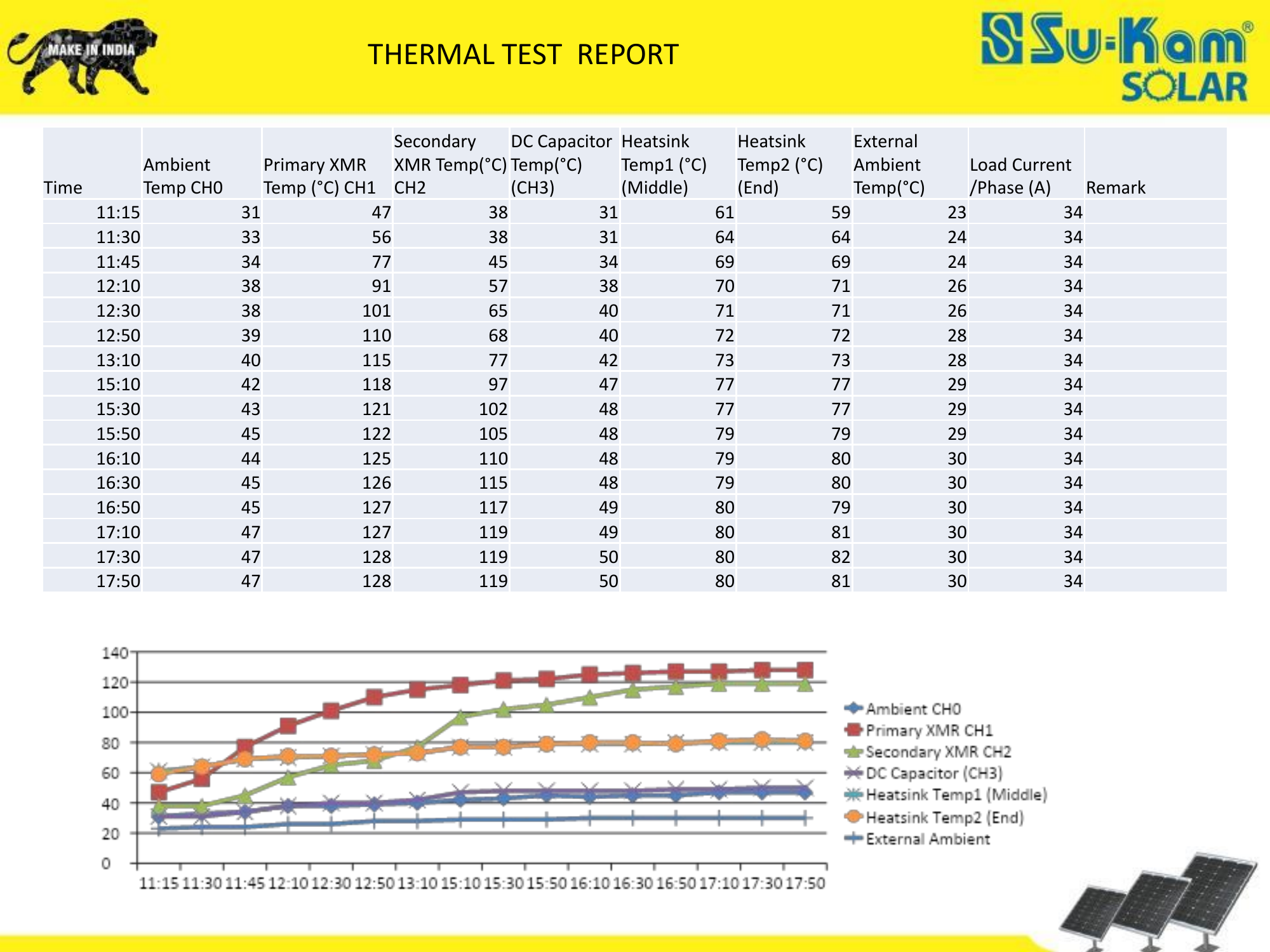
Thermal Test Report — Temperature readings across all critical components over 6.5 hours of sustained full-load operation
✅ Thermal Equilibrium
Primary transformer stabilized at 128°C — within Class H limit of 180°C, giving a 52°C safety margin. The transformer you need for Indian power conditions.
✅ Uniform Heat Distribution
Heatsinks showed less than 2°C difference (80°C vs 81°C) — even thermal spread across IGBT modules.
✅ Conservative Capacitor Temps
DC capacitor at 50°C — well below 85°C/105°C limit, meaning extended lifespan in hot Indian conditions.
⚡ AC-to-AC Efficiency
Transformer-based double-conversion Online UPS under full load
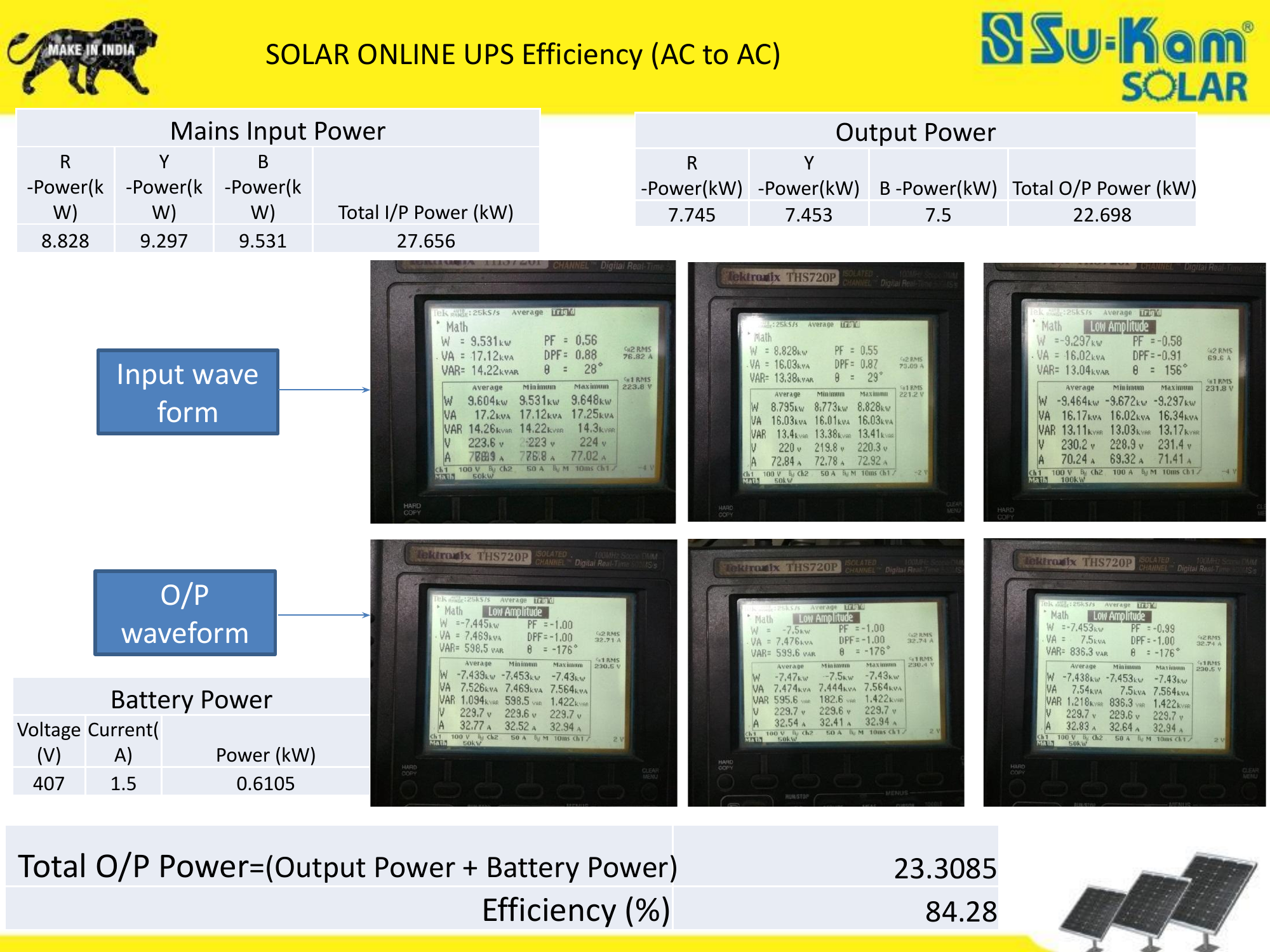
Efficiency measurement: 84.28% AC-to-AC — showing actual input/output waveforms captured from lab instruments
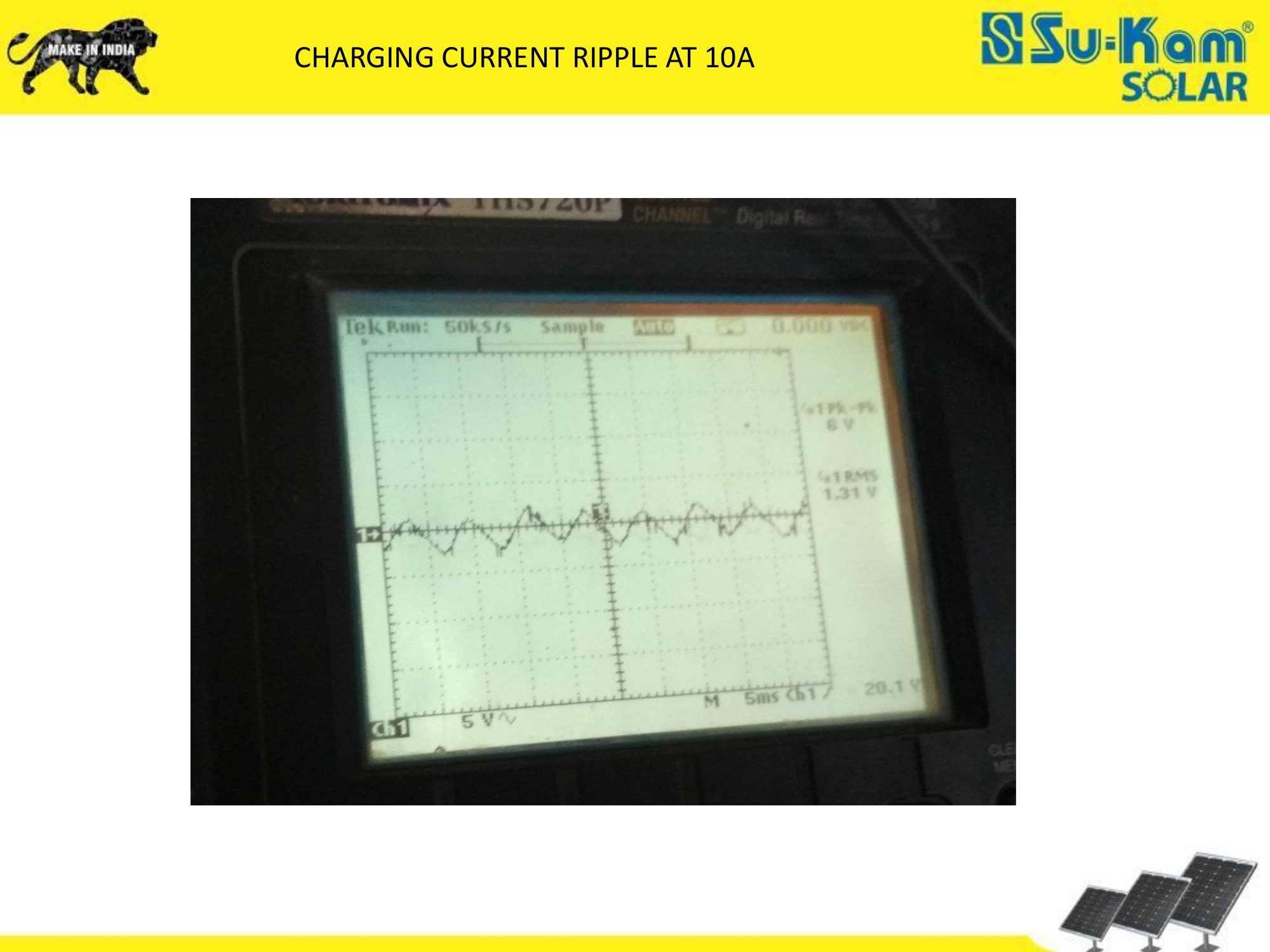
Charging current ripple measurement at 10A — critical for battery health and longevity
📈 Power Quality: Input Waveforms, THD & Power Factor
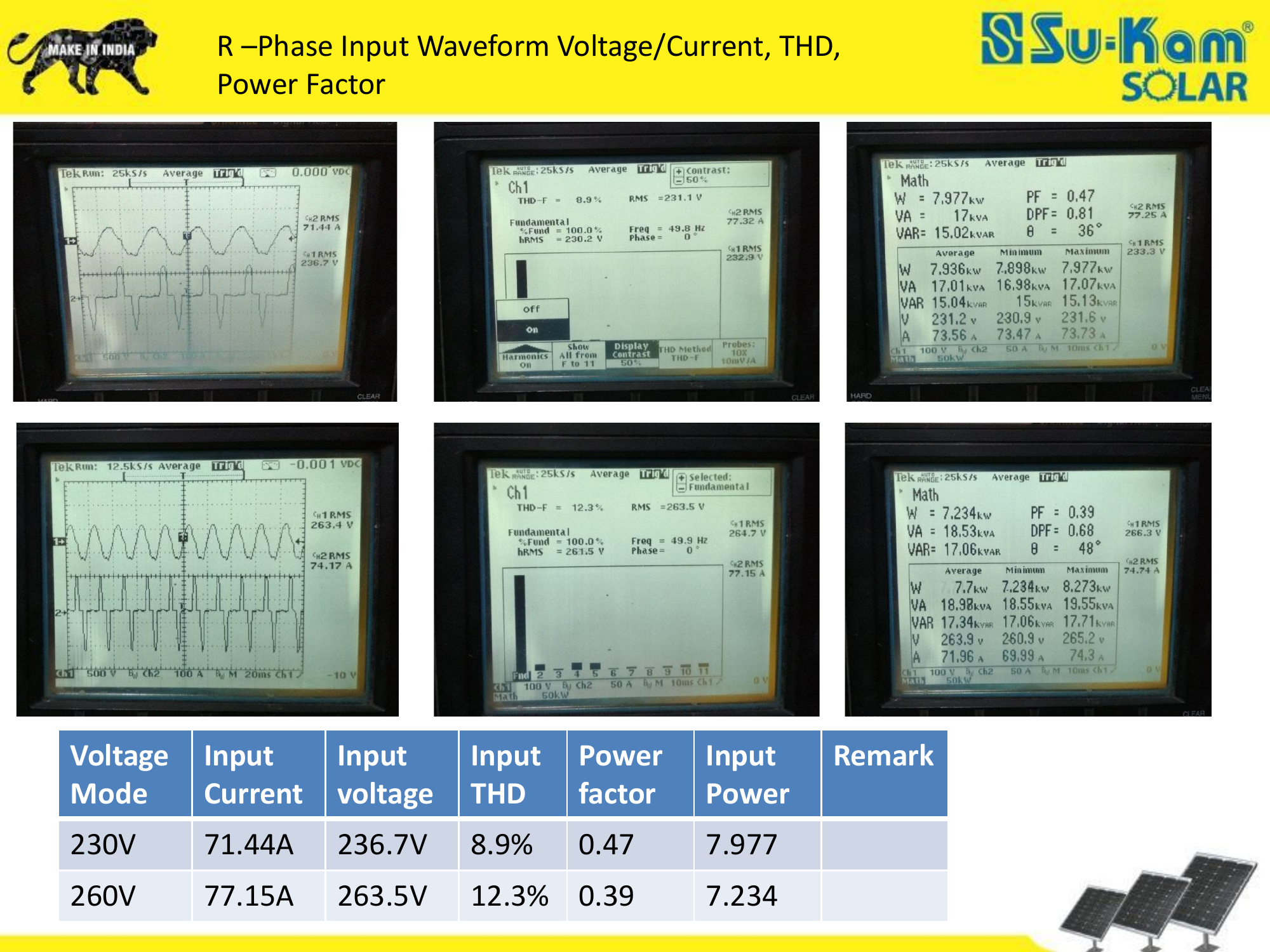
R-Phase input waveform analysis — voltage, current, THD and power factor at 230V and 260V input
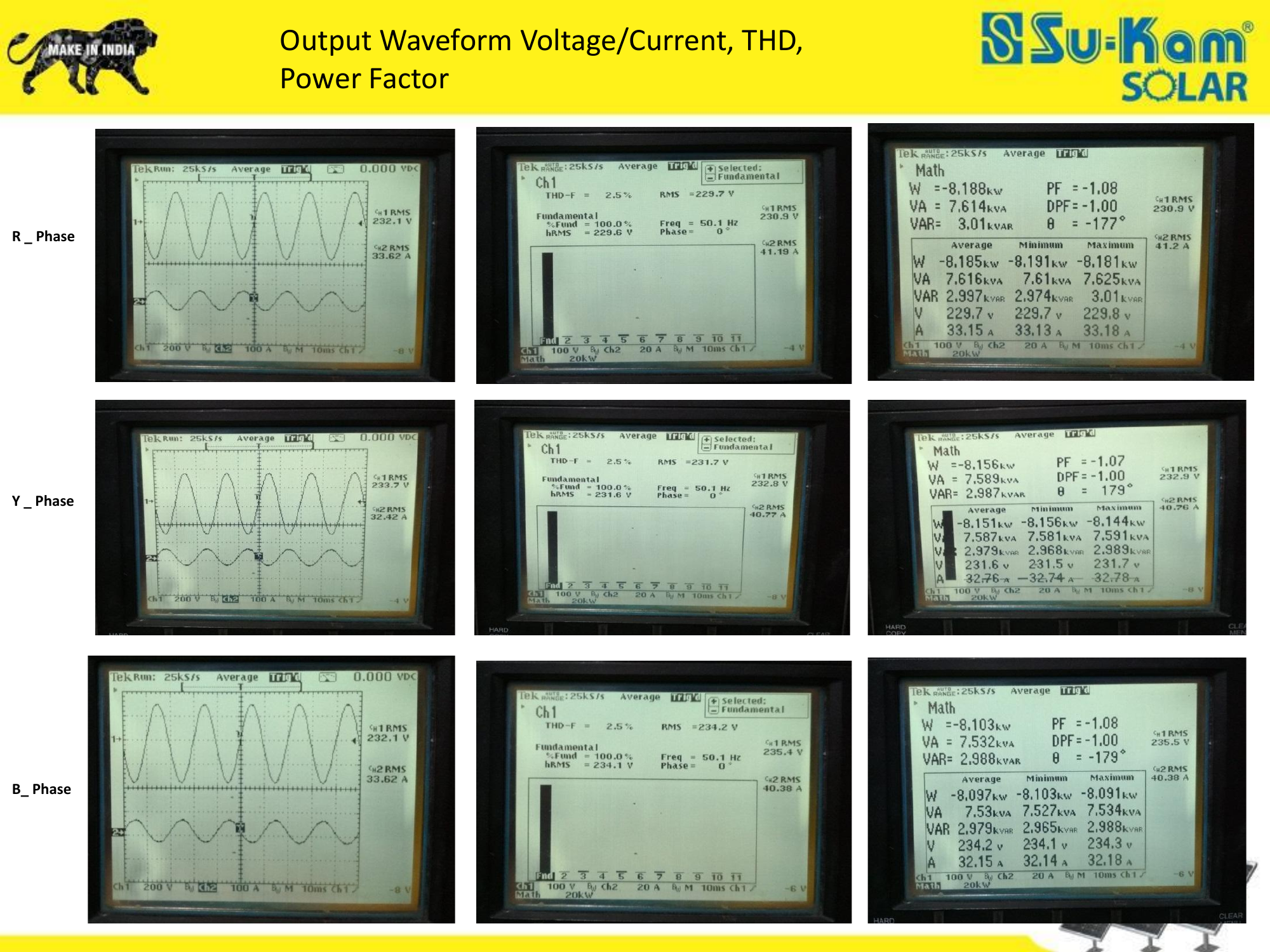
Output waveform analysis for all three phases (R, Y, B) — the pure sinewave that the double-conversion topology creates
🔬 IGBT Switching Validation
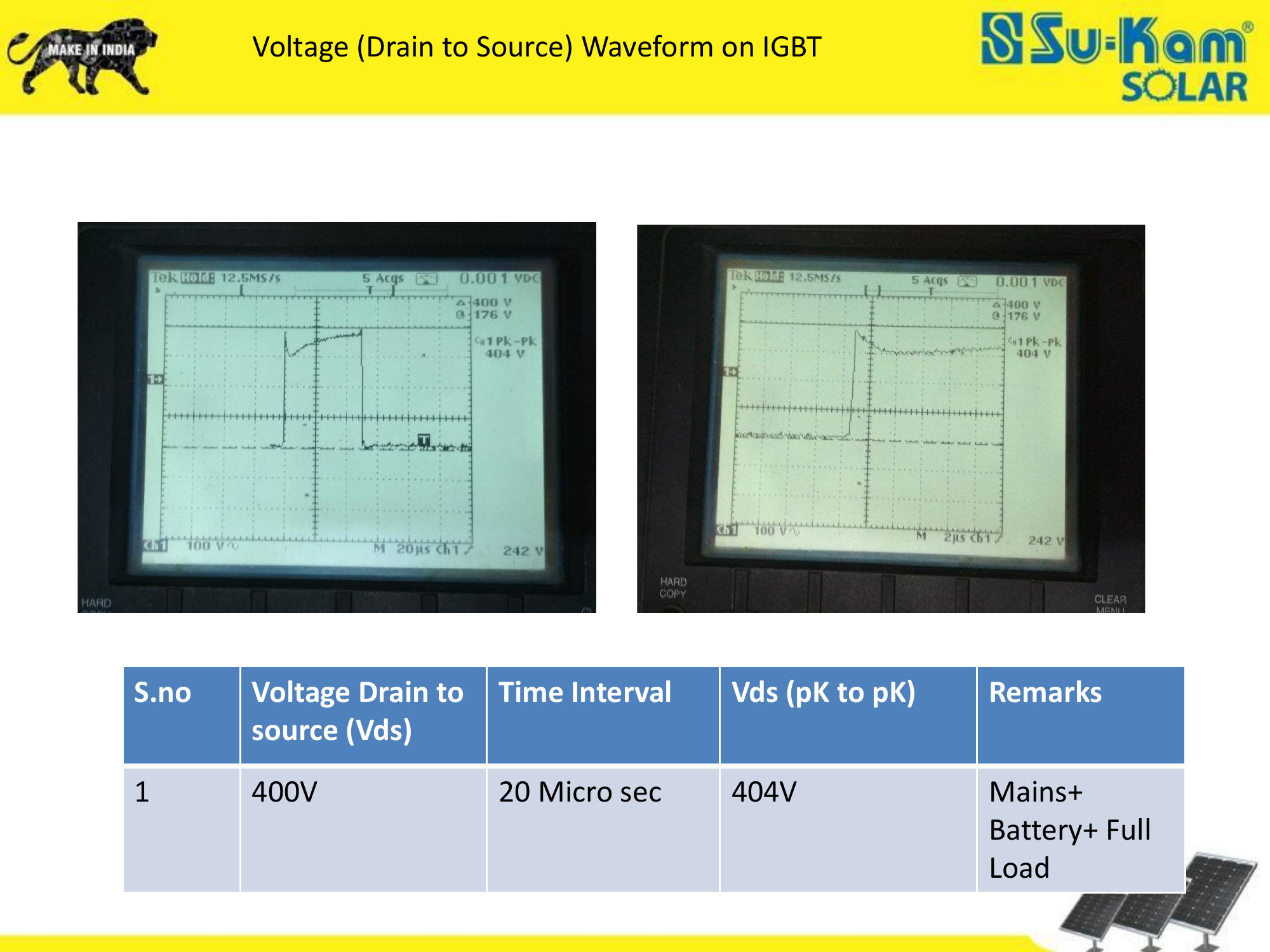
IGBT drain-to-source voltage waveform — 404V peak-to-peak at 20 microsecond switching, clean with no voltage spikes under full load
🏆 Su-Kam’s Innovation Legacy
The Solar Online UPS was one chapter in Su-Kam’s story of Indian firsts:
- World’s first Solar Hybrid UPS — integrating solar into home UPS systems
- India’s first DSP Sinewave Inverter — replacing square wave with pure sinewave
- India’s first touchscreen Solar PCU — with MPPT controller & Wi-Fi monitoring
- World’s first plastic body inverter
- India’s first Solar Online UPS (2015) — the product in this blog
- Largest patent holder in India’s power backup industry — two patents per month
🔗 External References
Questions About Solar Online UPS Technology?
I’m always happy to discuss power backup innovation and solar technology
Get in Touch →
Founder of Su-Kam and Kunwwer.ai, and mentor at Su-vastika and several other companies — the “Inverter Man of India” and the “Solar Man of India.” Read his story →
24 products and instruments. This page is one of them. The others are here.
- Colossal overview
- Colossal 1P 10 kVA
- Colossal 3P 30 kVA
- Colossal 3P 40 kVA
- Colossal 3P 100 kVA
- Brainy Eco 1100
- Brainy Eco hybrid PCU
- Brainy Hybrid GTI
- Brainy S modular
- Brainy Touch PCU
- Intelli S 40 kVA
- Falcon HBU
- Falcon Plus 1100
- Chic plastic inverter
- DT-6S charging
- Here — Solar online UPS
- Electroscopy
- Battery life-cycle tester
- Lithium BMS
- Sun Way street light
- IoT solar monitoring
- Tubular gel battery
- Commercial solar / MPPT
- UPS charging