PR, enterprise wins & proof
The Solar Projects — the installations that made us proud
Solar Installation Projects — I started the Solar Projects division at Su-Kam as one of the pioneer companies installing megawatt-scale projects in India. I hired people who had no solar background — because solar itself was non-existent then — and we started bidding. Our first allocation was 2 MW under SECI’s first phase, and from there we installed projects one by one.
01Punjab Engineering College — Solar Installation Projects
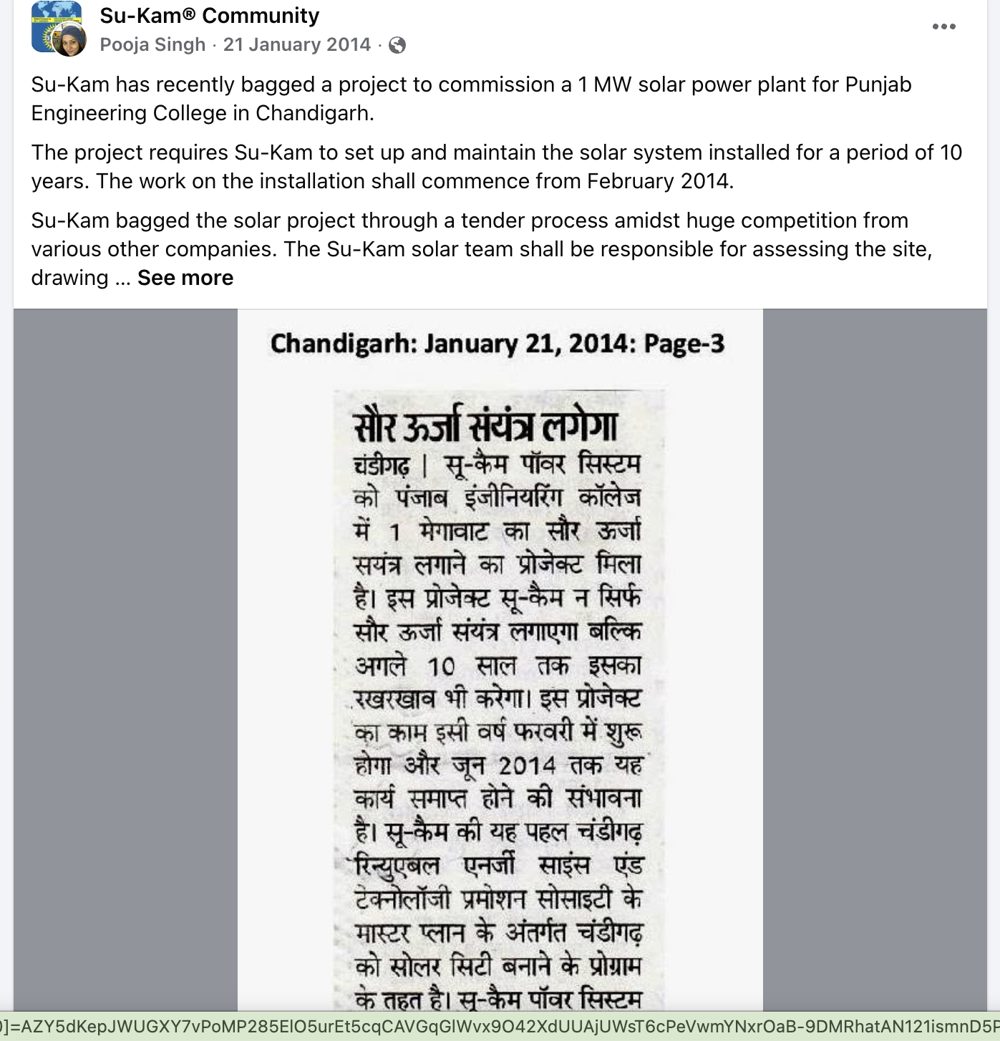
Around 2011 we executed the Punjab Engineering College project in Chandigarh — our first megaproject, an on-grid plant won through an open tender amidst huge competition, with a 10-year maintenance commitment. Installation agencies didn’t exist yet; after installation we battled shadow issues; and since there were no audit agencies either, I asked my own team to audit the project — not the right thing, but we learned enormously. After PEC, there was no looking back.
02Institutions that went solar with us
Chennai Metro
A tough city-centre installation, with the design changing before and after work began. Completed 2013.
IFFCO Headquarters
Solar at the head office of the world’s largest fertiliser cooperative.
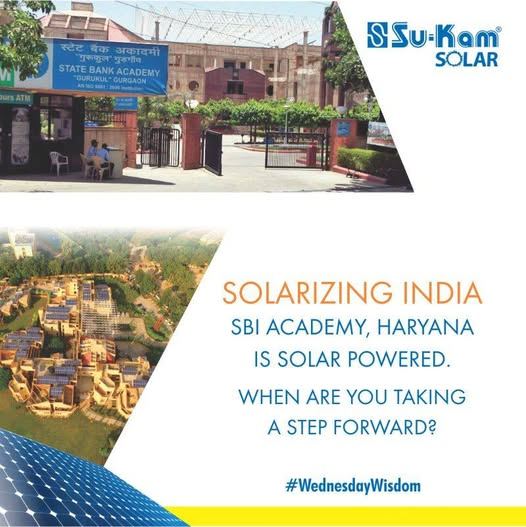
SBI Academy
We solarised the training campus of India’s largest bank — cutting its electricity bill by almost 70%.
ITM University
A car park became a solar shed — shade for the cars, power for the campus, double use of the same space.
03Malawi — wind and sun in the same battery
In 2010 we built the first combined wind-and-solar plant of its kind, electrifying five remote villages in Malawi, Africa — including Chigunda and Mdayaka. The windmills (4.2 kW) came from a Pune supplier; everything else was ours, including a common electronics stage where wind and solar energy charge the same battery bank with one common output. On the coast, you harvest both.
I visited the site personally, and I was very proud to execute this project outside India. I even duplicated it at my own farmhouse — windmill and solar working together — because I see hybrid inverter technology as the future for so many countries, including India.
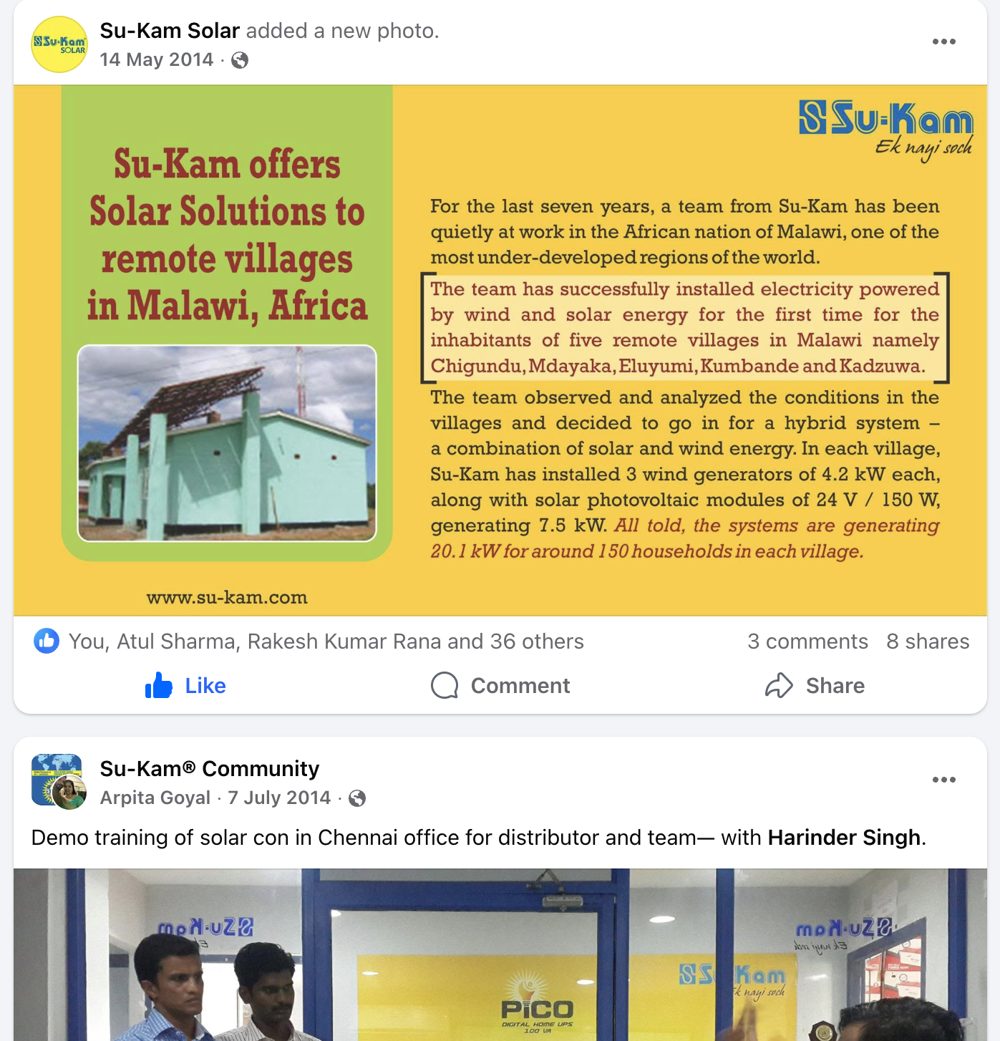
That plant is working even today. The experience of running wind and solar together came home with us — we replicated the concept in India too.
04Powering the North-East
In Arunachal Pradesh we delivered a 600 kW grid-feed plant — one of our most successful projects in a region where we eventually worked across all seven North-Eastern states.
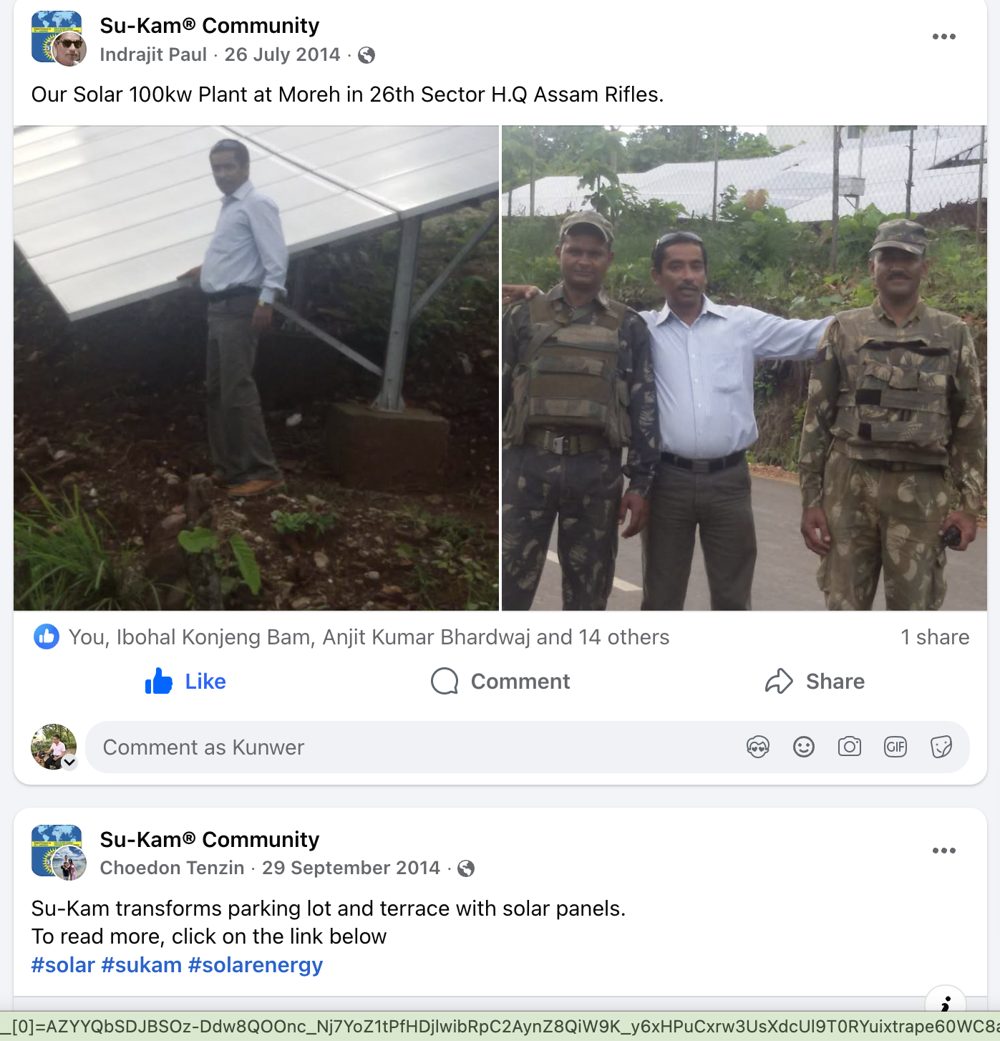
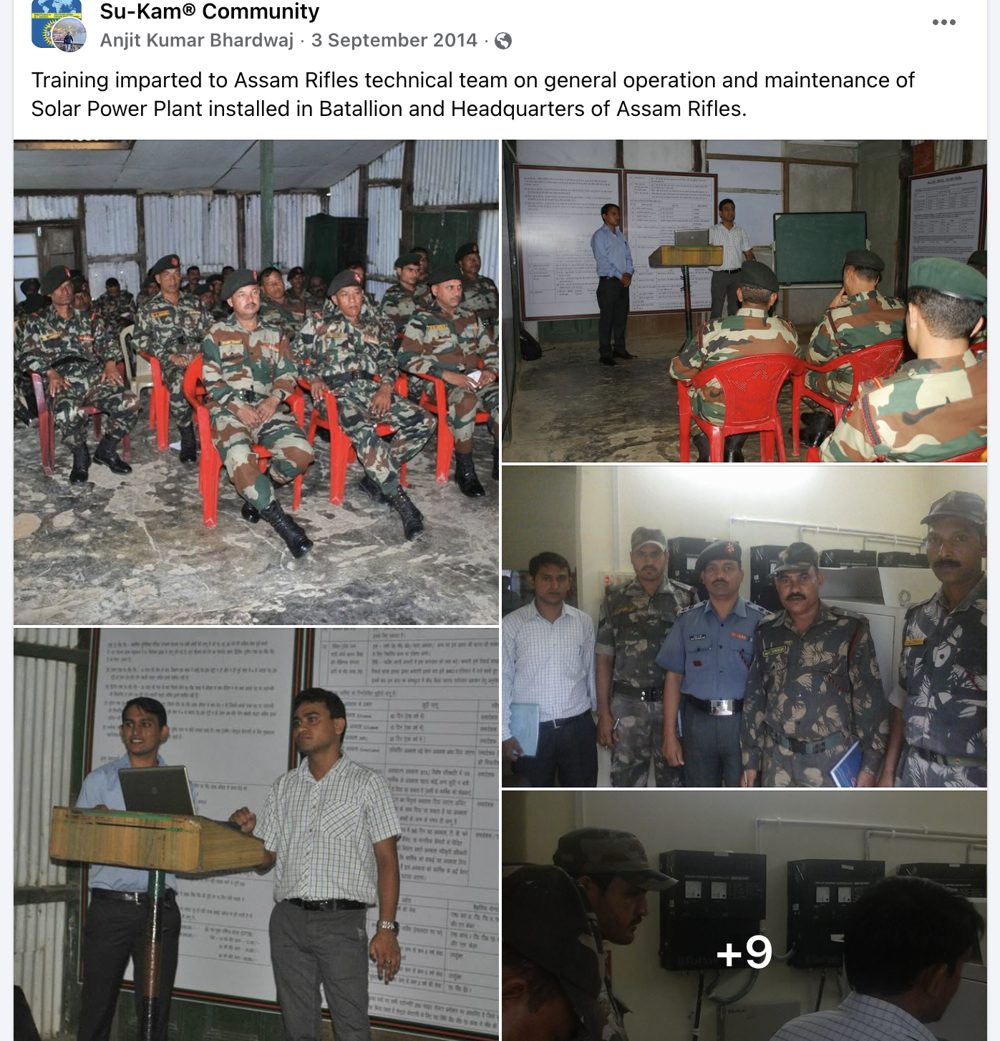
For the Assam Rifles we installed off-grid solar at seven locations — 100 and 150 kW plants in a joint venture with REIL (a Rajasthan state government company): they supplied panels, we supplied and installed the batteries and electronics, and we designed a remote monitoring system for all seven sites. Hauling diesel to those far-flung posts had been costly and dangerous; after our systems went in, the generators barely ran — press reports put the savings around ₹11 lakh a year. We even trained the Assam Rifles’ own technical teams to run the plants, and picked up two new distributors along the way.
05Lohia Awas — 40,000 homes that had never seen light
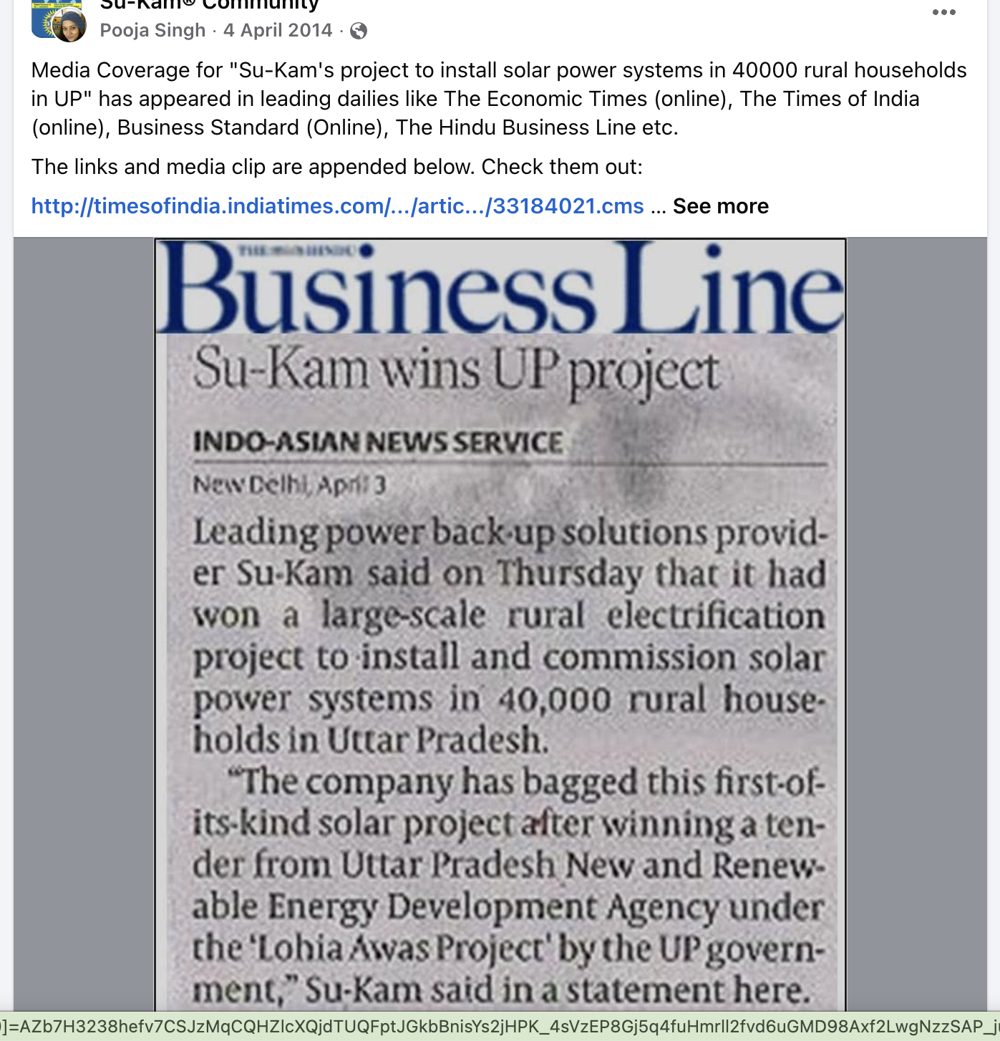
Under the UP government’s Lohia Awas scheme we installed 100-watt DC solar systems in rural households that had no electricity at all — each running one fan, two lights and mobile charging. The win made The Economic Times, The Times of India, Business Standard and The Hindu Business Line: solar for 40,000 rural households.
The engineering was the easy half. It was a time-bound project: we designed the DC system on schedule, got it approved, and built teams that could install in remote villages across UP. The hard half was everything else — outsourced agencies that moved too slowly, material that got stolen, payments that were a struggle, and a five-year maintenance tail during which even some of our own service staff made money claiming batteries from the company. The project lost money.
The honest lesson: the company was growing faster than its systems. I was deepest in R&D, sales and marketing, and assumed anyone could run HR — and my interest in finance was missing too. Loose HR and loose finance were mistakes I paid for later, and I write them here so other founders don’t repeat them.
06The mini-grids — free power, real fights
We built three 250 kW solar mini-grids in UP, each connecting five or six villages that had no electricity. Power was free, each home got a 100 W connection with a load controller — and human nature did the rest. People bypassed the controllers, wired up new fans, then irrigation pumps, then more pumps. The battery banks, sized for three days’ backup, were hammered by the overload. Villagers fought with our staff daily; nobody wanted a five-year maintenance posting there, and all three sites became a struggle.
But we were among the first in India to learn — the hard way — what running an off-grid mini-grid really takes. Similar projects came up later; we chose not to bid.
07Beyond India
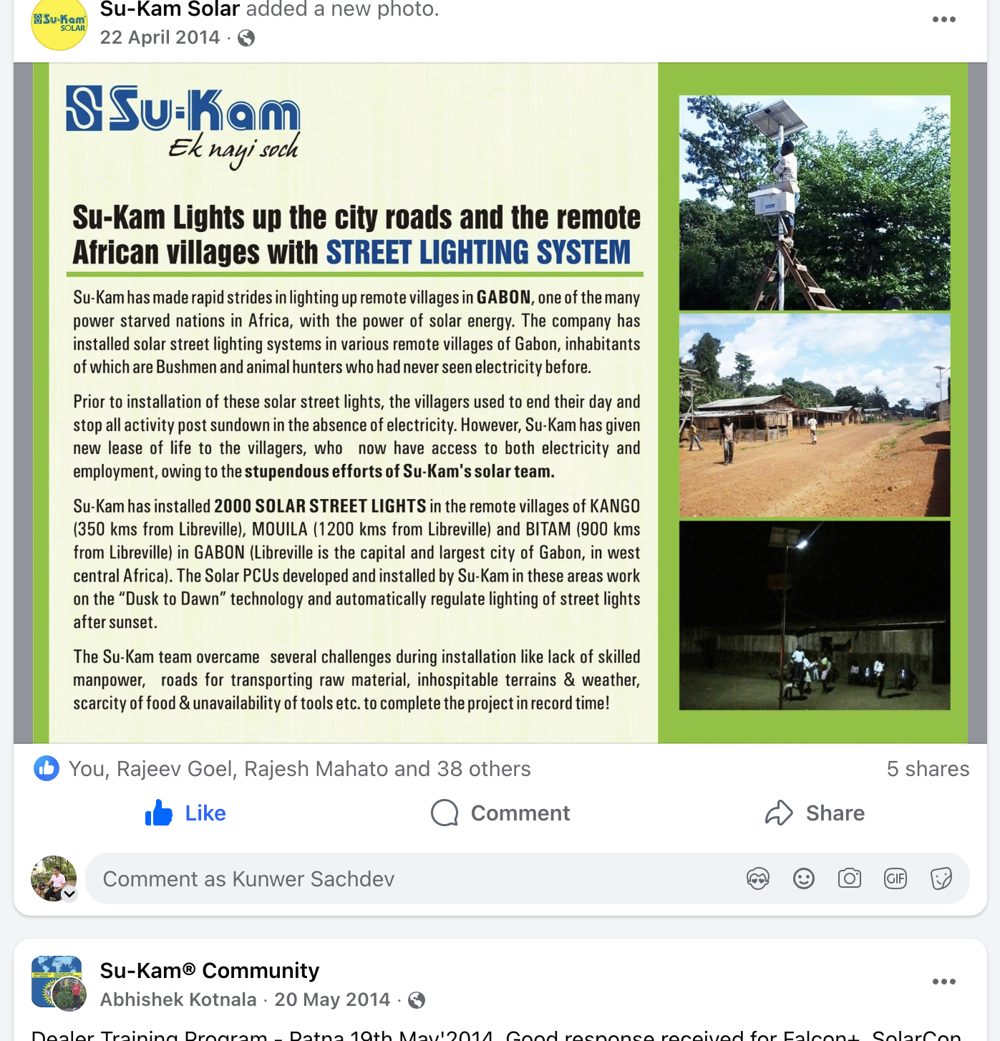
The projects travelled. We installed 2,000 solar street lights across Gabon — in Kango, Mouila and Bitam, villages hundreds of kilometres from Libreville that had never had lit streets. We electrified 35 remote schools in Rwanda and delivered a 105-site turnkey project there. Our solar PCUs went up on rooftops across Afghanistan, and projects followed in Namibia, South Sudan and beyond.
- The Su-Kam Solar Facebook Archive — solarmanofindia.com (original posts & photos)
- Pioneer Timeline — SolarManOfIndia.com
- Su-Kam Power Systems — Wikipedia
- Solar Energy Corporation of India (SECI) — Wikipedia
- Off-grid solar in Tripura — earlier on this blog
- BSF posts on the Indo-Pak border, powered by solar
- India’s first Solar Online UPS — the 30 kVA thermal test
Frequently Asked Questions: Solar Installation Projects
When did Kunwer Sachdev start the solar division at Su-Kam?
Kunwer Sachdev started the solar division at Su-Kam around 2011, with the company’s first megaproject being the 1 MW grid-tied solar plant at Punjab Engineering College in Chandigarh. This was a significant moment—Su-Kam was positioning itself as a pioneer in solar installation projects when solar barely existed as a mainstream sector in India. The project was won through competitive tender and came with a 10-year maintenance commitment, setting the tone for Su-Kam’s approach to long-term customer relationships and quality assurance in renewable energy.
What makes the 1 MW Punjab Engineering College plant significant?
The 1 MW solar plant at Punjab Engineering College in Chandigarh was significant for several reasons. It was Su-Kam’s first megaproject and among India’s early grid-tied solar installations in 2011. The project was won through competitive tender selection, proving Su-Kam’s technical capability and bid competitiveness. The 10-year maintenance commitment demonstrated the company’s confidence in system design and reliability. For a grid-tied system in that era, this represented advanced engineering—combining photovoltaics with grid connectivity in a way that was not yet mainstream in India. The project served as a portfolio anchor among Su-Kam’s solar installation projects and helped establish credibility in the institutional solar market.
Why was the Malawi wind-solar hybrid project important to Kunwer Sachdev personally?
The Malawi wind-solar hybrid project, completed in 2010, held special significance for Kunwer Sachdev for multiple reasons. It was Su-Kam’s first project outside India, proving the company could execute internationally. The technical innovation—combining wind generators and solar photovoltaics feeding a single battery bank—was ahead of its time and demonstrated Su-Kam’s expertise in hybrid renewable systems. Kunwer visited the site personally and was proud to bring Indian engineering to electrify five remote villages in Malawi that had no electricity access. Beyond the commercial success, this project provided valuable operational learning about running wind and solar together, knowledge that informed later hybrid inverter technology. The plant continues operating today, years later.
How many homes did Su-Kam electrify under the Lohia Awas scheme?
Under the Uttar Pradesh government’s Lohia Awas rural electrification scheme, Su-Kam installed 100-watt DC solar systems in 40,000 rural households—homes that had never seen electricity before. This was one of the largest rural solar electrification projects Su-Kam executed. The project was time-bound, requiring design and execution on a strict schedule. For Kunwer Sachdev, it became a turning point—as Su-Kam scaled rapidly, internal systems could not keep pace. He found himself involved in R&D, sales, marketing, and project execution simultaneously. The lesson: scaling requires organisational infrastructure, not only technical capability. The impact—electrifying 40,000 homes—remains one of Su-Kam’s proudest solar installation projects.
Where did Su-Kam expand solar installation projects beyond India?
Su-Kam’s solar installation projects extended beyond India to multiple African countries. In Gabon, Su-Kam installed 2,000 solar street lights across villages. In Rwanda, the company executed installations at 35 remote schools. These projects embodied Su-Kam’s mission: delivering Indian engineering to regions where electrification gaps were most severe. The tagline from these projects—”Indian engineering, African nights”—captures that expansion. International work also proved that Su-Kam’s hybrid inverter and solar system designs could function across different geographies, climates, and user contexts.
What did Su-Kam learn from operating off-grid mini-grid projects?
Su-Kam’s experience with three 250 kW solar mini-grid projects in Uttar Pradesh—each connecting 5 to 6 villages with free solar power—became a masterclass in the operational complexity of off-grid systems. While technical design and installation were manageable, the real challenges emerged in day-to-day operations and maintenance. As one of the first companies in India to operate off-grid mini-grids at scale, Su-Kam learned firsthand what it takes to keep such systems running: community management, technical maintenance, spare parts, and long-term operational sustainability. That learning shaped later solar installation projects: pairing technical design with a sustainable operating model.
Founder, Su-Kam Power Systems (1988–2019) and Kunwwer.ai, and mentor at Su-vastika and several other companies — the “Inverter Man of India” and the “Solar Man of India.” Read his story →