Su-Kam’s Sun Way: The Solar Street Light With No Grid Link
Why an off-grid solar street light has no grid
An off-grid solar street light was the point of Sun Way: no trench, no cable, no utility pole — the light stands on its own panel and pack.
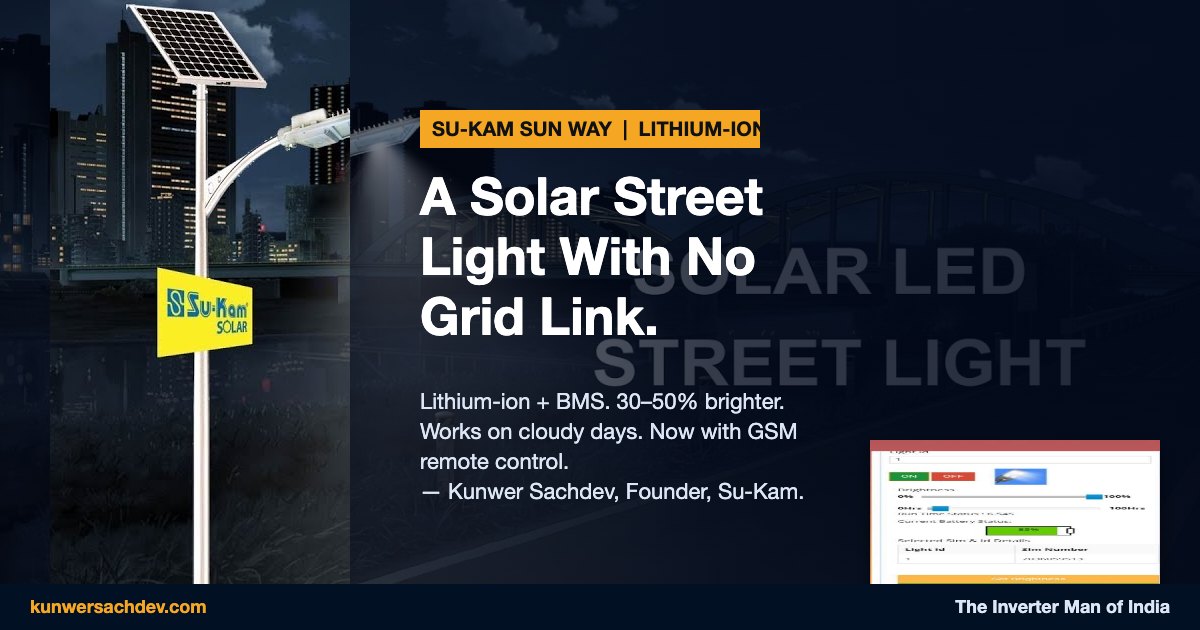
Off-grid solar street light — India spends a staggering amount of public money digging up roads to lay cables for street lighting. Trenches, transformers, distribution lines, meter boxes, electricity bills — every kilometre of street light is also a kilometre of grid dependency. I always believed there was a better way. That belief became the Su-Kam Sun Way — a solar LED street light that needs no grid link at all. A small solar panel on top, a lithium-ion battery and Battery Management System built into the same unit, an efficient LED fixture below, and a pole. That’s it. As The Hindu BusinessLine headlined it back then — “Su-Kam’s Solar Street Light is Sans Grid Link.”
Why a Street Light Without a Grid Link Matters
Once you remove the grid connection, three big things change:
- No civil work — no trenching, no underground cables, no meter boxes. You can light up a village road, a highway shoulder, a border check-post or an industrial park in days, not months.
- No electricity bill — the sun pays the running cost. The municipality or the establishment owns the asset outright after installation.
- No outage risk — the light works whether or not the grid is up. For villages, BSF posts on the Indo-Pak border, and disaster-relief zones, this is not a feature, it’s the entire point.
That was the unlock. A street light that didn’t ask anyone for permission to keep glowing.
Inside the Sun Way: Lithium-ion + BMS, Built In
Most solar street lights of that era used a lead-acid battery in a separate box at the base of the pole. They were heavy, prone to theft, lost capacity quickly, and broke down within 2–3 monsoons. Together with our technology partner, we took a different bet on the Sun Way: a lithium-ion battery integrated into the same fixture, controlled by a proper Battery Management System (BMS). The core electronics, the BMS, the GSM control and the product engineering came from Dr Kushant Uppal and his Hyderabad-based company Intellizon (more on that in a moment). That single design decision did the heavy lifting:
- 30–50% more brightness compared to competing outdoor lighting of the time — because the BMS could deliver clean, regulated power to the LED, instead of the LED dimming as a tired lead-acid battery sagged.
- Functions even on cloudy days — because lithium chemistry combined with a BMS gave us a much higher round-trip efficiency and predictable depth-of-discharge.
- Far smaller, lighter and more theft-resistant than the lead-acid + steel-box approach.
- Much longer service life — typically 3–5x the cycle life of a comparable lead-acid system, which is the difference between a fit-and-forget installation and a maintenance nightmare.
Watch how the unit actually works, end-to-end:
Then We Went a Step Further: The Sun Way GSM
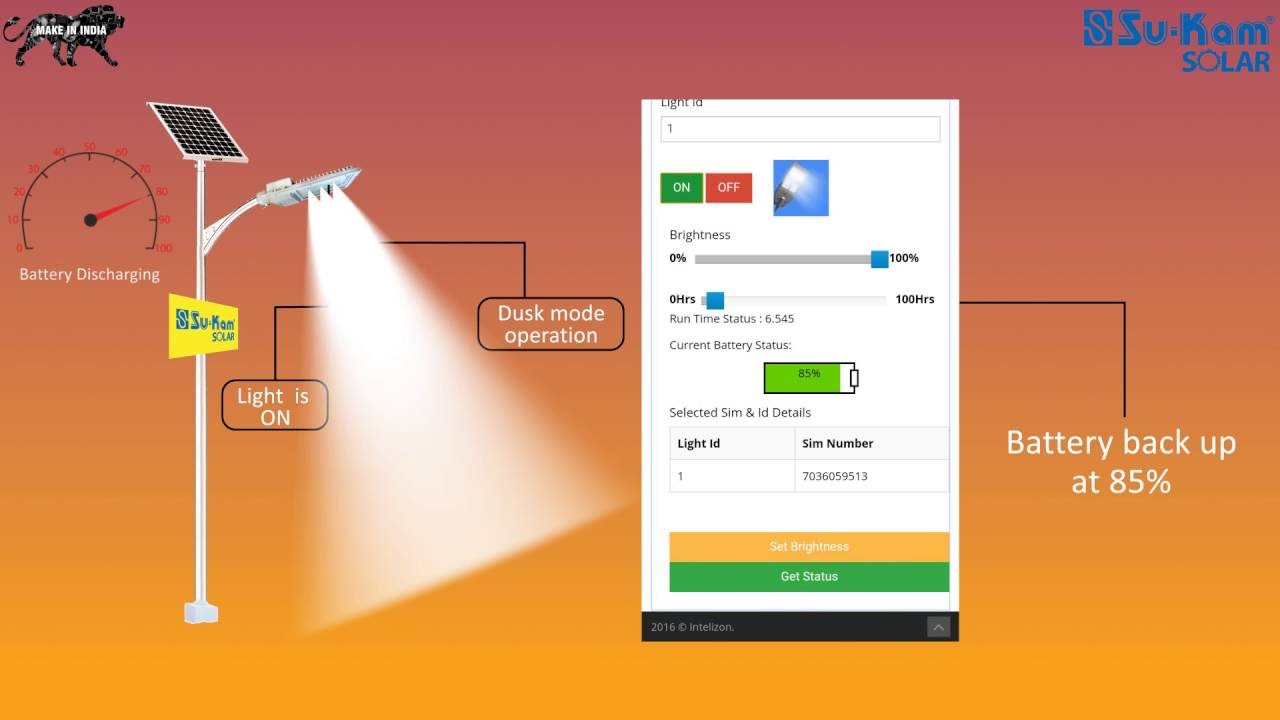
An off-grid street light is good. An off-grid street light you can see and control from anywhere is transformative. That’s why we built the Sun Way GSM variant — every fixture carried a SIM card and could be remotely:
- Switched ON / OFF by ID
- Set to any brightness from 0% to 100% (so you can dim deep into the night and save battery, then ramp up again at dawn)
- Queried for real-time battery state-of-charge and cumulative run-time hours
- Mapped, monitored and reported on across a city or a campus, light by light
This was years before “smart city” became a buzzword in India. We were already running fleets of solar LED street lights over GSM, in dusk-mode auto operation, with battery analytics streaming back to a dashboard. Made in India, in the truest sense.
Credit Where It Is Due: Dr Kushant Uppal and Intellizon
I want to use this space to put on public record something that I believe deserves to be said clearly.
The engineering that made the Sun Way what it was — the lithium-ion integration, the Battery Management System, the GSM-based remote-control electronics, the LED driver design, and the overall product architecture — did not come from inside Su-Kam. It came from Dr Kushant Uppal, a decent, soft-spoken engineer who had returned from the United States to build in India, and from his company, Intellizon, based in Hyderabad.
I met Dr Uppal at an industry exhibition. Within a short conversation it was obvious to me that he was the real thing — a serious technologist, working quietly on solar street lighting at a depth that very few people in India were attempting at the time. I made up my mind quickly: I wanted to back him.
I had wanted to invest in Intellizon personally. But the Su-Kam board at that time — Su-Kam had taken on Reliance as an investor — pushed for the investment to go through the company instead of through me as an individual. I accepted that decision, and Su-Kam invested in Intellizon. We then took Intellizon’s products to market through Su-Kam’s pan-India distribution and institutional channels. Because of that combination — Dr Uppal’s engineering plus Su-Kam’s reach — Su-Kam became the first brand in India to bring lithium-based solar street lights to market at scale. The technology was Intellizon’s. The brand pipe was Su-Kam’s.
And then came the part of this story that still sits heavily with me. When Su-Kam went into insolvency proceedings, Intellizon — as a company with Su-Kam as its majority stakeholder — could not escape the cascade. They suffered enormous losses. Eventually the company went into bankruptcy. Dr Kushant Uppal, who had only ever conducted himself with integrity, took a personal and professional hit that he did not deserve. And in all of it, he never once complained to me. Not in conversation. Not in writing. Not through anyone else. That kind of quiet dignity is rare, and it has stayed with me.
I am writing this here because credit and consequence both deserve to be named honestly. The Sun Way is celebrated — and rightly so — but its first author was Dr Kushant Uppal. The fact that the GSM dashboard you saw above carries a “© Intelizon” mark at the bottom is not incidental; it is a fingerprint of who actually built this. To Dr Uppal, and to every engineer and team member at Intellizon who lost out in that cascade — I see you, I am sorry, and I am thankful.
Where the Sun Way Made the Biggest Difference
- Rural and tribal villages with weak or no grid — the Sun Way often became the first reliable street light a village had ever seen.
- BSF and ITBP posts on the Indo-Pak and Indo-China borders — places where pulling a grid line is logistically and strategically a non-starter, and where reliable lighting is a force-multiplier.
- Highways and industrial parks — long stretches that don’t justify the cost of a transformer or copper cable network.
- Petrol pumps, schools and small towns — wherever a clean, low-maintenance, low-OPEX lighting solution was preferred over a 25-year grid commitment.
The Bigger Idea
The Sun Way wasn’t just a product. It was a quiet bet on a different model of public infrastructure for India — distributed, lithium-backed, self-sufficient, internet-of-things-ready. The same thinking later showed up in Su-Kam’s solar DC home systems, in the lithium street lights launched in 2016, and today drives the products we are building at Su-vastika. The technology only gets better. The conviction was always the same: India does not need to wait for the grid to reach every doorstep. The sun is already there.
Related on KunwerSachdev.com
- First lithium-based street lights launched by Su-Kam in 2016
- BSF posts at the Indo-Pak border powered by solar energy
- Best Su-Kam solar power plants for petrol pumps and schools
- How a solar DC system can solve India’s power crisis
- Green solar energy to each and every home
- My Story — Kunwer Sachdev
External coverage and resources
- Intellizon (formerly led by Dr Kushant Uppal) — original engineering partner for the Sun Way
- The Hindu BusinessLine — Su-Kam’s solar street light is sans grid link
- YouTube — How does a Street Light work? Solar LED Street Light
- YouTube — How does a GSM based solar street light work? — Su-Kam Sun Way GSM
- Su-Kam YouTube playlist — Solar Street Light Sun Way
🔗 Read the Full “My Story” Series

Founder of Su-Kam and Kunwwer.ai, and mentor at Su-vastika and several other companies — the “Inverter Man of India” and the “Solar Man of India.” Read his story →
24 products and instruments. This page is one of them. The others are here.
- Colossal overview
- Colossal 1P 10 kVA
- Colossal 3P 30 kVA
- Colossal 3P 40 kVA
- Colossal 3P 100 kVA
- Brainy Eco 1100
- Brainy Eco hybrid PCU
- Brainy Hybrid GTI
- Brainy S modular
- Brainy Touch PCU
- Intelli S 40 kVA
- Falcon HBU
- Falcon Plus 1100
- Chic plastic inverter
- DT-6S charging
- Solar online UPS
- Electroscopy
- Battery life-cycle tester
- Lithium BMS
- Here — Sun Way street light
- IoT solar monitoring
- Tubular gel battery
- Commercial solar / MPPT
- UPS charging
You must be logged in to post a comment.