PR, enterprise wins & proof
Someone on My Team Uploaded This Deck.
Forty-Seven Slides. Every One Still Tells the Truth.
Technovations Su-Kam 2012 SlideShare — In November 2012, Su-Kam staff published Technovations at Su-Kam on SlideShare — awards, plastic Chic inverters, tractor charging, sine wave, Home UPS, telecom, solar PCU, Brainy, street lights, defence sites. I did not upload it. I remember building everything on it.
Why I am writing this. After the Marriott Chandigarh talk in 2011, our marketing team kept compiling proof — products, projects, awards — into corporate decks. One became Technovations at Su-Kam on SlideShare. A reader recently sent me the link. Forty-seven slides. Uploaded 15 November 2012. Not my account — a staff profile — but my company’s engineering soul on display.
I scrolled slide by slide and remembered: the EFY ceremony, the ISA award for Solar PCU, the fight to put plastic Chic beside Tata Nano on an India Today list — competitors who copied plastic and failed while Su-Kam won — tractor inverters for kisans, MOSFET nights in the lab, Fairy Queen styling, Home UPS models named Shark and Torque, Colossal running three ACs on inverter when the market said advertise smaller, Tata Telecom sites, dentist chairs that could not lose power, Bharti–Walmart Easyday load priority at Jagadhri, Power Doc protecting TVs, Brainy hybrid logic, MPPT for farmers, Vellammal school rooftops, Assam Rifles in Manipur, thousands of TEDA street lights, Chhattisgarh on the horizon.
This is not a product brochure replay. It is a founder walking back through evidence — what we built when Indian power was broken and solar was still a promise. If you want the autobiography arc, start with My Story on SolarManOfIndia.com. If you want the 2011 conference version of the same spirit, read how I built Su-Kam — the Chandigarh slides. This deck is the companion volume: technovation as installed base — after the Chandigarh 2011 stage talk, not only as stage talk.
Below: all forty-seven slides, hosted permanently here, each with what I remember when I see it.
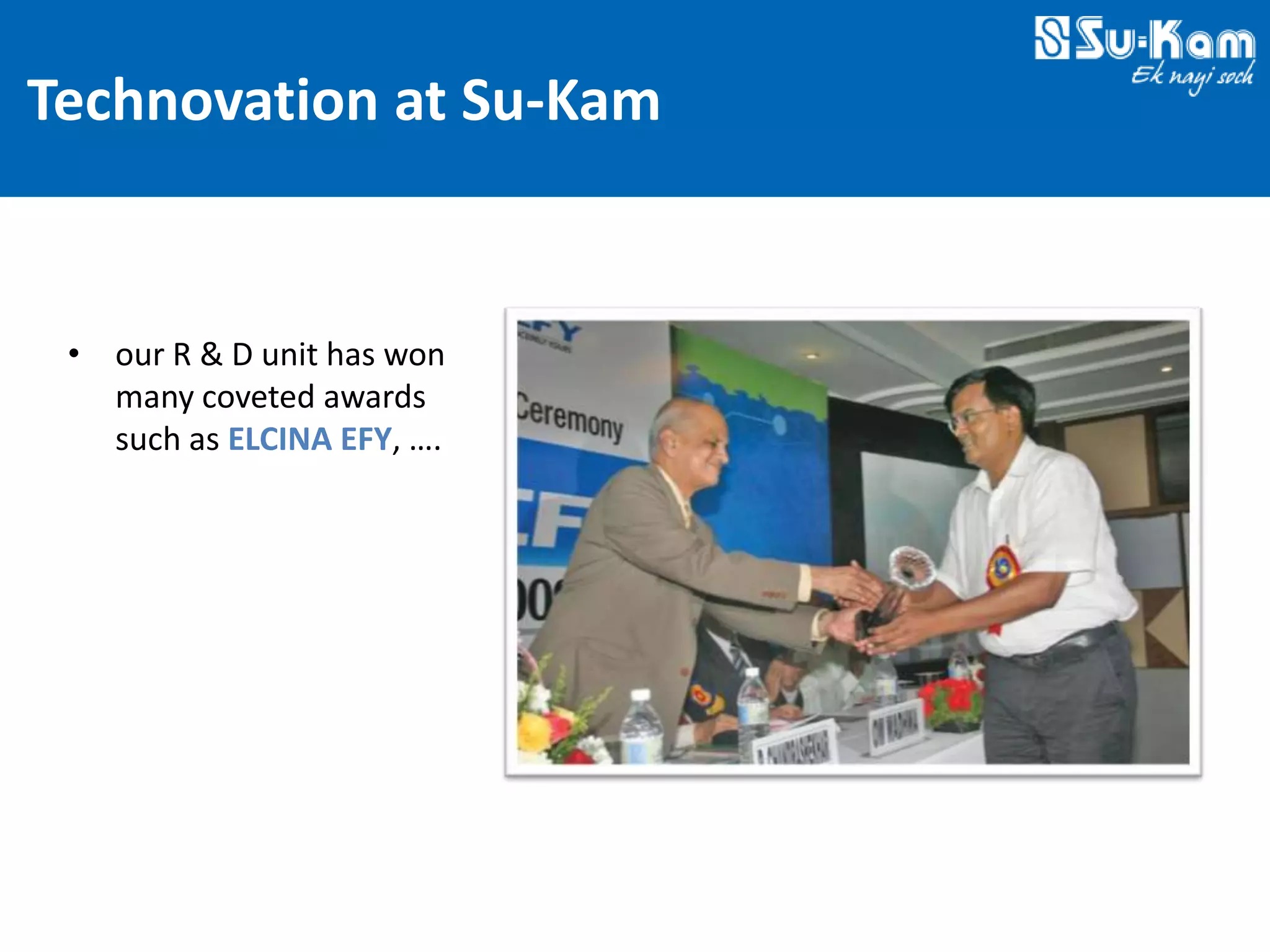
Slide 1: ELCINA EFY Award Ceremony
This photograph takes me straight back to a stage where Indian electronics still had to prove itself. The ELCINA EFY award was not vanity — it was the industry acknowledging that a power-backup company from Delhi had moved from assembly to genuine innovation. I accepted it as a dealer’s promise kept: we would keep engineering, not just selling.
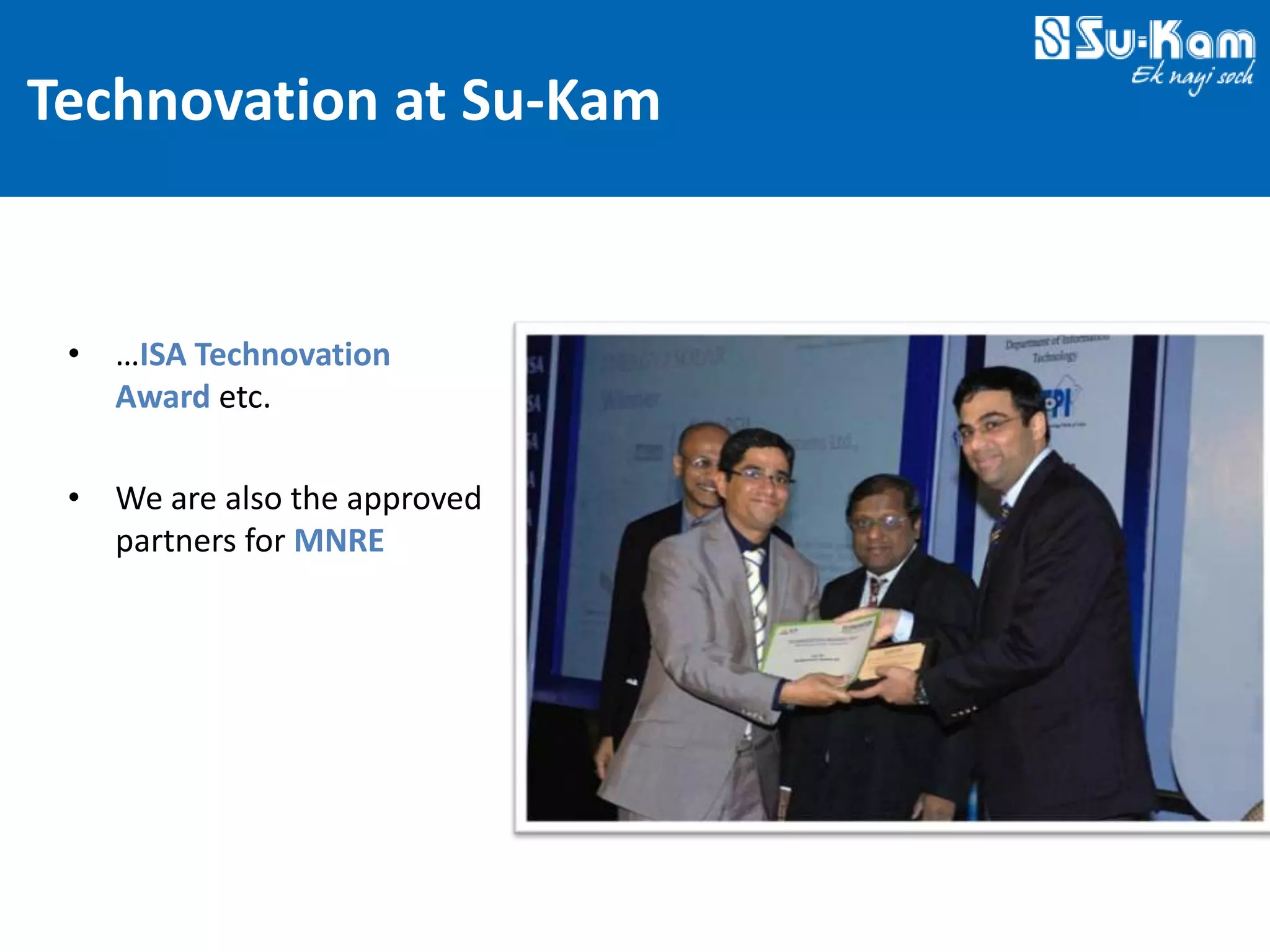
Slide 2: ISA Technovation Award & MNRE Approved Partner
The ISA Technovation Award for our Solar PCU in 2011 sits beside MNRE partner status on this slide — two different languages of trust. ISA spoke to engineers; MNRE spoke to government programmes. I wanted both on one slide because Su-Kam was never only a consumer brand. We were building the solar backbone India would need.
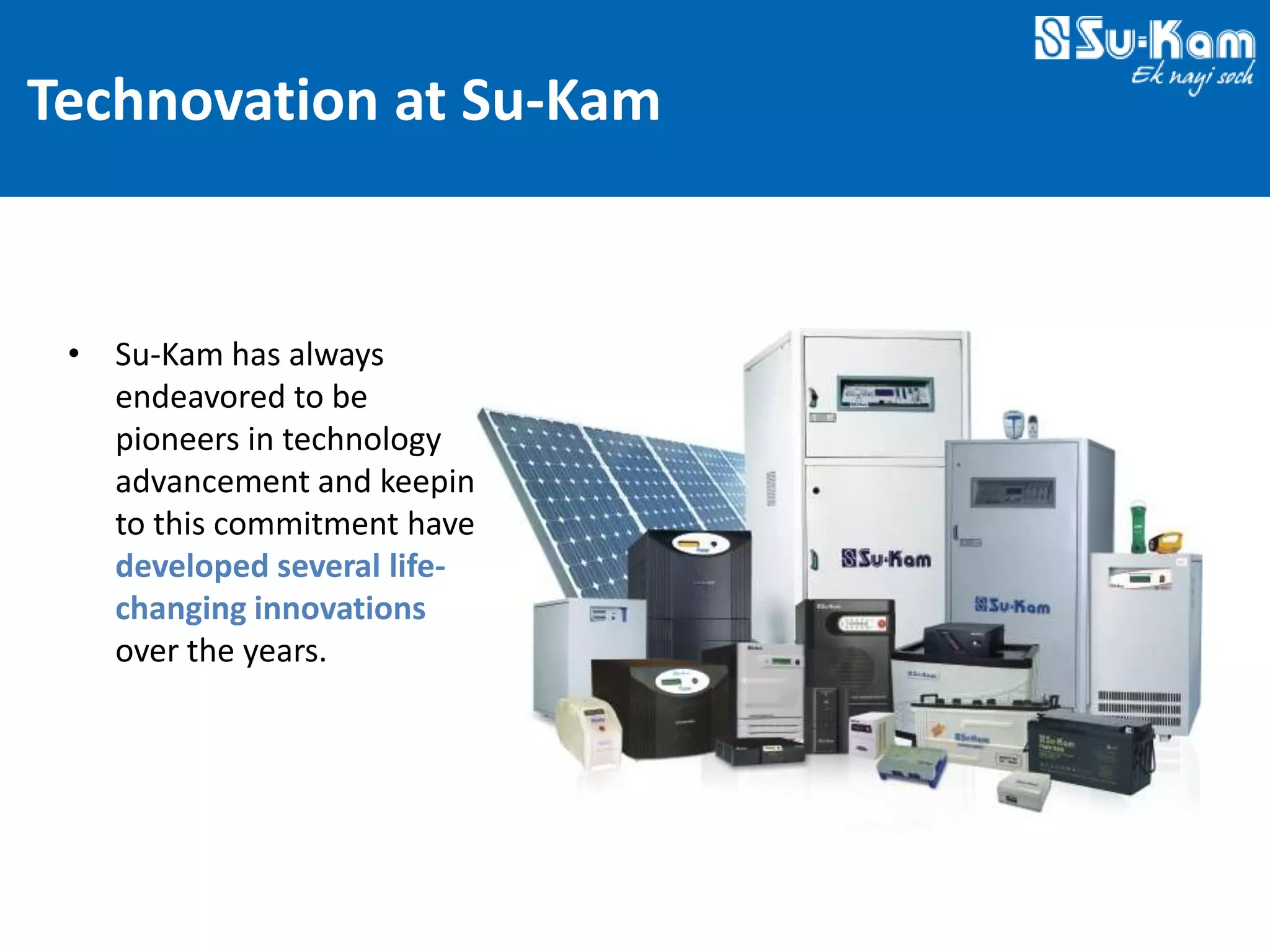
Slide 3: Pioneers Overview — Product Collage
This collage is the whole company in one frame: inverters, UPS, solar, batteries, telecom. When staff uploaded this deck in 2012, I was not in the room — but every product pictured here had passed through our R&D in Gurgaon first. It is the visual answer to anyone who asked, What does Su-Kam actually make?
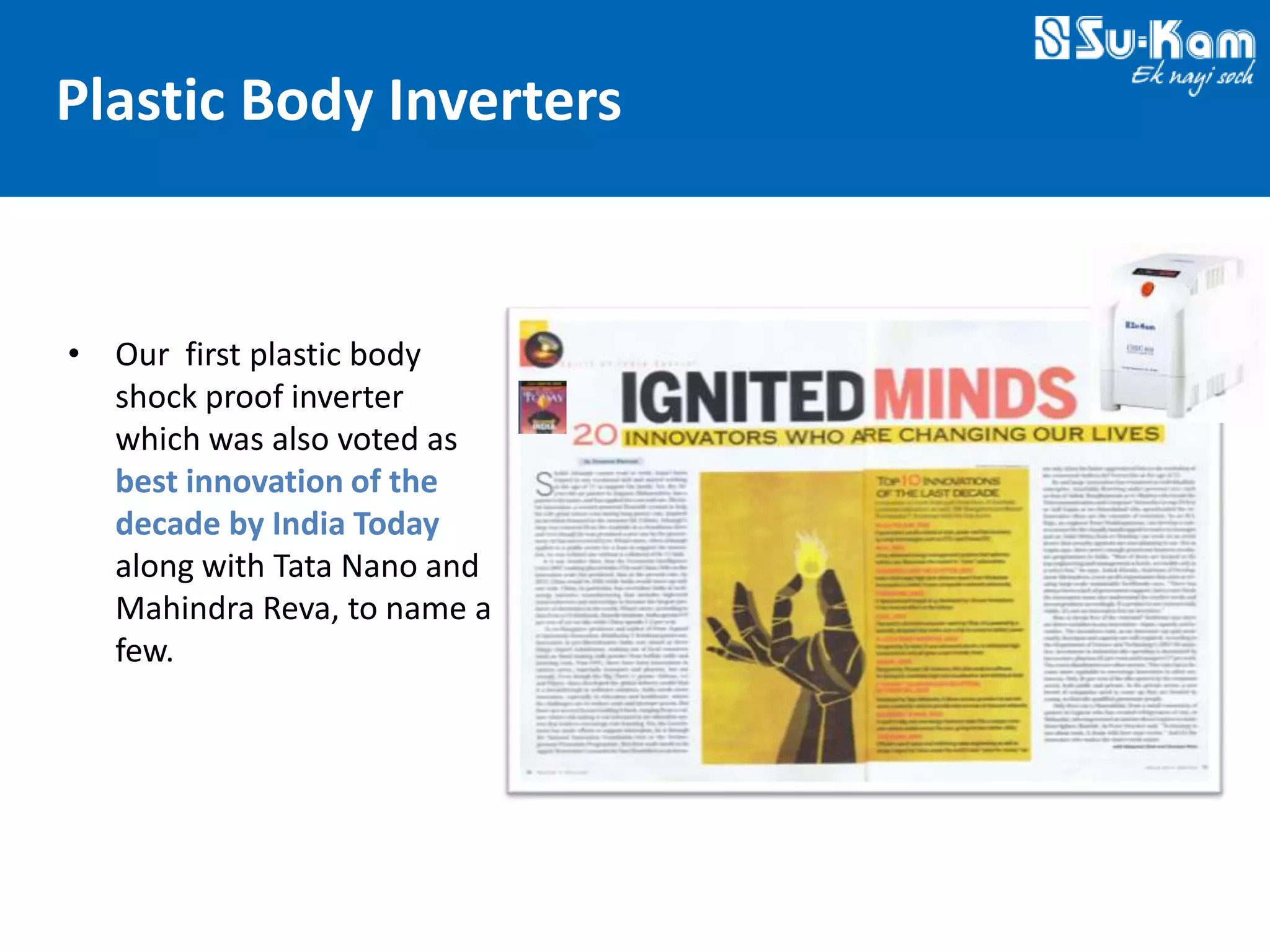
Slide 4: Chic — India Today Top 10 Innovation of the Decade
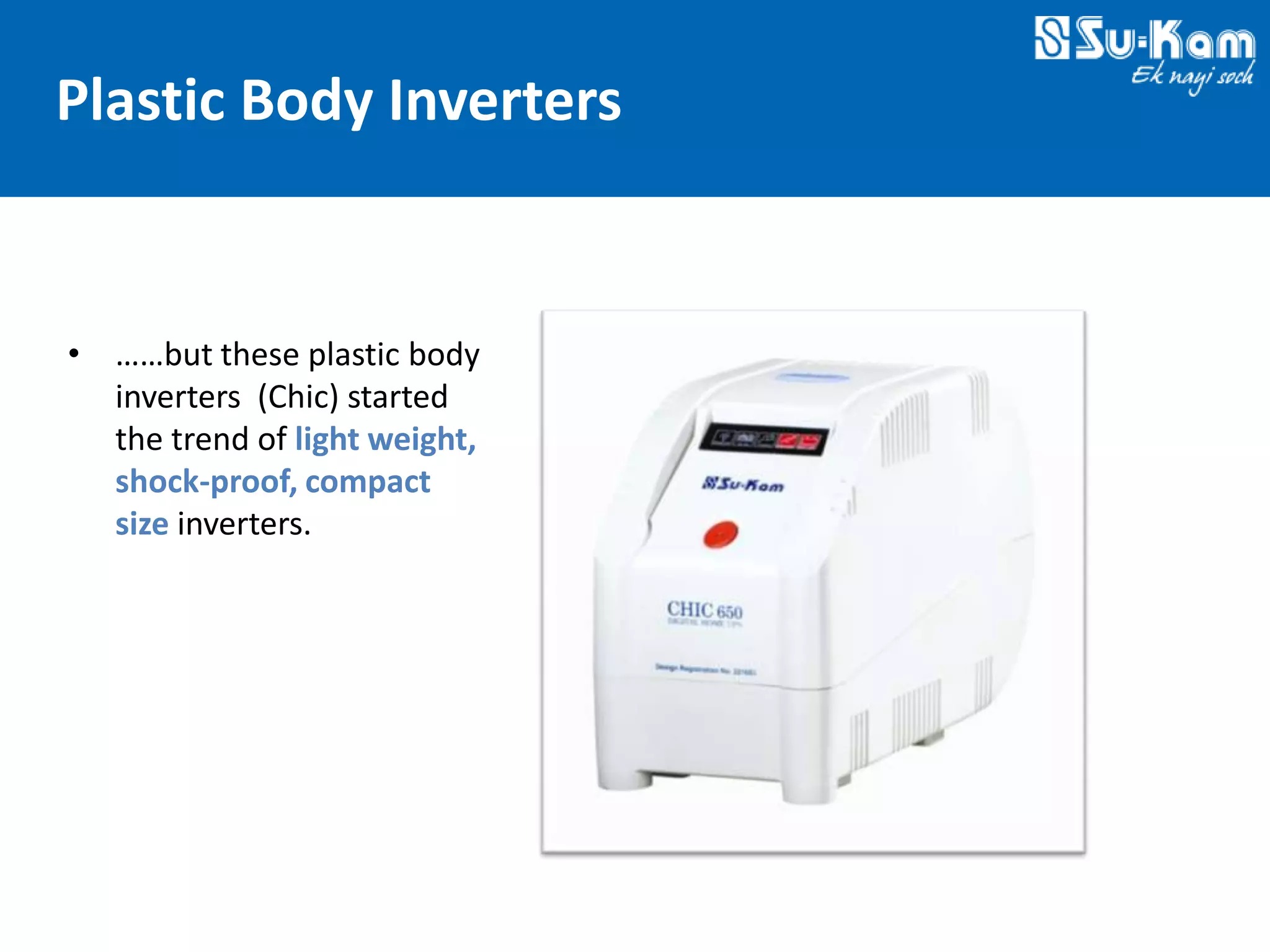
Seeing Chic beside the Tata Nano on an India Today list still makes me smile. Plastic housing, shockproof design, inverter as appliance — read how Chic and Fairy Queen changed the decade and the birth of the Chic inverter. Many competitors tried plastic inverters after we showed it was possible. Everyone failed. Su-Kam was the clear winner — not because plastic was a gimmick, but because we engineered the housing, heat path, and shock tolerance together. We did not copy the West. We asked why an inverter had to look like a metal box from a factory floor.
Slide 5: Chic 650 — Plastic Shockproof
The Chic 650 was the product I wanted my own family to live with — light enough to mount on a wall, tough enough for Indian voltage chaos. Plastic was not cheapness; it was safety and portability. After we proved the concept, half the industry rushed plastic cabinets to market. They cracked in heat, warped in monsoon, failed EMC — and quietly went back to metal. Dealers who first laughed at ‘plastic inverter’ later fought for Chic allocation because Su-Kam was the only name that made plastic work.
Slide 6: Bulky Metal Inverters — Before Plastic
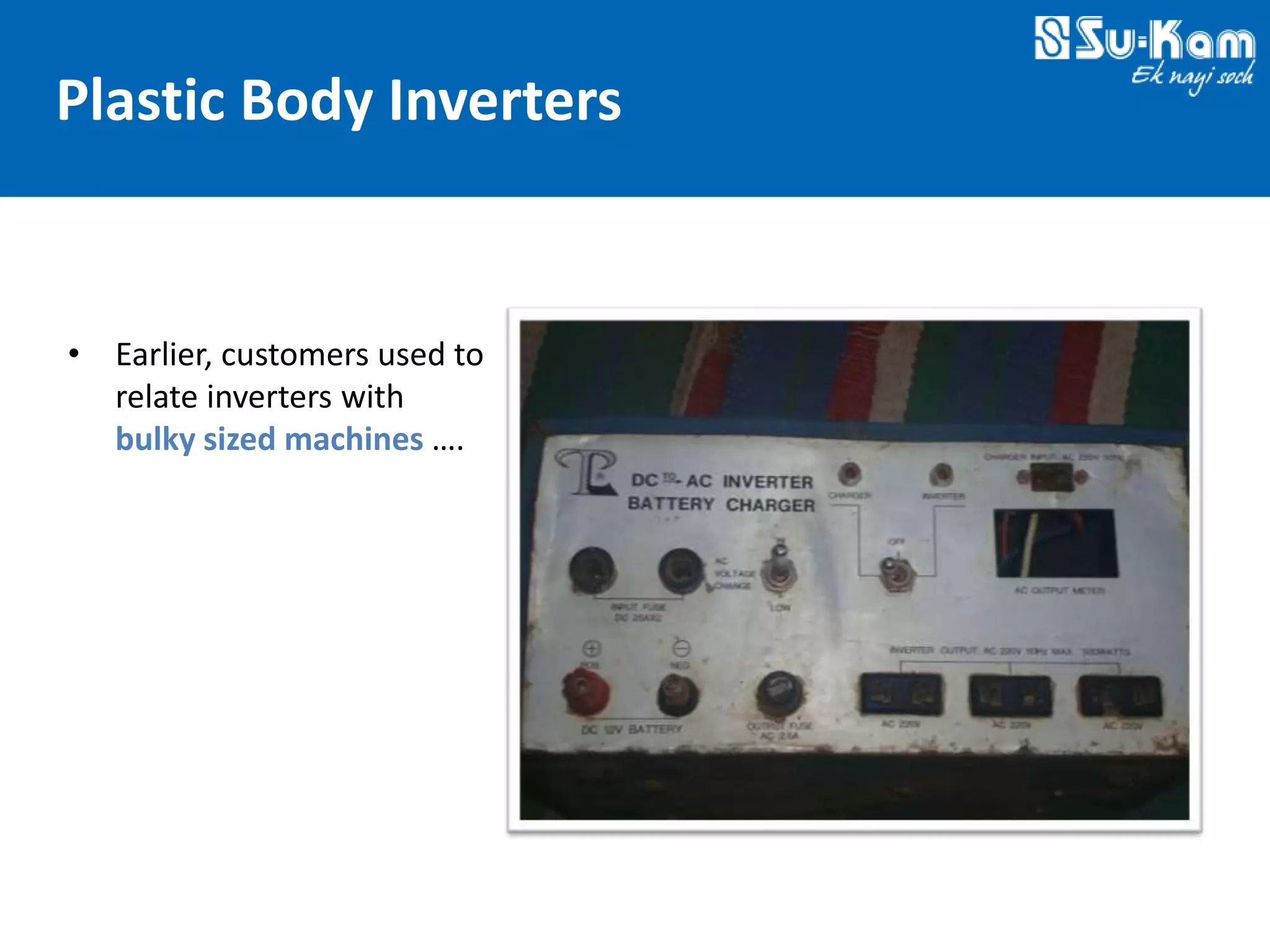
This slide exists because memory needs contrast. The metal cabinets we replaced were heavy, sharp-edged, and rust-prone in monsoon humidity. Every time I see this image I remember carrying sample units upstairs in Karol Bagh and thinking: There has to be a better form factor. Others saw Chic and tried to copy the look without the engineering. Plastic inverter became a fad — and a graveyard. Su-Kam survived because we had already lived through the failure modes they were about to discover. Chic was that answer.
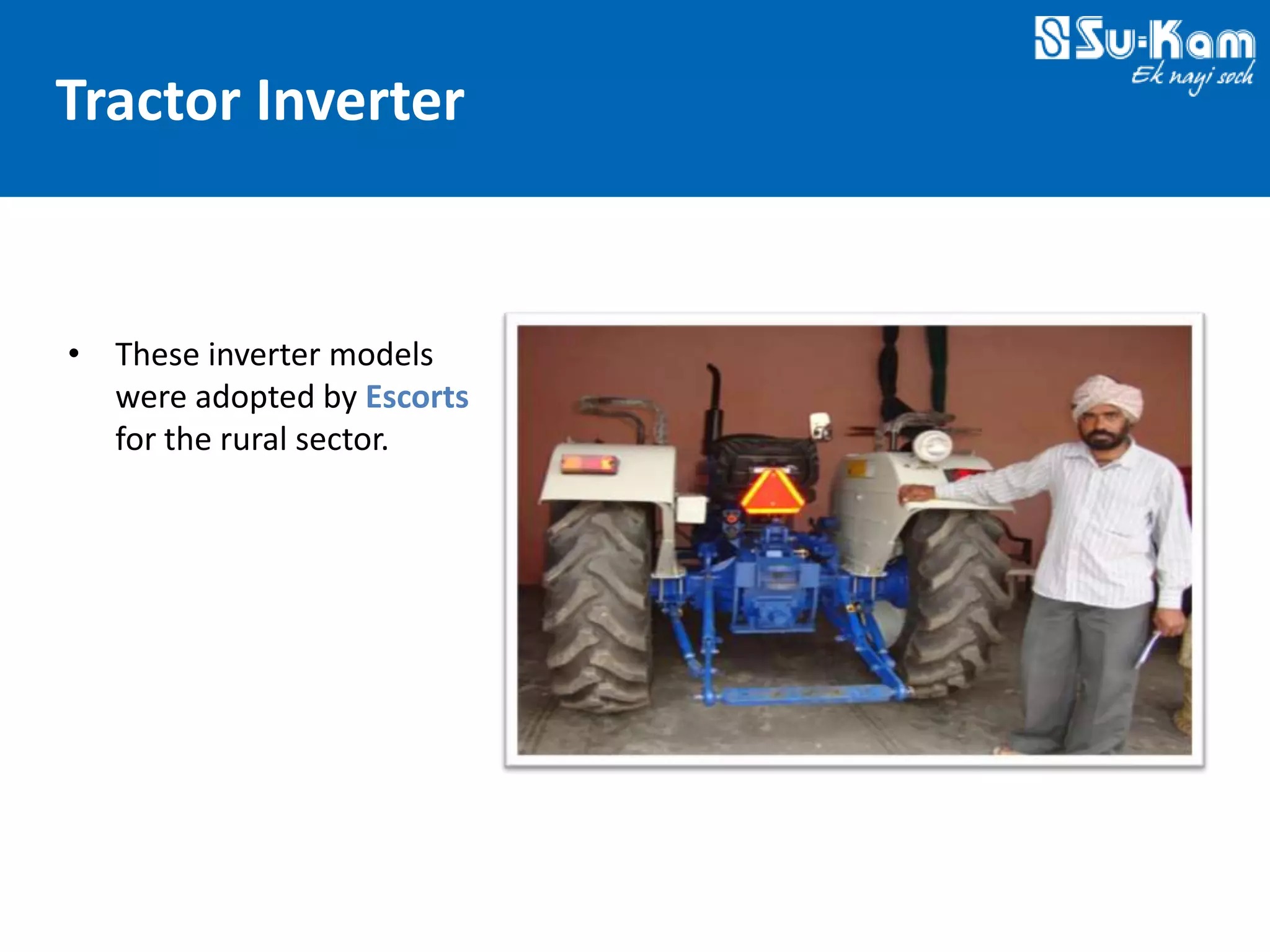
Slide 7: Kisan / Tractor Inverter — Farmers Charge from Tractor
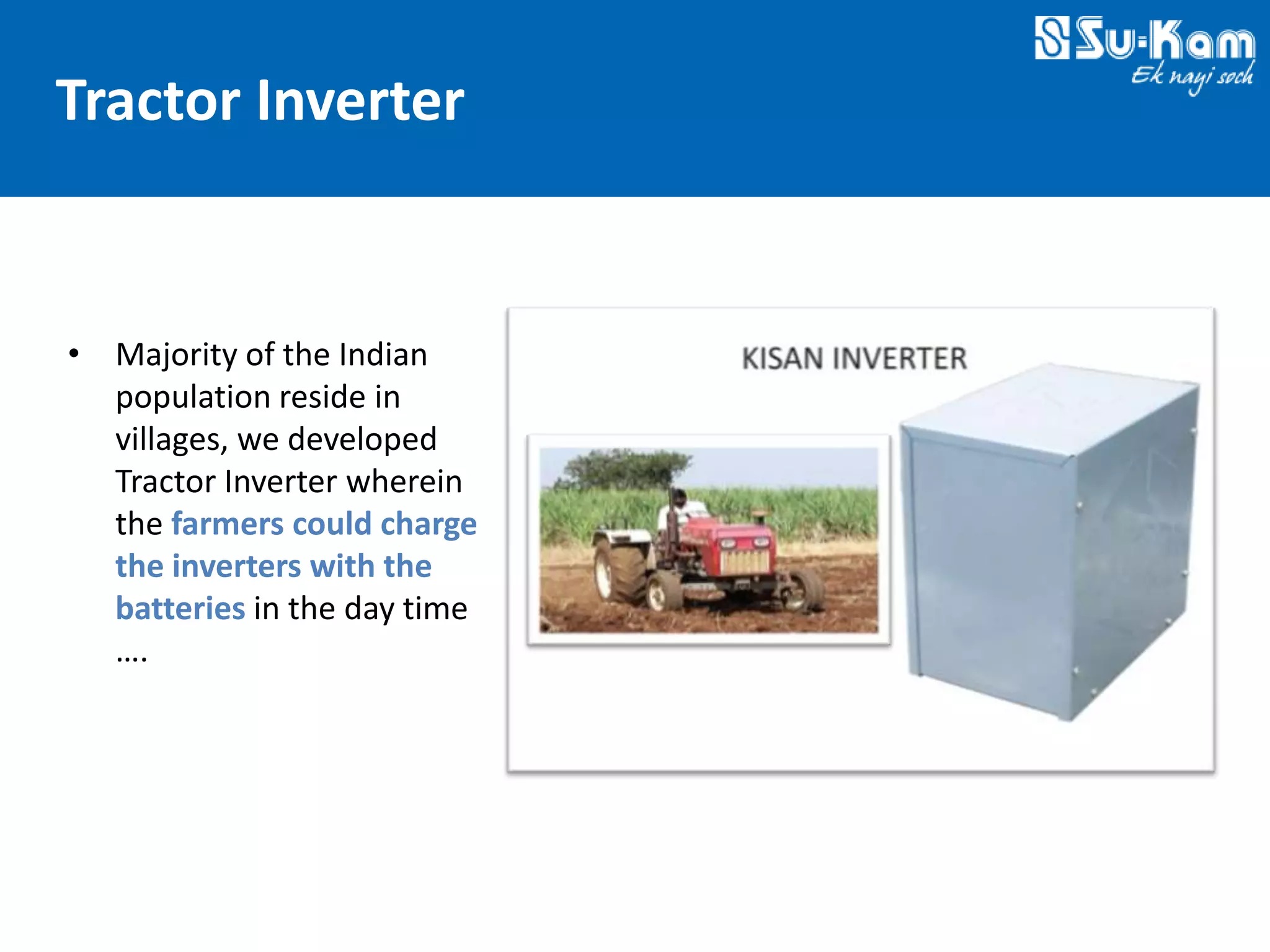
Rural India did not fail for lack of ingenuity — it failed for lack of grid hours. The tractor inverter idea came from fields: use the alternator while the farmer is working, store energy, run lights at night. Escort’s FT45 inverter-tractor partnership in 2011 was the corporate echo of what we had been prototyping for kisans.
Slide 8: Tractor Inverter — Light Homes at Night
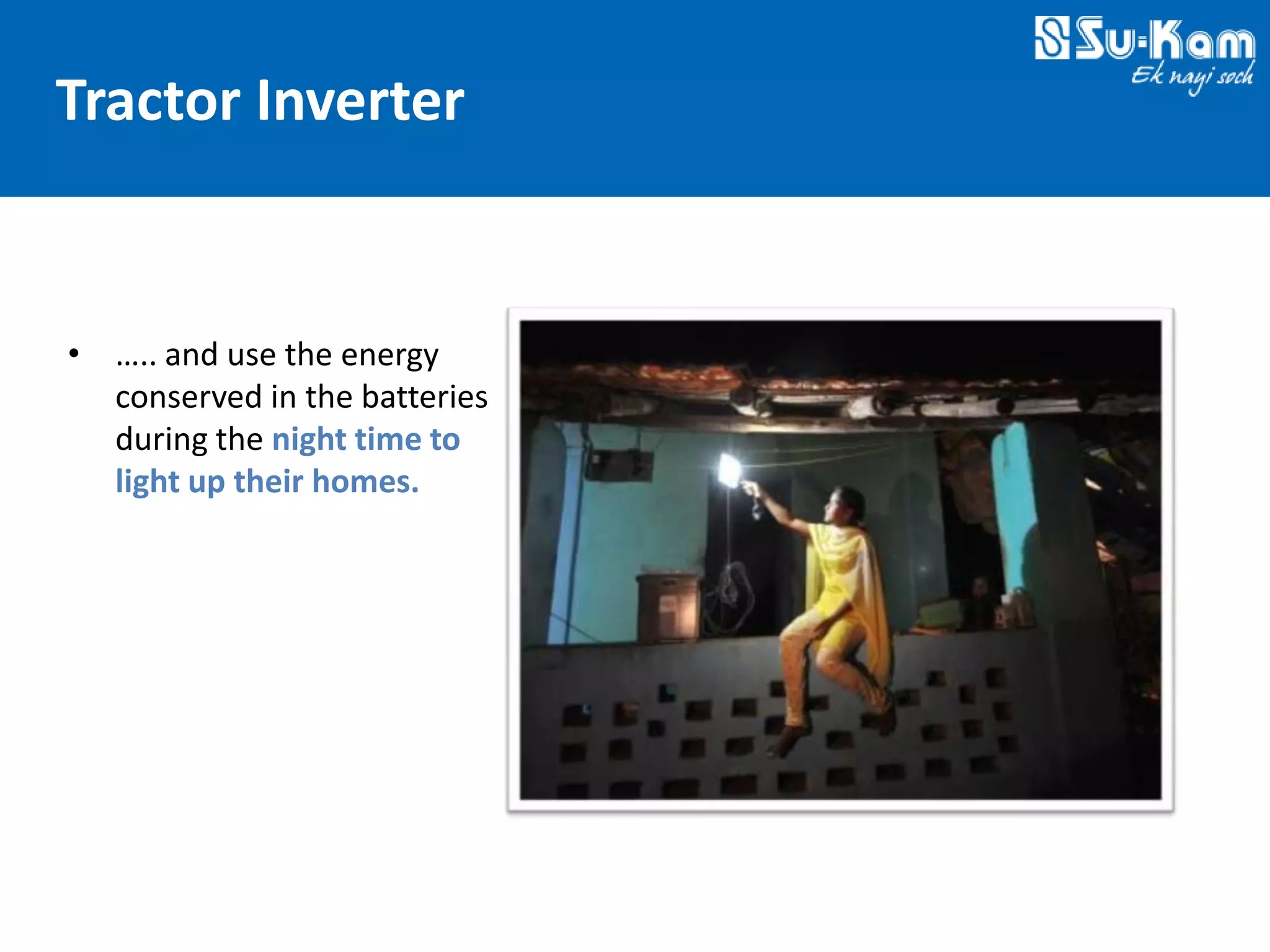
This slide is the human payoff — a home lit after sunset because power came from the day’s work, not from a diesel genset. I have always believed India’s energy story is rural first. Urban backup gets headlines; tractor charging gets children studying after dark.
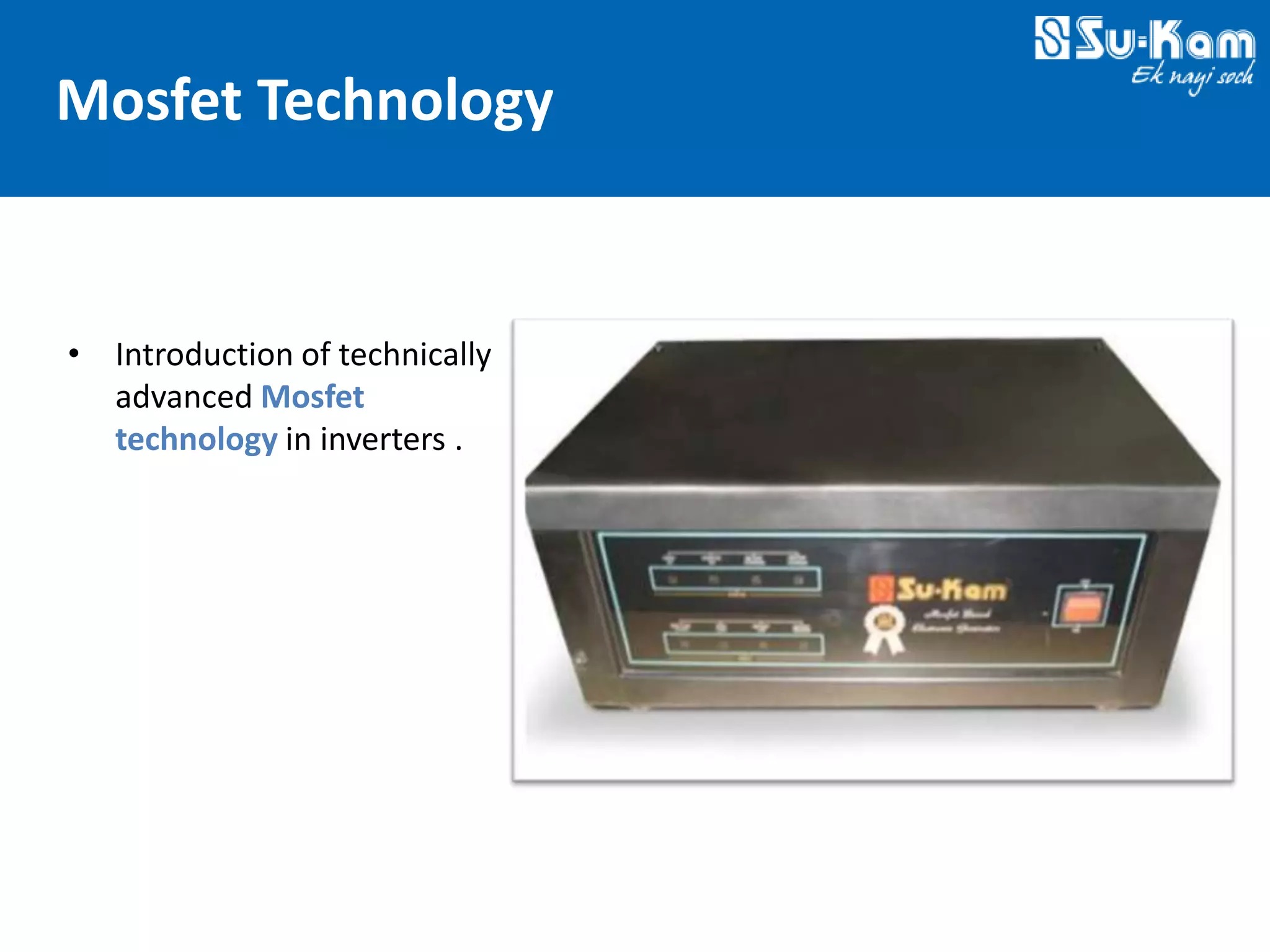
Slide 9: MOSFET Technology — Part I
MOSFET was the transistor bet that separated Su-Kam from the relay-and-transformer crowd. Smaller heat footprint, faster switching, cleaner waveforms — the slide is technical because the audience at technovation forums was technical. I did not dumb this down. Respect the engineer.
Slide 10: MOSFET Technology — Part II
Here the deck walks through efficiency and reliability gains. Every percentage point mattered when customers compared running cost of inverter versus genset. MOSFET was not a buzzword in our lab — it was the reason a Su-Kam unit could survive summer in Rajasthan.
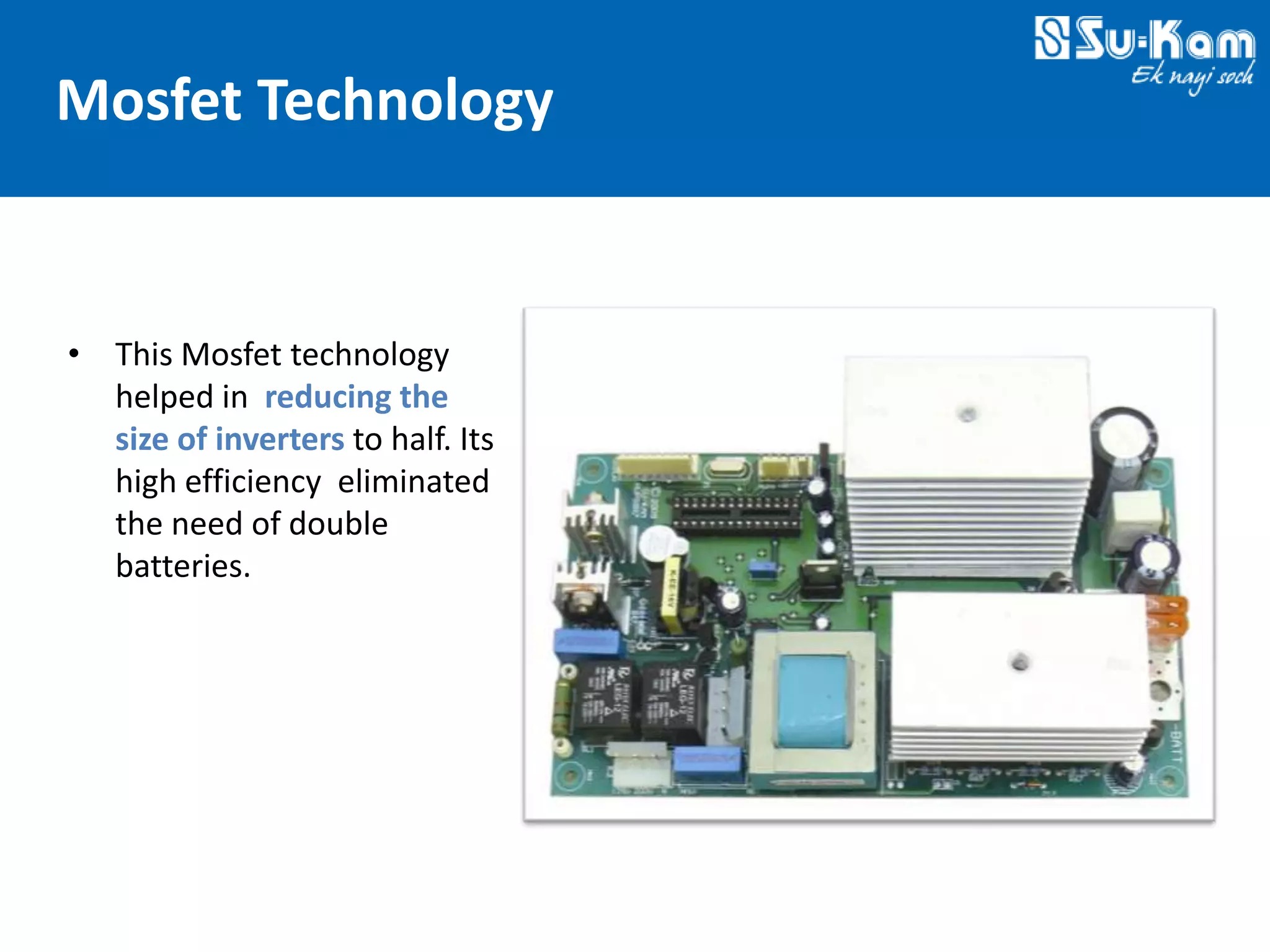
Slide 11: MOSFET Technology — Part III
By the third MOSFET slide the argument is complete: Indian conditions need Indian engineering choices. We were not importing boards and putting stickers on them. This series in the deck mirrors what I later said on stage in Chandigarh in 2011 — R&D as business strategy.
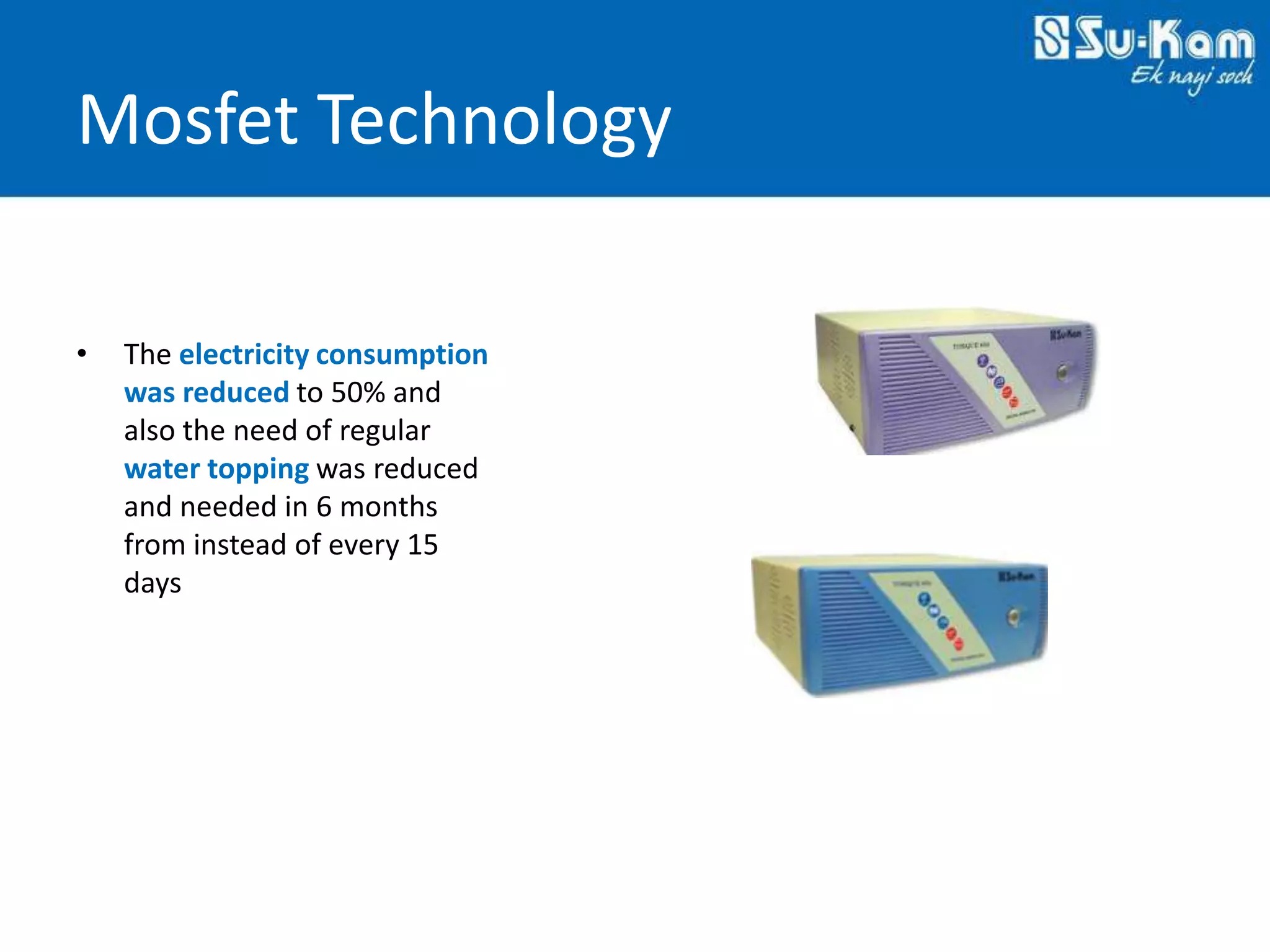
Slide 12: MOSFET Technology — Part IV
The closing MOSFET slide ties product lines to the same core platform. Platform thinking before Silicon Valley made it fashionable. One technology spine, many market faces — home, shop, telecom, solar.
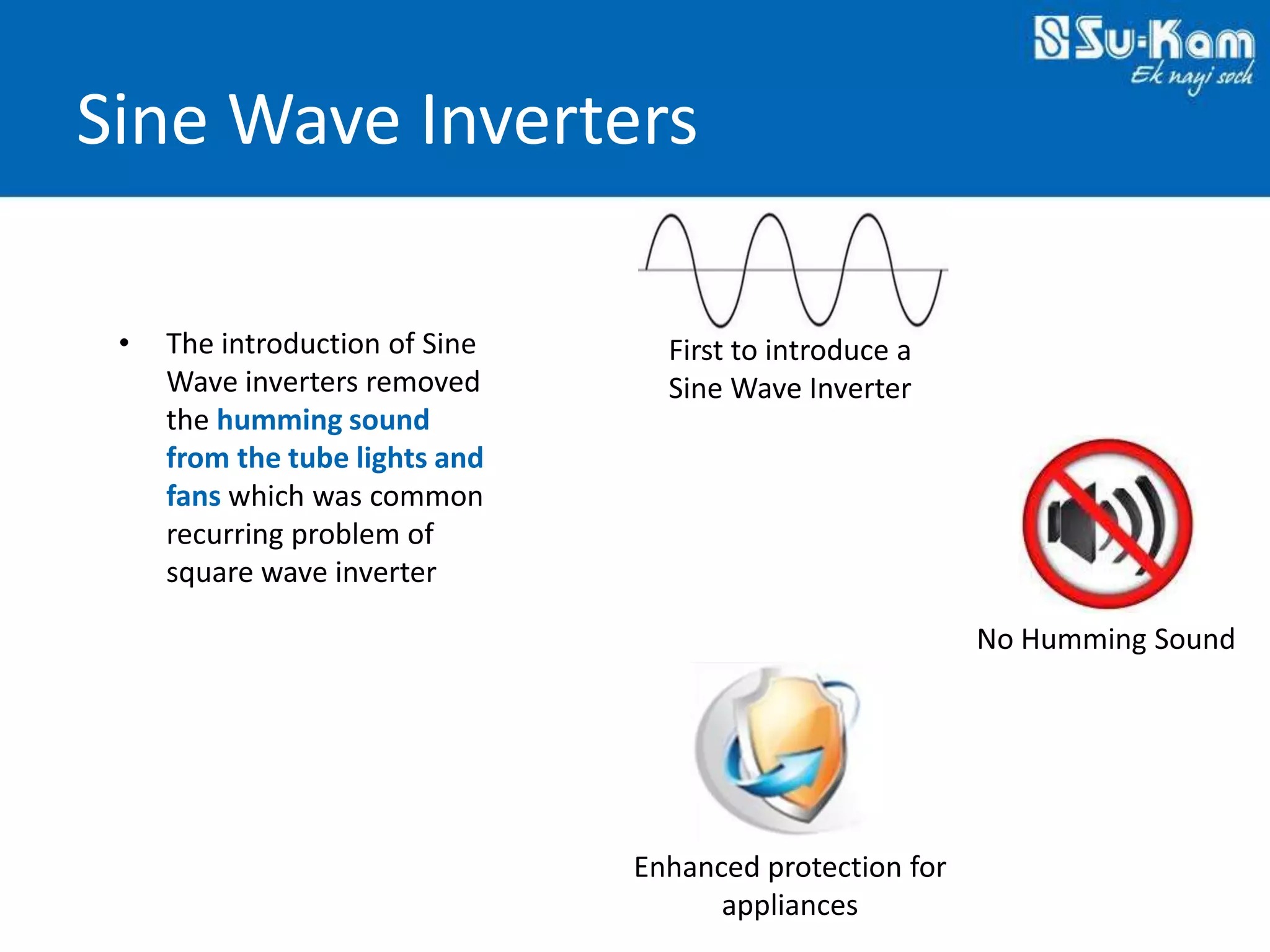
Slide 13: Pure Sine Wave Inverters
Pure sine wave was the moment Su-Kam stopped being ‘good enough for fans and tubelights.’ Computers, motors, sensitive electronics — the middle class was arriving and they needed clean power. Read the full arc in first sine wave inverter and the birth of Home UPS.
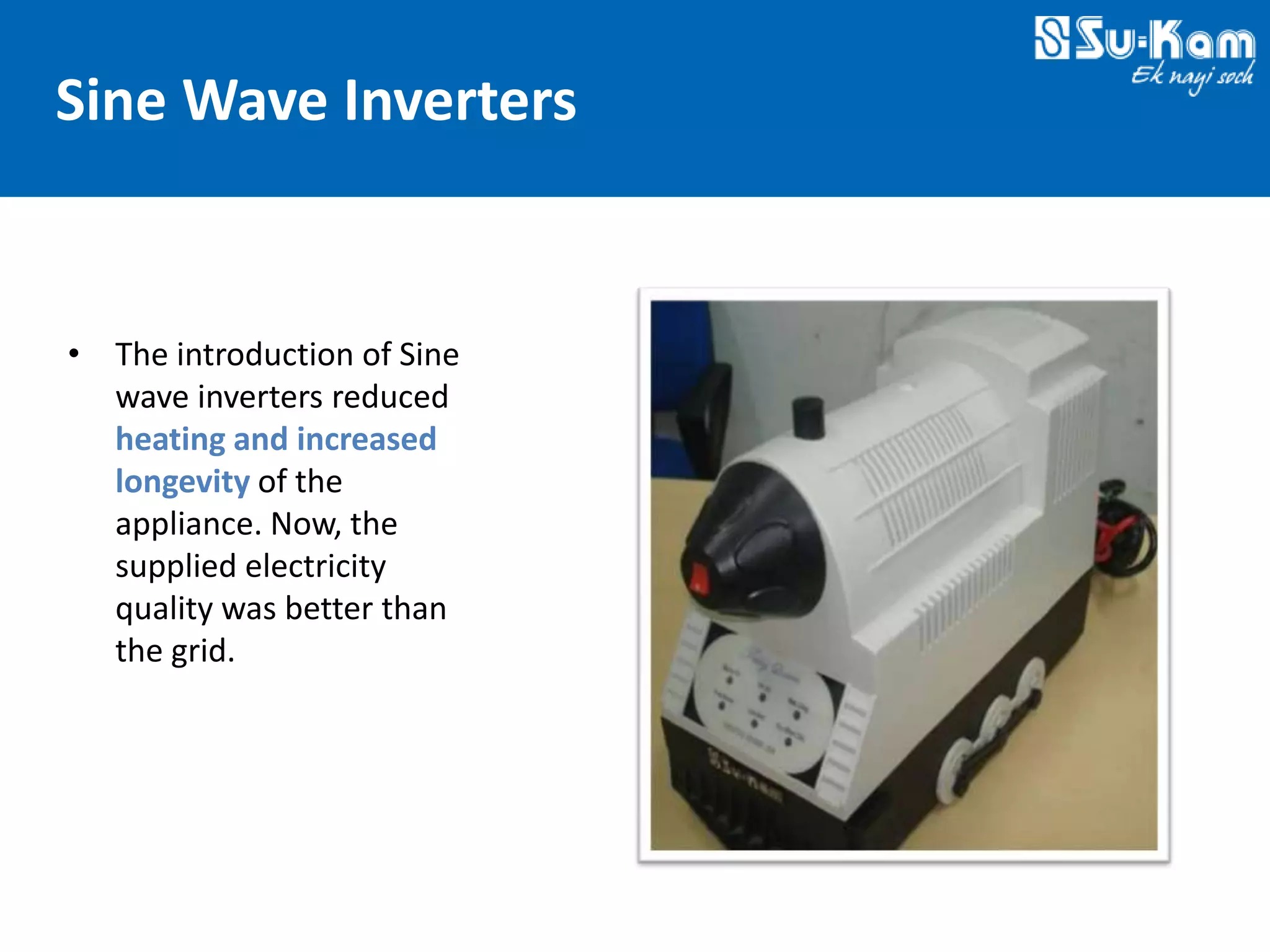
Slide 14: Fairy Queen Train Design
The Fairy Queen styling on this sine wave unit is deliberate nostalgia — India’s oldest running steam locomotive as design language for India’s newest power electronics. Beauty and patriotism in one housing. It also links back to the Chic story: an inverter can carry culture, not just watts.
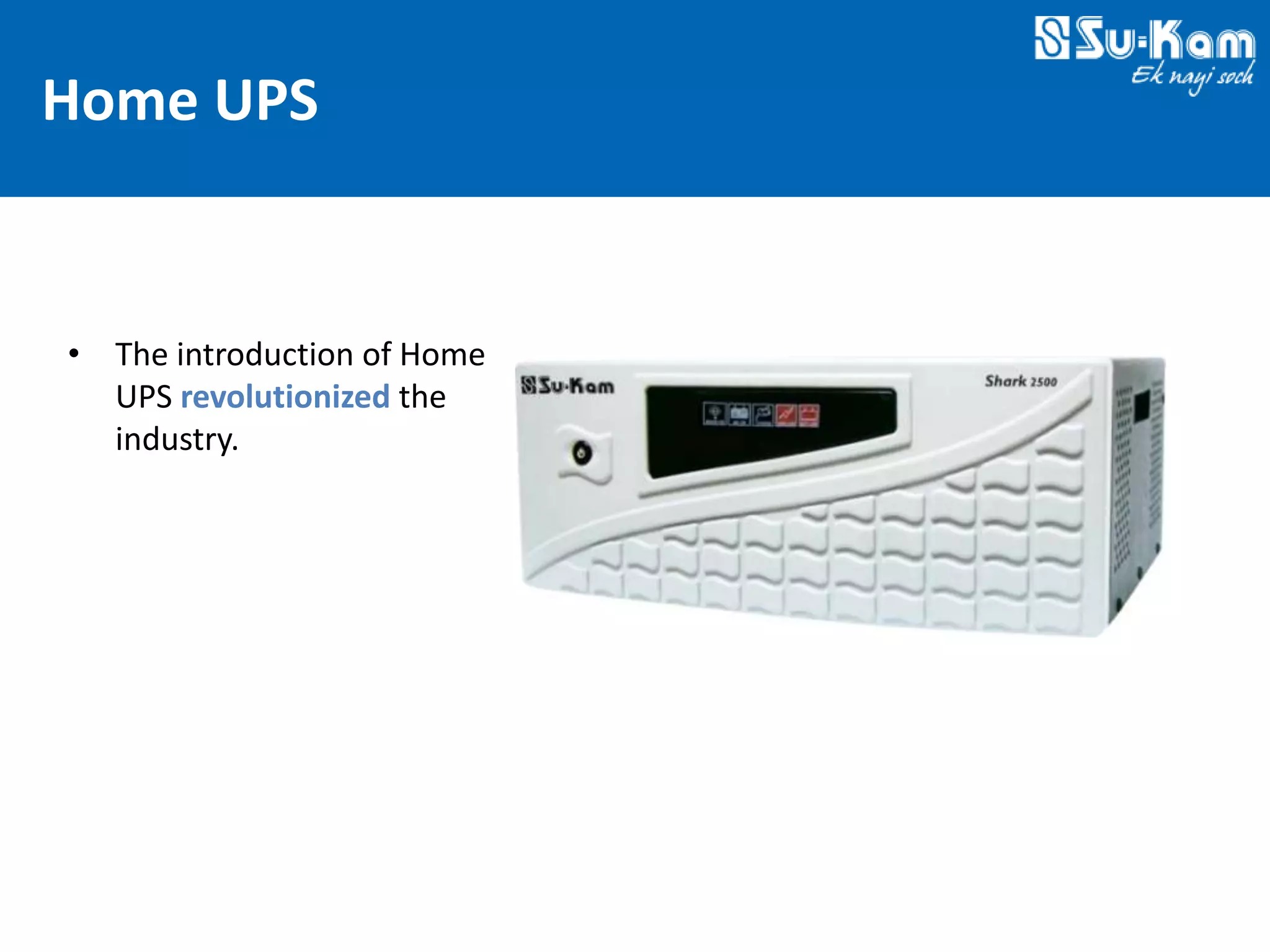
Slide 15: Home UPS Revolution — Shark
Home UPS was a category we essentially had to explain to the market. The Shark model was aggressive naming for an aggressive promise: no separate inverter and UPS fighting each other — one intelligent system for the home. Dealers learned a new pitch; customers learned a new word.
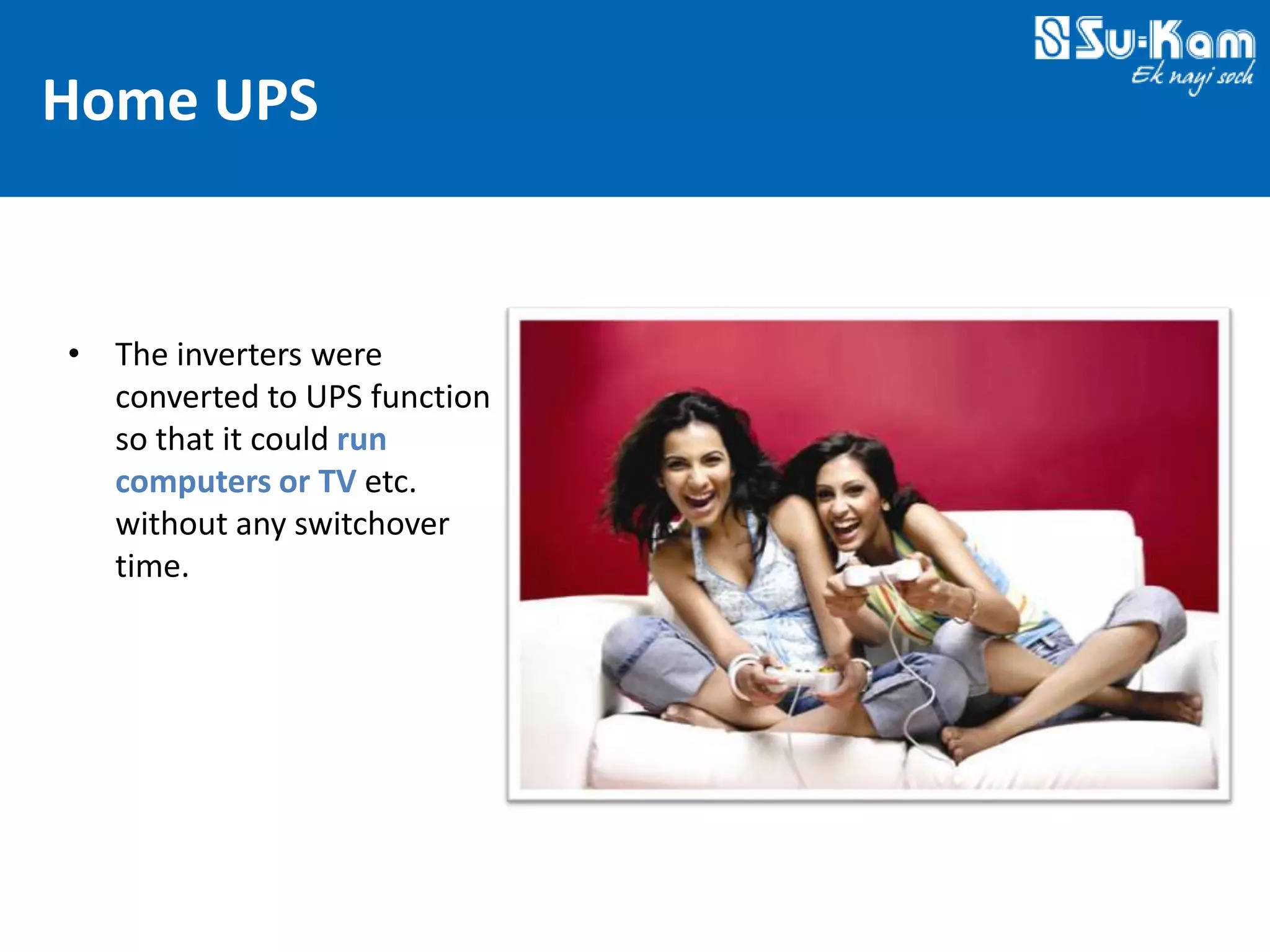
Slide 16: Home UPS — Torque
Torque sat in the muscular middle of the range — enough power for the aspirational Indian home with refrigerator, TV, and a few lights during the daily cut. Every model name in this series was tested in dealer meetings before it reached cartons.
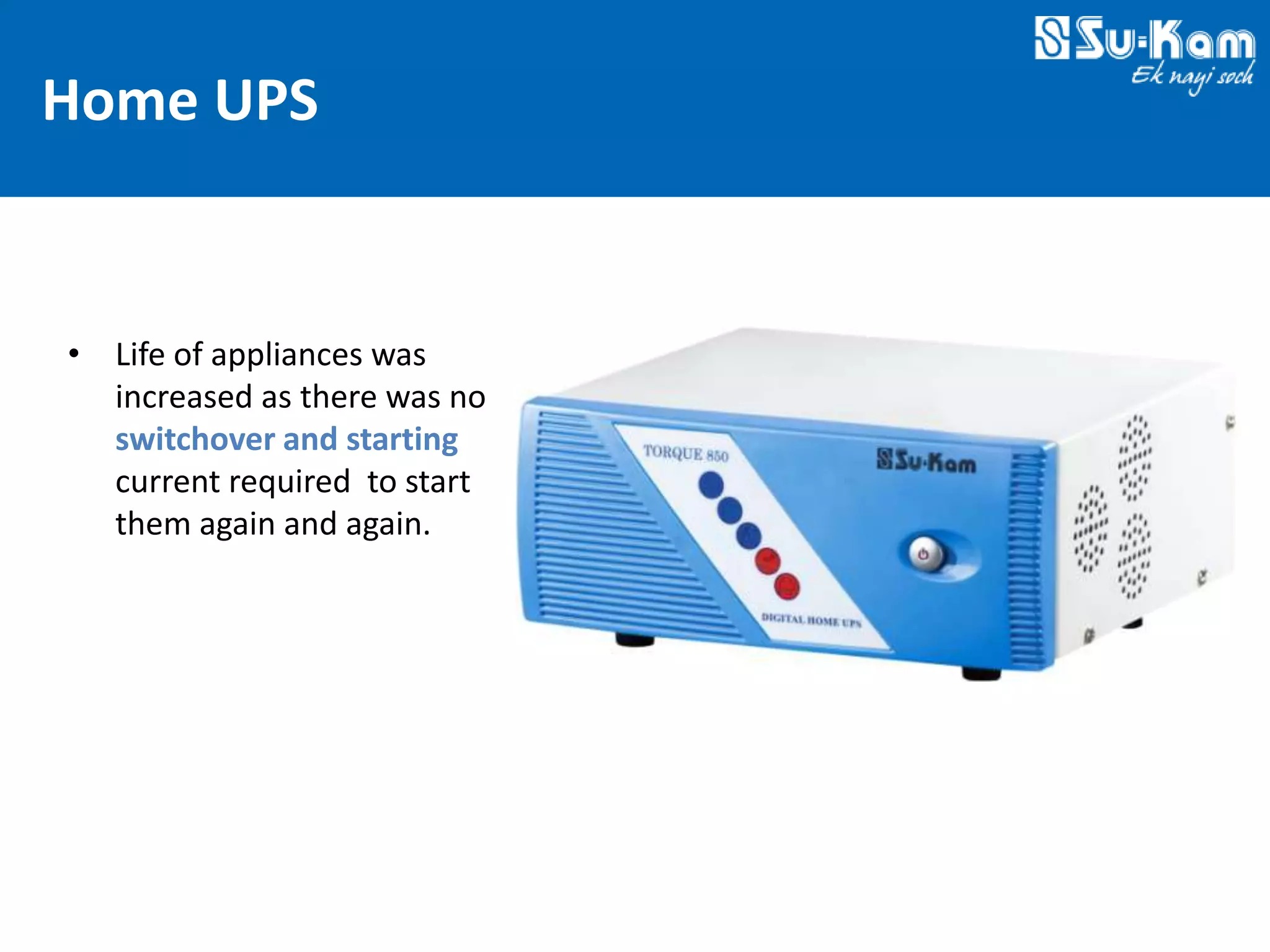
Slide 17: Home UPS — Shiny
Shiny was the design-forward sibling — for customers who already bought Chic and wanted the same philosophy in a Home UPS form factor. The slide deck captures a product generation that turned power backup from embarrassment into living-room acceptable.
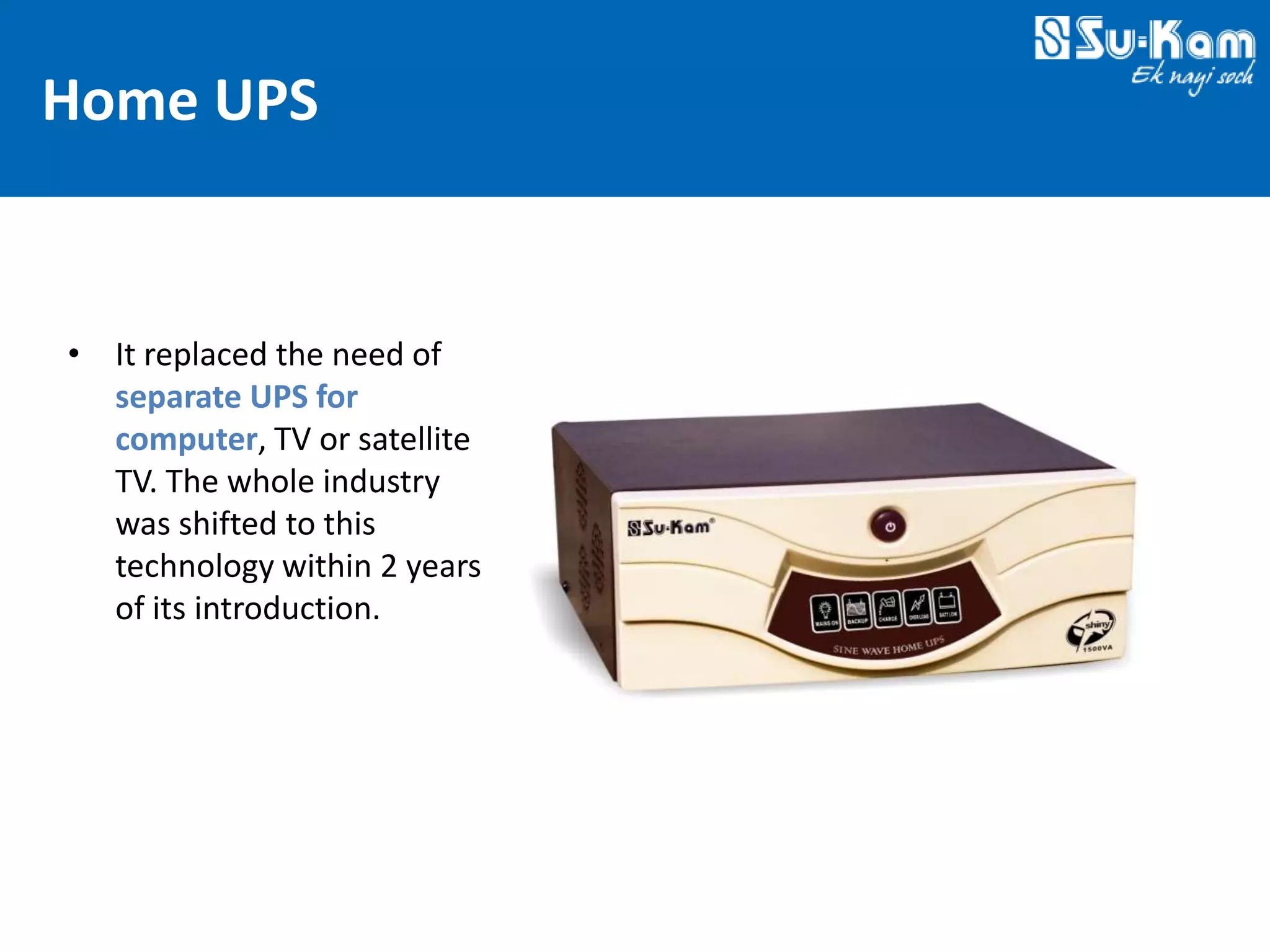
Slide 18: Home UPS — The Category Story
This slide closes the Home UPS chapter with the category argument: Indian grids would stay unreliable for years; the winning product is the one that switches silently and protects everything plugged in. We were not waiting for government reform. We were shipping the workaround.
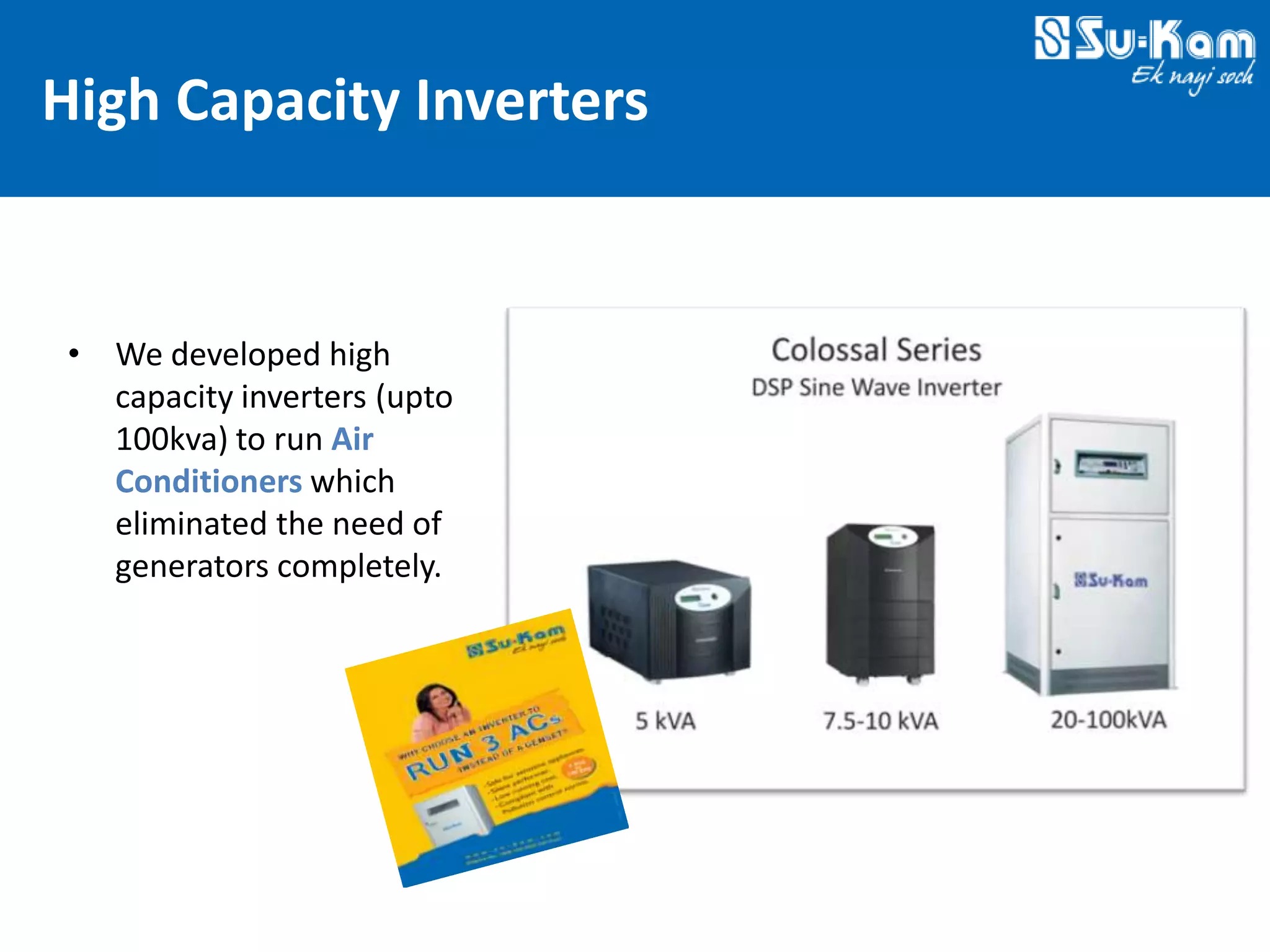
Slide 19: Colossal — High Capacity AC Without Genset
Colossal is the slide where home backup meets industrial ambition — run air conditioning without a diesel genset screaming outside. We ran an ad showing three air conditioners on inverter backup — not on a genset — and it became one of our most popular campaigns. No one in the industry initially believed big inverters had a market in India. My team kept saying: Smaller inverters sell — advertise smaller. My philosophy was the opposite: What we have, no one has — advertise what the market is NOT doing. The ad worked. Within about three years, everyone copied the pitch. The full founder story lives in Colossal Solar PCU — inverter to power plant. When this slide appeared in 2012, we were already thinking in megawatts, not kilowatts.
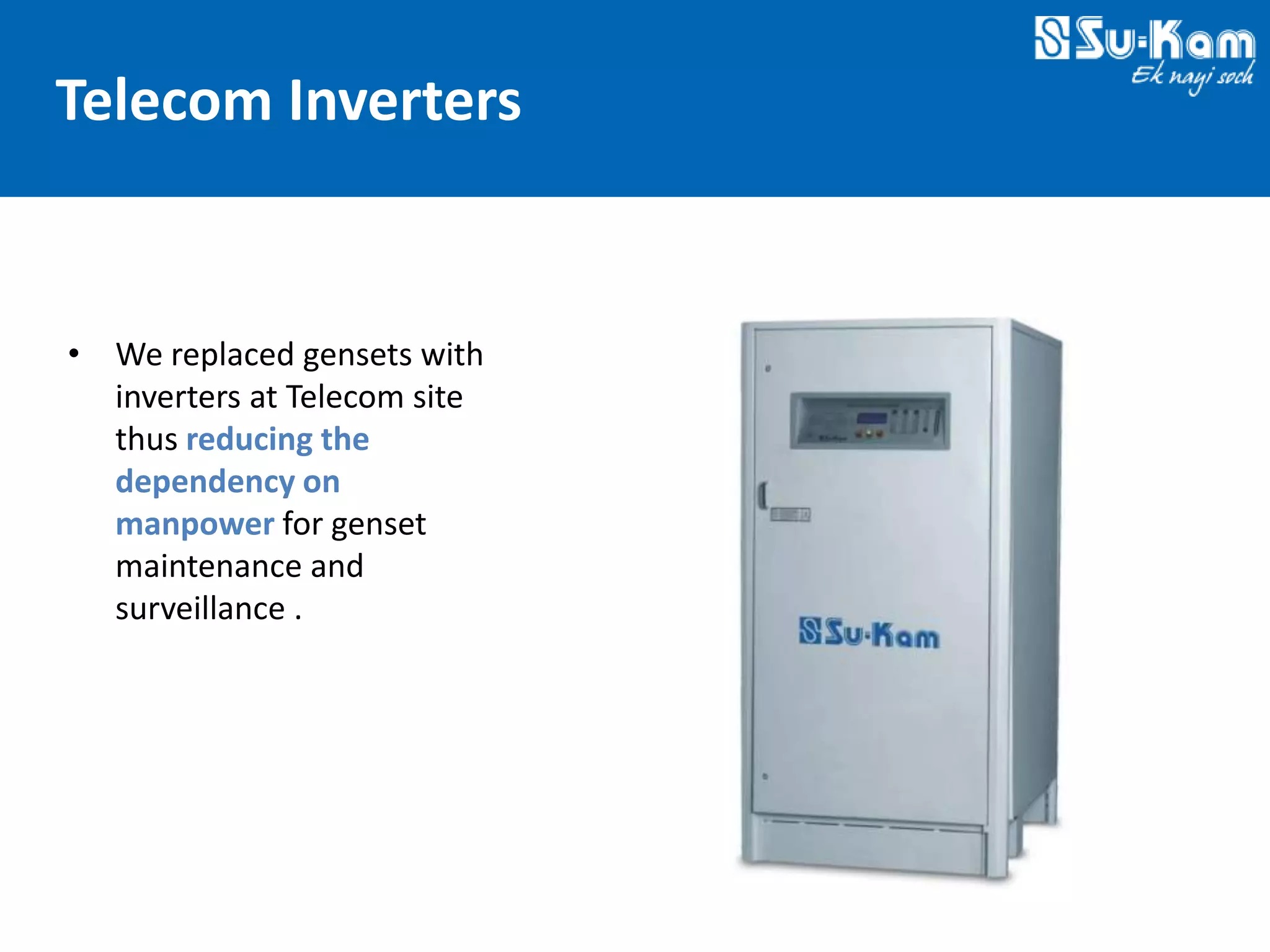
Slide 20: Telecom Inverters — Replacing Gensets
Telecom towers were India’s hidden energy disaster — diesel theft, maintenance, noise, pollution. Su-Kam telecom inverters were built for uptime math: when the grid fails, the tower stays live. This slide is B2B engineering at national scale.
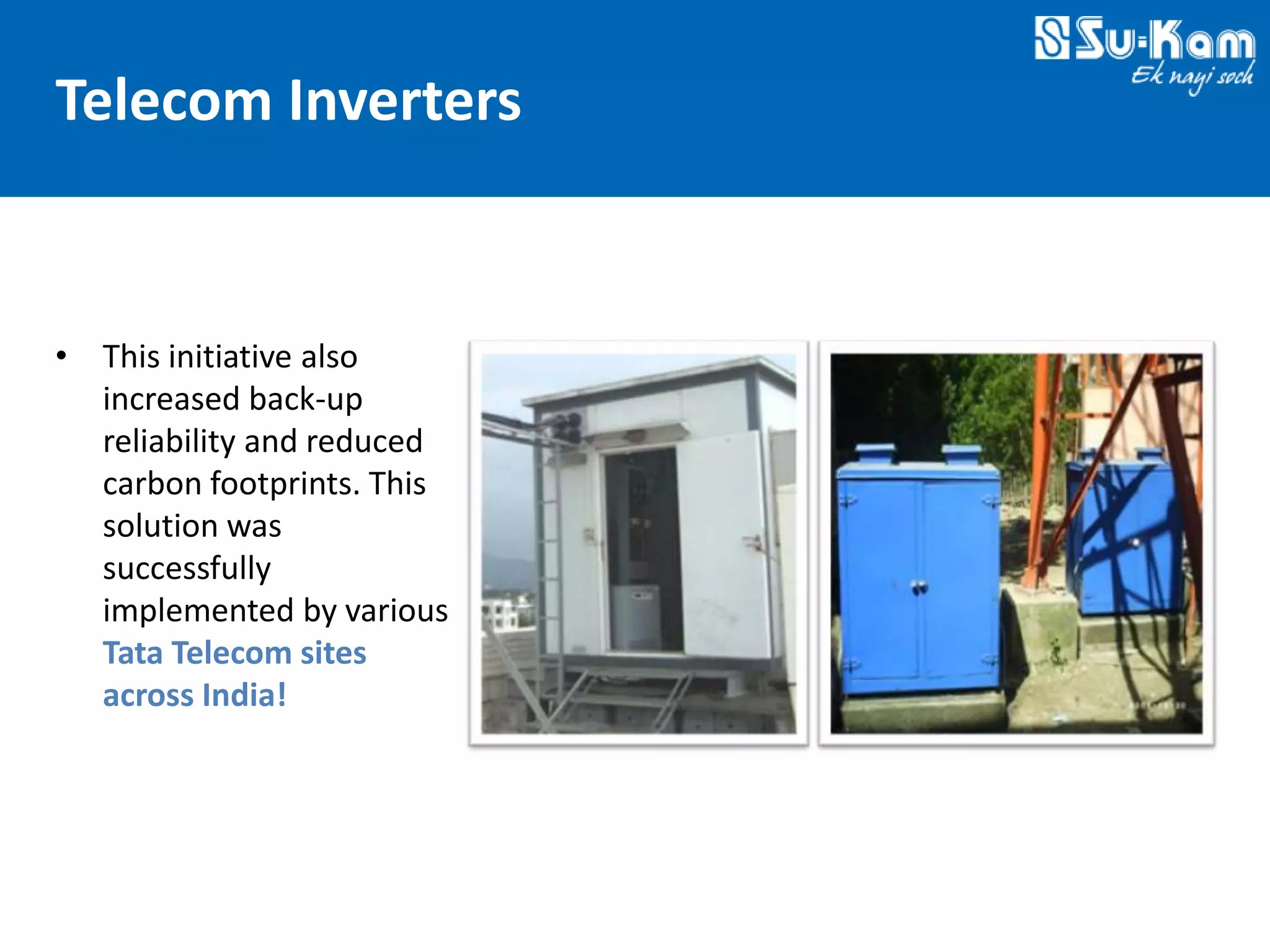
Slide 21: Tata Telecom Sites
Tata Telecom sites on a Su-Kam slide meant we had passed the reliability audit of a operator who could not afford downtime. I remember site visits where our engineer and their network head spoke the same language: minutes of outage, not marketing adjectives.
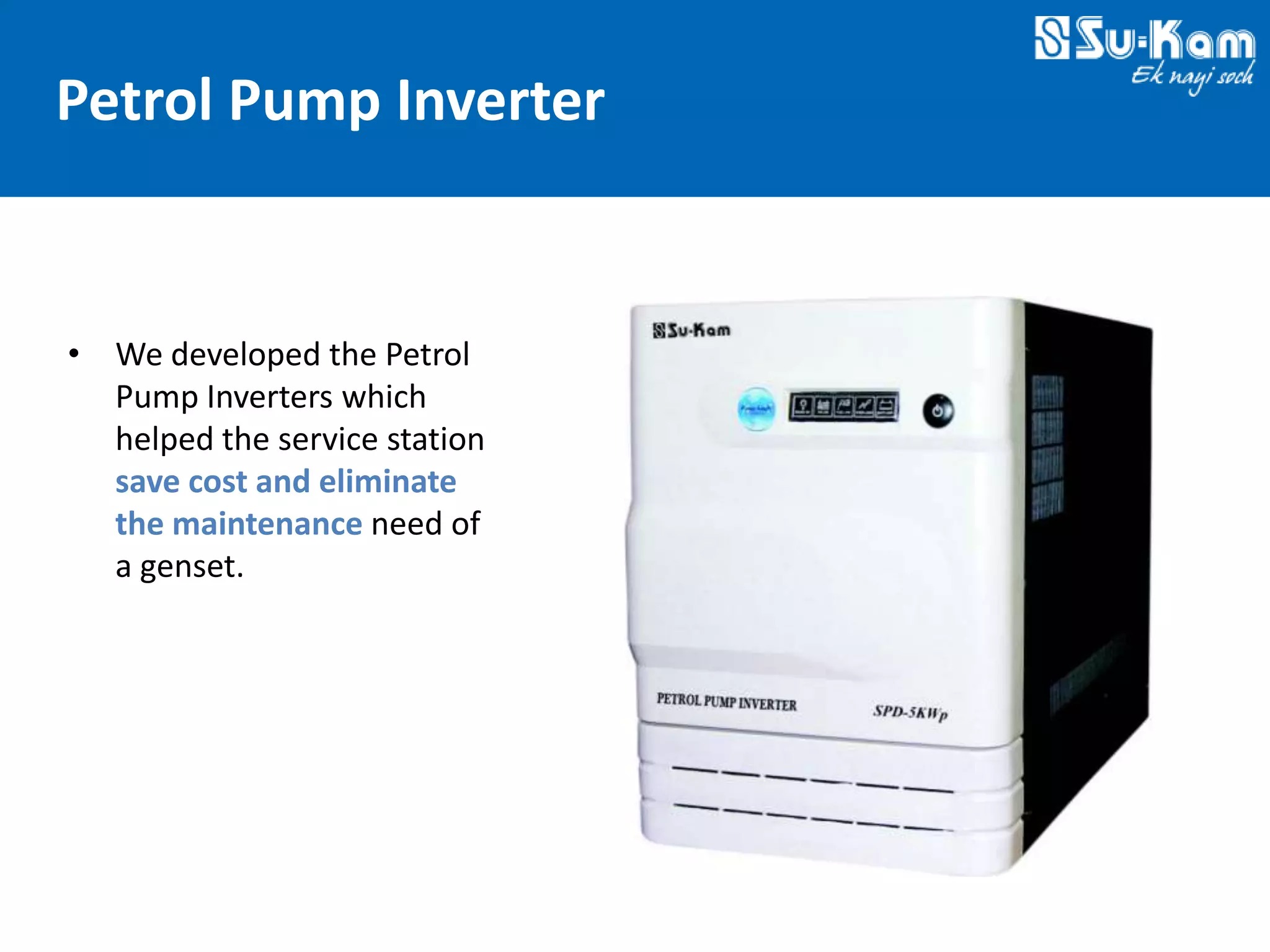
Slide 22: Petrol Pump Inverter — SPD 5 kWp
A petrol pump is a small business that cannot stop — pumps, POS, lighting. The SPD 5 kWp slide shows solar-backed continuity for forecourts. Gulmohar and other filling stations later became case studies; this slide is the template.
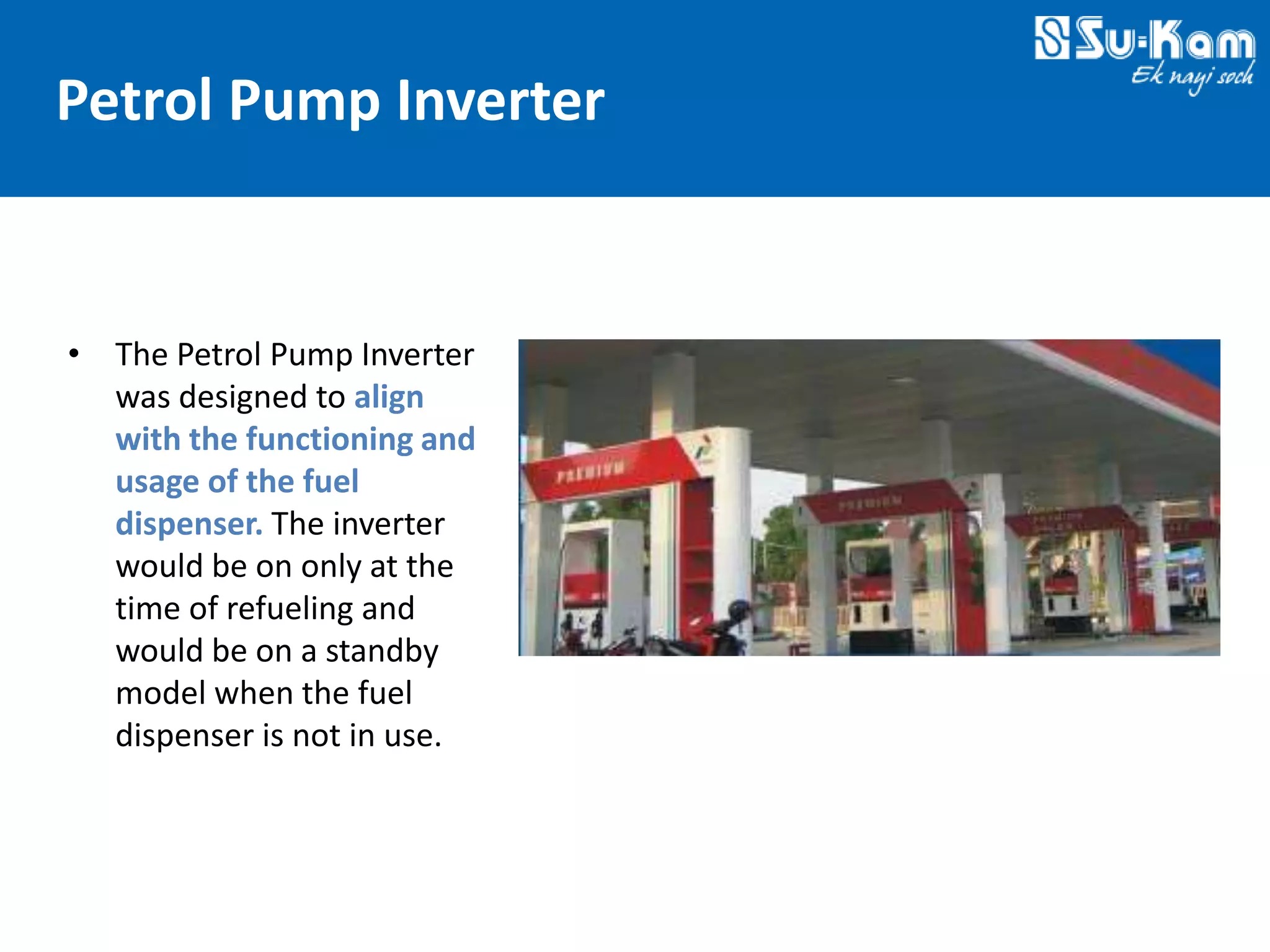
Slide 23: Petrol Pump — Surge & Load Profile
Pumps have ugly load profiles — motors starting, harmonics, long summer days. This companion slide explains why a generic inverter fails at a forecourt. We sold engineering hours, not SKUs.
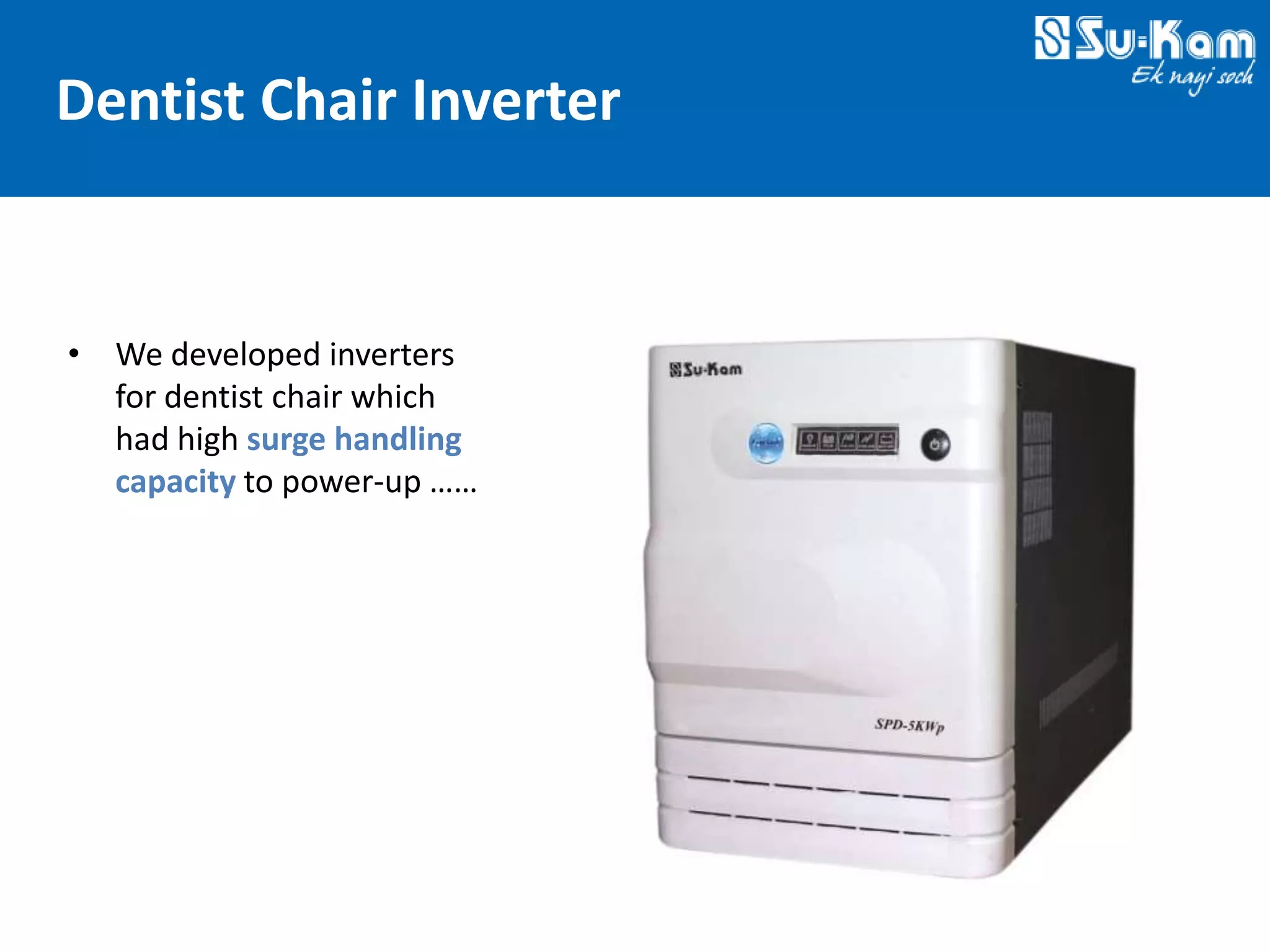
Slide 24: Dentist Chair Inverter — Surge Handling
Dental chairs were the surprise use case that taught us medical-grade surge tolerance. A compressor kicking in during a procedure cannot trip backup power. One Ahmedabad clinic became the story we told a hundred times: niche pain, bespoke solution, loyal referral.
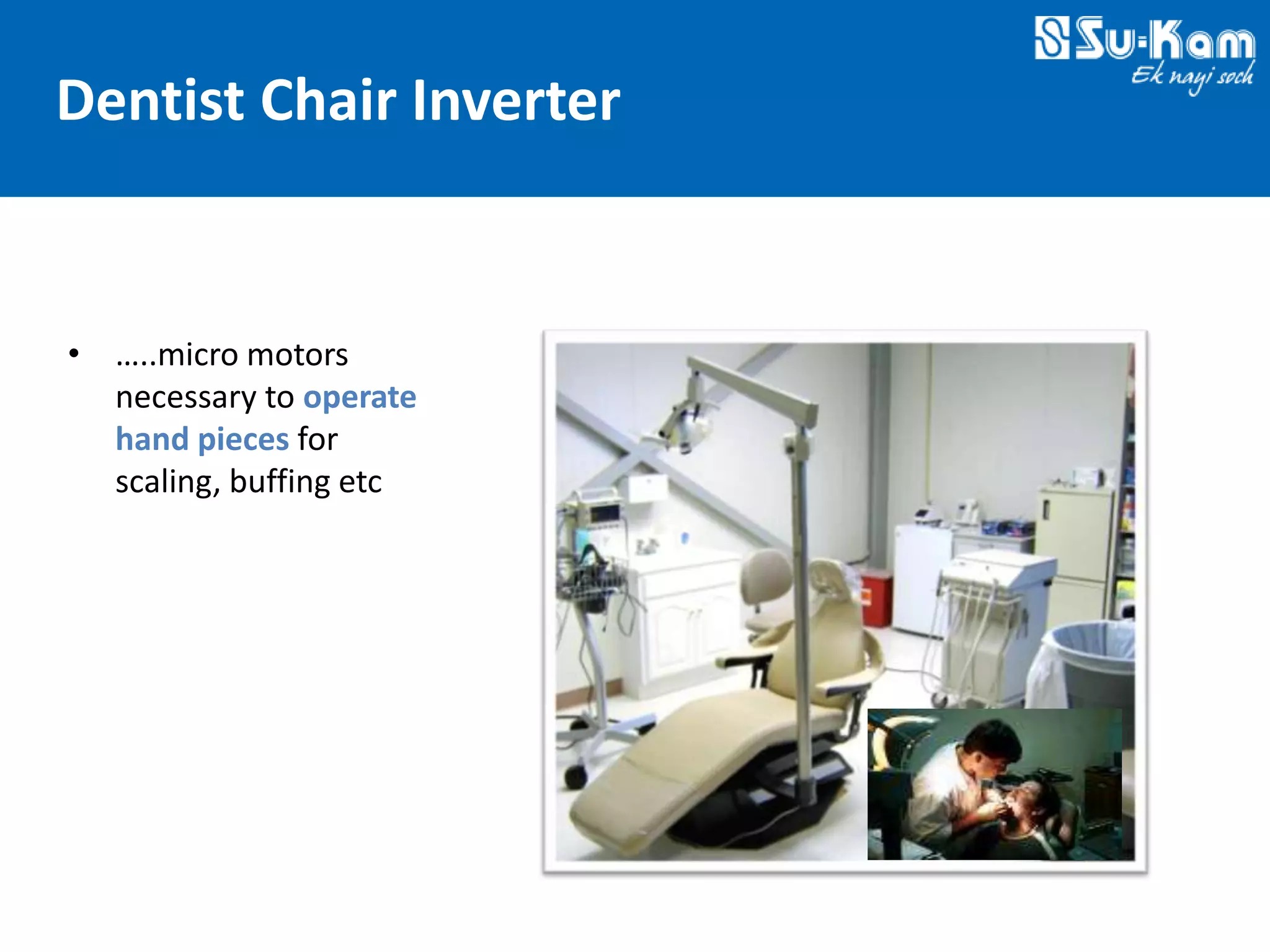
Slide 25: Dentist Chair — Clinical Continuity
The second dental slide makes the human point — patients in the chair, lights on, equipment stable. It is the same philosophy as Home UPS, applied to a profession that runs on precision and trust.
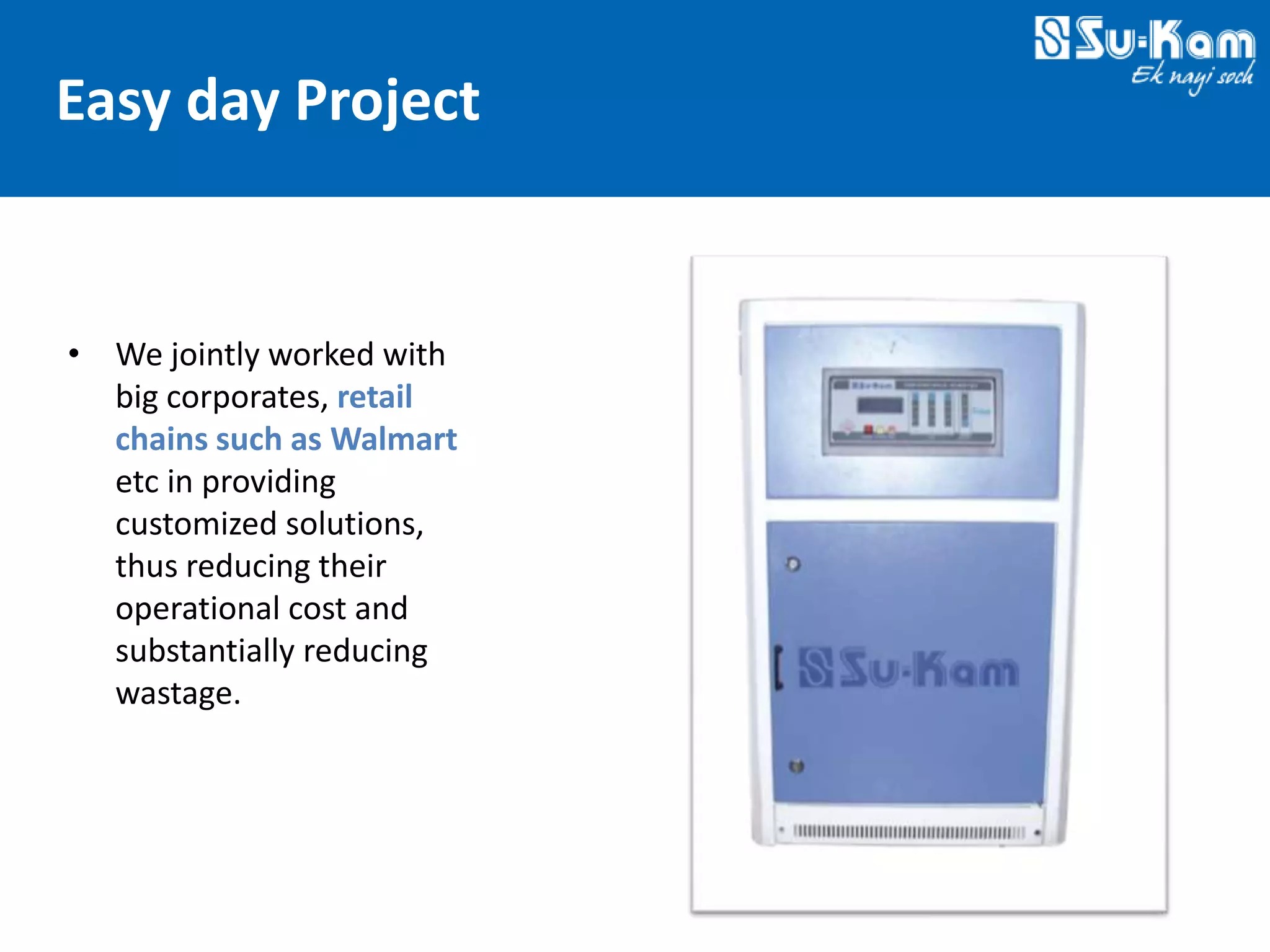
Slide 26: Easyday / Walmart — Retail Load Priority
Modern retail brought mixed loads: chillers, POS, signage, security. This slide is the Bharti–Walmart Easyday story — one of the greatest projects of my Su-Kam years. Around 2010, in the very early days of Walmart in India, the CFO called me: every power cut stopped tills and refrigeration, generators were expensive, diesel was being stolen. We built the Jagadhri store system — 25KVA three-phase inverter, 360V 200AH battery bank, 7.5KVA AMF diesel backstop, battery equaliser — and a volt-by-volt load-shedding ladder (362V / 350V / 325V / 316V priorities). Read the full engineering story in The day we kept Wal-Mart’s stores running.
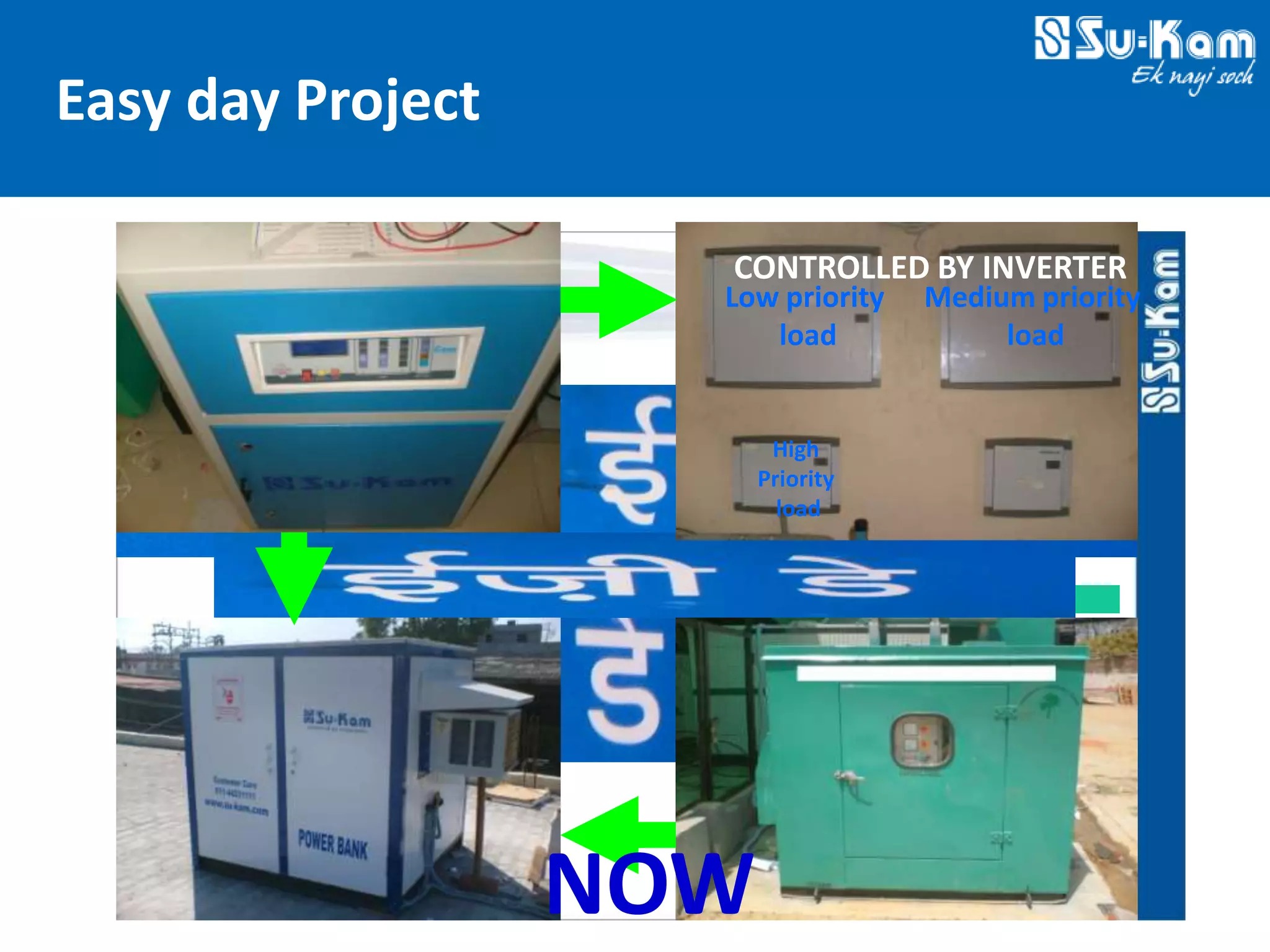
Slide 27: Power Bank — Priority Logic
Power Bank here is not a pocket battery — it is intelligent shedding and prioritisation for stores that cannot afford full blackout. At Easyday, we ranked circuits and watched battery voltage: drop Priority 1 at 362V, bring the small diesel set in; shed Priority 2 at 350V, Priority 3 at 325V; cut non-essential load at 316V to protect the bank from deep discharge. Phase two added remote monitoring — years before IoT was fashionable. The CFO phone call, the Jagadhri diagrams, the ladder logic — all in The day we kept Wal-Mart’s stores running. I loved these projects because they forced software thinking into hardware years ahead of the market.
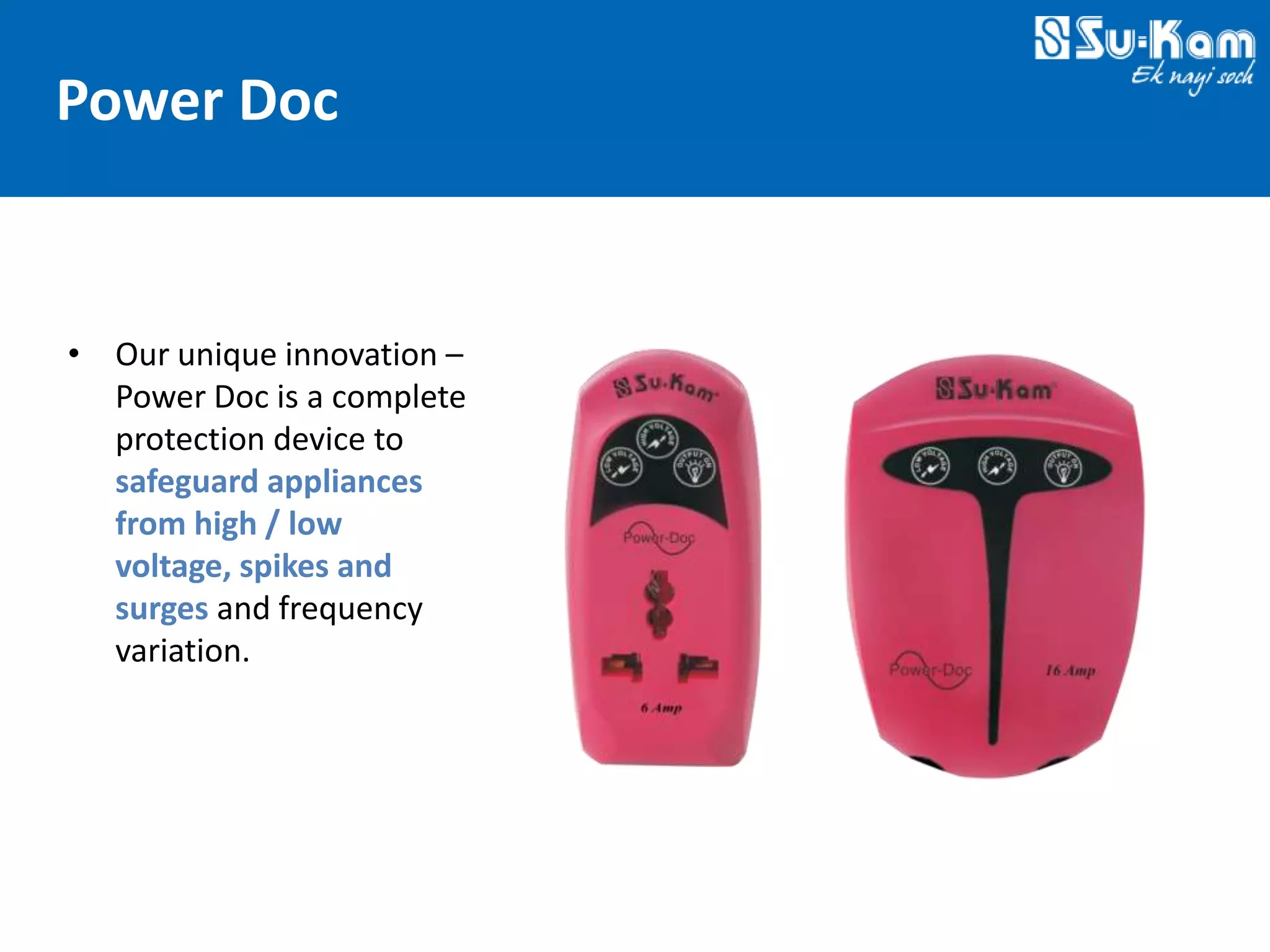
Slide 28: Power Doc — Voltage Protection
Power Doc was our answer to the TV-and-fridge anxiety of middle India — voltage that kills appliances slowly. Protection, not just backup. The slide is simple; the installed base was huge.
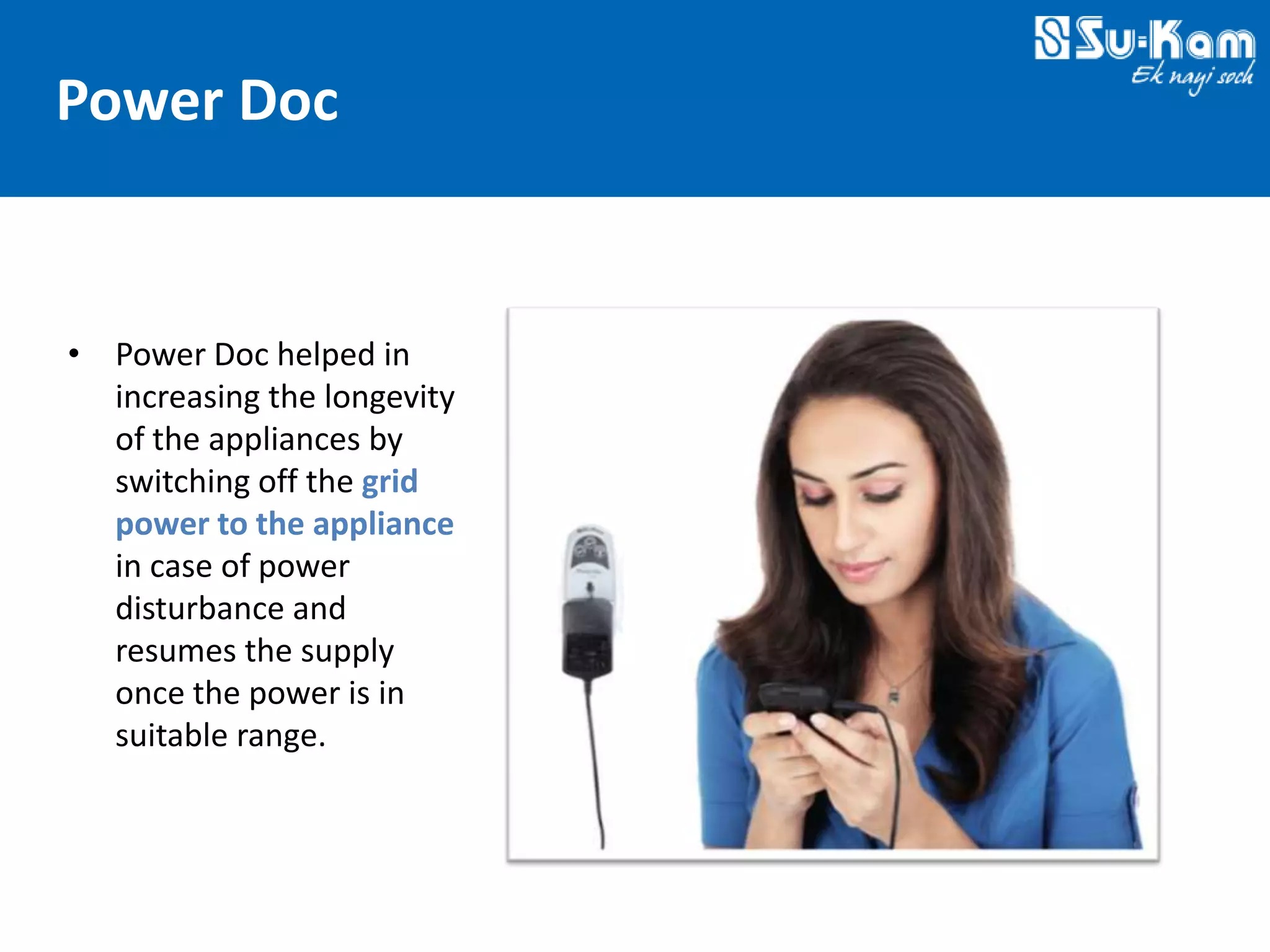
Slide 29: Power Doc — Monitoring
This slide adds monitoring and user feedback — because protection without visibility still feels like magic to the customer. We wanted the household to see when the grid was lying about being ‘normal.’
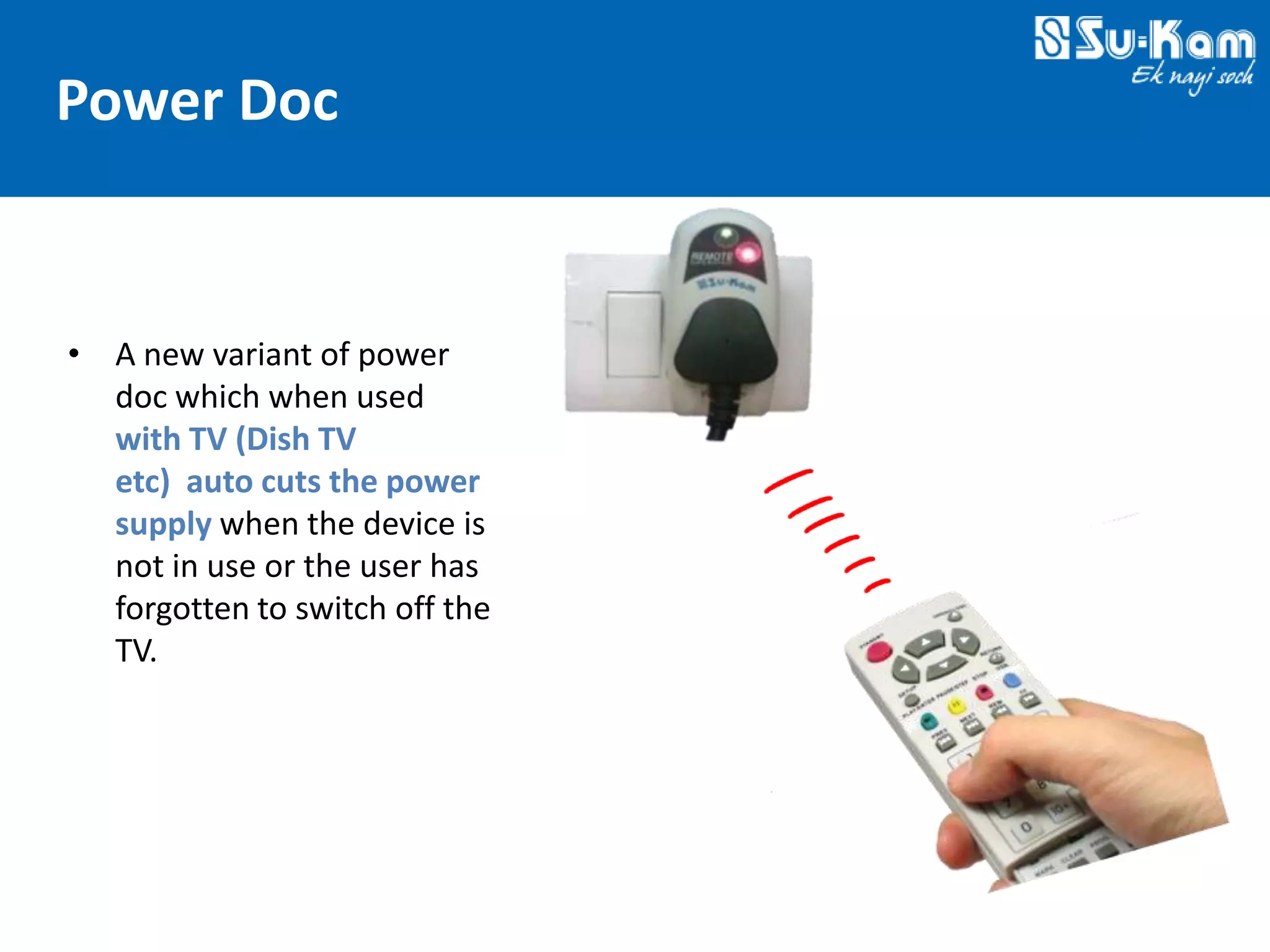
Slide 30: Power Doc TV Auto-Cut Variant
The TV auto-cut variant was born from a specific fear: brownouts that cook set-top boxes and panels. Indians were investing in flat screens; we built the guard rail. Small feature, massive word-of-mouth.
Slide 31: Power Doc — Family Safety Story
The closing Power Doc slide ties to brand promise — Su-Kam as guardian, not just generator substitute. This is the consumer soul of the company inside a technovation deck otherwise heavy on telecom and solar.
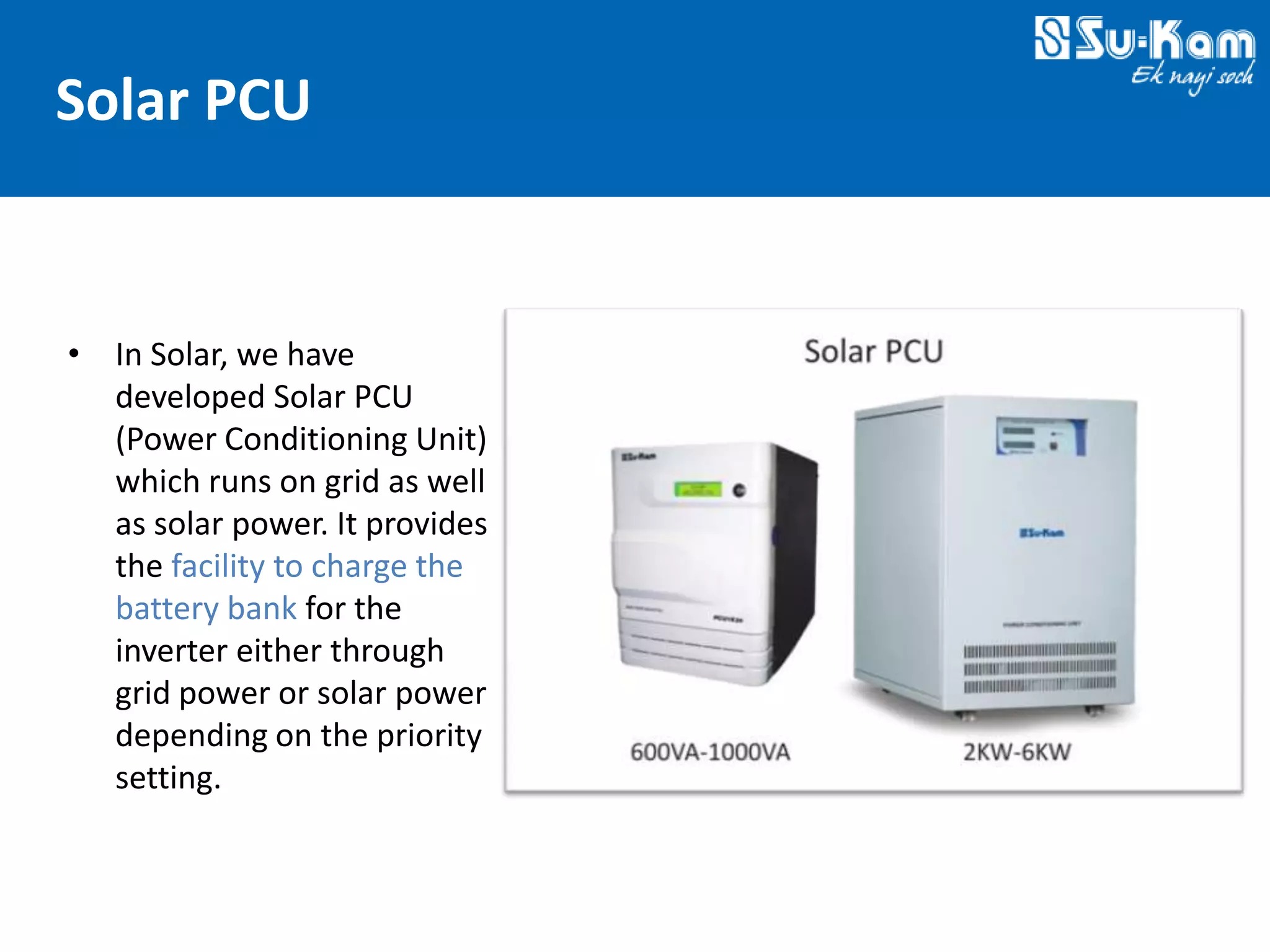
Slide 32: Solar PCU
The Solar PCU slide is the spine of my second career as Solar Man of India. Invented in 2005 — read how the Solar PCU paved India’s energy future. By 2012 this was not experimental; it was MNRE programmes, dealers, and rooftops.
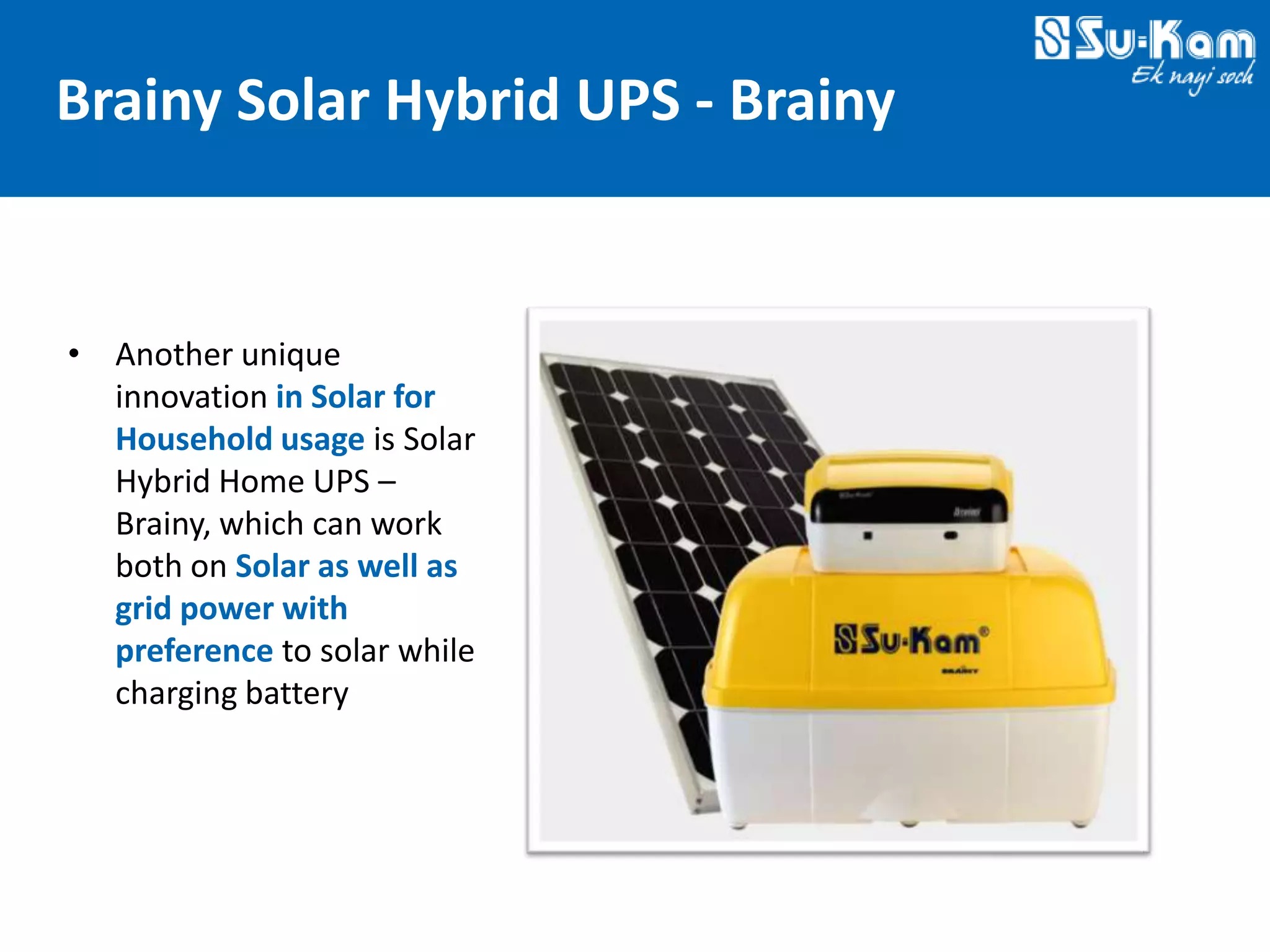
Slide 33: Brainy Solar Hybrid UPS
Brainy Eco sits one step later in the evolution — hybrid intelligence for homes that want solar without becoming electricians. The founder story is in Brainy Eco — the solar hybrid PCU that changed home power. This slide proves the pipeline from 2005 PCU to 2012 brainy home.
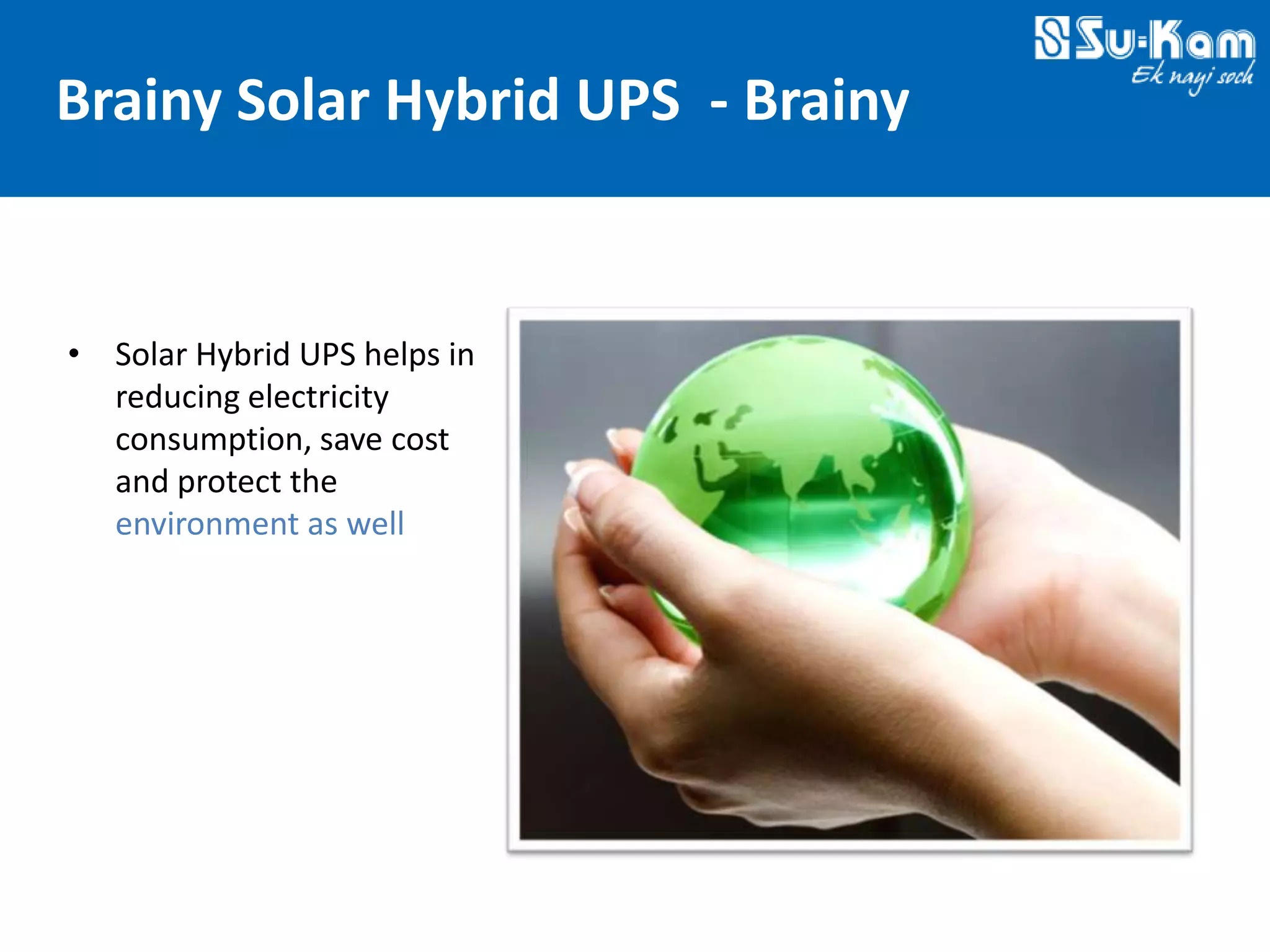
Slide 34: Solar Product Line — Grid & Off-Grid
Between Brainy and charge controllers, this slide bridges grid-tie ambition and off-grid necessity. India needed both — cities net-metering, villages never metered at all. One company tried to speak both languages.
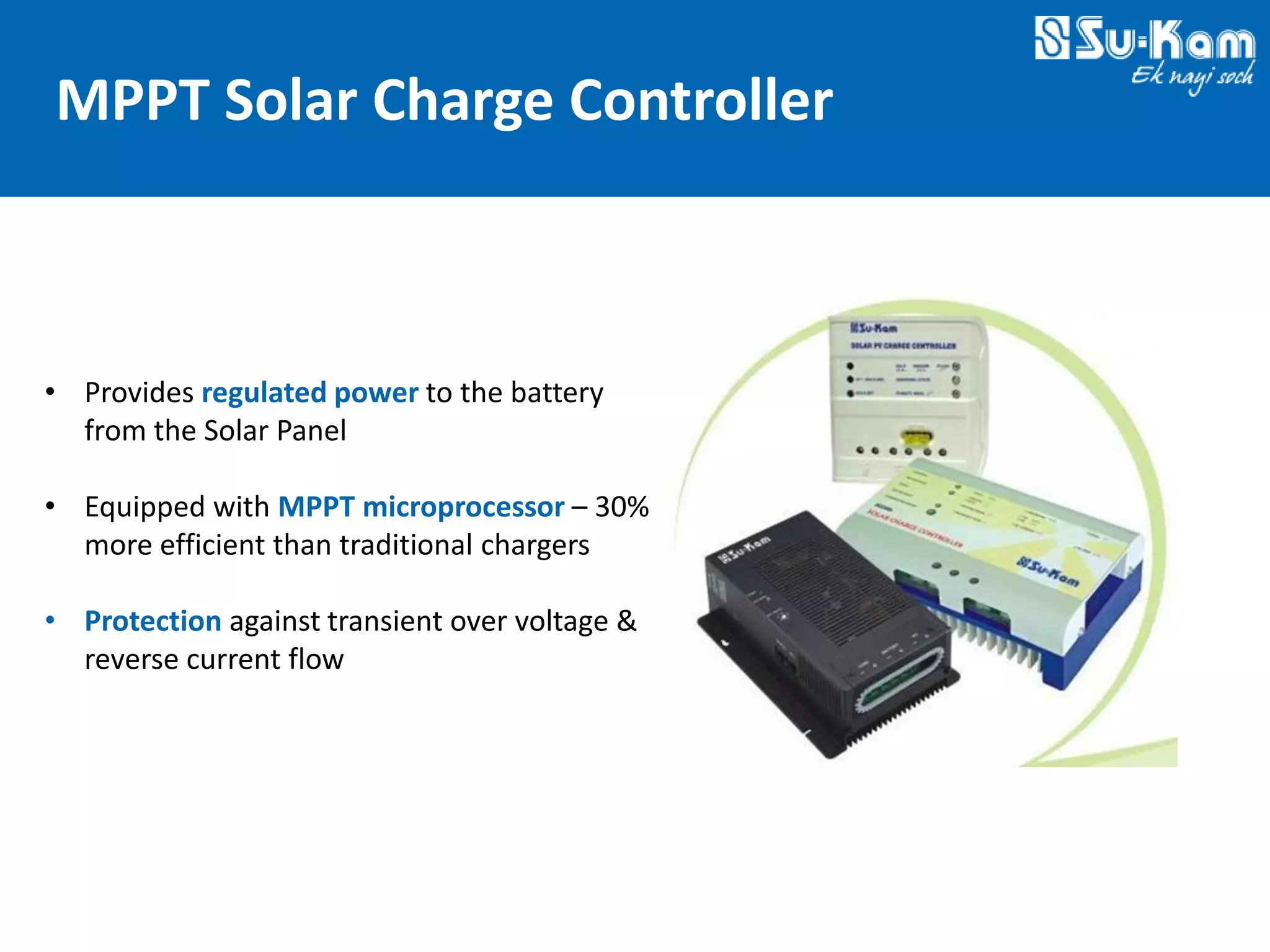
Slide 35: MPPT Charge Controller
MPPT is the unsung hero of solar yield — extract every watt from imperfect panels in heat and dust. We packaged MPPT for dealers who could not explain calculus but could explain more light, more charge to a farmer.
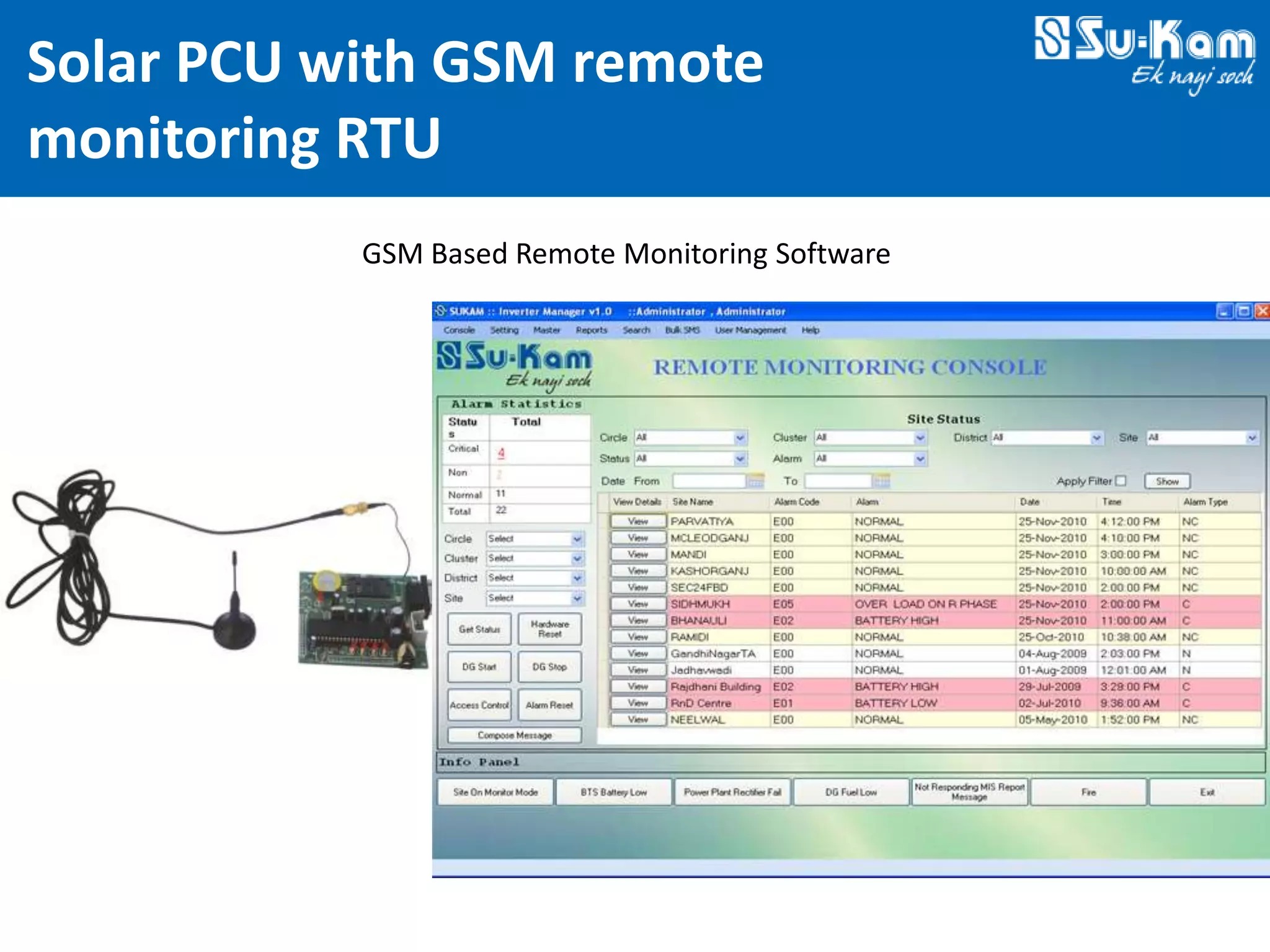
Slide 36: Charge Controller — Field Economics
This companion slide translates MPPT into rupees saved per month — the only language that closes a rural sale. Technovation is not only lab awards; it is ROI on a receipt.
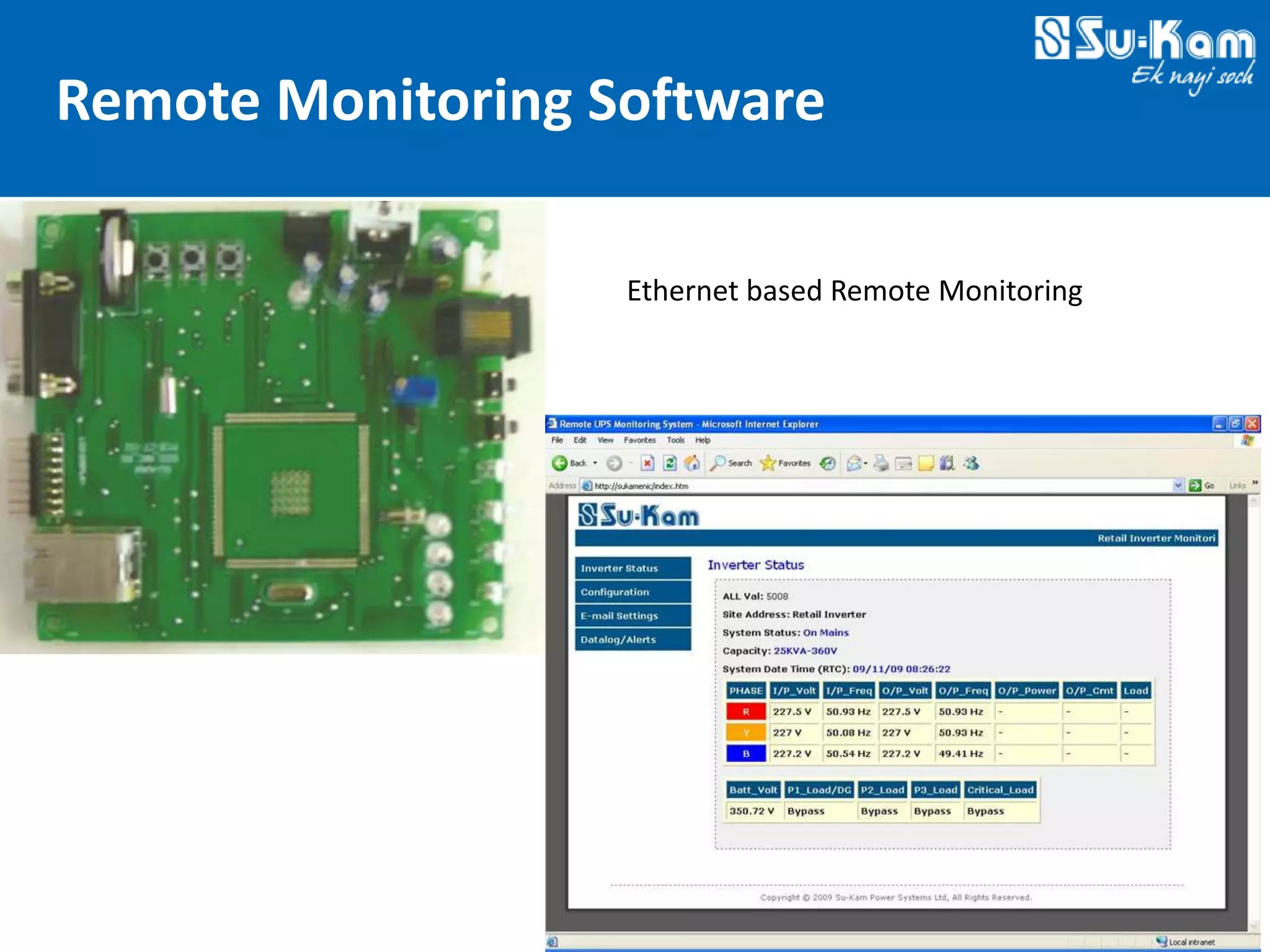
Slide 37: Solar Pump & Rural Applications
Solar pumping slides connected our world to agriculture — water when the sun shines, less diesel, less labour. The same MNRE partner badge on slide 2 becomes real here on the ground.
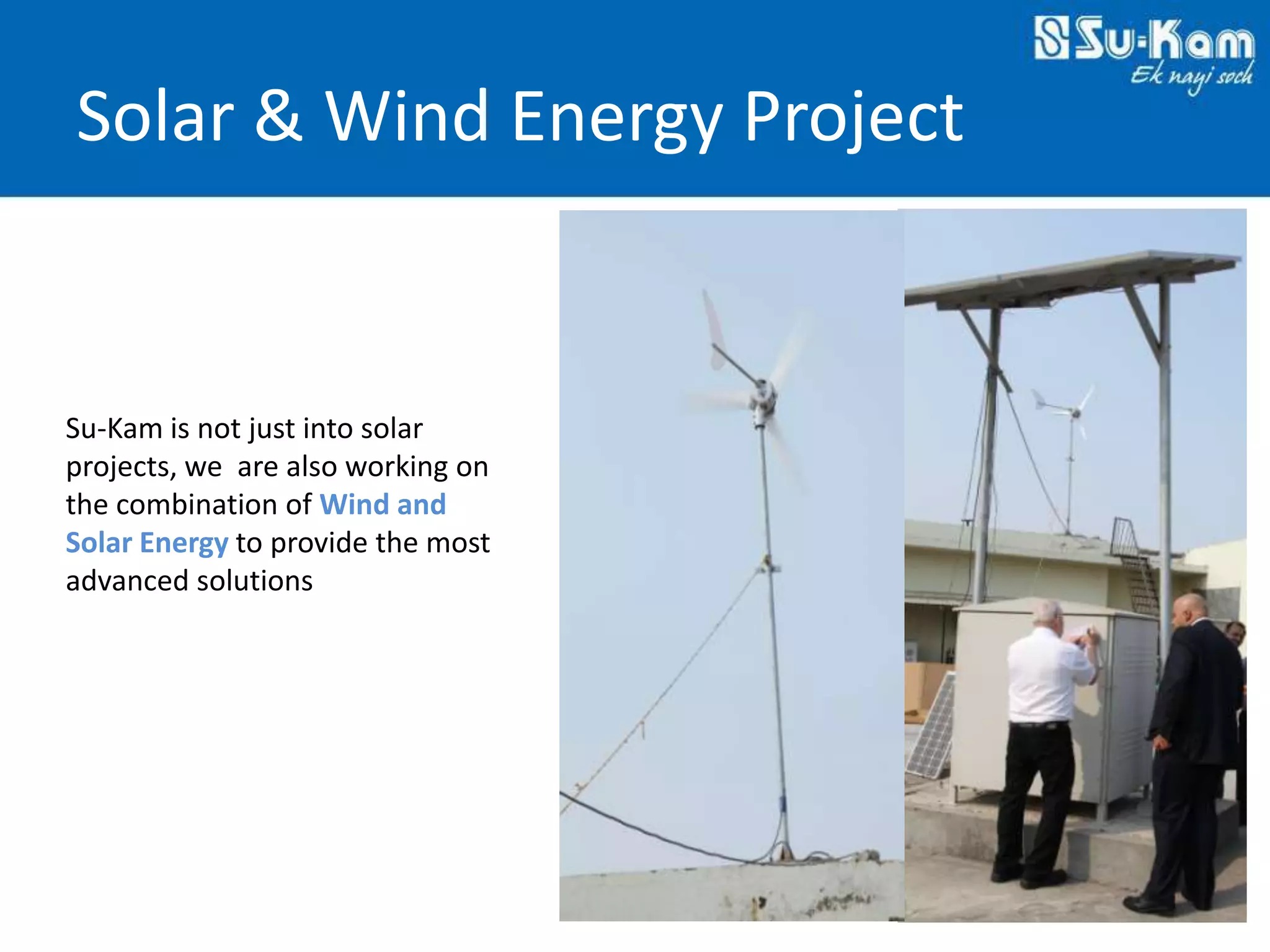
Slide 38: Solar & Wind Hybrid Project
Hybrid renewable projects were our bet on Indian diversity of resource — sun in Rajasthan, wind in coastal corridors, both unpredictable alone. This slide shows integrated thinking before storage economics made hybrids fashionable everywhere.
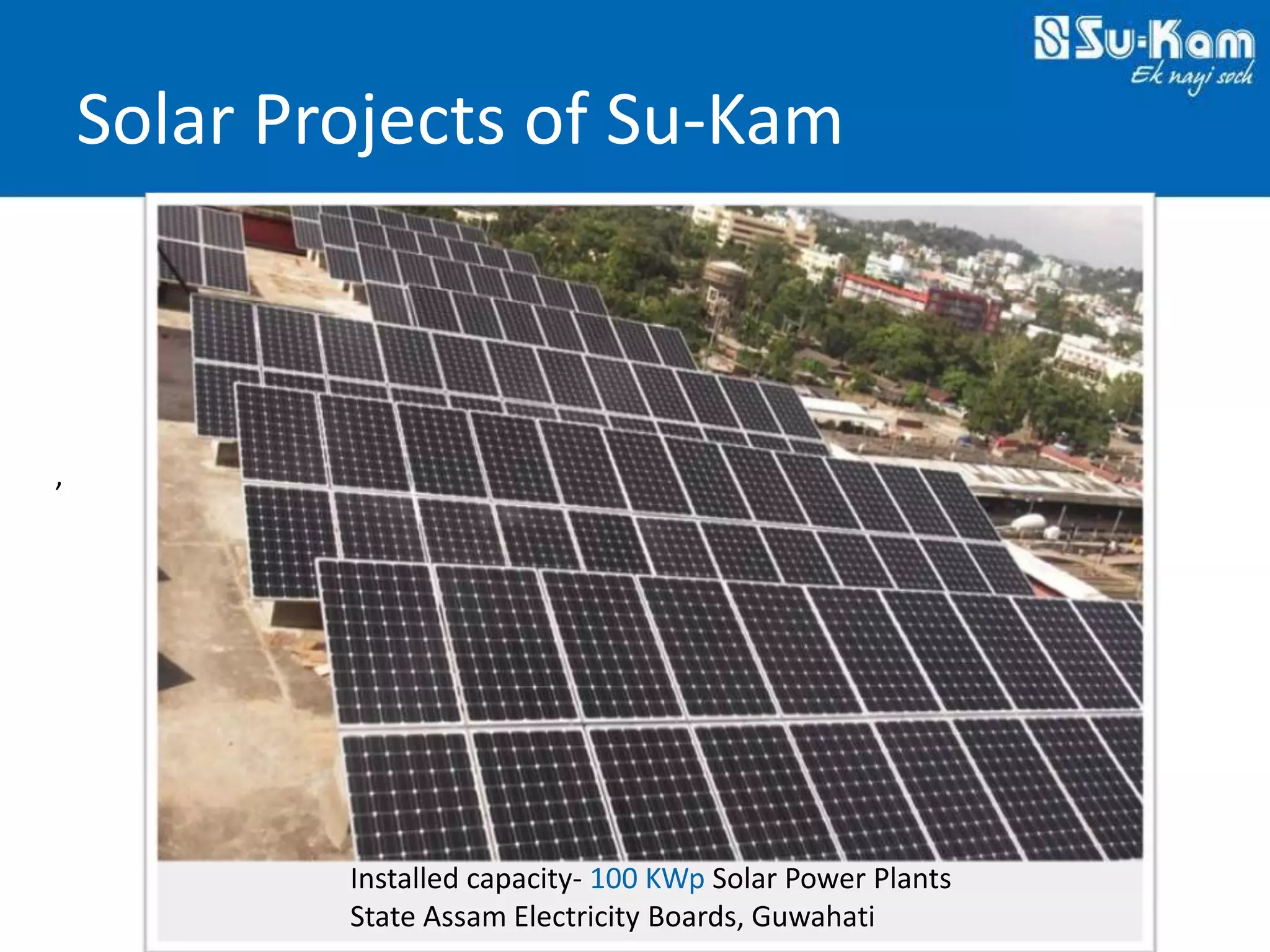
Slide 39: Hybrid System — Architecture
The architecture slide is for engineers auditing us — charge paths, failover, monitoring. I insisted our corporate decks include one slide the technical buyer could photograph and email to HQ.
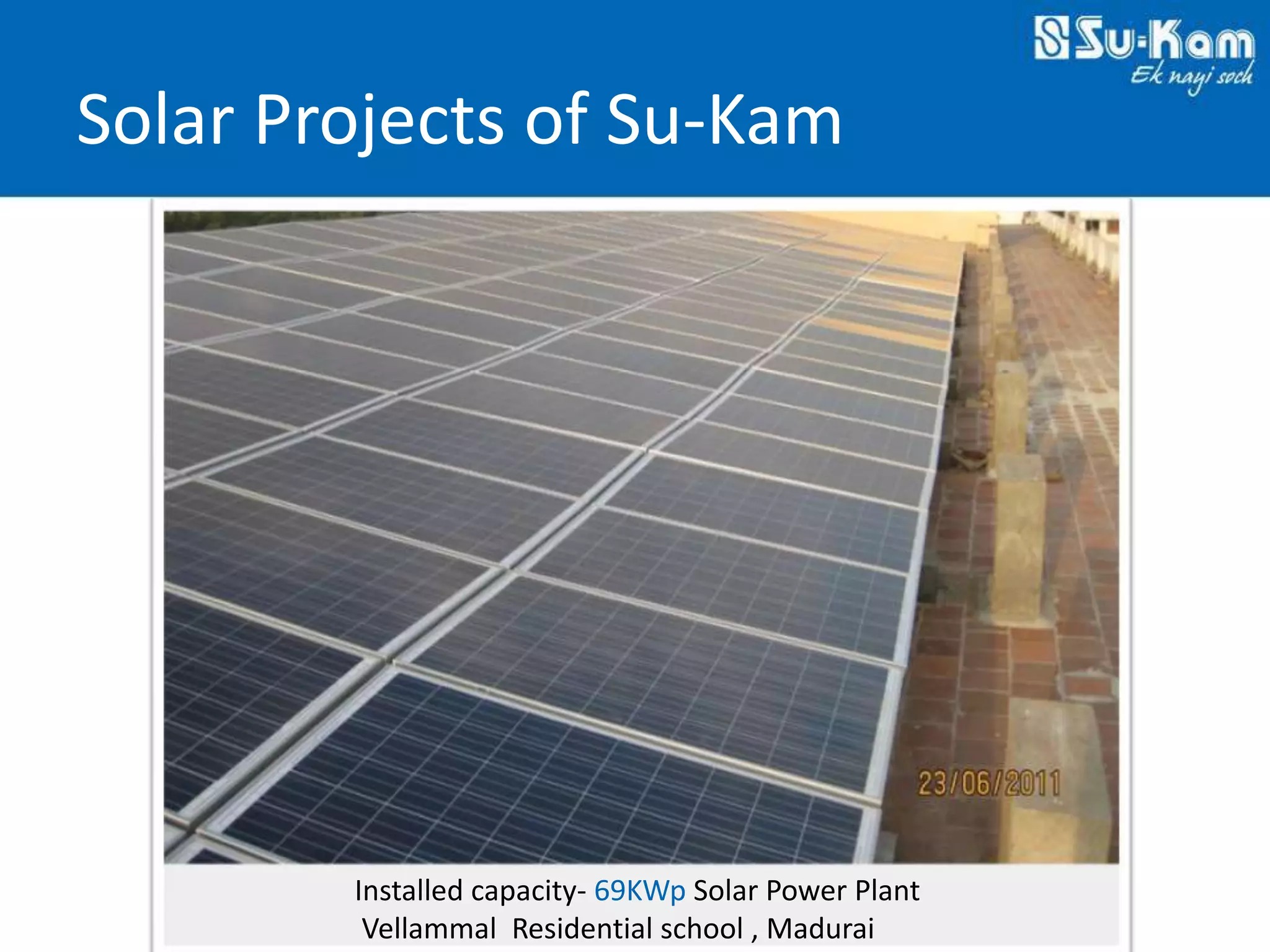
Slide 40: Vellammal School Madurai — 69 kWp, June 2011
Vellammal School, Madurai — 69 kWp, commissioned June 2011. Children under solar-lit classrooms; a school board that treated energy as infrastructure, not decoration. Installations like this are why the ISA award on slide 2 has a face.
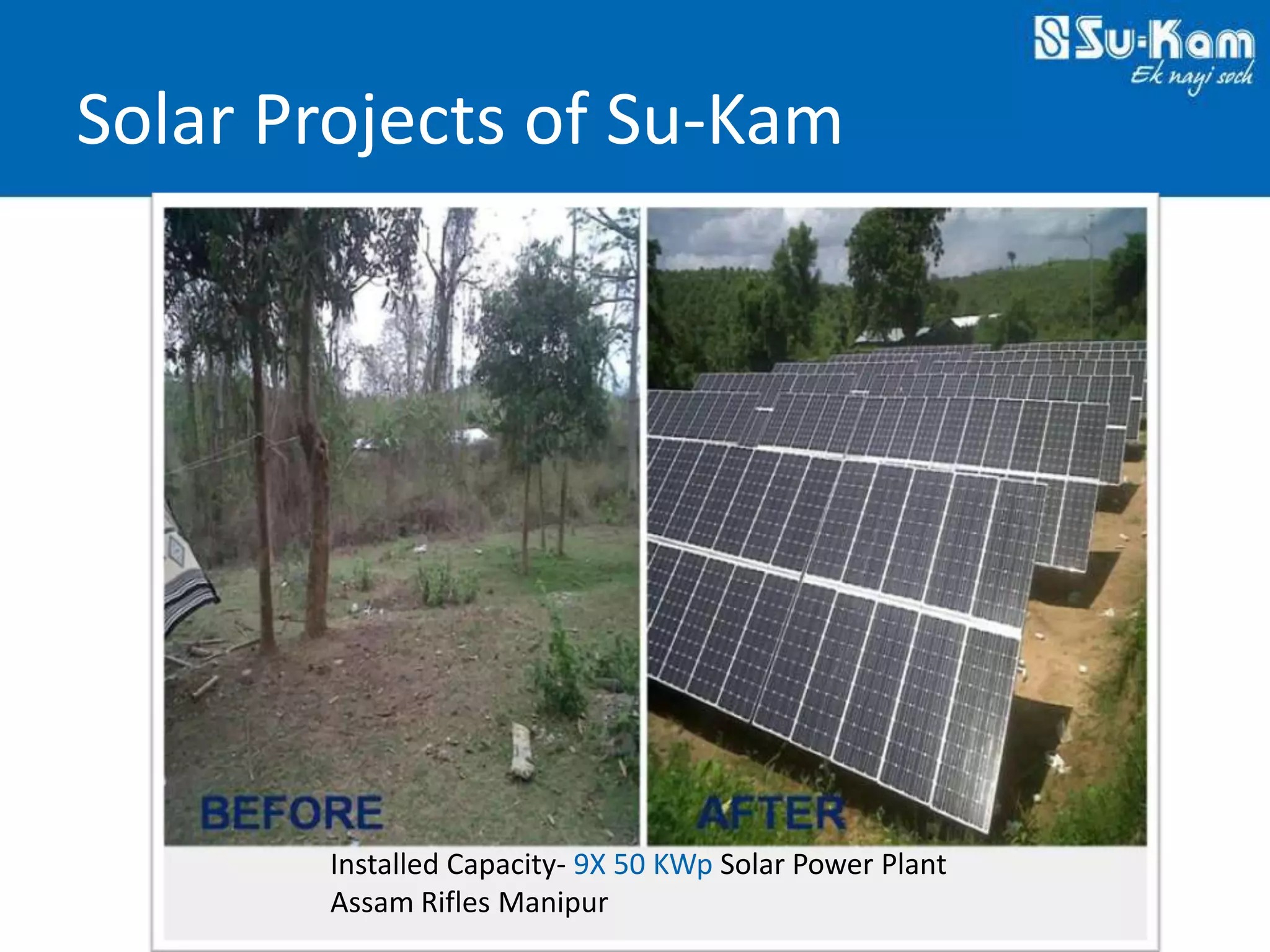
Slide 41: Assam Rifles Manipur — 9×50 kWp Before/After
Assam Rifles, Manipur — nine sites, 50 kWp each. The before/after photos do not need captions. Security forces at remote posts, diesel logistics painful, sun abundant. We sent teams where tourism decks never go. This is the same border ethos I later wrote about for BSF solar posts.
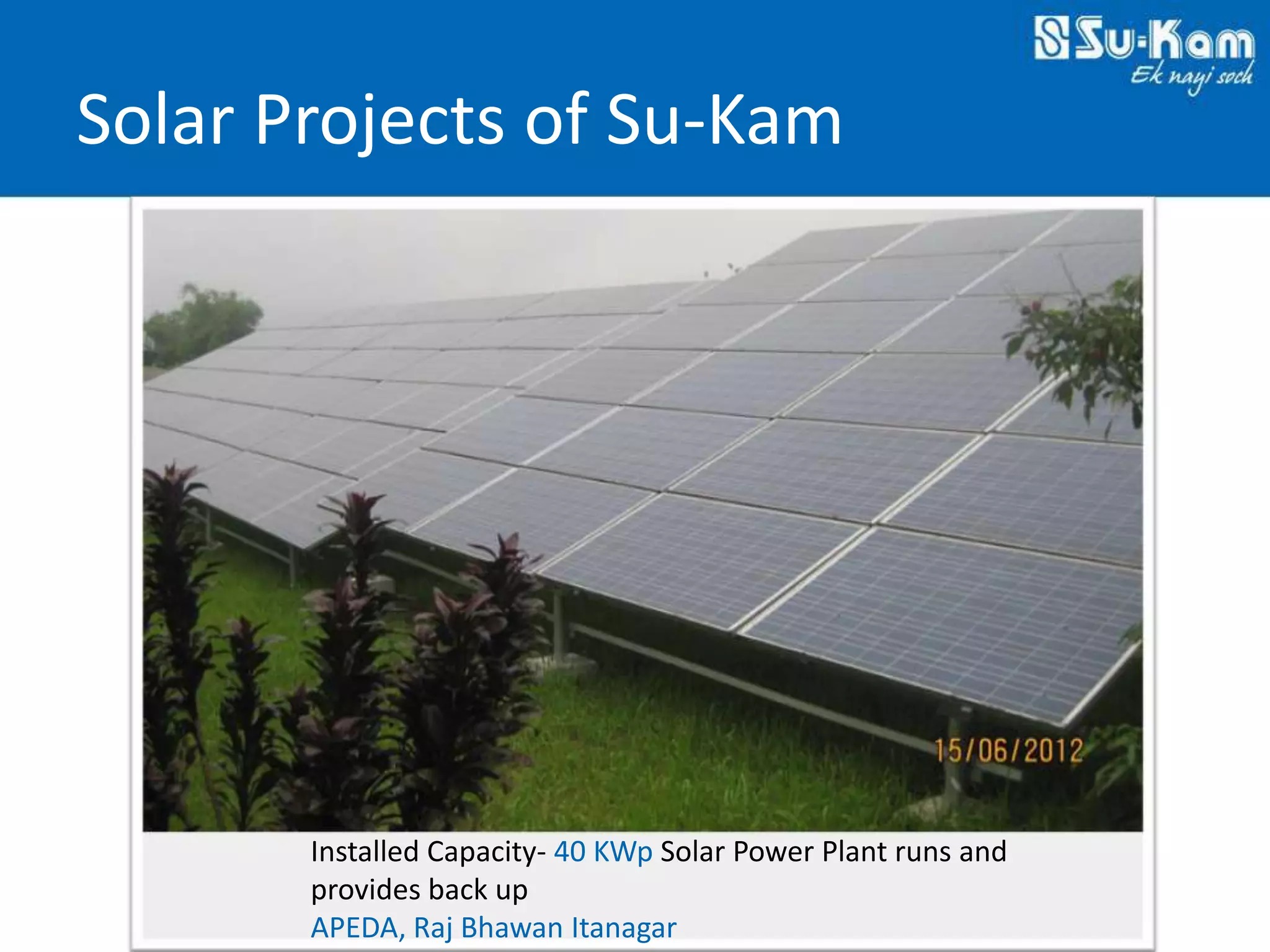
Slide 42: Defence & Institutional Solar — Reliability Spec
This slide documents specification-grade reliability — not residential softness. Defence buyers ask what happens at 45°C and when the battery is abused. We answered with data, not brochures.
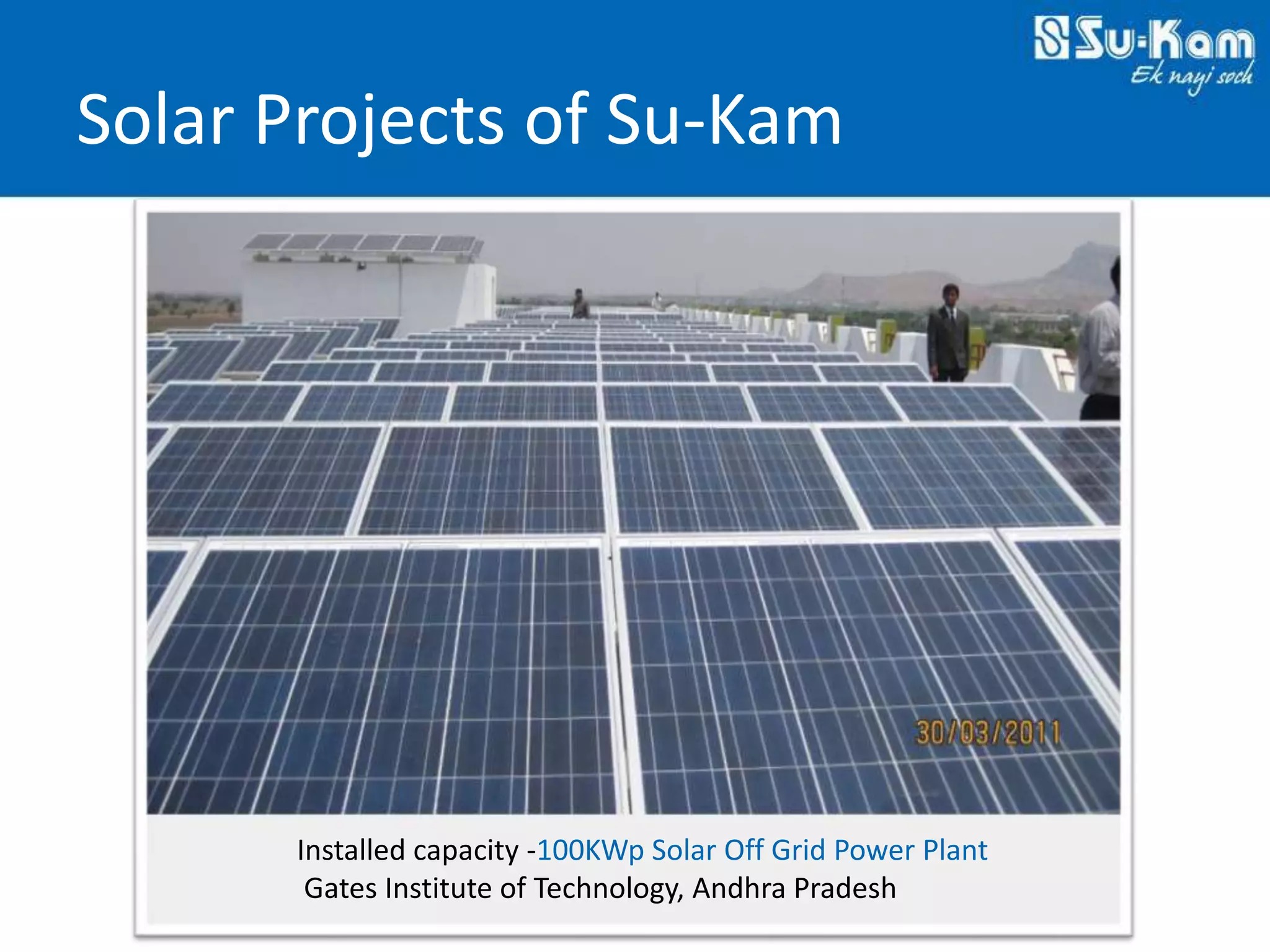
Slide 43: Institutional Reference List
A reference collage of schools, offices, and public buildings — social proof for procurement officers. By 2012 the list was long enough to need its own slide; that itself was the milestone.
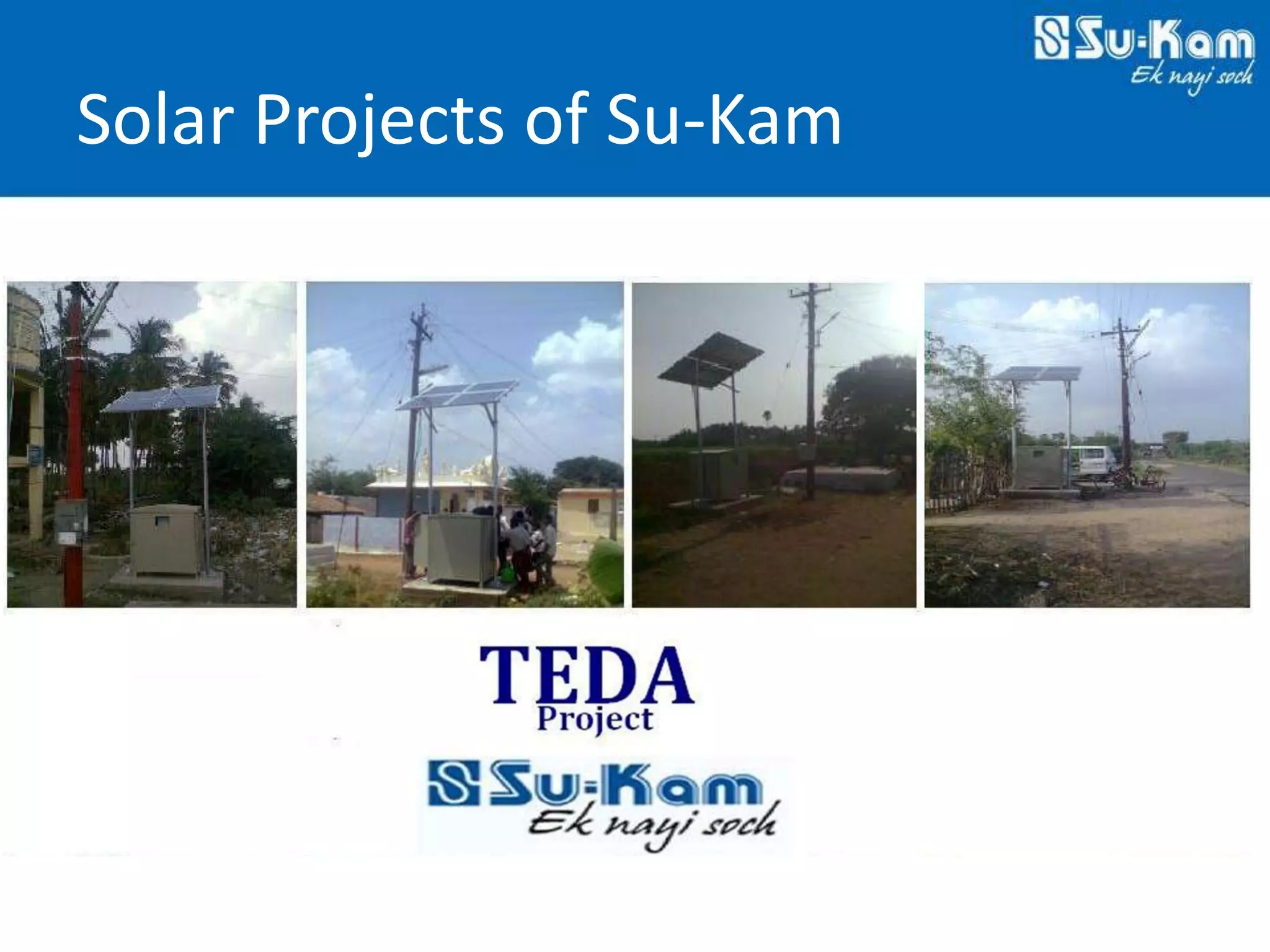
Slide 44: Eastern & North-East Deployments
Geography as strategy — North-East deployments where grid weakness made solar the primary plan, not the green optional extra. I am proud this deck gives the region visible space; too many corporate stories stay Delhi-Mumbai.
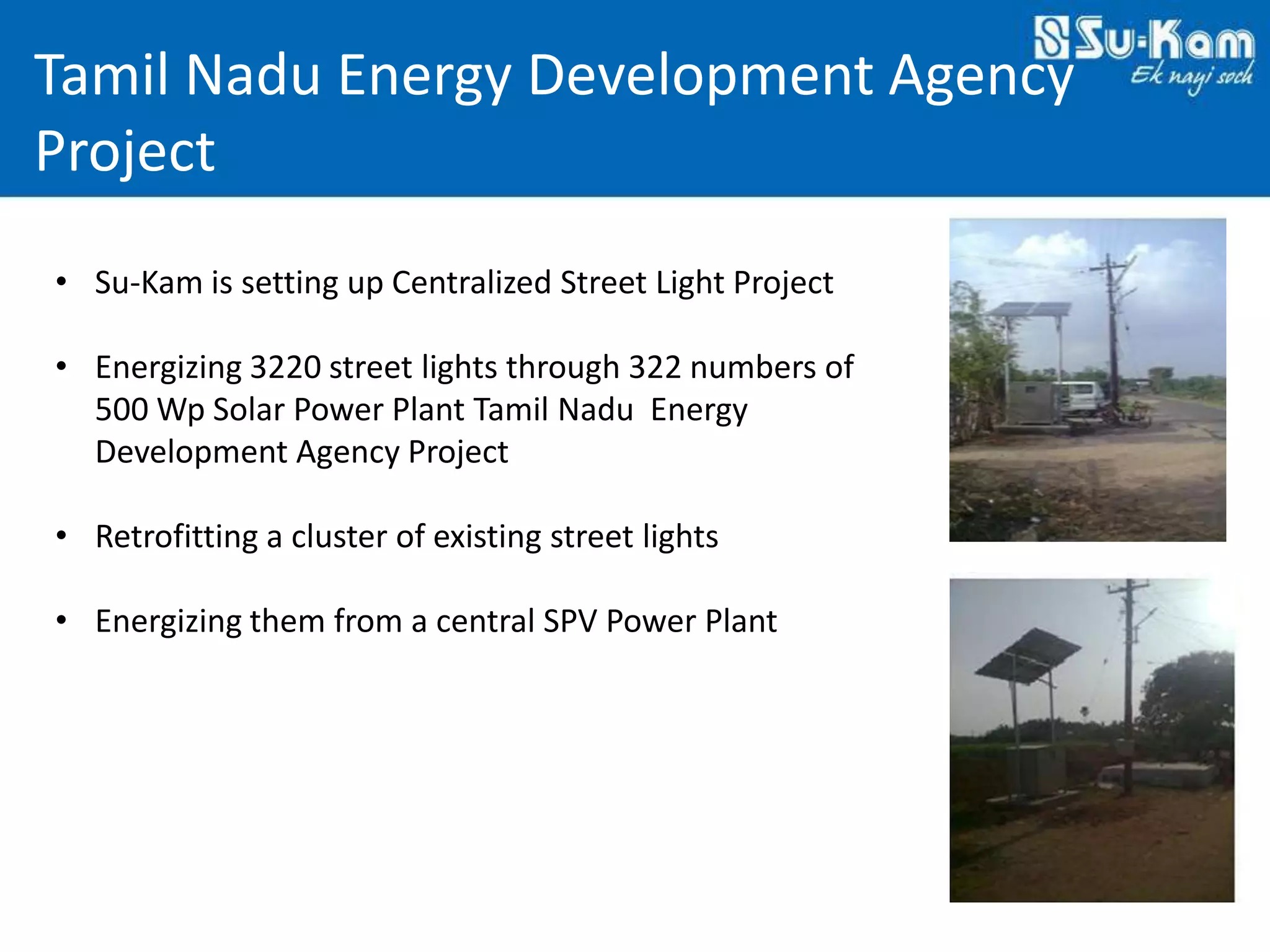
Slide 45: TEDA Tamil Nadu — 3,220 Street Lights
TEDA Tamil Nadu — 3,220 street lights. Municipal scale solar is unglamorous and essential. Each pole is a contract, a civil works problem, a maintenance schedule. This slide is Su-Kam as public infrastructure vendor, not gadget maker.
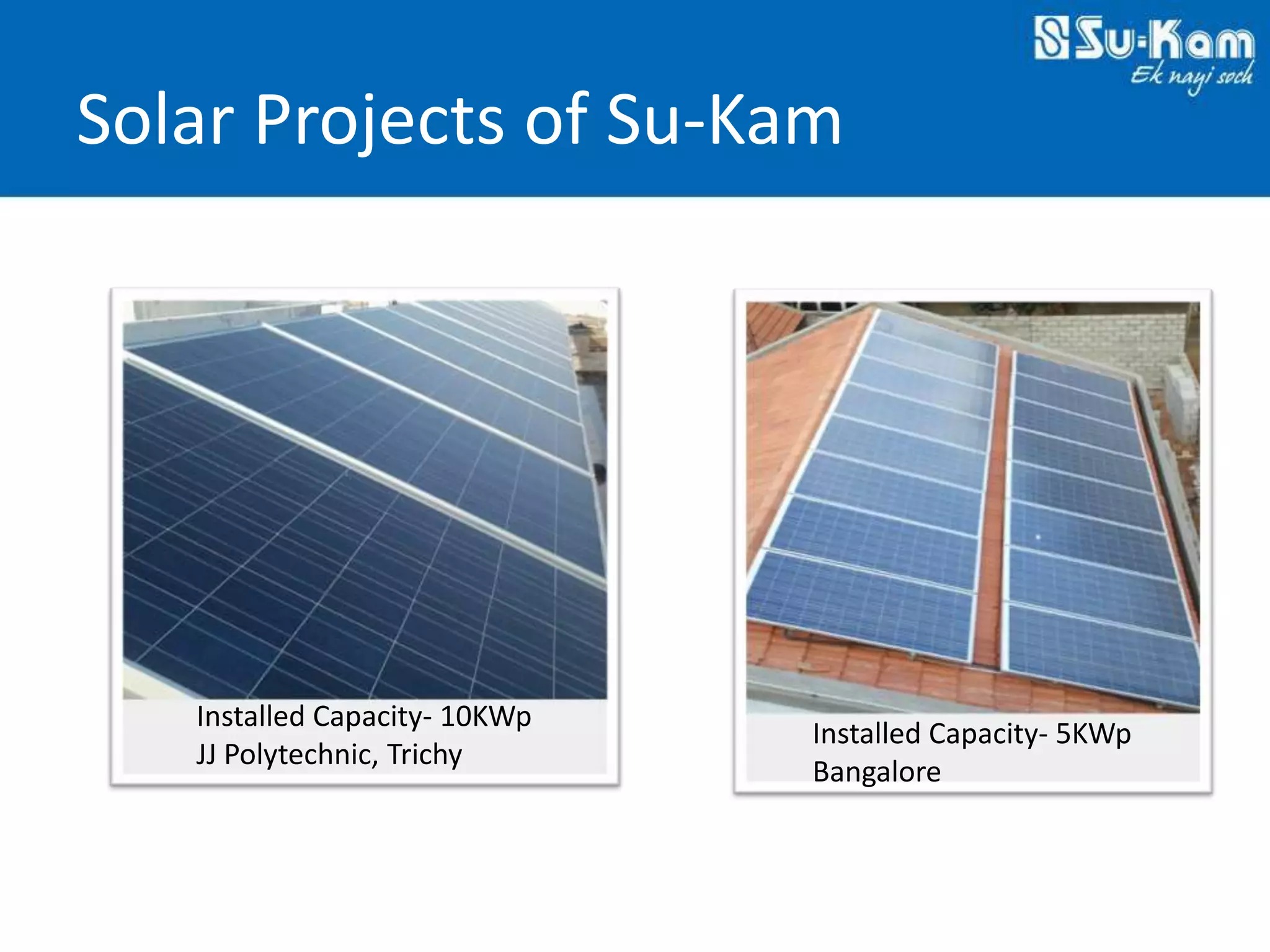
Slide 46: Street Lighting — System Diagram
The diagram slide explains how thousands of poles stay synchronised — controllers, timers, battery sizing for monsoon weeks. Dealers who mastered street lighting became a different species from home UPS sellers; we trained both.
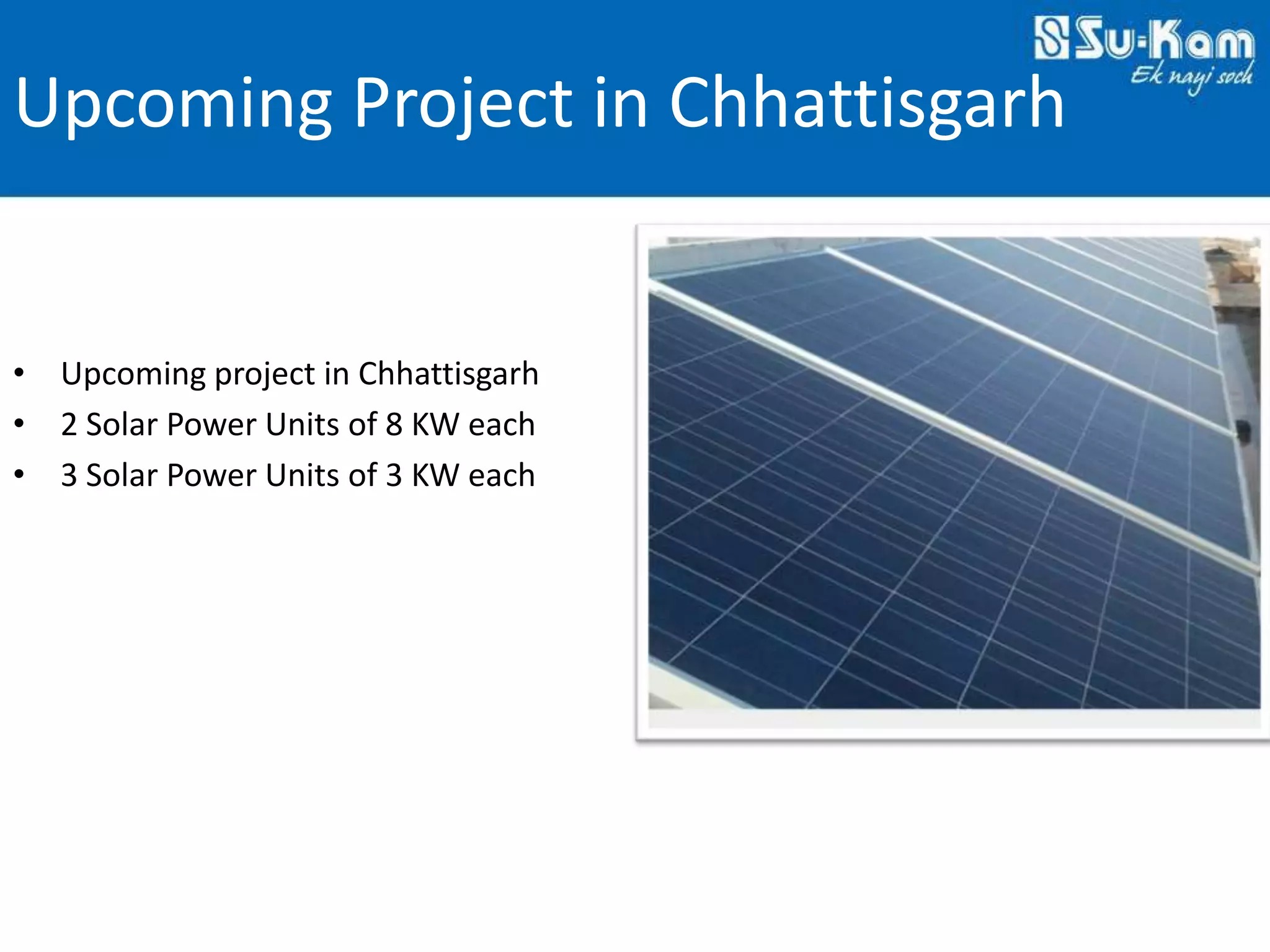
Slide 47: Chhattisgarh — Upcoming Solar Programme
The deck closes looking forward — Chhattisgarh upcoming solar programme. In 2012 it was pipeline; today it reads as prophecy of state-level renewable appetite. I end this blog the same way: the story continues in the Su-Kam legacy and in awards earned along the way — even though my founder chapter closed in 2018.
I did not write this because SlideShare needs traffic. I wrote it because these slides are primary sources — dated 15 November 2012, uploaded while I was still building Su-Kam daily. They show an Indian company treating innovation as a portfolio: consumer, rural, telecom, retail, medical, defence, municipal solar. That portfolio thinking is what I later summarised in the Su-Kam legacy and what the industry acknowledged in awards collected over decades — see Kunwer Sachdev awards.
Compare eras: Chandigarh 2011 was me speaking. Technovations 2012 was the company showing. Both are true. Both belong to the same chapter — 1988 to 2018 — when I was founder and driving force. After 2018 I am not associated with Su-Kam in any capacity; these images and stories are historical record, not current endorsement.
If you are building hardware in India today, study these slides not for nostalgia but for scope. The winner did not pick one segment. The winner built platforms — MOSFET, sine wave, PCU, hybrid — and let applications attach like tractor charging and dentist chairs.
Technovations at Su-Kam · November 2012
🔗 Founder stories — read the series
- 📖 Marriott Chandigarh 2011 — Innovation & R&D Talk
- 📖 CE Mark & Intersolar Munich 2011
- 📖 Exporting Inverters to China
- 📖 BSF Border Solar Posts
- 📖 Why I Started the Su-Kam YouTube Channel
- 📖 Solar PCU Invented in 2005
- 📖 India’s First 3-Phase Solar System in 2006
- 📖 Baddi Factory & Tubular Gel Battery
- 📖 Kashmir Shikaras — Floating Billboards of Hope
- 📖 Brainy Eco Solar Hybrid PCU
- 📖 Colossal Solar PCU — Inverter to Power Plant
- 📖 0% Chinese Share in Inverters — India’s Pride
- 📖 My Story — Twelve Chapters on SolarManOfIndia.com
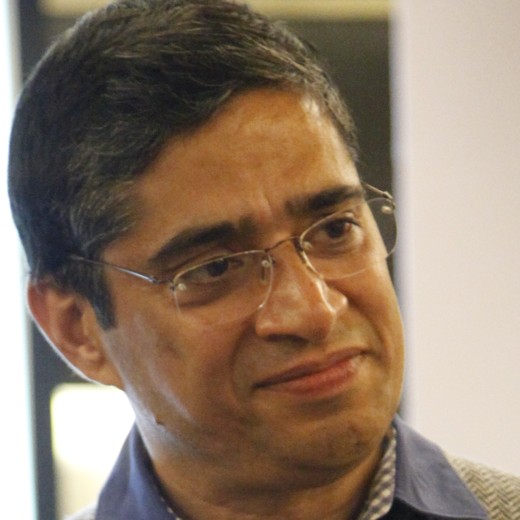
Kunwer Sachdev
Founder, Su-Kam Power Systems (1988–2019) and Kunwwer.ai, mentor at Su-vastika — the “Inverter Man of India” and the “Solar Man of India.” Read his story →
Sources: Primary slides from Technovations at Su-Kam on SlideShare (15 November 2012) — uploaded by Su-Kam staff. Related founder narrative: Marriott Chandigarh 2011 talk. All slide images hosted permanently on kunwersachdev.com.