When Su-Kam Worked to Export Indian Inverters Into China
The Headline Was One Line. The Work Was Two Years. And the Story Still Gets Glossed Over.
Exporting Indian inverters into China — when everyone else was defending against Chinese imports
This is a story I want to tell properly because it gets glossed over in most coverage of Su-Kam. People remember the headline. They do not remember the flights, the sample boxes, the solar team I was building at the same time, or the marriage that was falling apart while I was trying to sell Indian inverters on the factory floor that was supposed to own the world.
The Reverse Bet
In the mid-2000s, the manufacturing conversation in India had turned defensive. Electronics companies were fighting to survive against cheaper Chinese imports. Distributors were bringing inverters into India from factories abroad. The logic was everywhere: China is the factory of the world. Power backup was their category to lose, not ours to win. Su-Kam decided to do the opposite — even as Economic Times coverage of Chinese solar imports later showed how fiercely India would defend its home market.
We were convinced India had built something genuinely better — products engineered for heat, voltage fluctuation, and long backup hours. The only honest test was to show up and put them in front of Chinese buyers. So while the rest of the industry defended its home market, Su-Kam worked to export Indian inverters into China. That reversal was deliberate — and exhausting.
China Was My Personal Target
By then we were already selling across Africa, the Middle East, and South East Asia as our technology matured to international standards — the same export engine The Hindu BusinessLine would later describe as a major growth bet. But China was my personal target — the market I most wanted to crack, because if Indian inverters could earn respect on the factory floor that was supposed to own the category, that would mean something beyond revenue. The CE mark from Det Norske Veritas, which I write about in When Su-Kam Got the CE Mark, was part of that same global-quality discipline.
I was travelling constantly — inside India and outside the country — while building the solar megawatt project team, because I could see the opportunity for solar spreading across India. I tell that factory expansion in Building the Empire — Six Factories. China was the personal target. Solar was the next frontier. Both demanded the same thing: show up in person, again and again.
Exhibition Floors in China and Hong Kong
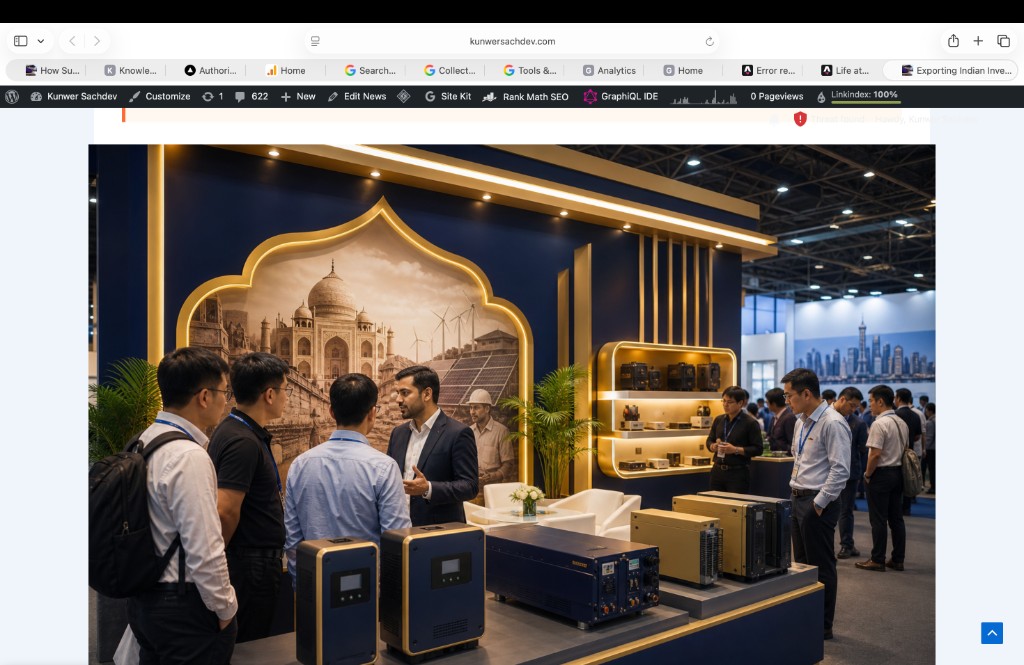
We travelled to exhibitions in China and Hong Kong — long flights, heavy sample boxes, and conversations in a language we did not speak. Walking those halls, we were the only Indian inverter brand on those exhibition floors. India was still largely seen as an import market for power electronics. We were there as exhibitors, with products made in our own factories.
Two years of effort before a one-line headline
The only Indian inverter brand on China and Hong Kong exhibition floors
The Chinese distributors were curious. Many had been selling to India for years. We had to persuade them to import from India — live demonstrations, warranty conversations, sample units left for testing, and return visits that cost time we did not have in surplus. I remember standing at booths like the one above, explaining Indian engineering through translators, believing that if we could earn respect here, everything we had built at home would mean more.
The Marriage Ended in the Same Years I Chased China
I need to say this plainly, because the business press never will. During the same period I was flying to China and Hong Kong, building the solar megawatt project team, opening Africa and the Middle East, and travelling constantly inside India, my marriage was ending. The divorce with my ex-wife did not happen in a neat chapter after the export story. It unfolded in parallel — in the same calendar, in the same exhaustion, in the same years when I was most visible as a founder and least present as a husband.
There is a particular loneliness in that kind of life. You land after a long flight with sample units in your luggage, walk into an exhibition hall where you are the only Indian inverter manufacturer on the floor, and for a few hours you feel like you are carrying the country on your shoulders. Then you fly home, and the home you return to is no longer whole. You cannot give a distributor in Guangzhou the follow-up he deserves and also give your marriage the repair it needed. I tried to do both. I failed at both, in different ways.
“The headline made it sound like we had arrived. In truth, I was arriving in airports while my personal life was departing. China was the market I wanted most. It was also the market I could not stay long enough to win — not only because the company pulled me everywhere, but because the years when that door opened were the same years my marriage closed.”
I do not say this for sympathy. Founders are not owed sympathy for the cost of ambition. I say it because it is part of the truth. Most Su-Kam coverage treats the China export as a clever strategic reversal — India exporting into the factory of the world. That is true. But it is not the whole story. The whole story includes a man who was building an empire, seeing solar opportunity across every state in India, and watching his marriage break apart at the same time — and who, because of that divided life, could not finish what he had started in China.
The Headline — and What It Left Out
Eventually, The Economic Times carried a one-line headline — “Su-Kam to export inverters to China” — and for most readers that was the end of the story. For us, it was the conclusion of two years of effort and a small but real demonstration that Indian engineering could compete on the world’s hardest factory floor.
It was not Africa-scale volume. But it was honest proof that a category India was supposed to import could travel the other direction — the same export philosophy that later produced the CE mark and the European exhibition push. News18’s profile of my journey later described Su-Kam as the first company in the power industry to initiate exports to international markets. In an interview with pv magazine, I would say plainly that Chinese products had not cracked the Indian power-backup market the way they had in other categories. Contemporary coverage from the same period — including The Economic Times and Business Standard — tracked how aggressively we were opening export markets abroad.
Where I Failed — China and Everything Else at Once
I could not fulfill the dream of truly cracking China — not in the way I had imagined when I first stood on those exhibition floors. We had opened a door. The headline had appeared. Distributors had been curious. But the sustained focus a market like China demands — repeated visits, local partners, engineering support on the ground, patience measured in years — was something I did not protect.
The reason is not only that I was spread across factories, patents, Africa, solar megawatts, and India’s domestic market. It is also that my personal life was collapsing in the same window. A divorce does not schedule itself around export strategy. It takes emotional bandwidth you cannot fake in a boardroom or replace with a strong week in Hong Kong. I was building Su-Kam at a speed that required all of me. My marriage needed a version of me I could not offer while I was everywhere else.
The China export story in most Su-Kam coverage stops at the headline. It does not mention the solar team I was building, the constant travel across India and abroad, or a marriage ending in the same years. It does not mention that the founder who opened the door could not stay long enough to walk through it — because the same years that made Su-Kam visible abroad made my personal life invisible at home. That is a failure I carry. Not the attempt. The follow-through.
Su-Kam would go on to export to more than ninety countries. China remained the market I wanted most and held least — the personal target I set when the world said it was impossible, and the unfinished chapter I still think about when I read that one-line headline. The effort was not wasted. But it was not finished. And part of why it was not finished is a human story the business pages never printed.
What I Learned
Opening a market and holding a market are two different skills — a lesson I learned again in Munich and in every export conversation where a distributor asked whether the founder would still be there in eighteen months. The China effort taught me that engineering conviction must be tested where the world is hardest on you. It also taught me that personal cost is real — that building at speed while your life is breaking apart is not a montage.
The fuller arc is in My Story. This chapter is smaller. But it mattered to me. And it deserved to be told without gloss.
🔗 Founder stories — read the series
- 📖 Marriott Chandigarh 2011 — Innovation & R&D Talk
- 📖 Technovations at Su-Kam 2012 — SlideShare Deck
- 📖 CE Mark & Intersolar Munich 2011
- 📖 BSF Border Solar Posts
- 📖 Why I Started the Su-Kam YouTube Channel
- 📖 Solar PCU Invented in 2005
- 📖 India’s First 3-Phase Solar System in 2006
- 📖 Baddi Factory & Tubular Gel Battery
- 📖 Kashmir Shikaras — Floating Billboards of Hope
- 📖 Brainy Eco Solar Hybrid PCU
- 📖 Colossal Solar PCU — Inverter to Power Plant
- 📖 0% Chinese Share in Inverters — India’s Pride
- 📖 My Story — Twelve Chapters on SolarManOfIndia.com
Founder of Su-Kam and Kunwwer.ai, and mentor at Su-vastika and several other companies — the “Inverter Man of India” and the “Solar Man of India.” Read his story →
Disclaimer: It is important to note that while Mr. Kunwer Sachdev founded Su-Kam Power Systems, he is no longer associated with the company as of 2019. Any information regarding his involvement in the company’s operations, strategies, or future plans reflects his tenure prior to that date. Therefore, any discussions or analyses of Su-Kam Power Systems should be considered in the context of his past contributions and not his current association with the company.