BSF Posts at the Indo-Pak Border — Powered by Solar
My Engineers Went to the Border. Their Families Were Terrified. I Had to Look Them in the Eye.
BSF border solar — Solar on BSF outposts in Rajasthan — where small firing across the line was part of the air
This is not a corporate case study. It is a story about sending ordinary men — electricians, technicians, field engineers — to one of the most tense stretches of land in India, while their wives and mothers called my office asking whether their sons and husbands would come back. It is about a border where small firing happened often enough that everyone stopped pretending it was unusual. And it is about why I believed solar power at those posts was worth that risk.
Why the BSF Called — and Why I Said Yes
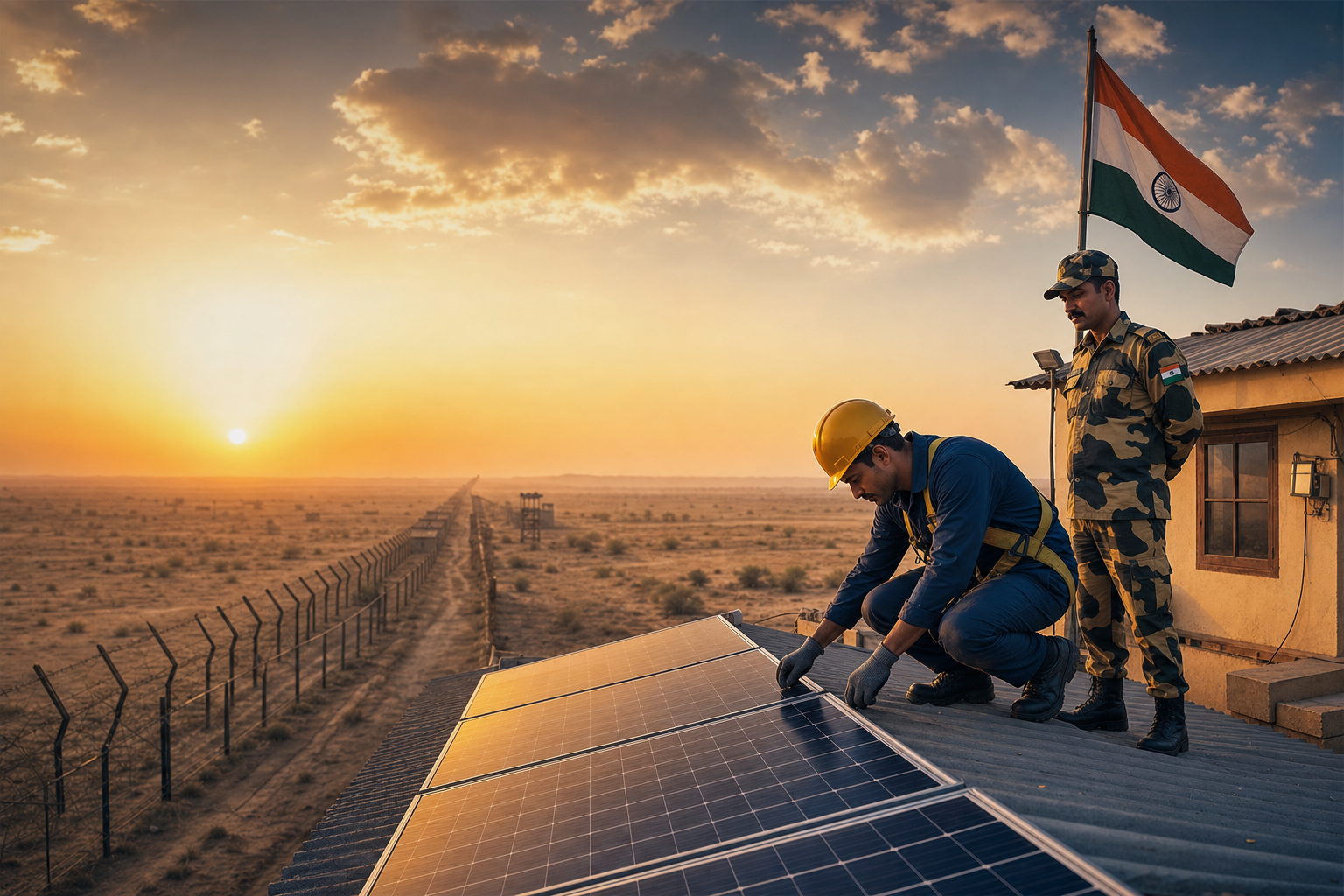
Along the Indo-Pak border in Sri Ganganagar district, Rajasthan, BSF front posts sat in geography that refused to cooperate. Far from habitation. No reliable grid. Harsh desert heat by day, cold at night, dust that eats electronics alive. The jawans who guard that line needed light, fans, and charged communication gear — not as comfort, but as operational necessity. Before solar, many had to walk four to five kilometres back to base camps just to recharge wireless sets and mobile phones. Surveillance does not pause because a battery is dead.
Diesel generators were the old answer — noisy, polluting, dependent on fuel convoys that themselves become a logistics and security problem. The BSF needed something silent, dependable, and maintainable on the ground. They needed solar. ET Energyworld reported the rollout as a first-of-its-kind initiative: each post fitted with a 1.5 kilowatt solar system — Su-Kam’s Brainy Eco inverter, 500-watt panels, and batteries sized to carry the post through the night. Lights. Two or three fans. Charged radios. Power where the grid had never come.
When the project came to Su-Kam, I did not see a tender to win. I saw men who stand on a hostile line so the rest of the country can sleep. I said yes because if our solar systems could work anywhere, they had to work there — at the edge of the nation.
The Border Is Not a Normal Job Site
People who have never been near an active international border imagine it as a line on a map. It is not. It is a soundscape. Watchtowers. Fence wire. Wind across empty desert. And always — always — the possibility of tension. In those years, small firing across the border was not a rare emergency. It was background. Something that could flare in the afternoon and settle by evening, or not. You learned to listen differently. You learned that every installation trip had to be planned around more than weather and material lists.
Sending Su-Kam employees to work there was not like sending them to install a home inverter in Gurgaon. These were young technicians and field engineers with families. Wives called the office. Mothers came to see me. Fathers asked direct questions: Why does my son have to go there? Can you not send someone else? What happens if something happens? I understood every question. I would have asked the same ones if it were my child.
1.5 kW of solar at each post — so a jawan never walks five kilometres to charge a radio again
Brainy Eco inverter · 500W panels · batteries for after sunset
I Gave the Assurances Personally
I did not delegate those conversations to HR. I sat with families in my office and on phone calls that went long past working hours. I told them what we would do: travel only with BSF coordination, work during approved windows, withdraw when the situation demanded, daily check-ins, no heroics. I told them — and I meant it — that I would not ask anyone to take a risk I was not willing to stand behind myself.
That is why I went to the border personally, more than once. Not for a photo. To see the posts, to understand the dust and heat that kills inverters, to shake hands with jawans who live without the things city people treat as automatic. When your team is working within earshot of a fence line where incidents happen, presence matters more than a project plan. The men needed to know their founder was not watching from a spreadsheet in Gurgaon. The BSF needed to know the company would not disappear after the press release. MediaInfoline and EQ Mag Pro quoted my line at the time: our jawans work relentlessly to keep us safe — a 24×7 power supply is a necessity for them, not a luxury.
“A wife asked me plainly: ‘Will he come back?’ I could not promise the border would be quiet. Nobody can. I could promise we would not treat her husband as expendable — that every safety protocol BSF gave us would be followed, that I would pick up the phone myself if fear crept in, and that the work would stop the moment the uniformed men on the ground said stop.”
What the Installations Demanded
Engineering at a border post is unforgiving. Panels must sit secure in wind that never rests. Batteries must survive temperature swings that would wreck consumer-grade storage. Inverters must run silently — because sound carries in desert air and because jawans need quiet as much as light. Every failed connection is not a service complaint; it is a jawan back to walking kilometres in the dark to charge a radio.
My team learned to work fast, clean, and without drama. BSF coordination was tight — you do not wander on an active border. Materials had to be right the first time because a return trip was never guaranteed. When an installation held through a week of heat and a night of dust storm, the feedback from the post was not a testimonial. It was a jawan plugging in a wireless set at his own table. That was the metric.
Press coverage in Rajasthan described border posts illuminated by solar for the first time. The Economic Times framed it as Su-Kam solarizing BSF front posts along the international boundary. For me, the headline was smaller and heavier: a mother stopped calling every afternoon because her son’s phone checked in on schedule.
What It Meant — and What I Carry
This project sits apart from exhibition floors in Munich or China. Nobody wrote a one-line headline about the families who were afraid. Nobody reported the meetings where I promised a mother I would treat her son’s safety as my own. The public story was solar adoption and national security. The private story was trust — between me and my employees, between Su-Kam and the BSF, between a company that makes power equipment and men who stake their lives on power being there when they need it.
I am proud of what we installed. I am proud that Indian solar worked where failure was not an option. But I do not romanticize the border. Men went there because I asked them to. Families worried because worry is love. Small firing across the line was real. This chapter is not about celebrating danger — it is about acknowledging that building an energy company is sometimes sending ordinary people into extraordinary places, and owing them the truth before they go.
The solar revolution I had been building since the 2005 Solar PCU was never only about rooftops in cities. It was about taking sunlight seriously as infrastructure — in factories, in villages, and on the nation’s edge. The BSF project proved that. Quietly. Without glamour.
What I Learned
Technology is the easier part. The harder part is human — families who trust you with someone they love, uniformed partners who trust you not to be reckless, and your own conscience when you send people toward a line where small arms fire is part of the week. Leadership at a border is not a strategy deck. It is showing up, giving assurance you intend to keep, and building systems that work so the men who live there have one less reason to walk five kilometres in the dark.
The fuller arc of building Su-Kam — factories, exports, solar teams — is in Building the Empire and My Story. This post is for the jawans who accepted our panels on their roofs, and for the families who let their sons go install them.
🔗 Founder stories — read the series
- 📖 Marriott Chandigarh 2011 — Innovation & R&D Talk
- 📖 Technovations at Su-Kam 2012 — SlideShare Deck
- 📖 CE Mark & Intersolar Munich 2011
- 📖 Exporting Inverters to China
- 📖 Why I Started the Su-Kam YouTube Channel
- 📖 Solar PCU Invented in 2005
- 📖 India’s First 3-Phase Solar System in 2006
- 📖 Baddi Factory & Tubular Gel Battery
- 📖 Kashmir Shikaras — Floating Billboards of Hope
- 📖 Brainy Eco Solar Hybrid PCU
- 📖 Colossal Solar PCU — Inverter to Power Plant
- 📖 0% Chinese Share in Inverters — India’s Pride
- 📖 My Story — Twelve Chapters on SolarManOfIndia.com
Founder of Su-Kam and Kunwwer.ai, and mentor at Su-vastika and several other companies — the “Inverter Man of India” and the “Solar Man of India.” Read his story →
You must be logged in to post a comment.