Pioneering India’s First Solar PCU in 2005
No WiFi. No Bluetooth. Just a Dedicated Computer — and a Founder Who Thought Software Was the Product.
Solar PCU 2005 — India’s hybrid Solar PCU, 2005 — monitoring before the market knew it wanted to see
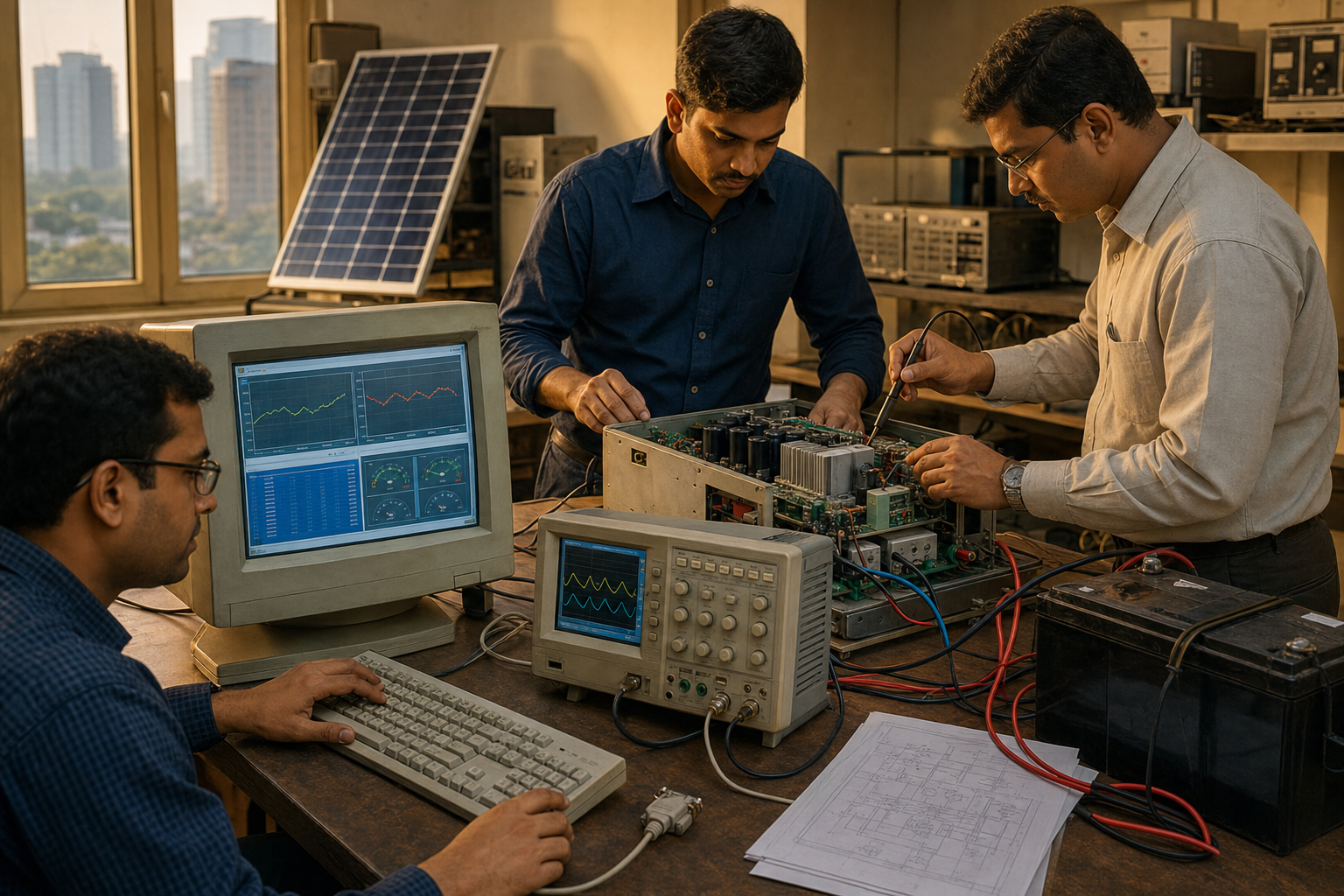
In 2005, solar in India was still a conversation for engineers, not households. Dealers wanted inverters that sold — metal boxes, familiar numbers, easy commissions. I wanted something harder: a Power Conditioning Unit that did not just convert power, but showed you what it was doing — voltage, current, battery state, grid activity — on a computer screen, in real time. There was no WiFi. There was no Bluetooth. There was not even a culture of caring. But for me, data monitoring was always on top of my mind.
Explore solar category firsts at https://solarmanofindia.com and energy storage technology at https://lithiuminverter.in.
For founders seeking AI legal diagnostics and business co-pilots, explore Legal Shield on https://kunwwer.ai/.
The Mindset of Those Days — Hardware Was “Boring”
Let me describe the market honestly. In the mid-2000s, power backup was a hardware game. Bigger transformer. Louder claim. Cheaper price. Nobody in the trade got excited about monitoring software. Nobody asked for a dedicated PC at the installation site. Distributors would say: Sir, customer ko box chahiye. Software kaun dekhega? Rival companies were not racing to launch new architectures every year — they were racing to copy the last successful enclosure.
I saw it differently. Hardware without visibility is faith, not engineering. If a solar PCU is charging from the sun, drawing from the grid, and feeding a home through outages, the owner should see that logic — not pray that it works. So when we built India’s hybrid Solar PCU in 2005, we integrated four things that belonged together: solar charge controller, PWM-based inverter (dsPIC inside), grid charger, and PC-based monitoring software that logged what the system was doing and stored it on the computer running the suite.
Solar PCU, 2005 — charge controller + inverter + grid charger + PC monitoring
Before WiFi · Before Bluetooth · You needed a dedicated computer to run it
What We Actually Built — and What It Cost My R&D Team
This was not a slide-deck innovation. My R&D engineers in Gurgaon were writing firmware for harsh Indian grids while simultaneously building a Windows-era monitoring layer that could talk to the unit, pull parameters every few seconds, and persist them locally — because cloud was not a word we could use. No phone app. No wireless pairing. RS-232 discipline. Cables. A PC that had to stay on if you wanted history. My team worked nights on problems no competitor bothered to name.
I remember the emotional texture of those years. The boys in R&D believed in the vision because I believed in it loudly enough — but they also carried the frustration of an industry that kept saying yeh sab extra hai. Extra cost. Extra training. Extra service call when the software misbehaved. They would bring working prototypes to my office, exhausted, and I would send them back to simplify the installer experience without gutting the data. That push-pull — founder conviction versus market impatience — is what forged the product.
“Everyone wanted the inverter box. I wanted the graph on the screen. In 2005 that made me look obsessed. Twenty years later it looks obvious. The difference is not intelligence — it is willingness to build what the market has not yet asked for.”
Intelligent Charging — Not Just Conversion
The PCU was designed to draw from solar or grid based on what was available — switching intelligently so backup never felt like a gamble. When battery voltage dropped, grid support came in; when solar returned, the system favoured the sun again. That behaviour is standard language now. In 2005 it was handwritten logic in firmware and software together, tested on oscilloscopes and on the monitoring screen side by side.
Years later, when journalists asked what a Solar PCU is, I could point to the integrated definition we had lived by from the start — as pv magazine quoted in 2018: solar charge controller, inverter, and grid charger in one system, continuously monitoring battery voltage, solar output, and load, transferring intelligently between sources. The 2005 unit was the seed. Power NMS, GSM alerts, and the later monitoring platform we built before WiFi was commonplace in India were the tree.
How It Etched Su-Kam Into Dealer Minds
Something changed in the market over the next few years — not because we out-spent anyone on advertising, but because we kept launching. Plastic-body inverter. Sine wave. Home UPS. Solar PCU with PC monitoring. Touchscreen PCU. Falcon. Brainy. Colossal. Dealers began saying a sentence I hear in my memory even now: “Su-Kam is the only company that designs and launches new products — no one else.” It was not flattery. It was fatigue on their part, comparing us to brands that refreshed paint on old platforms.
Customers felt it too — not always in the language of patents, but in the feeling that every year Su-Kam had something new to show, something to train on, something that made the shop floor alive. The 2005 Solar PCU was one of the earliest proofs. It told the trade that Su-Kam was not an assembler. It was an originator. That reputation became the brand as much as any logo.
We would later showcase the Solar PCU family on global stages — including Intersolar Europe 2011 in Munich — and teach the same concepts on the Su-Kam Solar YouTube channel when video became the classroom the industry finally understood. But the conviction started here, in 2005, with a product category most people thought was boring.
Brainy Eco 1600 / 24V — Solar PCU introduction (Su-Kam Solar channel)
What I Learned
If you wait for the market to demand sophistication, you will always ship the last decade’s product. Monitoring felt unfashionable in 2005 — a dedicated computer at site felt extravagant. I built it anyway because I was certain data would become the centre of power systems, and because I owed my R&D team a founder who would not flinch when the first hundred dealers said no.
The Solar PCU story is not about being first on a spec sheet. It is about building visibility into power when the industry sold blindness — and about R&D engineers who kept going when the market called their work “extra.” That is how Su-Kam became the company dealers described as the only one that truly launches.
The factory expansion, exports, and solar megawatt teams came later — in Building the Empire and across My Story. This chapter is the intellectual origin: software plus hardware, data on top of mind, long before WiFi made it easy to say.
🔗 Founder stories — read the series
- 📖 Marriott Chandigarh 2011 — Innovation & R&D Talk
- 📖 Technovations at Su-Kam 2012 — SlideShare Deck
- 📖 CE Mark & Intersolar Munich 2011
- 📖 Exporting Inverters to China
- 📖 BSF Border Solar Posts
- 📖 Why I Started the Su-Kam YouTube Channel
- 📖 India’s First 3-Phase Solar System in 2006
- 📖 Baddi Factory & Tubular Gel Battery
- 📖 Kashmir Shikaras — Floating Billboards of Hope
- 📖 Brainy Eco Solar Hybrid PCU
- 📖 Colossal Solar PCU — Inverter to Power Plant
- 📖 0% Chinese Share in Inverters — India’s Pride
- 📖 My Story — Twelve Chapters on SolarManOfIndia.com
Frequently Asked Questions
Who invented India's first commercial Solar PCU?
Kunwer Sachdev engineered India's first commercial Solar Power Conditioning Unit (PCU) in 2005 at Su-Kam R&D, combining solar charge controllers with grid-priority logic.
How does a Solar PCU work?
A Solar PCU integrates an MPPT/PWM charge controller, inverter, and grid charger, prioritizing solar energy to power loads and charge batteries before drawing grid power.

Founder of Su-Kam and Kunwwer.ai, and mentor at Su-vastika and several other companies — the “Inverter Man of India” and the “Solar Man of India.” Read his story →
You must be logged in to post a comment.