Why I Started the Su-Kam YouTube Channel
I Trained People. Competitors Hired Them. So I Put the Knowledge Where It Could Not Walk Out the Door.
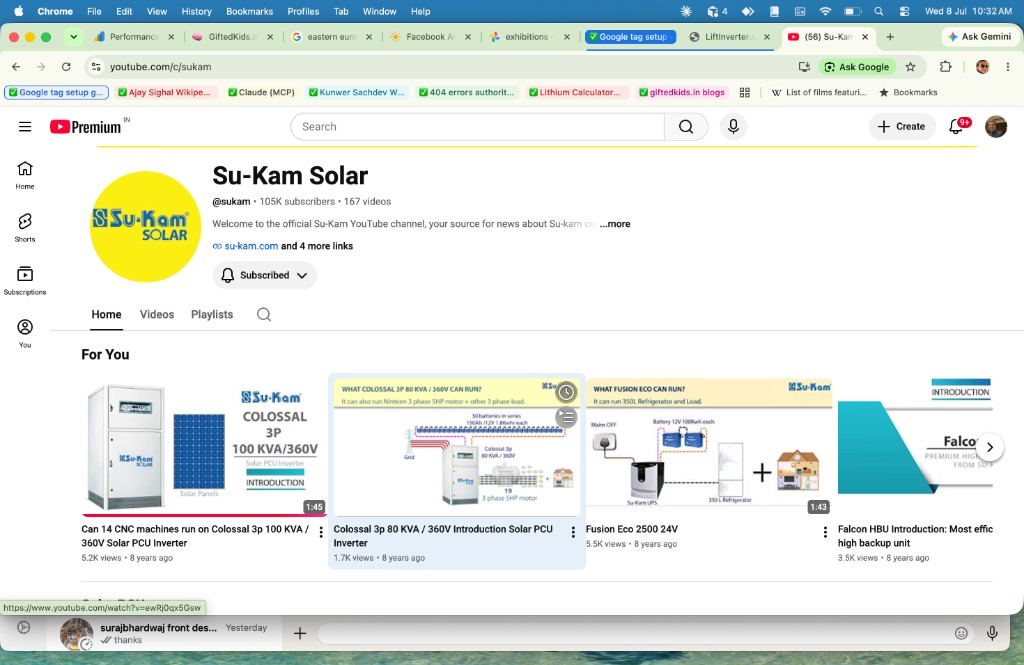
Su-Kam Solar on YouTube — joined 17 August 2009, before our industry understood what was coming
My passion was never only to sell inverters. It was to train people — dealers, technicians, product managers, field engineers — so that the right knowledge reached the market. We built classrooms, ran product sessions, invented roles when the industry had no language for them. And still, whoever we trained and placed in the market was eventually taken by competitors. YouTube became my answer — not marketing fluff, but a permanent classroom that could not be poached.
Training People in a Market That Did Not Yet Have the Words
In the early years of Su-Kam, the power-backup industry ran on relationships and rough experience. There was no formal product management culture. I introduced the term product manager in my company when most people around us had no clue what it meant. We selected sharp people, trained them on inverter topology, battery behaviour, solar charging logic, installation fault-finding — the real knowledge, not brochure language.
It worked — partially. Some trainees became excellent. Some remained average. Some left. And there was always a lacuna: the deepest engineering intuition does not transfer in a single training cycle. When a good person left, a slice of institutional knowledge walked out with them. Competitors knew this. They did not need to build a training culture. They could wait, watch who we developed, and hire them. I watched it happen more times than I want to count.
Joined 17 August 2009 · 105K subscribers · 167 videos · 12M+ views
Probably the first power-backup company in India to treat YouTube as a permanent classroom
I Saw Digital Coming When Everyone Else Saw Newspapers
When YouTube was still young, most Indian manufacturers were arguing about newspaper supplements, outdoor hoardings, and television spots. I was convinced that digital and online would take over — not eventually, but as the primary classroom for a technical product. A dealer in Indore or Coimbatore would not learn inverter selection from a print ad. He needed to see the product, hear the logic, replay the explanation at midnight before an installation.
The Su-Kam Solar channel was registered on 17 August 2009. That date is itself the story. YouTube was not yet a habit for Indian industry. We were not copying a competitor’s playbook — there was no playbook. I pushed for company social channels to work alongside it: LinkedIn, Facebook, Instagram — not as decoration, but as parts of one digital teaching system. While the industry chased print, we were building a library.
“Training in a classroom ends when the person leaves. A video stays. I was tired of educating the market and watching competitors harvest the people who carried that education. YouTube was not a branding exercise for me — it was an act of preservation.”
Making Videos Was a Tough Job — We Built a Process
Today anyone can film on a phone. In those years it was not simple. Camera work, lighting, script discipline, product demos without making engineering look like theatre — all of it was new inside a manufacturing company. We selected people carefully and ran the process under my direct guidance: what to explain, what to simplify, what must not be simplified, how to show a battery backup calculation honestly instead of magically.
Look at the channel home today — playlists for Off-Grid Solar, On-Grid rooftop systems, Colossal, Fusion Eco, Falcon HBU, Falcon+. That structure was deliberate. Each playlist is a syllabus. A technician who never sat in our Gurgaon classroom could still learn how to size backup, install grid-tie, or understand a Brainy Eco PCU — if he was willing to watch.
Videos That Carried the Real Knowledge
These are examples of what we put on the channel — practical, technical, meant for installers and dealers, not applause tracks:
Can 14 CNC machines run on Colossal 3P 100 KVA / 360V Solar PCU?
Colossal 3P 80 KVA / 360V — Solar PCU inverter introduction
Fusion Eco 2500 / 24V — how the UPS powers your home
Falcon HBU — Bluetooth and mobile app for high-backup UPS
Over the years the channel grew to more than 167 videos, 105,000+ subscribers, and 12 million+ views — numbers I cite not for vanity, but as proof that India wanted technical honesty on screen. The same instinct drove the 2005 Solar PCU, the BSF border solar posts, and every other place where I believed education was part of the product.
What It Cost Me — and What It Gave the Market
Building a video culture inside a fast-scaling hardware company is slow, expensive, and emotionally thankless. People argue about cameras when you want scripts. Sales teams want shorter ads when you want longer explanations. Competitors copy the topics without copying the depth. And still — every time a dealer in a small town installed a system correctly because he had watched one of our videos at midnight, the effort was justified.
I could not stop competitors from hiring our trained people. I could not force every employee to pass on the deepest engineering knowledge before leaving. What I could do was record the knowledge in public — permanently — so the market did not depend on any one person’s memory. That is what the channel was. That is what it still is.
What I Learned
If you believe your product is technical, your marketing must be educational. The founder who understood digital early does not win by being clever on social media — he wins by teaching better than anyone else in the category. Training scales when it is filmed with respect for the learner’s intelligence. And the date on a YouTube channel — 17 August 2009 — can matter more than a full-page newspaper ad ever did.
The longer arc of building Su-Kam — factories, exports, solar teams — is in My Story. This chapter is about a different kind of infrastructure: knowledge that stays when people go.
Digital firsts
🔗 Founder stories — read the series
- 📖 Marriott Chandigarh 2011 — Innovation & R&D Talk
- 📖 Technovations at Su-Kam 2012 — SlideShare Deck
- 📖 CE Mark & Intersolar Munich 2011
- 📖 Exporting Inverters to China
- 📖 BSF Border Solar Posts
- 📖 Solar PCU Invented in 2005
- 📖 India’s First 3-Phase Solar System in 2006
- 📖 Baddi Factory & Tubular Gel Battery
- 📖 Kashmir Shikaras — Floating Billboards of Hope
- 📖 Brainy Eco Solar Hybrid PCU
- 📖 Colossal Solar PCU — Inverter to Power Plant
- 📖 0% Chinese Share in Inverters — India’s Pride
- 📖 My Story — Twelve Chapters on SolarManOfIndia.com
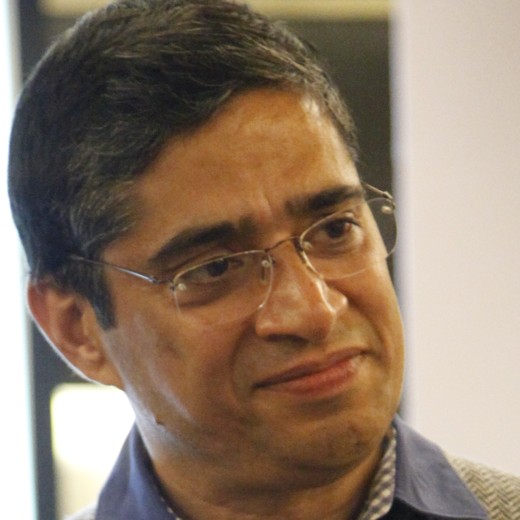
Founder of Su-Kam and Kunwwer.ai, and mentor at Su-vastika and several other companies — the “Inverter Man of India” and the “Solar Man of India.” Read his story →
You must be logged in to post a comment.