
The Section 29A Paradox: Why Barring Manufacturing Founders Destroys Enterprise IP
How IBC Section 29A, weaponized wilful defaulter and fraud notices, and multi-bank consortium litigation bleed technical founders dry — turning 77 patents and decades of indigenous manufacturing into scrap.
Historical disclosure: Kunwer Sachdev ceased all association with Su-Kam Power Systems Ltd. in April 2018. References to Su-Kam’s CIRP, patents, and liquidation arc are archival — not a current affiliation.
When the President of India promulgated the Insolvency and Bankruptcy Code (Amendment) Ordinance in November 2017—inserting what is now the infamous Section 29A of the Insolvency and Bankruptcy Code, 2016—the move was greeted with widespread public applause.
The political logic was simple: promoters who ran companies into the ground should not be allowed to buy back their own assets for pennies on the rupee via the back door.
It was hailed as a moral victory against crony capitalism and deliberate siphoning.
Yet, in the engineering and clean-tech manufacturing sectors, Section 29A did not punish fraudulent oligarchs; it systematically amputated the technological brain of Indian manufacturing enterprises. It created an economic paradox where lenders, terrified of statutory disqualification, chose to sell live intellectual property, 70+ patents, and active production lines at 1.5% scrap value rather than accept transparent, court-monitored restructuring with the original innovators.
For the shop-floor chronology under the National Company Law Tribunal (NCLT), see What Really Happens to a Manufacturing Brand Under NCLT. Pressure-test the ₹250 Cr vs scrap gap in the IBC Value Destruction Modeler. For how suppliers bled in parallel, see Pillar #4: The Silent Bloodbath.
1. The False Equivalence: Commodities vs. Tech Hardware
Section 29A was drafted with steel mills, real estate land parcels, and road concessions in mind — and published by the Insolvency and Bankruptcy Board of India (IBBI) as part of the IBC framework.
If a steel plant or a thermal power station enters the Corporate Insolvency Resolution Process (CIRP), the asset is largely agnostic to its creator:
- A blast furnace melts iron ore regardless of who owns the equity.
- A commercial building collects rent whether the developer is in office or in litigation.
- A financial buyer, mining conglomerate, or asset reconstruction company (ARC) can parachute in a generic management team to keep the turbines spinning.
Advanced hardware manufacturing does not work that way.
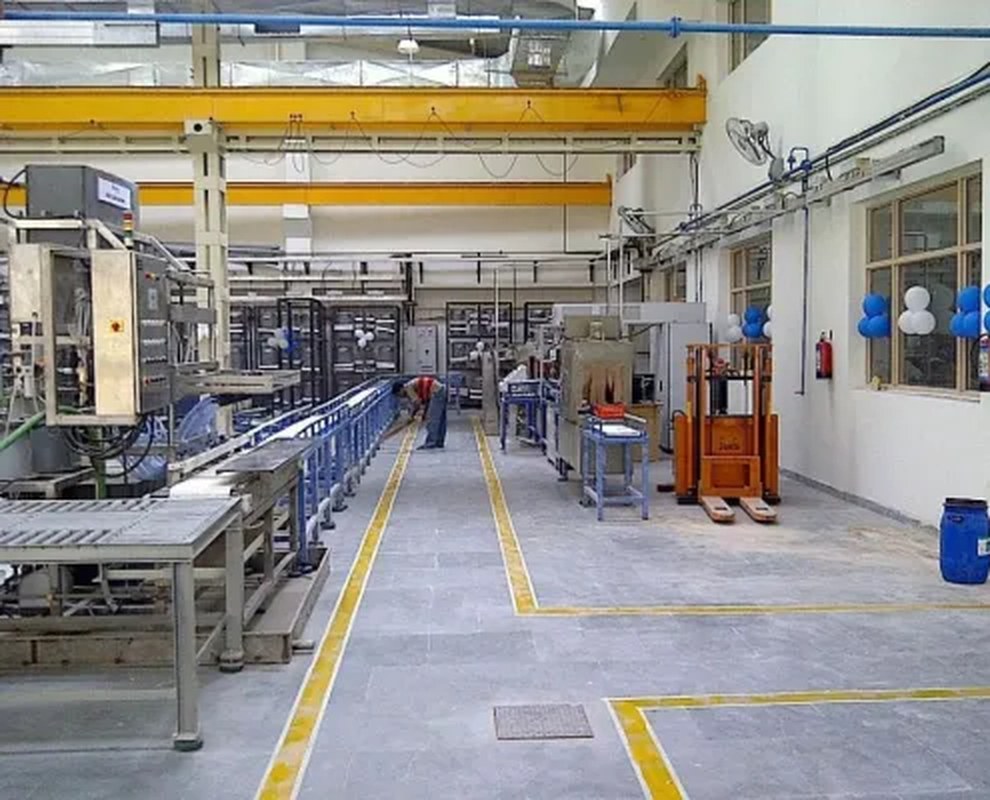
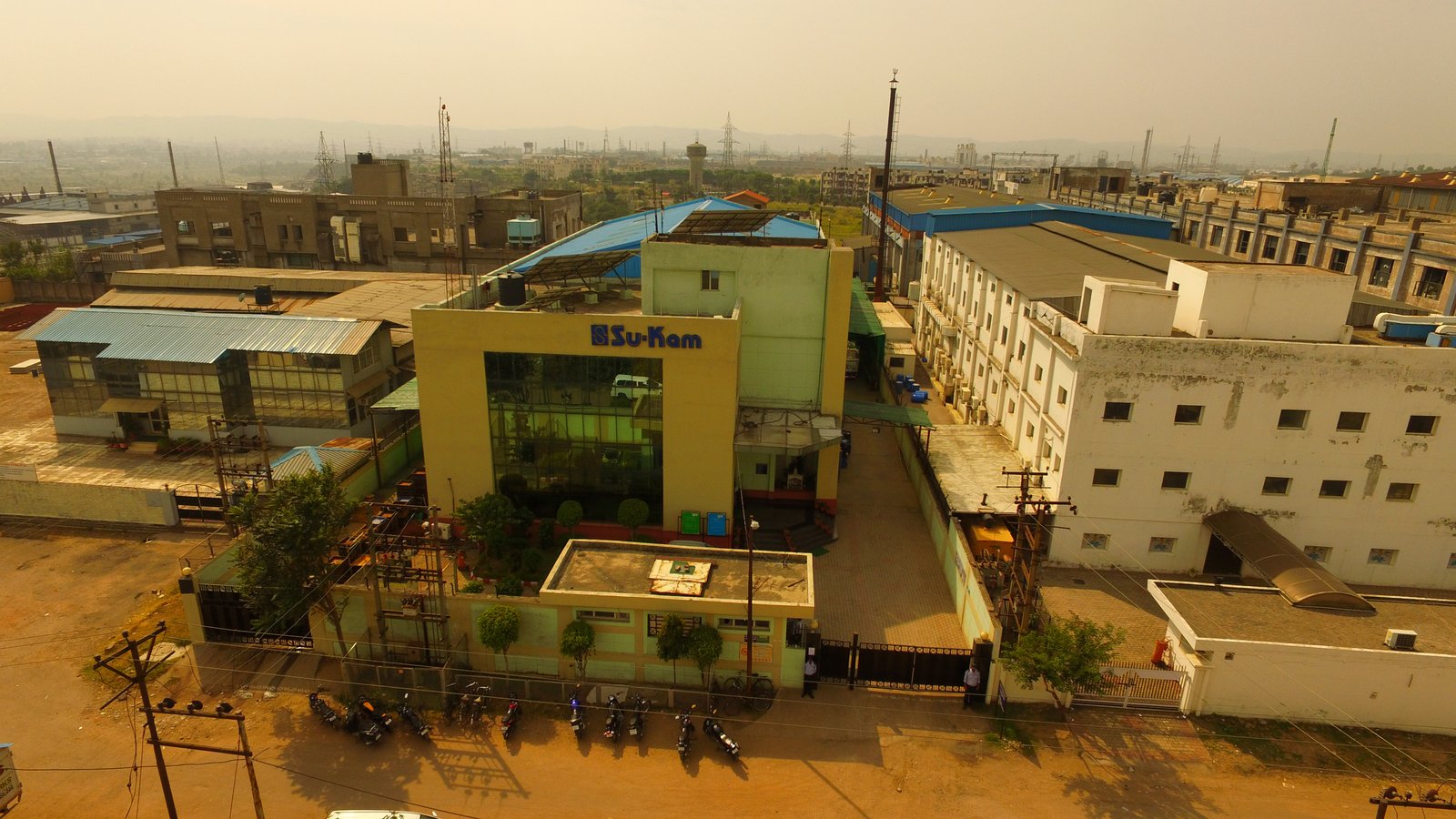
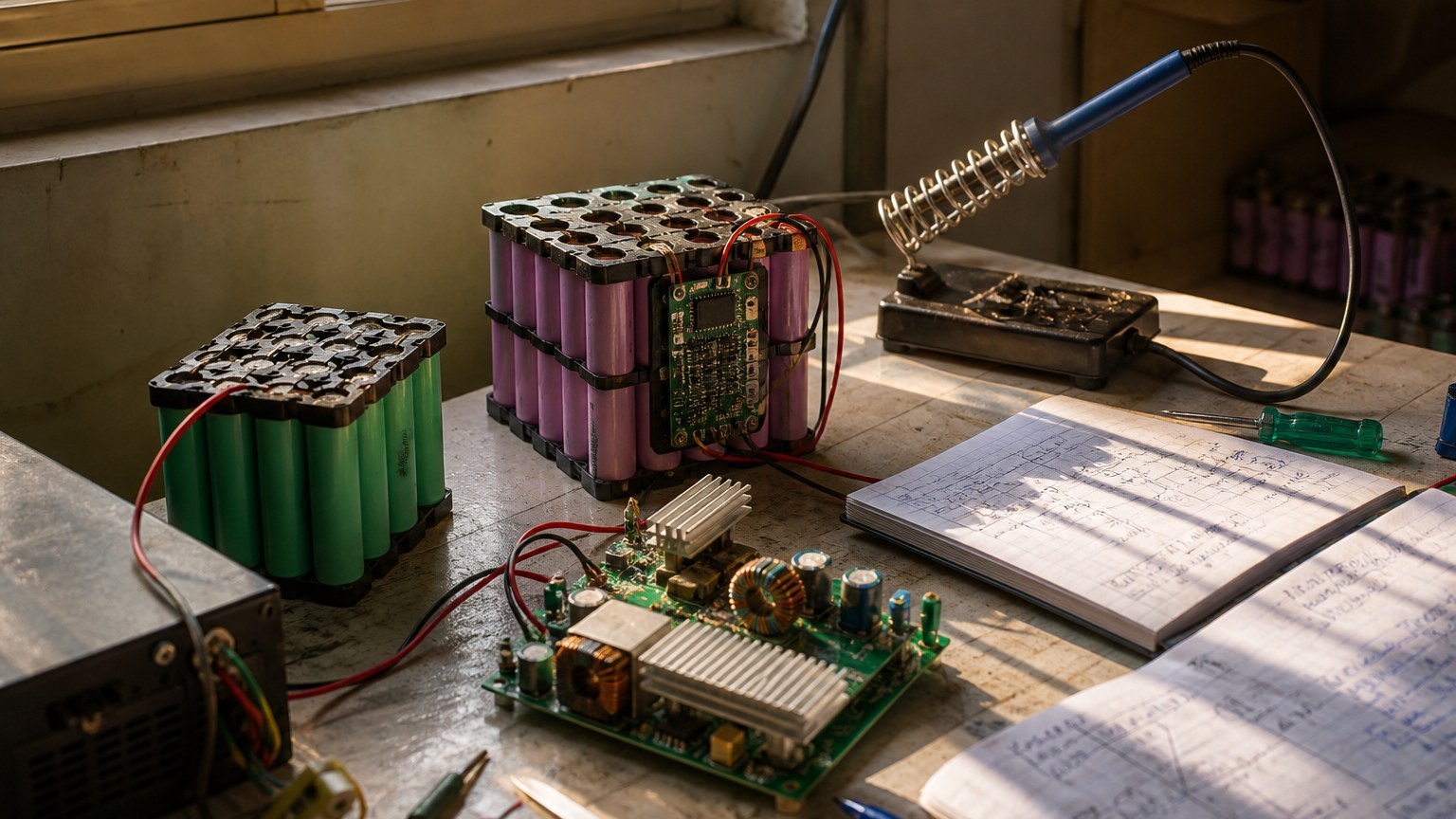
At Su-Kam, enterprise value was not stored in the sheet-metal bending machines or the concrete floor slabs of our six plants across Gurgaon, Manesar, and Baddi. It was stored in:
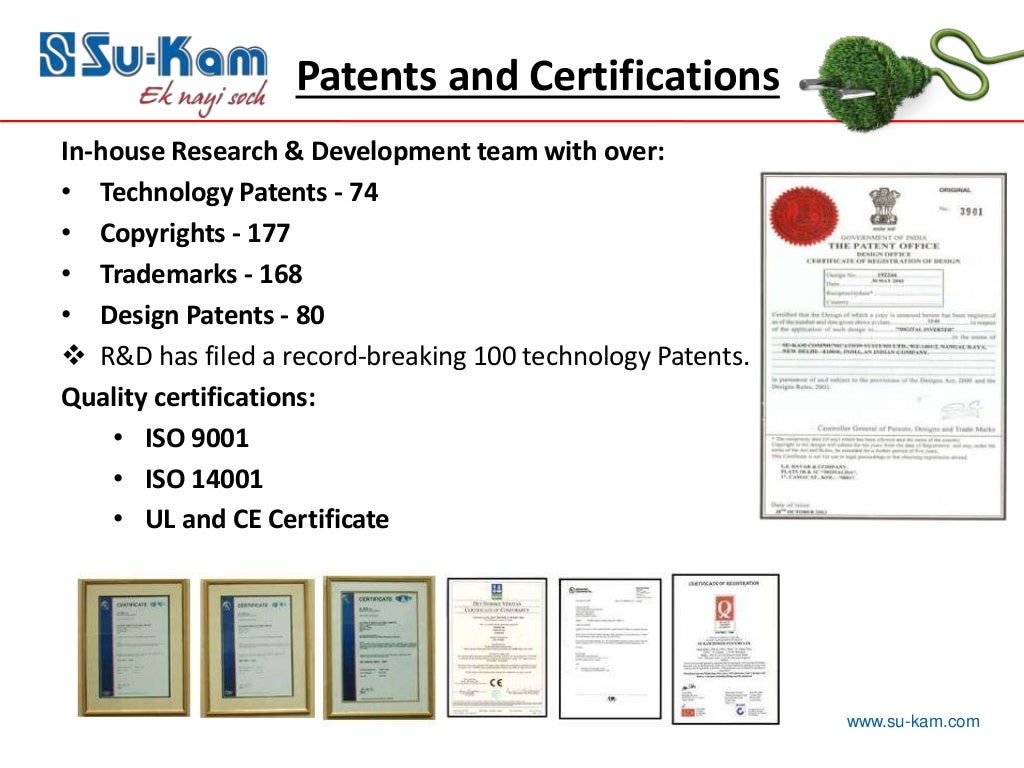
- 77 Patents and Designs: Proprietary MOSFET switching topologies, high-efficiency solar charge controllers, and hybrid grid-interactive algorithms tuned for India’s extreme voltage fluctuations (90V–300V).
- Proprietary Embedded Code: Firmware source code written over three decades that handled short-circuit protections, phase-locking loops, and battery life maximization.
- Calibrated Testing Jigs: Custom-designed automated testing benches engineered in-house to simulate grid noise and harmonic distortions.

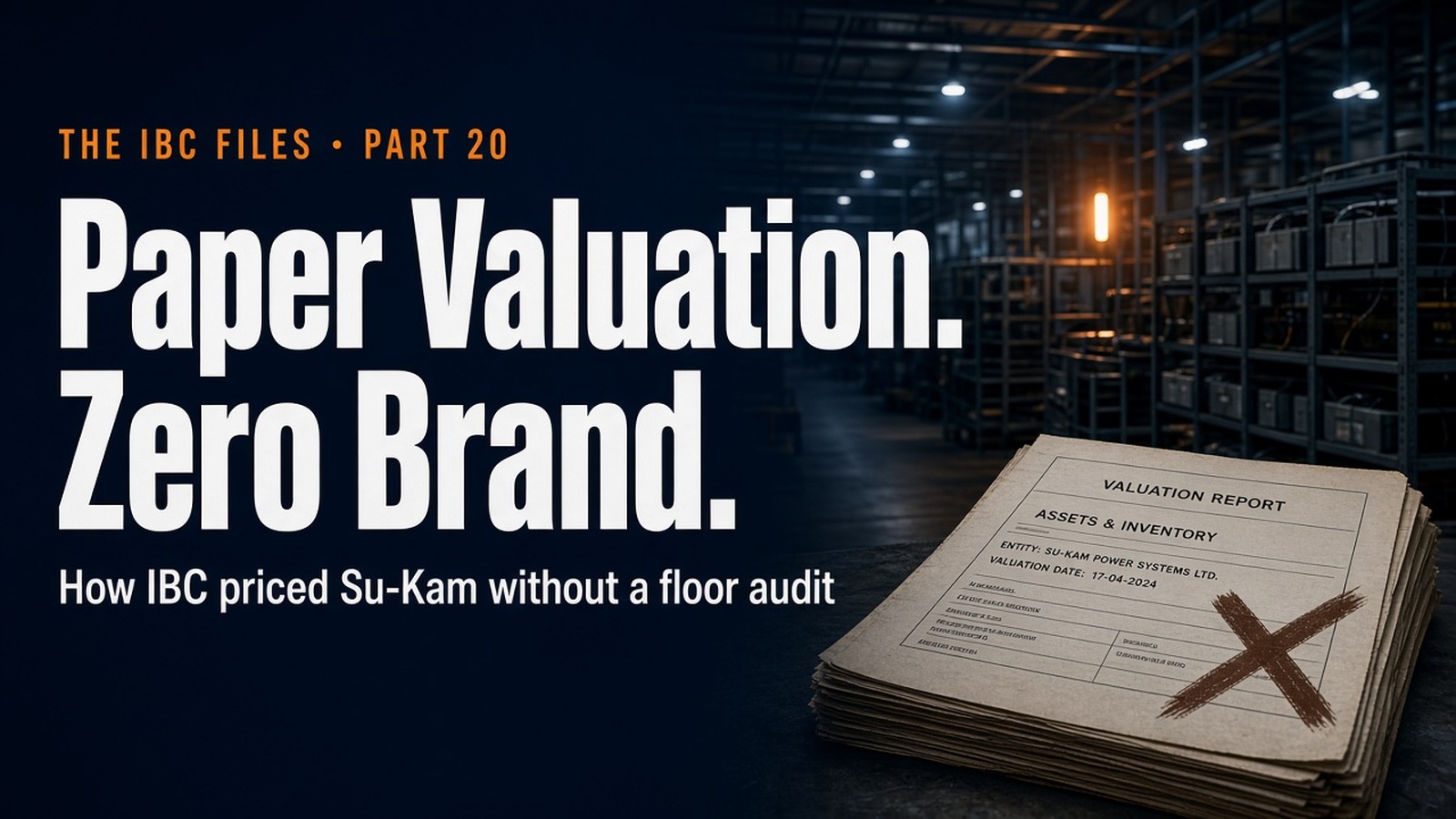
When Section 29A slammed the door shut on founding promoters, it treated an indigenous power electronics firm like an empty gravel quarry. That mispricing is dissected in Paper Valuation, Zero Brand and in the RP–founder conflict of IBBI Cancels 207 IPs.
2. The Mechanics of the Disqualification Trap
The core flaw of Section 29A lies in its broad, blunt classification — also mapped in The Law That Punishes the Builder.
Under clauses (c) and (g), any promoter whose account has been classified as a Non-Performing Asset (NPA) for more than a year is rendered legally radioactive. The statute draws no distinction between:
- A borrower who intentionally siphoned consortium capital into offshore shell entities (Wilful Defaulter, under RBI circulars).
- A first-generation manufacturer caught in cyclical credit freezes, delayed EPC government receivables, or sudden policy reversals (Genuine Business Distress).
By grouping all NPA accounts into a single basket of moral hazard, Section 29A produced immediate, destructive unintended consequences:
A. The Elimination of the Only Informed Bidder
A strategic buyer walking through an R&D facility sees proprietary circuit boards as unidentified electronic waste. They do not know which engineer wrote the inverter control code, how the MOSFET gate drivers prevent thermal runaway, or why a specific custom transformer core was selected.
The founder is often the only person capable of pricing the future economic yield of that technology. By barring the founder, the CoC guarantees that the bidding pool drops to bargain hunters, asset strippers, and liquidation scrap aggregators.

B. Paralysis Over Section 12A and Promoter-Backed Settlements
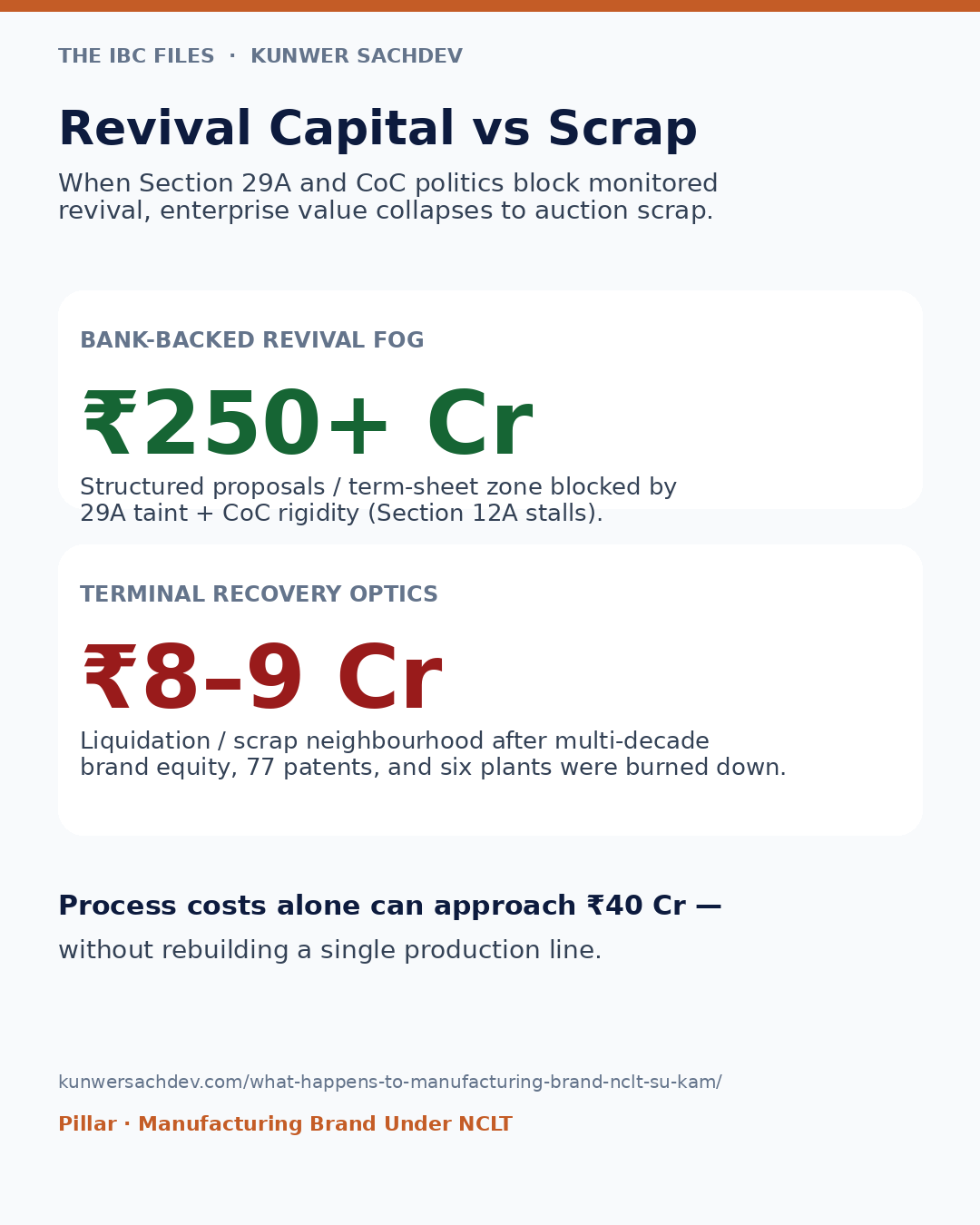
Even when external non-banking lenders, family offices, or institutional private credit firms offered to back a settlement—in our case, supported by viable institutional term sheets of up to ₹250 crore—lenders froze.
Consortium delegates feared that approving any plan where the original founder retained operational or advisory roles would invite vigilance inquiries, CAG audits, or accusations of circumventing Section 29A. The safe institutional choice was always the same: let the asset rot, file for Section 33 liquidation, and take a 98% write-off on the books. See also Commercial Wisdom: The Myth and Inside the CIRP.
| Option | Outcome | Committee risk | Typical decision |
|---|---|---|---|
| A — Transparent revival (₹200–250 Cr + IP saved) | Value preserved | “Favored treatment” / 29A circumvention fear | REJECT |
| B — Piecemeal liquidation (₹8–9 Cr scrap) | Value destroyed | Near-zero personal regulatory risk | APPROVE |
3. The Parallel Trap: Weaponizing ‘Wilful Defaulter’ and ‘Fraud’ Notices
Beyond the strict wording of Section 29A lies an even more insidious institutional tactic—one that strikes at the entrepreneur personally and psychologically.
When a company enters distress or CIRP, banks do not simply sit in CoC meetings to evaluate revival plans. In a coordinated scramble to insulate their own balance sheets and internal committees from regulatory audits, lenders routinely resort to a standard operating playbook: loan recall notices, Show Cause Notices for Wilful Default, and sudden classification as a ‘Fraud Account’ under the RBI Master Directions on Frauds.
These classifications are rarely immediate upon default. They are often triggered at the eleventh hour—precisely when a promoter is attempting to negotiate a viable turnaround, bring in external capital, or structure a Section 12A withdrawal.
The intent is psychological and procedural: to render the entrepreneur legally radioactive before the NCLT and eliminate any possibility of a revival under Section 29A.
- Default / Cyclical Distress
- ↓
- Loan Recall Notice (full payment demand in 7–15 days)
- ↓
- Show Cause Notice: “Wilful Defaulter” (passport / directorship threats)
- ↓
- Sudden “Fraud Account” tagging (RBI Master Directions on Fraud)
- ↓
- Section 29A absolute disqualification → liquidation path
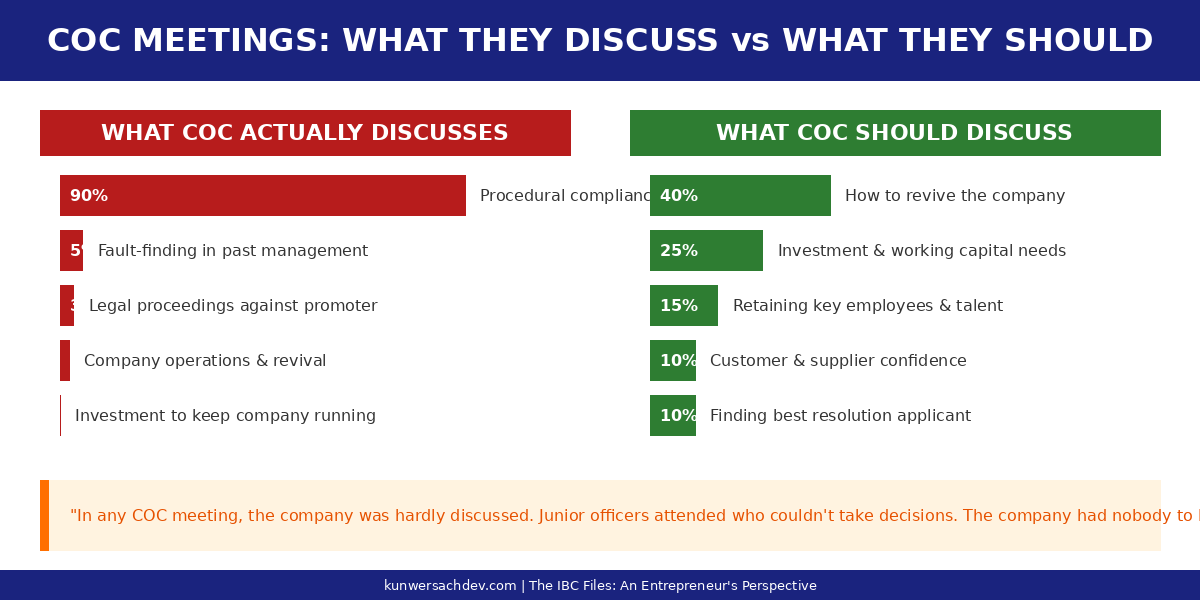

The Consortium Multiplier: Multi-Front Legal Bleeding
If your working capital was funded by a consortium of 8 to 12 banks, this playbook turns into an orchestrated nightmare.
Although every bank shares the exact same underlying cause, the exact same transaction history, and the exact same joint forensic audit report, they do not act as one unified legal body when attacking the promoter personally:
- Bank A issues a Show Cause Notice for Wilful Default before its internal Identification Committee.
- Bank B initiates separate proceedings to report the account as ‘Fraud’ under RBI’s 2016 Master Directions—often without giving the borrower a fair hearing, a copy of the forensic audit report, or natural justice (until the Supreme Court stepped in via the landmark State Bank of India v. Rajesh Agarwal ruling).
- Bank C initiates separate personal guarantee recovery proceedings before the Debt Recovery Tribunal (DRT) — the personal-guarantee trap is also mapped in Subhash Chandra & Personal Guarantees.
- Bank D files an independent petition before the NCLT.
For a first-generation entrepreneur, the operational effect is devastating. You are forced to hire senior legal counsels and advocates across 8 to 10 distinct benches, tribunals, and high courts just to defend your personal integrity against the same cut-and-paste allegations. Process-as-punishment dynamics also appear outside insolvency — see The Illusion of the Statute.
- 10 Separate Show Cause Committees
- 10 Separate High Court Writ Petitions
- 10 Distinct Senior Counsel Retainers
Result: Financial exhaustion and psychological paralysis designed to force complete surrender.

The staggering legal costs—easily running into tens of lakhs every single month—drain the founder’s remaining personal reserves at the exact moment their assets, bank accounts, and corporate salaries are frozen.
It is designed to take the fight out of you. You are no longer defending the company’s manufacturing patents, factory machinery, or employee jobs; you are spending 100% of your emotional and financial bandwidth simply trying to keep your personal freedom, protect your passport, and prevent your name from being splattered across public notices as a criminal.
By the time you exhaust yourself securing High Court stays against arbitrary fraud tagging, the NCLT clock has run out. The CoC points to Section 29A, marks you disqualified, and orders your life’s work to be auctioned for scrap — see Inside the CIRP and Personal Insolvency: The Last Straw.
What Sets an MSME Apart from a Normal Corporate Under the IBC
To understand why the Insolvency and Bankruptcy Code breaks manufacturing businesses, one must first recognize the fundamental divide between a statutory MSME (Micro, Small, and Medium Enterprise) and a Normal (Large Corporate) Enterprise.
They are governed by different statutory thresholds, operate on completely different economic foundations, and face radically different fates inside the National Company Law Tribunal (NCLT).
| Dimension | Statutory MSME | Normal / Large Enterprise |
|---|---|---|
| 1. Statutory Threshold (Investment & Turnover) | Composite criteria under the MSMED Act: Micro — Inv ≤ ₹1 Cr / Turn ≤ ₹5 Cr; Small — Inv ≤ ₹10 Cr / Turn ≤ ₹50 Cr; Medium — Inv ≤ ₹50 Cr / Turn ≤ ₹250 Cr (Ministry of MSME) | Exceeds MSME caps: investment in plant & machinery > ₹50 Cr, or annual turnover > ₹250 Cr |
| 2. Corporate Architecture & Operational Depth | Founder-centric organism: technology, R&D, vendor credit, and strategic relationships reside in the founding technical team | Institutional machinery: deep second-tier professional management, decentralized systems, independent board oversight |
| 3. Market for Resolution (M&A / Buyout Appetite) | Non-existent external bidders: global funds, ARCs, and conglomerates rarely bid on specialized regional manufacturing units | Active distressed bidding market: strategic buyers and PE funds routinely bid for market share, land banks, or turnkey assets |
| 4. IBC Disqualification (Section 29A Rules) | Shielded via Section 240A: exempt from Section 29A(c) [1-year NPA] and 29A(h) [invoked personal guarantees]; promoters may bid | Strict blanket bar under Section 29A: barred from submitting a resolution plan if NPA > 1 year or guarantee invoked |
| 5. Balance Sheet & Legal Litigation Resilience | Fragile personal liquidity: personal assets and guarantees frozen; zero cash flow to fight multi-bank consortium cases | Dedicated corporate war chest: legal budgets, treasury reserves, institutional ability to sustain court battles |
Walk the MSME path interactively: MSME 240A Neutralization Flow.
The 3 Core Distinctions That Decide Survival
1. The Operational Reality: A Living Brain vs. A Turnkey Machine
In a large commodity corporation—such as a steel mill, cement plant, or toll road concession—the enterprise is largely asset-agnostic. The blast furnace melts steel and the toll booth collects fees regardless of who sits in the boardroom. A court-appointed Resolution Professional (RP) can bring in an operations agency to keep running the site.
In an MSME or mid-market technology manufacturer (like Su-Kam), the enterprise is an extension of the founder’s mind. The proprietary circuit board topologies, the firmware algorithms that handle erratic Indian grid fluctuations, the custom automated testing benches, and the relationships with local component vendors are not off-the-shelf commodities. When you remove the founder from an MSME, the business does not continue under professional management—it flatlines. That false equivalence is the spine of §1 above and of Paper Valuation, Zero Brand.
2. The Statutory Bidding Void (Why Section 240A Was Created)
For a large enterprise with ₹2,000+ crore in debt, international vulture funds, conglomerates, and Asset Reconstruction Companies (ARCs) actively participate in CIRP auctions.
For an MSME manufacturing plant in an industrial cluster, there are no third-party white knights.
- Outside investors will not take on the legal risks, unresolved vendor liabilities, and complex technical integration of a ₹50–₹200 crore manufacturing unit without the founding engineering team.
- Parliament recognized this market reality in 2018: if you bar an MSME promoter from bidding under Section 29A, the company has a near-0% chance of resolution and near-certainty of scrap auction. Section 240A was enacted to prevent this exact slaughter — see the IBC Act via IBBI.
3. The “Mid-Market Valley of Death”
The biggest tragedy under Indian corporate law strikes companies that scale:
- When an ambitious hardware manufacturer succeeds and scales revenues to ₹300 Cr, ₹600 Cr, or ₹1,000 Cr, it crosses the statutory ₹250 Cr turnover ceiling of the MSMED Act.
- Legally, the company is instantly reclassified as a “Normal Large Corporate.”
- Yet, structurally, it remains a founder-dependent engineering enterprise. It has neither the multi-billion-dollar treasury of an industrial conglomerate nor the statutory protections of Section 240A.
When cyclical liquidity stress strikes, the NCLT treats this homegrown technology innovator like an overleveraged multi-billion-dollar conglomerate. Section 29A shuts down the founder, third-party buyers stay away, and a company that took 30 years to build is liquidated as scrap for 1.5% of its peak enterprise value — pressure-test that gap in the IBC Value Destruction Modeler.
That framing sets up the harder policy question next: why special status was granted—and why even that is not enough.
Why MSMEs Were Given Special Status—And Why They Must Be Pulled Out of the IBC Entirely
When the legislature carved out Section 240A, it was an admission of an undeniable economic truth: an MSME is not a miniature corporate conglomerate; it is an organic extension of the entrepreneur.
Under Indian corporate law, large enterprises and MSMEs are treated as fundamentally different species for good reason — mapped in What Sets an MSME Apart. Understanding that distinction exposes why dragging small and mid-sized manufacturers to the NCLT is an exercise in pure economic vandalism. Walk the same trap interactively: MSME 240A Neutralization Flow.
1. The Entrepreneur Is the Operating System
In a multi-thousand-crore conglomerate, operations run on institutional inertia. There are delegated boards, vice presidents, standard operating protocols, and deep enterprise resource planning (ERP) architectures. If you remove the promoter from a cement plant or a steel foundry, the factory continues to ship freight the next morning — the commodity false equivalence of §1 above.
In an MSME, the entrepreneur is the operating system:
- The Technical Core: The founder designed the circuit topologies, debugged the firmware code, chose the specific transformer core alloys, and calibrated the automated test jigs — see How Su-Kam Came to File 77 Patents.
- The Commercial Trust Network: Component vendors extend 60 to 90 days of unsecured credit not based on balance-sheet credit ratings, but on decades of personal relationships with the founder — the supplier bleed in The Silent Bloodbath.
- The Customer Franchise: Key distributors, institutional buyers, and channel partners place repeat purchase orders because they have direct access to the technical creator who stands behind the product.
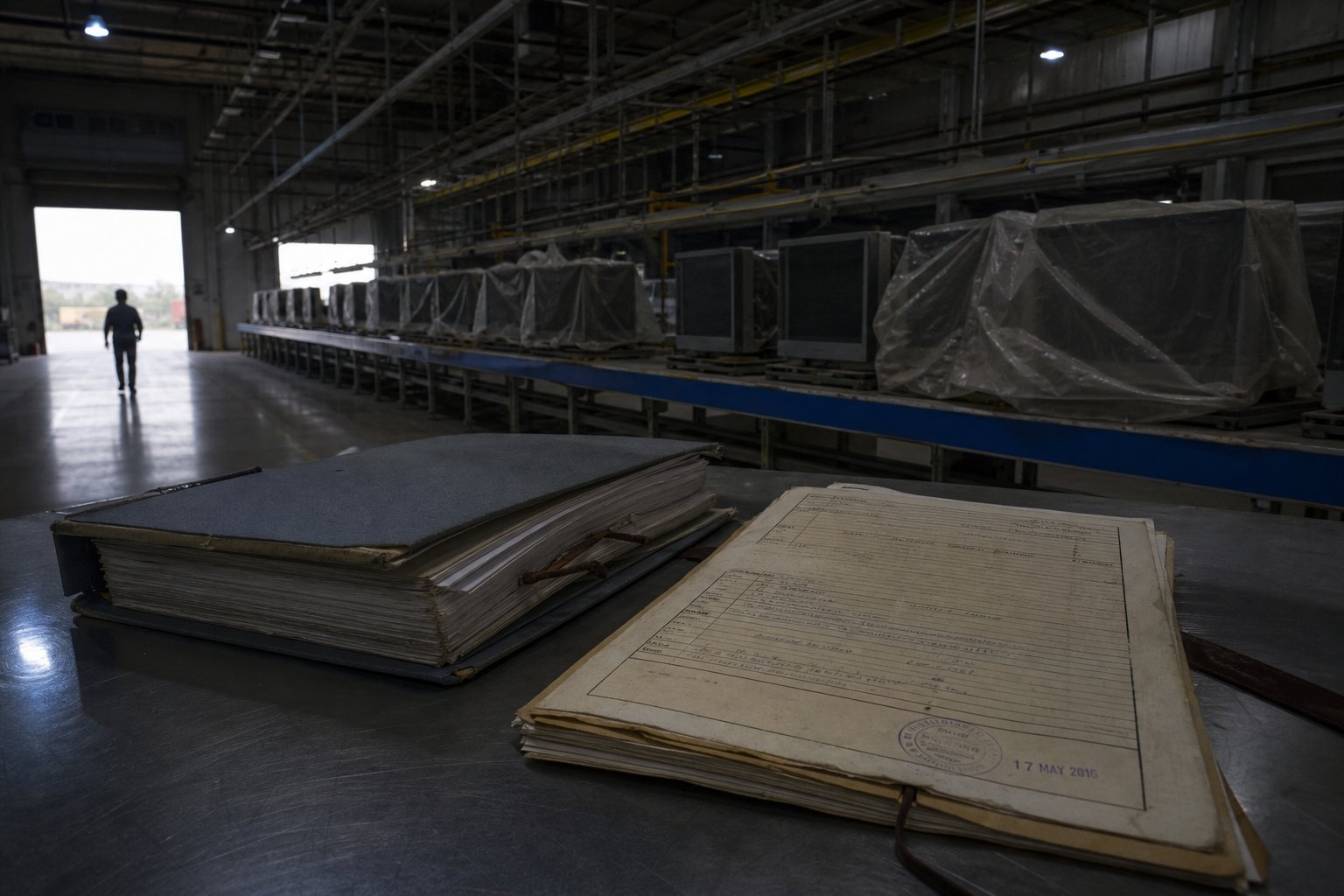
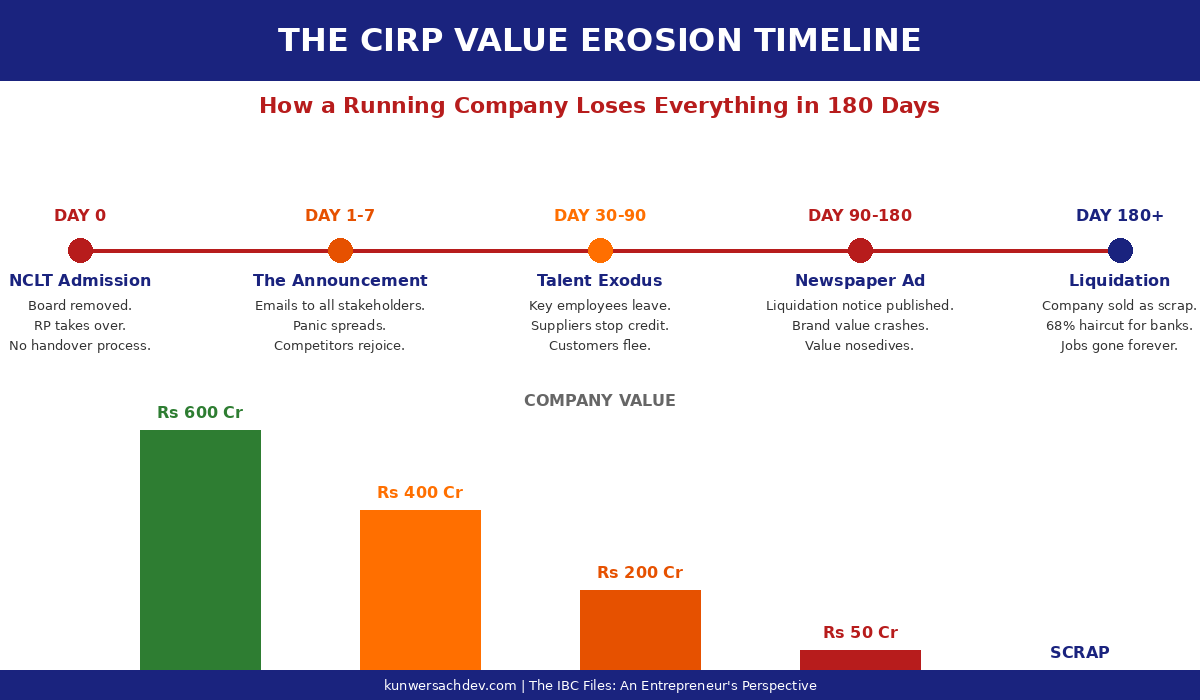
When an Interim Resolution Professional (IRP) suspends the promoter and walks in with security guards, the company’s brain is amputated. The trust evaporates within 24 hours. Credit lines snap shut, raw material dispatches halt, and engineers walk out the door — the shop-floor chronology of What Really Happens to a Manufacturing Brand Under NCLT and Inside the CIRP.
2. The NCLT Buyer Myth: Who Are You Selling To?
The entire premise of the Corporate Insolvency Resolution Process (CIRP) rests on a market assumption: if a business fails, the open market will produce an agile, well-capitalized resolution applicant to take it over, inject equity, and revive it.
For large assets—like Bhushan Steel, Essar Steel, or Jaypee Infratech—that market exists. Domestic conglomerates, private equity turn-around funds, and multinational strategic buyers will bid aggressively to capture market share, ports, and land banks.
For an MSME manufacturing plant, that market is completely non-existent:
No external strategic buyer or corporate fund wants to take over a specialized ₹50 crore or ₹150 crore manufacturing unit where the original intellectual property, circuit design history, and dealer goodwill reside entirely in the head of a barred founder — the empty chair of Section 29A: The Law That Punishes the Builder.
Even if an outsider buys the physical factory shell at an NCLT auction, they cannot run it. They do not have the embedded firmware algorithms to manufacture the product, nor the technical authority to service existing warranty backlogs. The NCLT process for an MSME does not result in resolution—it guarantees an unmitigated descent into piecemeal liquidation (The Day Su-Kam Died, 30-year liquidation case study).

3. Regulatory Asymmetry: The Law Already Treats MSMEs Differently
Indian jurisprudence and economic policy already recognize that MSMEs require distinct, protective statutory frameworks rather than draconian corporate compliance:
- The MSMED Act, 2006: Provides statutory interest on delayed payments (Sections 15–16), mandatory facilitation through MSME Samadhaan councils, and protective procurement policies (Ministry of MSME).
- Companies Act Exemptions: MSMEs enjoy simplified secretarial reporting, exemptions from cumbersome internal financial control audits, and streamlined board meeting mandates.
- RBI Priority Sector Lending (PSL): Banks operate under mandatory quotas to support small enterprises precisely because they lack access to commercial paper and international capital markets (RBI PSL framework).
Why, then, should an entity that is protected, nurtured, and recognized as unique under every other statute be thrown into the exact same insolvency slaughterhouse designed for multi-billion-dollar conglomerates — administered by the IBBI under the same IBC Act?
4. My Verdict: MSMEs Must Be Excluded from the IBC Entirely
Section 240A was a half-hearted patch. Parliament recognized the problem—that MSMEs have no external buyers and cannot survive without their founders—but instead of fixing the vehicle, they merely added an exemption that banks routinely bypass using eleventh-hour Wilful Defaulter tags (RBI Wilful Defaulters, Master Directions on Frauds).
In my view, Micro, Small, and Medium Enterprises should be removed from the jurisdiction of the IBC and NCLT altogether.
- Cost Prohibitive: CIRP administration costs (IRP fees, forensic auditors, legal retainers) routinely consume 15% to 30% of an MSME’s entire enterprise value.
- Time Lethal: A 330-day corporate resolution timeline kills a small manufacturer whose cash cycle is measured in 30-day working capital blocks — see Inside the CIRP.
- Complete Scrap Bias: Barring the founder under Section 29A eliminates the only viable operator, ensuring the asset is sold for metal weight — pressure-test in the Value Destruction Modeler.
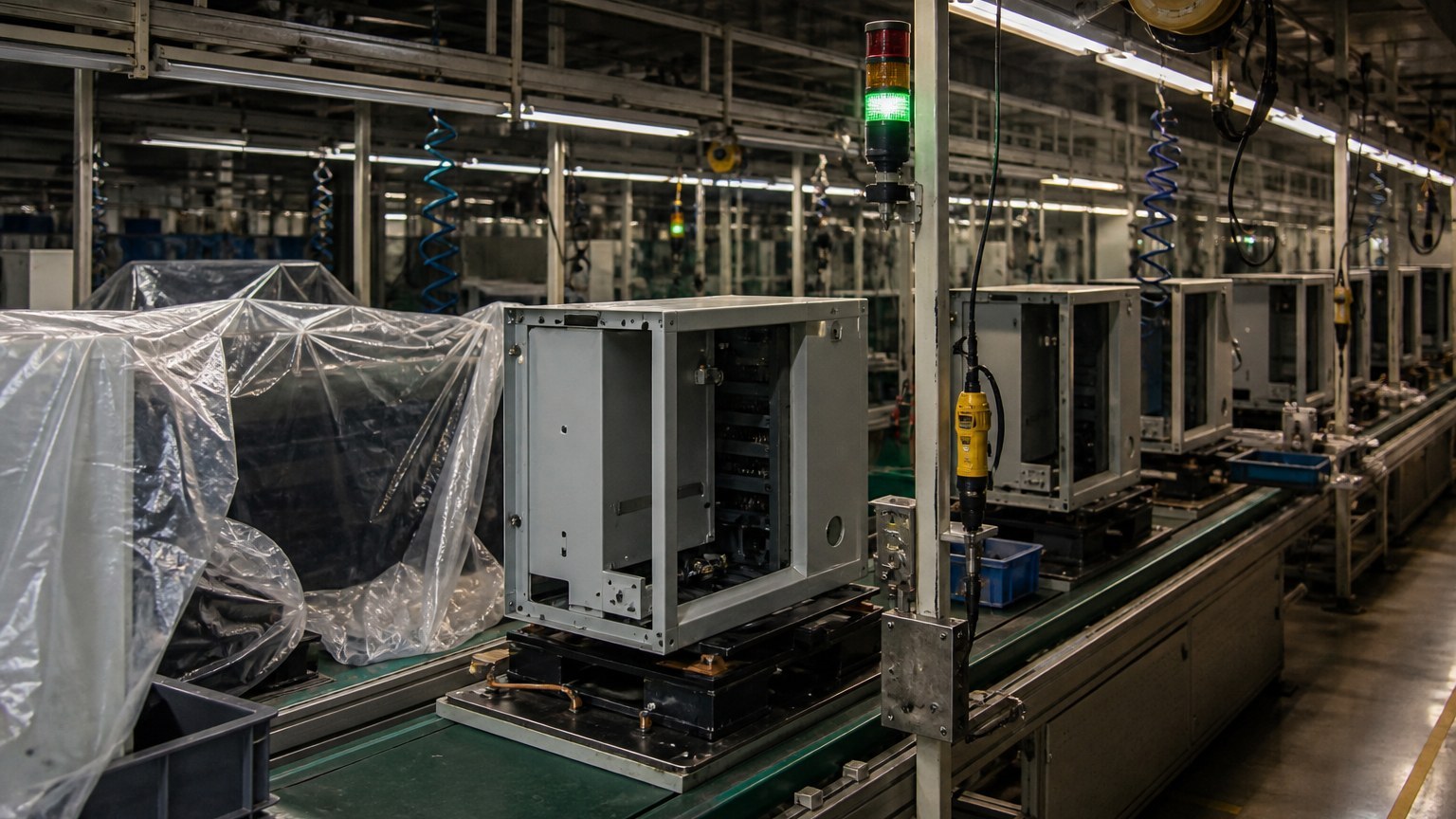
The Alternative: A Dedicated MSME Debt Restructuring Code
Instead of subjecting small businesses to the adversarial, zero-sum NCLT arena, India needs an independent, non-adversarial MSME Debt Restructuring Framework:
- Court-Supervised Mediation, Not Asset Takeover: Management should remain with the entrepreneur under the oversight of an independent technical ombudsman—not an accounting professional who knows nothing about running a factory (Founder vs Resolution Professional).
- Restructuring Over Liquidation: If an MSME enters debt stress, the sole focus must be restructuring terms, extending moratoriums, and converting debt into sustainable long-term cash-flow obligations based on plant production capacity.
- No Liquidation Powers for Banks: Lenders should be barred from pushing an active manufacturing MSME into piecemeal liquidation unless independent forensic technical audits prove criminal fraud or intentional asset-stripping.
Subjecting an MSME to the NCLT is like sending a patient with a curable fracture to the morgue instead of the orthopedic ward. It is time for India to stop destroying its small manufacturing base under the guise of corporate resolution. Pull MSMEs out of the IBC.
How personal guarantees complete the pincer — and how banks neutralize even the partial 240A patch — are the next sections.
The Illusion of Limited Liability: Why Taking Personal Guarantees Brings Down the Entrepreneur Alongside the MSME
There is a fundamental contradiction at the heart of Indian industrial lending: if an MSME is incorporated as a Private Limited company, why do banks routinely demand the promoter’s personal guarantee for everyday working capital?
Special Investigation: the full Part III personal-guarantor exile — valuation fishing, phantom capital gains, zombie claims, and Look Out Circulars that survive No Dues Certificates — is mapped in The Hostage Trap: How Part III of the IBC Weaponizes Personal Guarantees.
The answer exposes how the banking system treats small manufacturing enterprises not as corporate entities taking commercial risks, but as pawn shops with corporate stationery. Interactive briefing: MSME 240A Neutralization Playbook.

1. The Real Reason Banks Demand Personal Guarantees
- Skin in the Game as Coercion: dispute interest resets, LC fees, or delayed renewals — and the bank can threaten the family home.
- Subverting Credit Appraisal: pledge factory + machinery + promoter/spouse guarantees substitutes for evaluating patents, technology, and order books.
- Weaponization for Part III: if Section 240A lets the founder bid on the company, lenders file personal insolvency under Section 95, freezing personal accounts during resolution talks — see Personal Insolvency: The Last Straw and Personal Guarantees under IBC.
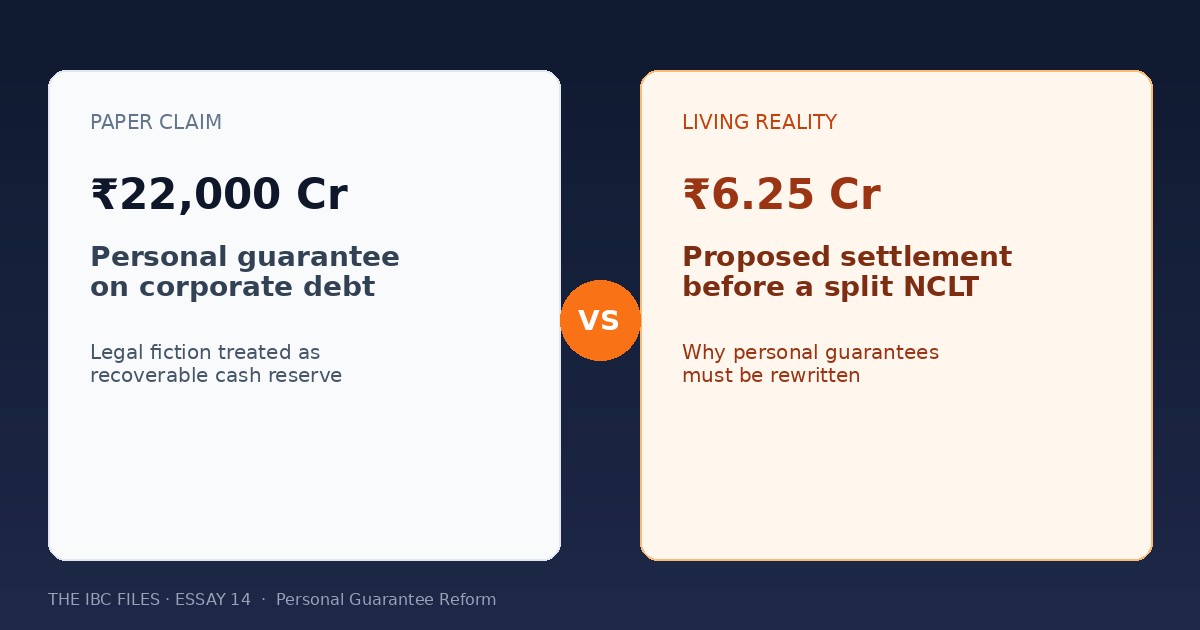

2. How Personal Guarantees Bring Down the MSME Entrepreneur
When a large conglomerate defaults, holding structures often ring-fence family wealth. When an MSME manufacturer defaults, the personal guarantee ensures total, irreversible destruction:
- It Paralyzes the Defense: personal cash is attached exactly when restructuring counsel is needed.
- It Destroys Bounce-Back: commercial failure becomes lifelong credit exile.
- It Kills Make-in-India Hardware Risk-Taking: why build indigenous electronics if a cycle can throw the family onto the street?
Case law pincer: Lalit Kumar Jain v. Union of India (2021) — corporate resolution does not discharge the personal guarantor. Dilip B. Jiwrajka v. Union of India (2023) — Section 95 can trigger interim personal moratorium/scrutiny under Section 96 before merits are fully tested.

3. The Necessary Policy Fix: Ban Personal Guarantees for Standard MSME Lending
- Statutory prohibition on personal guarantees / residential mortgages for standard MSME WC and term loans already secured by factory assets, inventory, and book debts.
- Guarantee invocation only after judicial findings of fraud/siphoning — not for ordinary commercial failure.
- Automatic discharge upon MSME resolution under Section 240A, overriding the Lalit Kumar Jain residual-chase loophole for MSMEs.
A country cannot build a manufacturing economy on entrepreneurs forced to wager their families’ homes for every working-capital facility.
How banks neutralize the remaining corporate 240A shield on the ground is next.
4. How Section 240A Failed MSME Manufacturing — And How Banks Neutralize It
In 2018, Parliament recognized that MSMEs rarely attract external resolution applicants. Section 240A was inserted as a deliberate carve-out so that founding promoters of registered MSMEs could still submit resolution plans.
A. The Statutory Exemption: What Section 240A Actually Shields
Under Section 240A(1), for a resolution applicant proposing a plan for an MSME corporate debtor, the disqualifications under:
- Section 29A(c) — NPA account for more than one year, and
- Section 29A(h) — personal guarantor in default
do not apply.
The policy intent was clear: if the original promoter cannot bid, an MSME is virtually guaranteed to be liquidated and scrapped. See the IBC Act text via IBBI and the Ministry of MSME framework.
B. The Statutory Matrix: What 240A Does Not Exempt
| Disqualification clause | What it covers | MSME exempt under §240A? |
|---|---|---|
| Section 29A(c) | NPA account over 1 year | Yes — exempted |
| Section 29A(h) | Personal guarantor in default | Yes — exempted |
| Section 29A(b) | Wilful Defaulter | No — still disqualified |
| Section 29A(g) | Preferential / undervalued / fraudulent trading | No — still disqualified |
| Section 29A(d) (and related integrity bars) | Convictions / related integrity bars as applicable | No — still disqualified |
This is the critical statutory divide. Section 240A was supposed to protect MSME founders from the NPA trap of Section 29A(c). But banks found the back door: because Section 240A does not exempt Wilful Defaulters under Section 29A(b) (or fraud-linked bars under Section 29A(g)), lenders manufacture last-minute wilful-default and fraud allegations specifically to neutralize the MSME exemption and force the asset into liquidation.
C. The Backdoor Neutralization Playbook
Because an MSME promoter cannot be blocked merely for having an NPA under Section 29A(c), bank committees shift tactics:
- Standard credit-default metrics no longer suffice to keep the founder out.
- At the eleventh hour — often when a Section 12A settlement or promoter-backed plan is live — they issue Show Cause Notices for Wilful Default under the RBI Master Circular on Wilful Defaulters, or tag the account under the RBI Master Directions on Frauds.
- The moment the promoter is tagged under Section 29A(b) (or a fraud/preferential finding triggers Section 29A(g)), the Section 240A shield evaporates entirely.
Natural justice before fraud tagging was later forced by State Bank of India v. Rajesh Agarwal — but by then the CIRP clock and personal litigation bleed have usually already done their work. That personal playbook is mapped in §3 above.
Eight statutory nodes compressed into five interactive steps. Theory vs ground reality at every stage · हर चरण पर सिद्धांत बनाम जमीनी हकीकत.
Fullscreen / पूरा स्क्रीन: MSME 240A Neutralization Flow.
D. RBI MSME Revival Framework vs. Ground Reality
Separately, the Reserve Bank of India framed a Framework for Revival and Rehabilitation of MSMEs:
- SMA triggers: Banks must identify incipient stress at SMA-0 / SMA-1 / SMA-2 and refer eligible MSMEs to a Committee for Stressed MSMEs.
- Corrective Action Plan (CAP): Rectification, restructuring, or change-in-management before coercive recovery.
On the ground:
- Consortium banks routinely treat these internal revival committees as a check-the-box paper exercise rather than evaluating genuine restructuring.
- If an enterprise scales past MSME investment/turnover caps (e.g. beyond ~₹50 Cr investment / ₹250 Cr turnover), or if Udyam registration is attacked as an afterthought during CIRP, banks refuse the rehabilitation framework altogether — while NCLT benches litigate the timing of the MSME certificate.
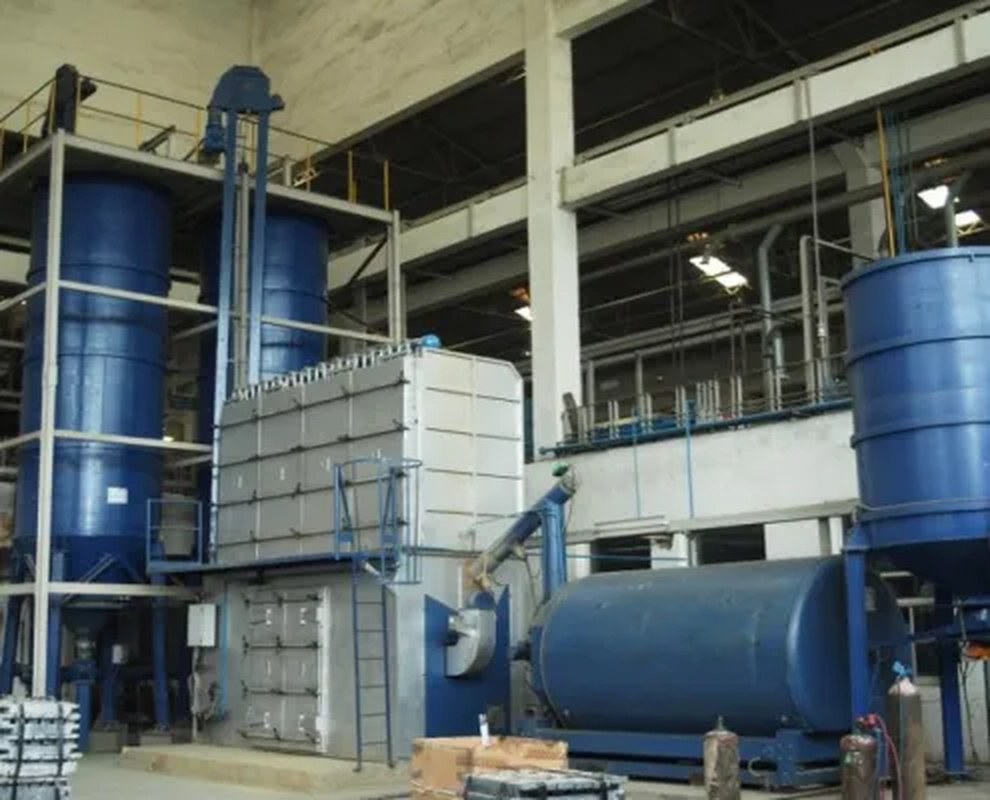
While lawyers argue over registration dates, factory machinery sits unpowered, humidity degrades calibration instruments, and patent maintenance fees go unpaid.

E. Why Consortium Bleed Is Fatal for an MSME Founder
For a mid-sized MSME manufacturer, the multi-bank playbook in §3 is disproportionately fatal:
- Large conglomerates have in-house legal teams and balance-sheet liquidity to fight 10 separate writs across High Courts.
- An MSME founder whose personal guarantees, savings, and FDs are frozen has zero working capital to pay senior advocates ₹5–10 lakh per hearing against 8–10 separate identification committees.
- Banks know that individual wilful-default notices exhaust personal finances long before the NCLT ever reaches a clean Section 240A eligibility finding — see also personal guarantees under IBC and Personal Insolvency: The Last Straw.
Two earlier structural failures remain: turnover-ceiling disqualification for mid-market tech manufacturers that outgrew MSME caps while staying founder-dependent, and the timing trap over when the MSME certificate had to exist. Together with the wilful-default backdoor, Section 240A becomes almost useless for the indigenous manufacturers it was meant to save.
5. The Real-World Calculus: ₹250 Crore vs. Scrap Value
The economic absurdity of this framework is demonstrated by our empirical record at Su-Kam:
| Stage / Proposal | Stated Enterprise Valuation | Actual Realization for Creditors | Fate of Technology & Patents |
|---|---|---|---|
| Peak Performance (Pre-CIRP) | ₹600+ Crore (Annual Turnover) | Debt serviced regularly | Active R&D; 77 patents filed/approved |
| Revival Offers (CIRP Period) | ₹200 – ₹250 Crore (Structured proposals) | Stalled / Rejected by CoC fear | Technology intact; plants ready to restart |
| Piecemeal Liquidation Auction | Discredited scrap floor value | ₹8 – ₹9 Crore (Terminal recovery) | Patents orphaned; equipment sold as scrap metal |
Consider what was sacrificed to enforce this rigid moral posture:
- Creditors recovered a fraction of what structured settlement proposals offered.
- Thousands of direct and indirect factory jobs evaporated.
- India lost one of its few domestic patent-holding innovators in power conversion, opening the market wider for imported Chinese power electronics — see the 30-year liquidation case study and The Day Su-Kam Died.
Who won? The scrap dealers and auction aggregators who bought precision high-speed pick-and-place machines by gross tonnage.
Simulate the same gap: Value Destruction Modeler.
6. What Policy-Makers Must Fix in the IBC
If India is serious about domestic manufacturing sovereignty and intellectual property preservation, Section 29A must undergo targeted legislative surgery. The IBBI and the IBC Act remain the reform surface.
1. Carve Out “Pure Economic Distress” from Wilful Default
Section 29A must be amended to draw an unmistakable statutory line between wilful defaulters (under RBI wilful-defaulter circulars or court findings of siphoning under Sections 43, 45, and 66) and bona fide industrial founders facing cyclical distress. If forensic audits return clear of fraud, the founder should be permitted to participate in resolution under court-monitored conditions.
2. Introduce an IP Stewardship Window
When an insolvent debtor holds registered patents, proprietary designs, or active R&D infrastructure, the IBBI should mandate an independent IP valuation. If third-party resolution applicants fail to match the economic value of the IP, the founding technical team should have a statutory “Right of First Offer” to match external bids under an open, transparent auction.
3. Consolidate Consortium Proceedings
Consortium lenders should be barred by statute from initiating fragmented, multi-front wilful default and fraud proceedings across different forums. If lenders wish to allege fraud or wilful default under the Master Directions on Frauds, the consortium must act jointly before a single designated adjudicating forum within a strict 60-day window, ensuring natural justice and preventing the weaponized financial bleed of the promoter.
4. Reform Voting Incentives for Section 12A Settlements
Section 12A currently demands a punishing 90% voting threshold of the Committee of Creditors to withdraw an admitted petition. In a multi-bank consortium, a single dissenter holding an 11% share can sabotage a viable promoter settlement, forcing the company into the scrapyard. That threshold should be aligned with ordinary resolution approval at 66%.
The Cost of Inaction
A modern economy cannot run an insolvency system that values physical scrap over human ingenuity and domestic intellectual property.
Section 29A was written to prevent the corrupt from gaming the system. But in its current unyielding form, weaponized by eleventh-hour fraud notices and fragmented consortium litigation, it forces Indian banks to destroy their own collateral and forces Indian manufacturing patents into early graves. It is time to replace moral posturing with industrial pragmatism.
— Kunwer Sachdev
Founder, Su-Kam Power Systems (1988–2018) · Founder, Kunwwer.ai
Further reading in The IBC Files
- Special Investigation — The Hostage Trap (Part III Personal Guarantors)
- What Really Happens to a Manufacturing Brand Under NCLT
- Section 29A: The Law That Punishes the Builder
- Paper Valuation, Zero Brand
- How Su-Kam Came to File 77 Patents
- Commercial Wisdom: The Myth
- Inside the CIRP: 180 Days of Helplessness
- Personal Insolvency: The Last Straw
- Su-Kam: 30-Year Liquidation Case Study
- The Day Su-Kam Died
- Pillar #4 — Silent Bloodbath (Operational Creditors)
- Pillar #5 — CIRP Cost Parasite
- IBBI Cancels 207 IPs — Founder vs RP
- Subhash Chandra & Personal Guarantees
- IBC Value Destruction Modeler
- What Sets an MSME Apart from a Normal Corporate
- Why MSMEs Must Be Pulled Out of the IBC
- The Personal Guarantee Trap
- The 90% Hostage Crisis (Section 12A)
- MSME 240A Neutralization Playbook
- The IBC Files — Series Hub
Key external references
Found this story worth sharing? Post it to your network — it takes one click: