The CIRP Cost Parasite: Why Banks Spend ₹40 Cr to Recover ₹9 Cr
Why financial creditors refuse interim working capital to save running plants while authorizing tens of crores in CIRP fees — Su-Kam ₹40 Cr process cost vs ~₹9 Cr scrap.
Historical disclosure: Kunwer Sachdev ceased all association with Su-Kam Power Systems Ltd. in April 2018. References to Su-Kam’s CIRP and liquidation arc are archival — not a current affiliation.
When an operating manufacturing business enters the Corporate Insolvency Resolution Process (CIRP), the statute declares that the enterprise must be maintained as a “going concern.” Section 20 of the IBC commands the Interim Resolution Professional (IRP) to protect and preserve asset value and manage day-to-day operations.
In actual practice, an institutional parasite takes over: the Committee of Creditors (CoC) routinely refuses to disburse interim working capital to keep production lines running, yet authorizes tens of crores in CIRP administrative expenditures. The factory floor is starved of raw-material liquidity, while the debtor’s balance sheet is hollowed out to pay professional fees, Big-4 forensic retainers, senior advocates, and plant security contractors.
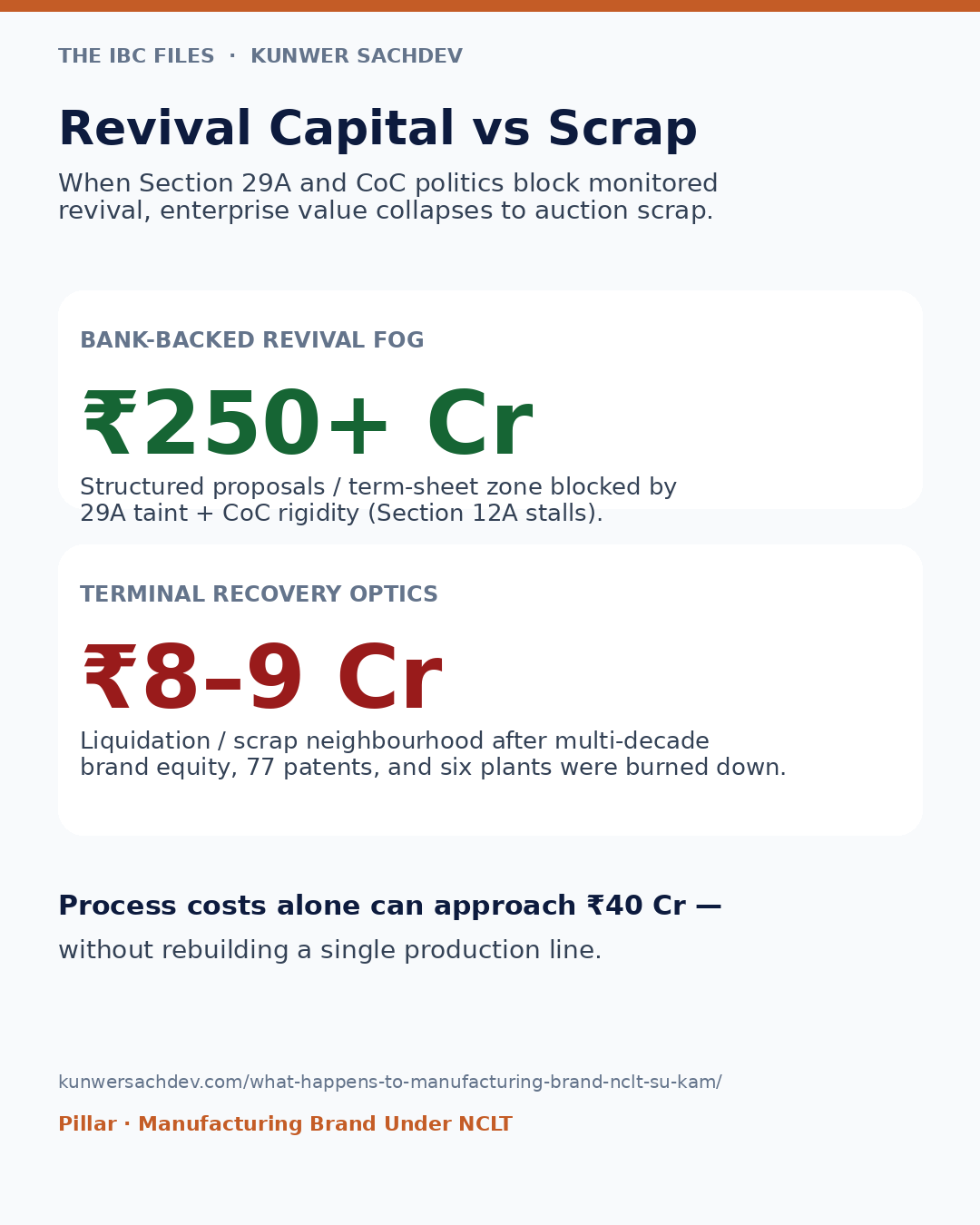
In Su-Kam’s case, this distortion produced a devastating ledger: approximately ₹40 crore was drained under CIRP administrative costs, while the final scrap liquidation auction yielded a mere ₹8.5 to ₹9 crore.
More capital was consumed winding the asset down than the banking consortium recovered at auction. Neither IBBI nor MCA tracks how much Interim Finance lenders disburse to preserve enterprises versus how much is drained by CIRP fees.
1. The Arithmetic of Destruction: Su-Kam vs. Scrap Realization
| Metric / Balance Sheet Item | Pre-CIRP Operational Reality | The CIRP Outcome (Post-600 Days) |
|---|---|---|
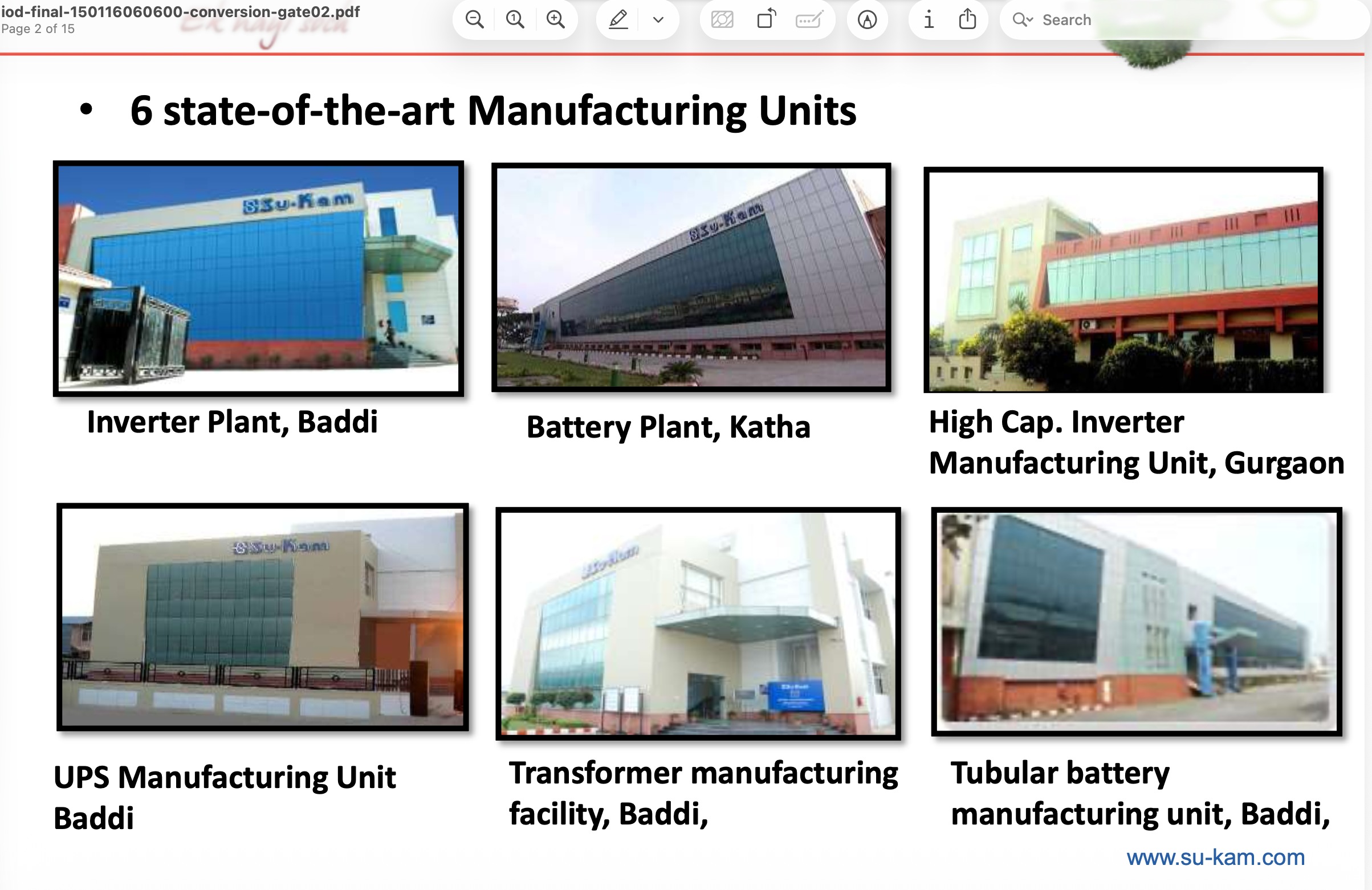
| Manufacturing Infrastructure | 6 fully automated plants across Gurgaon and Baddi | Assembly lines idled, equipment oxidized, plants auctioned as scrap |
| Annual Revenue & Patents | ₹600+ Crore annual turnover; 77 registered patents | Zero revenue; proprietary firmware and IP sold off unvalued |
| Interim Finance Disbursed by Banks | Requested ₹30–₹40 Cr working capital to fulfill POs | ₹0.00 (Zero Rupee Working Capital Disbursed) |
| Total Incurred CIRP Expenses | Targeted procedural administration | ~₹40 Crore (RP fees, Big-4 auditors, legal counsels, security) |
| Final Scrap Realization for Creditors | Book debt and ongoing enterprise valuation | ~₹8.5 to ₹9 Crore |
| Net Value Created / Destroyed | Baseline going-concern asset value | -₹31.5 Crore Net Cash Extraction Loss |
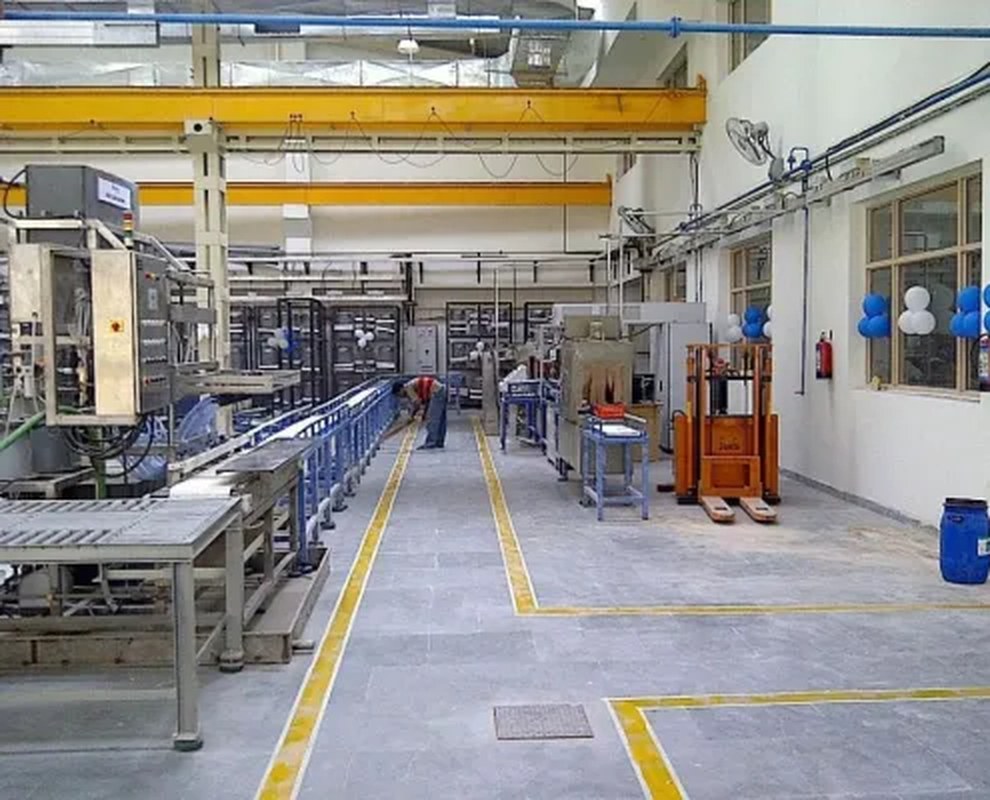
Had the consortium approved a ₹30 to ₹40 crore working capital line as statutory Interim Finance in 2018:
- Solar hybrid inverter and BESS lines would have continued.
- 400+ MSME suppliers would have retained an active customer — preventing secondary failures in Pillar #4: The Silent Bloodbath.
- Engineers would have stayed employed rather than migrating during idle months.
- Creditors could have pitched turnaround investors on active cash flows rather than cold metal weight — see Pillar #3 and the Value Destruction Modeler.
Instead, lenders disbursed zero operating capital, locked the gates, and let retainers consume the estate. Shop-floor chronology: Pillar #1.
2. Industry-Wide Evidence: The Fee Machine Across Sectors

Case 1: Jet Airways
When Jet Airways was admitted into CIRP in 2019, the SBI-led consortium discussed emergency interim liquidity of ₹1,500 crore to keep slots operational. In reality the taps were turned off. Aircraft were repossessed, slots lapsed, and hundreds of crores were consumed in professional fees and preservation charges over years of litigation.
Case 2: Amtek Auto
A flagship tier-1 automotive forging manufacturer was trapped in CIRP for over three years amid bidder pull-outs and appeals. Working-capital financing was rationed while advisory retainers, Big-4 monitoring, and valuation charges were steadily debited against internal cash accruals.
Case 3: Monnet Ispat & Energy
Monnet’s multi-year CIRP illustrated the same inversion at steel-scale: interim working capital to keep furnaces and downstream lines operational was rationed or refused, while RP retainers, legal teams, and monitoring fees continued to debit the estate. By the time control stabilized, plant economics had already absorbed months of idle burn that process costs never had to justify against recovery.
3. The Statutory Inversion: Why Bankers Starve the Factory Floor
- The Vigilance Trap for Interim Finance: Approving ₹20 crore interim finance for copper and semiconductors exposes PSU officers to CVC/CAG/personal accountability if revival fails. Approving administrative CIRP fees is a shielded procedural sign-off. Related fear loops: Section 29A Paradox / 240A Playbook.
- Super-Priority under Section 53(1)(a): Insolvency Resolution Process Costs are paid first—ahead of secured FCs, workers, and suppliers. The CoC treats fees as an unavoidable tax, not an ROI investment.
- The Forensic Industry: To manage Section 29A / avoidance risk, the CoC commissions forensic reviews and transaction audits (Sections 43, 45, 50, 66) that cost tens of lakhs per month and often recover nothing—while equipment sits uncalibrated.
“In advanced manufacturing, an idle factory does not freeze in time. Wave-soldering baths oxidize, pick-and-place feeders jam, electrolytic capacitors degrade, and top engineering talent departs. An idle plant is dying by the hour.”
— Kunwer Sachdev

4. The Human Capital Write-Off: How 3,000+ Liquidations Destroyed Over 1.5 Million Manufacturing Jobs
The preamble to the IBC explicitly defines its purpose: revival of the corporate debtor, maximization of value of assets, and balancing the interests of all stakeholders.
Nowhere does the statute state that its goal is to act as a debt-collection agency for state-owned banks at the expense of livelihoods. The economic justification for creating the IBC—over archaic liquidation acts—was to protect running enterprises and preserve industrial jobs.
Yet the regulatory apparatus treats employment data as completely invisible.
The Statistical Fraud: The “85% Retention” Myth
When IBBI occasionally touches employment, it releases curated studies claiming that “85% of jobs were saved across resolved corporate debtors.” This is a statistical sleight of hand:
- The Denominator Trap: The 85% figure is calculated only across the ~1,400 companies that had approved resolution plans.
- The Liquidation Blackout: It omits the 3,000+ companies sent to liquidation—where job retention is zero percent (100% termination).
- The Contractor Erasure: Official counts cover only on-roll permanent employees. In modern manufacturing, 60% to 75% of assembly operators, coil winders, packers, and logistics handlers are contract workers. When the gate locks under Section 14, they are dropped overnight with zero retrenchment compensation, zero statutory tracking, and zero presence on the IBBI dashboard.
THE REAL EMPLOYMENT CASUALTY RATE OF THE IBC:

Total Companies Entering CIRP:           ~7,000+
  ├── Approved Resolution Plans:          ~1,480  (Only ~21% of closed cases)
  │    └── Retained Workforce:            ~85% of on-roll staff
  │
  └── Sent to Scrap Liquidation:         ~3,070+ (Over 50% mortality rate)
       └── Retained Workforce:            0.0% (Total termination)

Cumulative Industrial Job Losses:        Estimated 1.5M to 2.0M+ workers
(Direct factory staff + 400+ ancillary vendor supply chains per plant)
Official Regulatory Records:              ZERO DATA MAINTAINED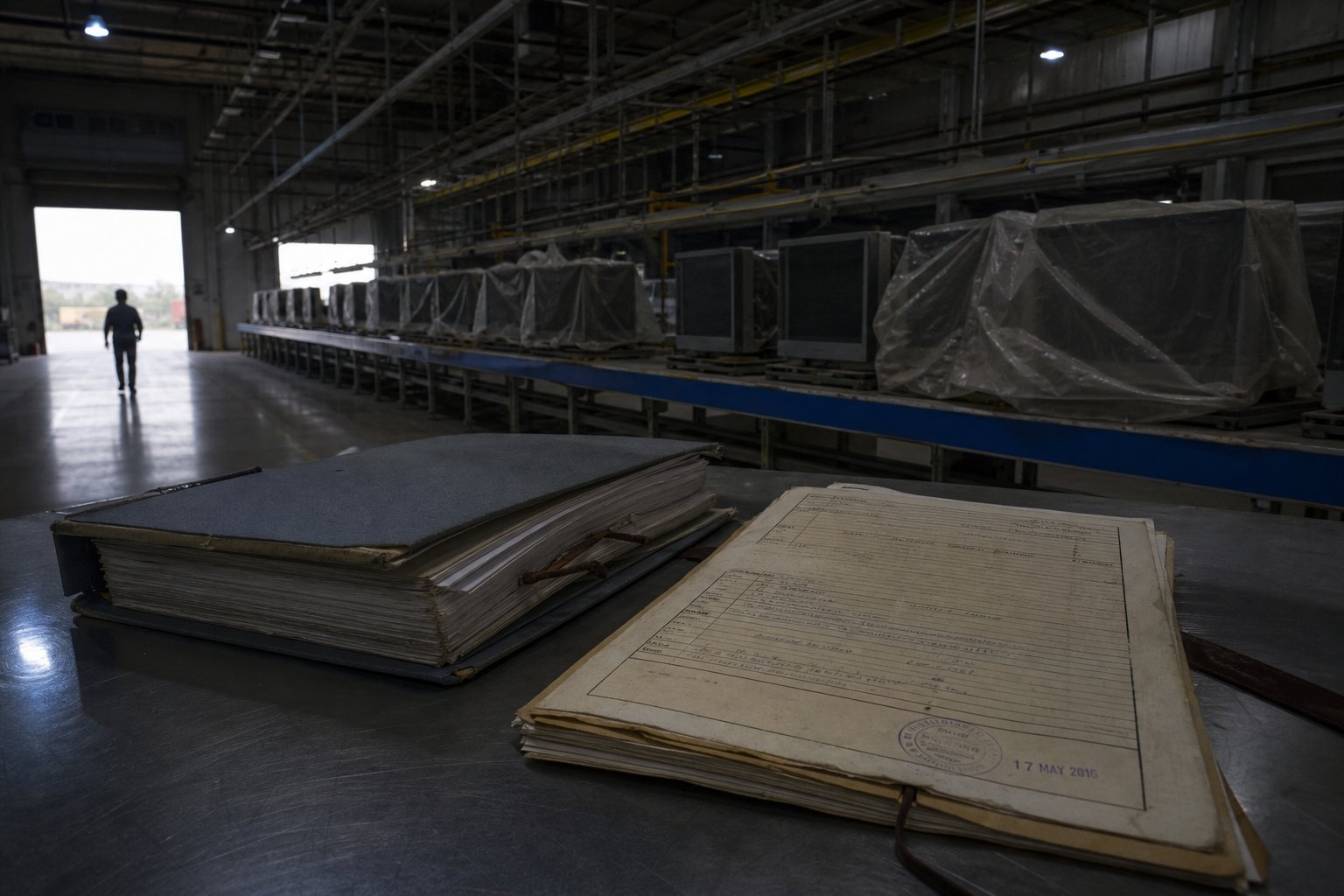
The Su-Kam Empirical Reality: Skilled Human Capital Scrapped
An advanced manufacturing enterprise is not only CNC machines and dies—it is decades of human skill:
- Assembly & Calibration Technicians trained over 15 years on high-frequency windings, IGBT modules, and solar charge controllers.
- R&D and Embedded Engineers who wrote proprietary firmware for 77 patented power topologies.
- Service & Field Engineers—over 2,000 pan-India technicians servicing hospitals, telecom towers, and rural bank branches.
When banks starved the company of ₹30 crore in interim working capital, thousands of direct and indirect livelihoods evaporated:
- In-house workers in Gurgaon and Baddi were cast onto the street with months of unpaid wages stuck behind the Section 53 waterfall.
- Across 400+ MSME suppliers, specialized tooling operators lost shifts as component orders fell to zero (Pillar #4).
- High-end electronics talent migrated away or left hardware design entirely.
When an asset is liquidated as scrap metal, that human capital is dismantled forever. You can buy another sheet-metal press; you cannot rebuild a 30-year engineering and assembly ecosystem overnight.
The Three Employment Blindspots the Government Must Track
| Employment Metric | Current Official Status | The Ground Reality |
|---|---|---|
| Direct Shop-Floor Layoffs | Not Tracked in Liquidation | 100% of workers terminated when Section 33 scrap orders are issued |
| Supply-Chain Livelihoods | Zero Tracking | 3 to 5 jobs lost in tier-2/3 vendor shops for every 1 anchor manufacturing job lost |
| Contract & Informal Labor | Excluded from Studies | 60–75% of plant workforce dismissed without notice on Day 1 of CIRP |
| Provident Fund & Gratuity Delays | Lumped in Resolution | Workmen forced to wait 600+ days for Section 53 Priority 2 payouts |
An economic law that spends ₹40 crore in administrative fees, collects ₹9 crore in scrap, wipes out 400 MSME suppliers, and terminates thousands of specialized manufacturing workers is not saving the economy—it is systematically de-industrializing the nation.
5. The Data Blackout: What the IBBI Deliberately Omits
| Process & Financial Metric | Published in Official IBBI Bulletins? | The Ground Reality in Tribunals |
|---|---|---|
| Total CIRP Costs Approved per Debtor | NO (Buried in private CoC filings) | Routinely 5% to 25% of final enterprise value in mid-market manufacturing |
| Percentage of CIRPs Receiving Interim Finance | NO | Working capital disbursed in less than 3% of manufacturing cases |
| CIRP Cost vs Final Realization Ratio | NO | Often procedural costs exceed recovery (Su-Kam: ₹40 Cr spent vs ₹9 Cr recovered) |
| Asset Value Erosion from Day 1 to Final Order | NO | Idled technology enterprises suffer 60% to 80% valuation decay |
This blackout rhymes with Pillar #4’s Recovery-Only Data Blindspot: an insolvency regime that starves debtors of operating capital while paying uncapped professional fees is not restructuring—it is value destruction.
Pair this cost blackout with the employment blackout in Section 4: without publishing CIRP-cost-to-recovery ratios and liquidation job mortality, Parliament only sees bank haircut headlines — never the ₹40 Cr vs ₹9 Cr inversion or the 1.5M+ livelihood wipeout.
6. Three Statutory Reforms to End the Parasitic Model
1. Financial Creditors Must Directly Fund CIRP Costs
CIRP expenses must not be deducted from the debtor’s cash or sale proceeds. Financial creditors who initiate CIRP or constitute the CoC must fund process costs from their own balance sheets upfront. When banks pay the RP, advocates, and forensic auditors from their operating budgets, 600-day delays and frivolous litigation shrink.
2. Mandatory Interim Working Capital Thresholds
If the CoC resolves that an enterprise should be managed as a going concern under Section 20, statute must mandate an obligatory Interim Working Capital Line (at least 10% to 15% of trailing annual turnover) funded proportionately by consortium lenders. If banks refuse operational liquidity, the debtor should exit CIRP into court-supervised mediation or promoter-led restructuring.
3. Mandatory Publication of the “Process-to-Recovery” Ledger
Amend Section 196 so IBBI publishes a quarterly public register of every rupee of CIRP cost for every resolved and liquidated debtor. When Parliament can see ₹40 crore spent to recover ₹9 crore, procedural delay loses its cover. The same Section 196 mandate must publish the Human Ledger of CIRP—liquidation job mortality, contract-labour dismissals, and supply-chain livelihood losses—not only bank cash realization (see also Pillar #4’s Total Economic Impact Scorecard).
The Verdict
An insolvency framework that spends ₹40 crore to recover ₹9 crore is fundamentally flawed. It penalizes the entrepreneur who built the factory, wipes out MSME suppliers who sustained the line (Pillar #4), and sacrifices industrial capability for procedural overhead.
Make financial institutions accountable for the processes they trigger. Ensure operating companies receive working capital to survive. Stop sacrificing real manufacturing for paper recoveries.
— Kunwer Sachdev
Founder, Su-Kam Power Systems (1988–2018) · Founder, Kunwwer.ai
The IBC Files — Complete Series Navigation
- Pillar #1: What Really Happens to a Manufacturing Brand Under NCLT?
- Pillar #2: The Section 29A Paradox
- Pillar #3: The 90% Hostage Crisis (Section 12A)
- Pillar #4: The Silent Bloodbath (Operational Creditors)
- Pillar #5: The CIRP Cost Parasite (Current)
- Interactive: IBC Value Destruction Modeler
- Interactive: MSME 240A Neutralization Flow
Key external references
Found this story worth sharing? Post it to your network — it takes one click: