I Gave This Talk at the Marriott Chandigarh.
Years Later, Someone Uploaded It — and Sent Me the Link.
Su-Kam eRevolution Chandigarh 2011 — On 24 September 2011, I stood on stage at Hotel Marriott, Chandigarh for eRevolution 2011 and spoke about innovation, R&D, and how Su-Kam built India’s power backup industry — one factory, one patent, one dealer at a time. These are the original slides from that day.
Why I am writing this. I have spoken at dozens of conferences over the years — energy summits, dealer meets, industry forums, export councils, university events. I never kept count. You prepare your slides, you walk on stage, you speak from the heart, you come back to the factory on Monday. That was the rhythm for decades.
Recently, someone sent me a link. “Sir, do you remember this?” It was on SlideShare — my presentation from eRevolution 2011 at the Marriott Chandigarh, dated 24 September 2011. Uploaded by the conference organisers. Seventy slides. Crystal clear. My name on the title slide. Innovation and R&D for Business Development.
I opened it and time collapsed.
I remembered the hotel ballroom. The audience of engineers, dealers, industry people. The pride of showing what we had built — not what we planned to build, not what a pitch deck promised investors. What was already standing: factories, R&D labs, 10,000 dealers, exports to 71 countries. I remembered thinking that day: We are not a startup telling a story. We are a company showing proof.
There is also a corporate presentation floating on Scribd — uploaded much later by someone on my team, with a 2021 date stamp that means nothing historically. That deck is a company profile. Useful. But it is not the Chandigarh talk. The Chandigarh talk is me — on stage, in 2011, explaining why R&D was the spine of everything Su-Kam ever did.
This blog walks through the original 2011 slides — the ones that matter — with a few project photographs from the corporate archive where they add proof the stage presentation could not carry alone. Every date in this story is real. The conference was 24 September 2011. Su-Kam was founded in 1988, from one small shop in Delhi. That is where everything begins.
Before the Slides — One Shop in Delhi, 1988
I cannot show you a slide for 1988. There was no slide deck when I opened a small shop in Delhi and started learning the electronics market while India sat in the dark for hours every day. No investor. No incubator. Just heat, dust, voltage swings, and the stubborn thought: Indians deserve reliable power.
Everything in the Chandigarh presentation — every factory, every patent, every export container — grew from that shop. When you look at these slides, read them backwards. The 2011 stage is the outcome. The 1988 shop is the cause.
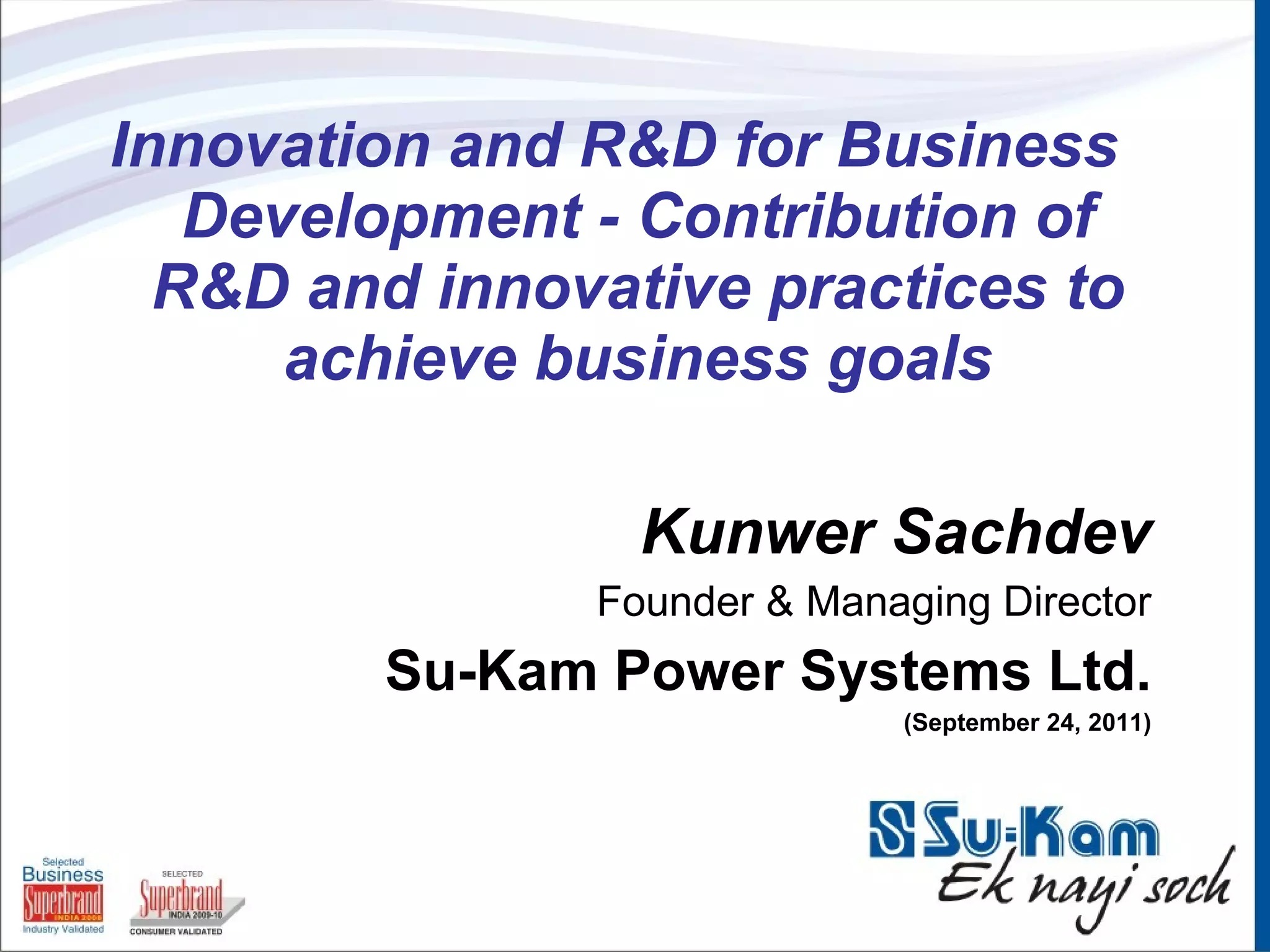
Slide 1: What I Told the Room That Day
The title slide says it plainly: Innovation and R&D for Business Development. Not marketing. Not finance. R&D. That was deliberate. I had watched too many Indian manufacturers become assembly shops for foreign brands. I wanted Su-Kam to be an engineering company that happened to sell products — not the other way around.
When I speak at conferences, I speak as a builder, not a brand ambassador. This slide is the proof. My name. My title. The subject I chose to talk about when I could have talked about anything.
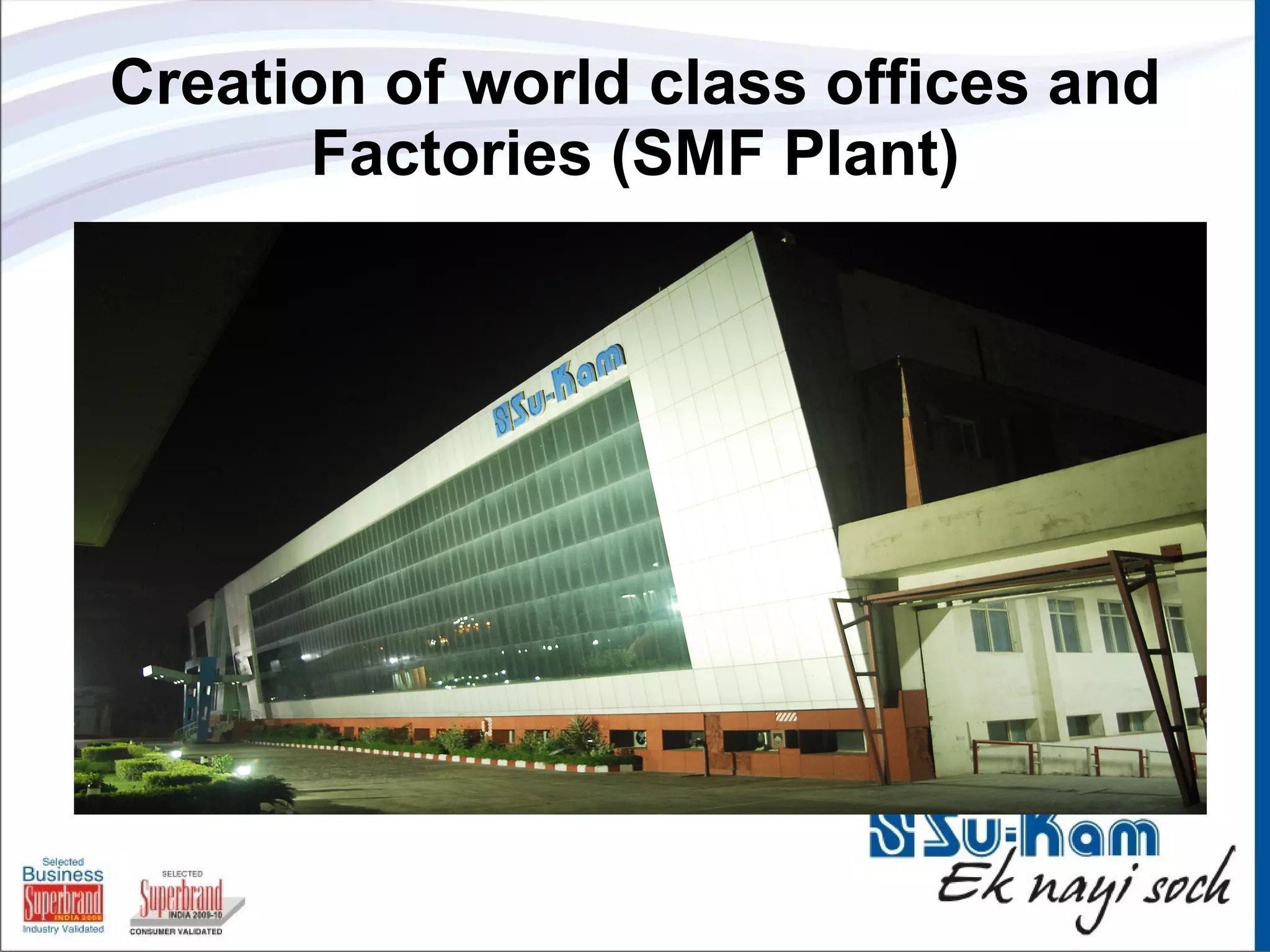
Slide 2: World-Class Factories — Not Slides, Buildings
This slide shows the SMF plant and our world-class offices. Photographs, not renderings. In 2011, when I clicked to this slide, the audience could see the lights were on, the building was real, the production lines were running. That mattered in an era when Indian manufacturing was still fighting for respect.
Every factory in this presentation was a bet. Parwanoo. Gurgaon. Baddi. When a dealer in Indore asked for ten thousand units, these buildings answered. Not a spreadsheet. Not a promise. A shift running overtime.
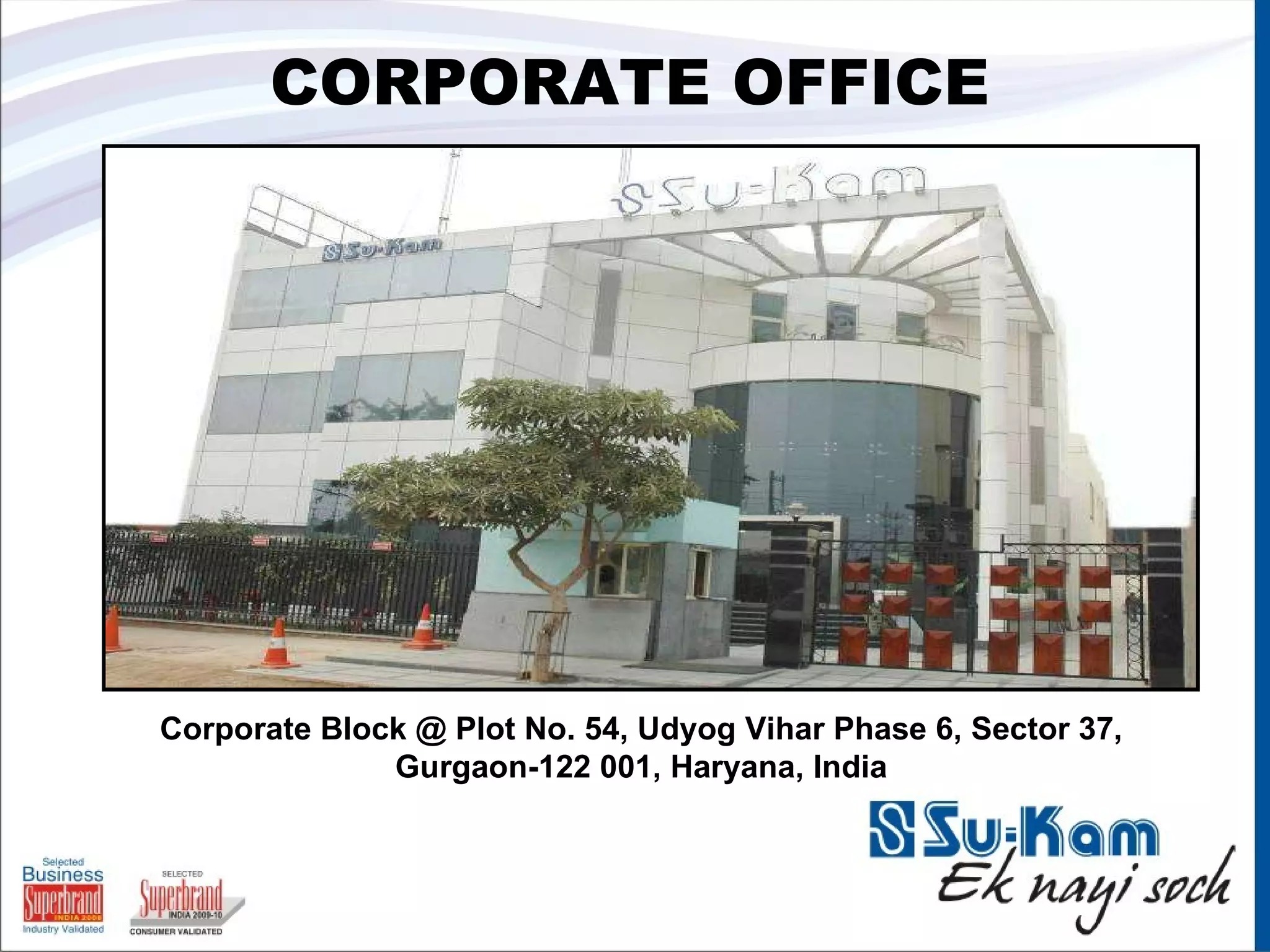
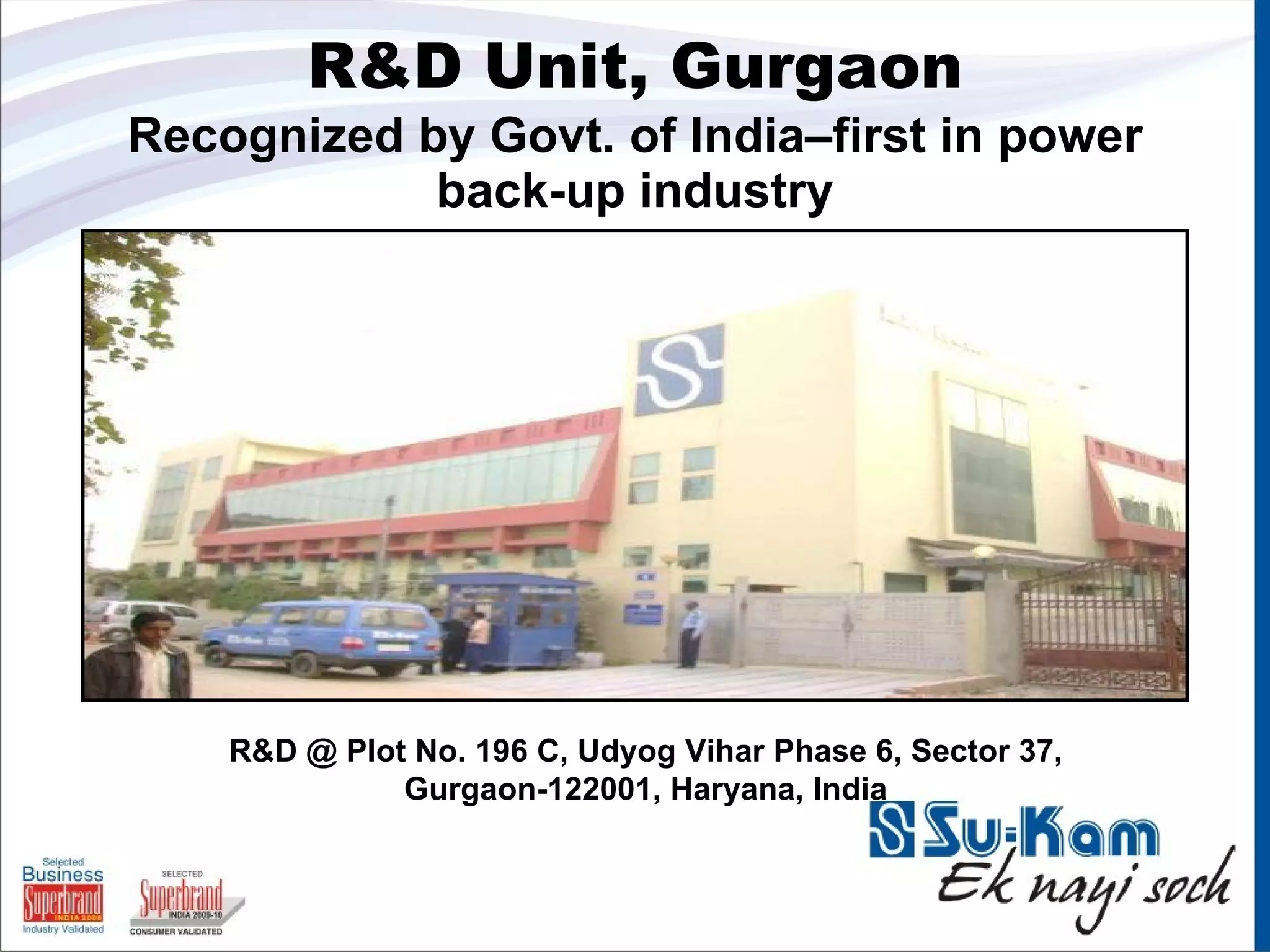
Slides 3–4: Corporate Office and R&D — Recognised by the Government of India
The corporate block at Udyog Vihar, Gurgaon — by 2011, Su-Kam had long outgrown the Delhi shop. Gurgaon was headquarters. But the roots were always Delhi. Always 1988.
The R&D unit slide carries a line I am still proud of: recognised by the Government of India — first in the power backup industry. That was not vanity. That was validation that we were not copying. We were inventing — MOSFET inverters, sine wave technology, high-capacity systems built for Indian heat and dust.
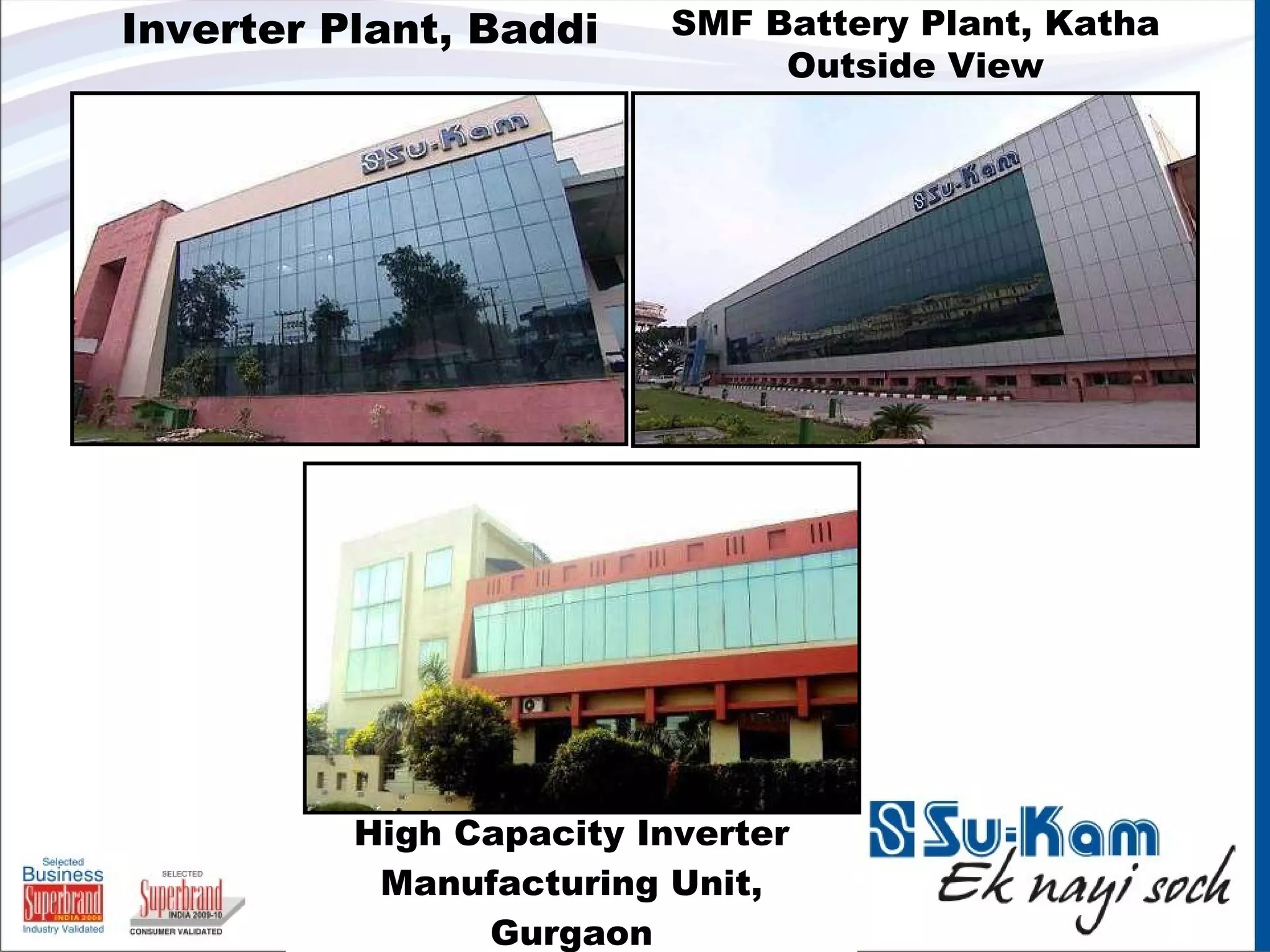
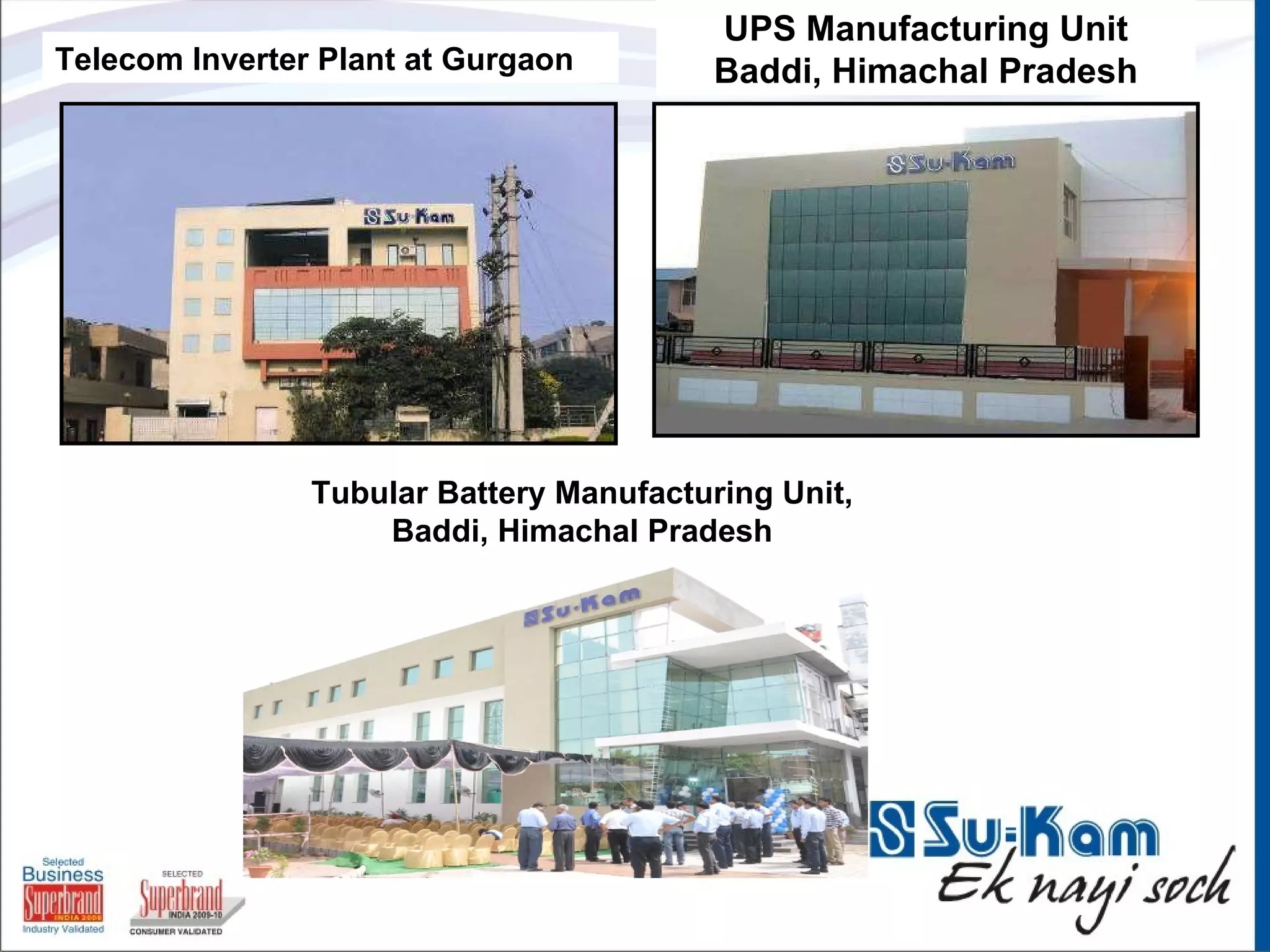
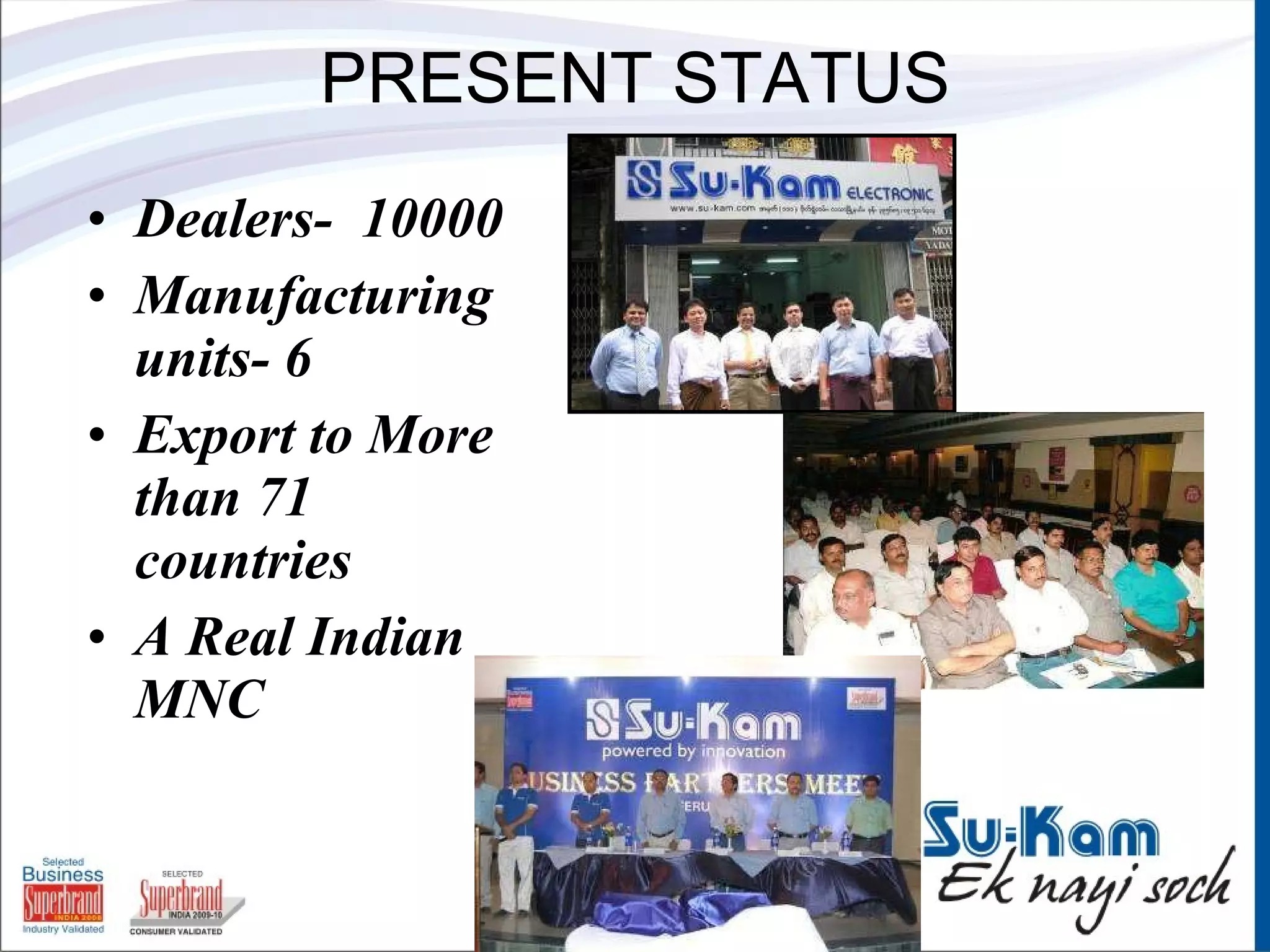
Slides 5–7: Six Manufacturing Units — The Backbone
High-capacity inverter plant. SMF battery plant at Baddi. Tubular battery manufacturing. Telecom inverter plant. UPS manufacturing. Each slide is a different kind of pain we solved — home backup, telecom tower uptime, industrial continuity, battery chemistry in Himalayan humidity.
Conference audiences sometimes expect inspiration. I gave them infrastructure. Because inspiration without infrastructure is a TED talk. Infrastructure without inspiration is a warehouse. Su-Kam was both.
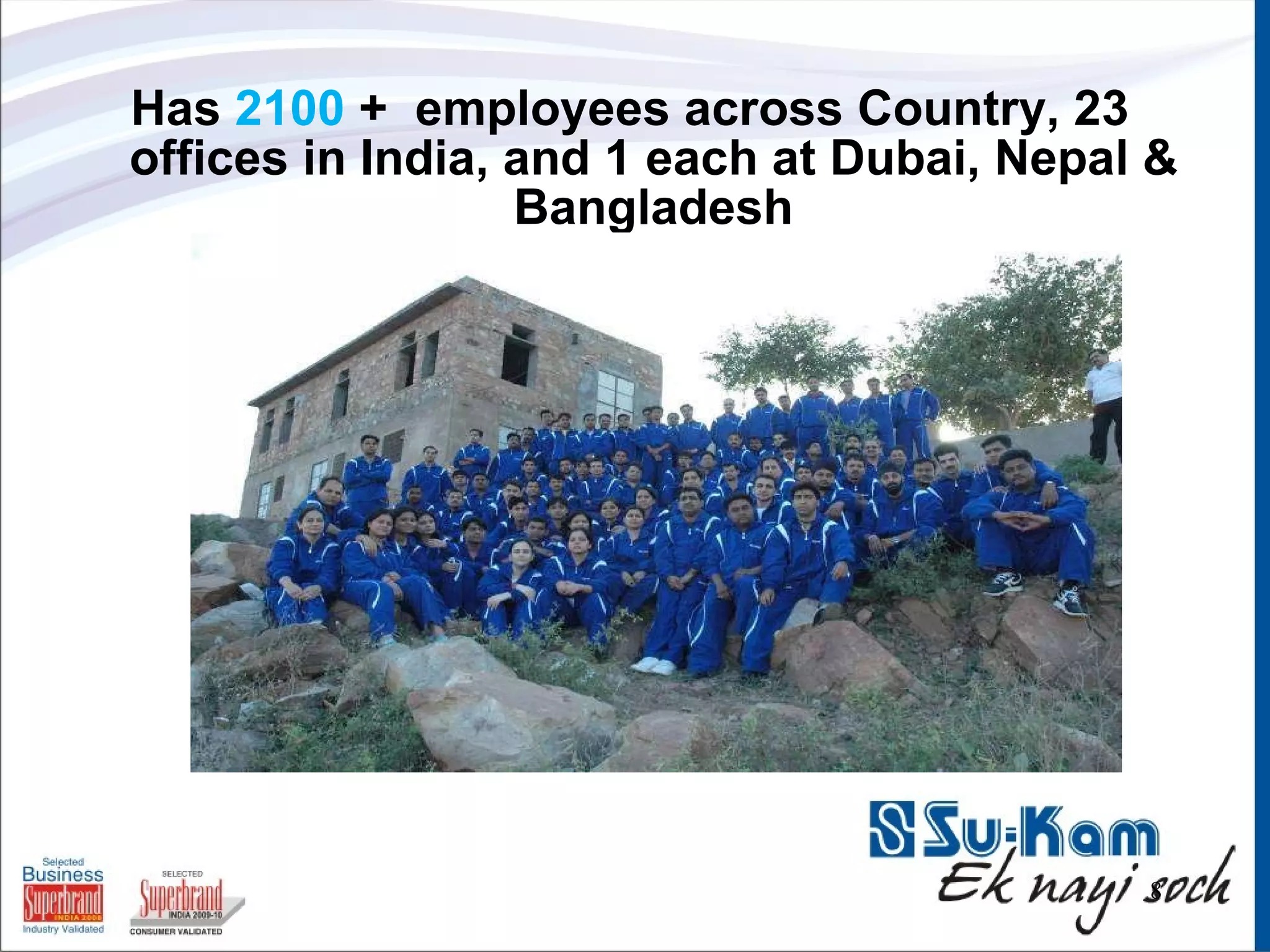
Slide 8: The Numbers — 10,000 Dealers, 71 Countries
This is the slide that quietens a room. Ten thousand dealers. Six manufacturing units. Export to more than 71 countries. A real Indian multinational — not in a press release, on a stage in Chandigarh in 2011.
Behind each number: a person. A dealer who staked his reputation on us. An export manager who sat in Lagos or Nairobi and explained why an Indian inverter was worth trusting. An engineer who missed a family dinner because a production line could not stop.
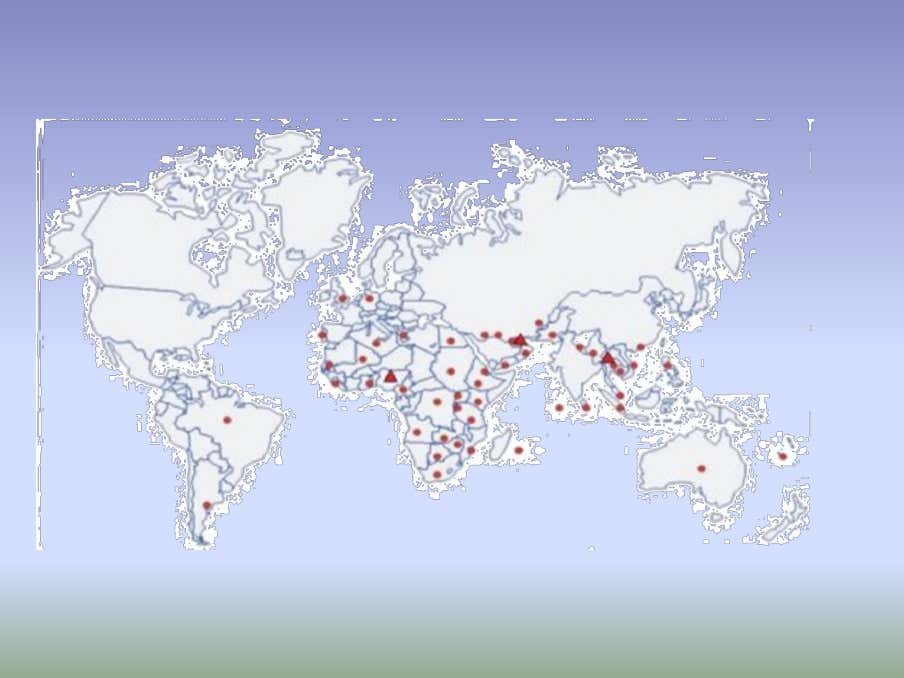
From the corporate archive — a world map showing Su-Kam’s export footprint. Each red mark on this map was a flight, a handshake, a container, a customer who chose India.
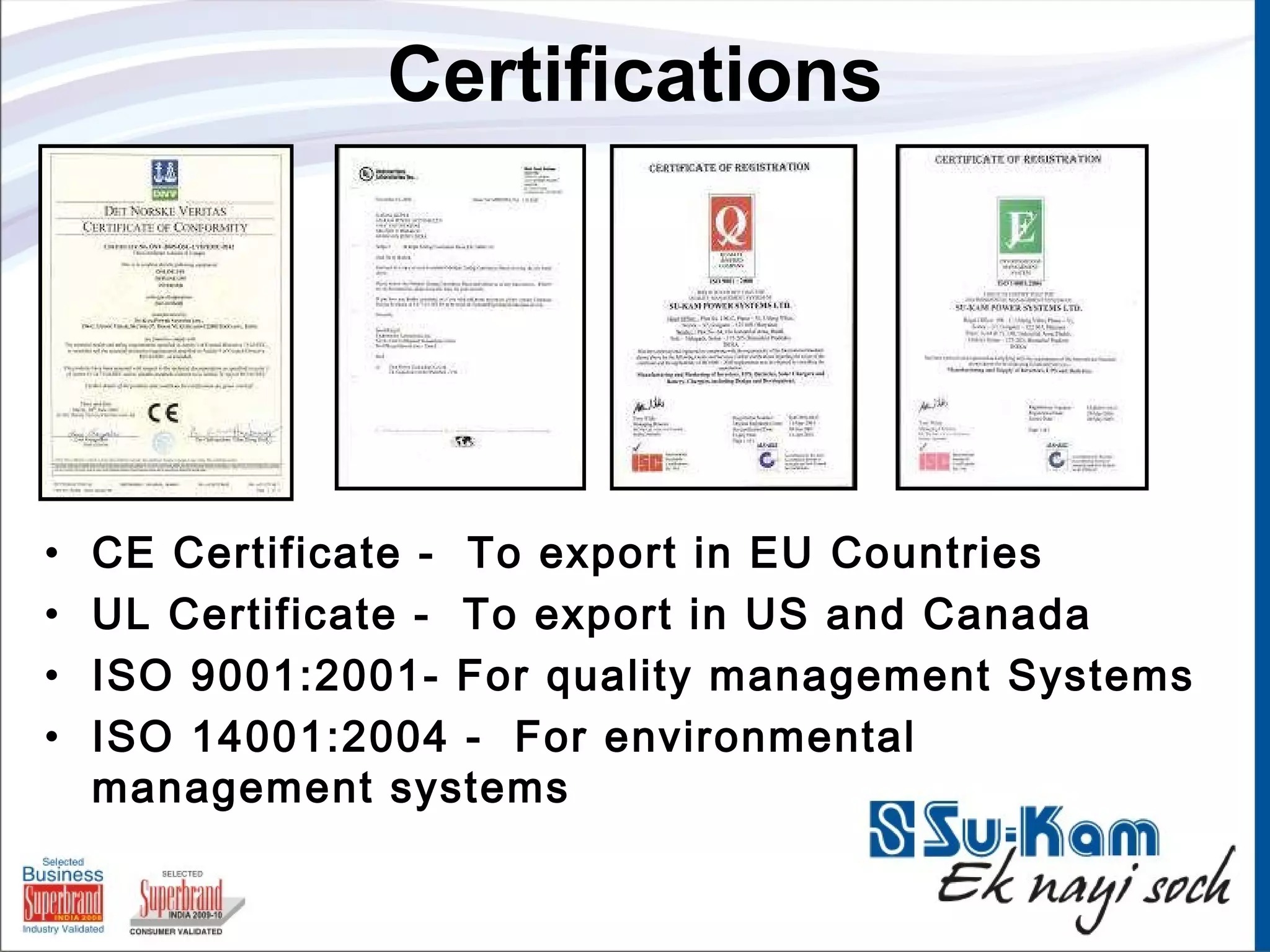
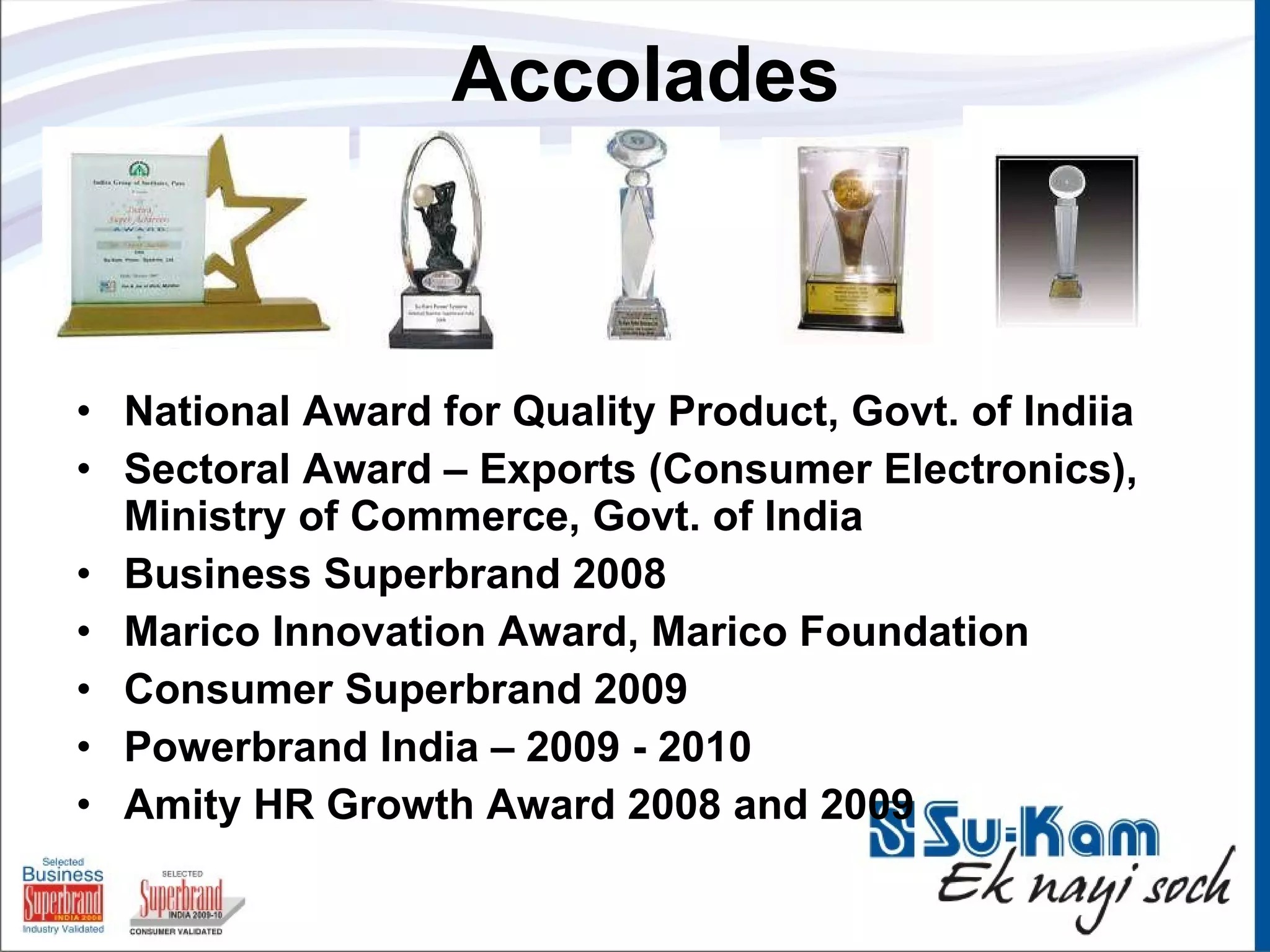
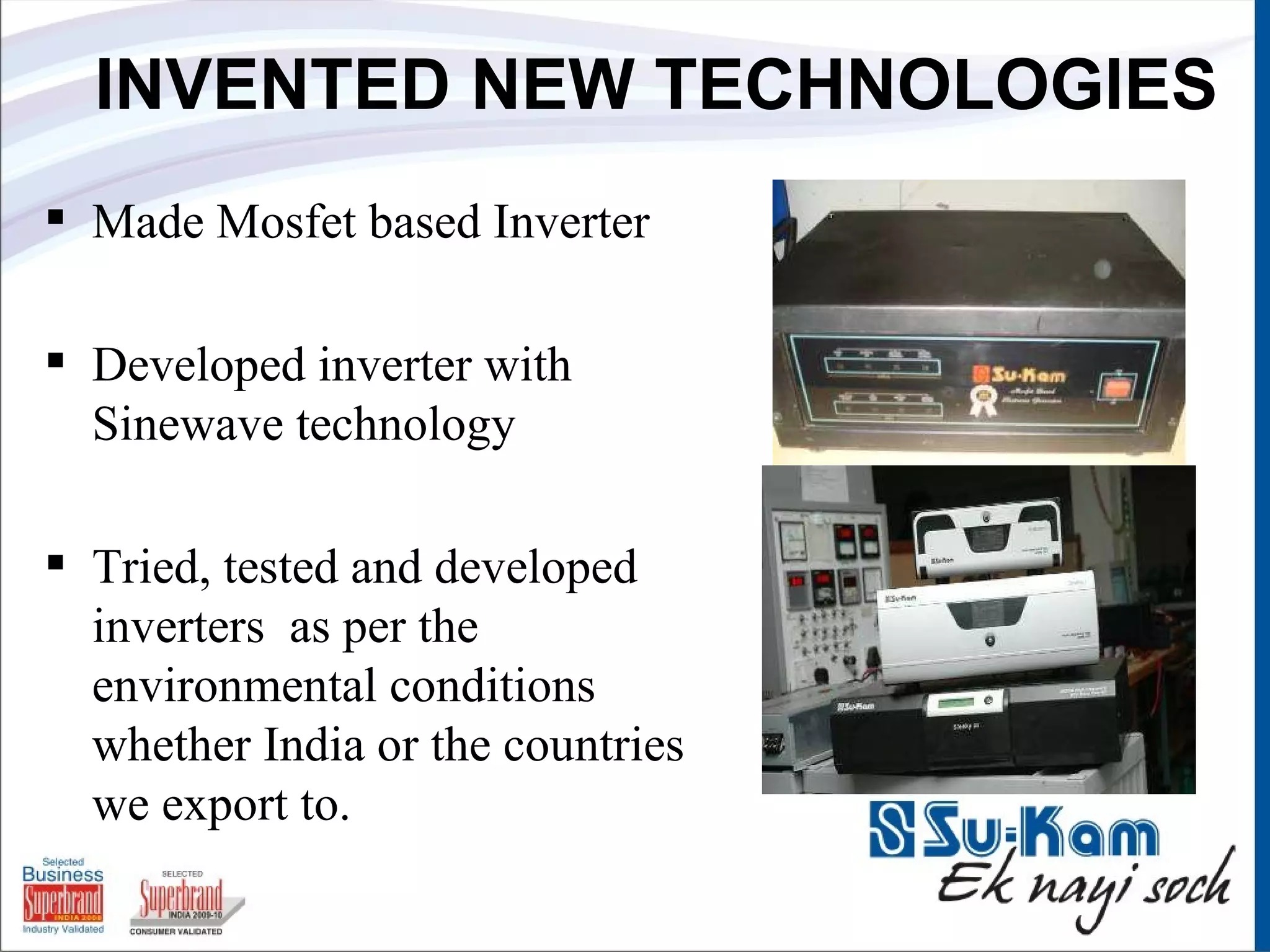
Slides 9–12: The Technology Story — Why R&D Was Never Optional
MOSFET-based inverters. Pure sine wave. India’s first high-capacity inverter. Sixty-five patents filed in India and internationally. These slides are the answer to every person who ever asked, “Can India innovate?”
I did not put these slides in to impress. I put them in because the room was full of engineers who would know if I was bluffing. Chandigarh was not a motivational talk. It was a technical account of what we had built and how.
Project Proof — From the Field (Corporate Archive)
The Chandigarh presentation focused on innovation and infrastructure. These project slides — preserved separately in a corporate deck — show what that infrastructure delivered on the ground.
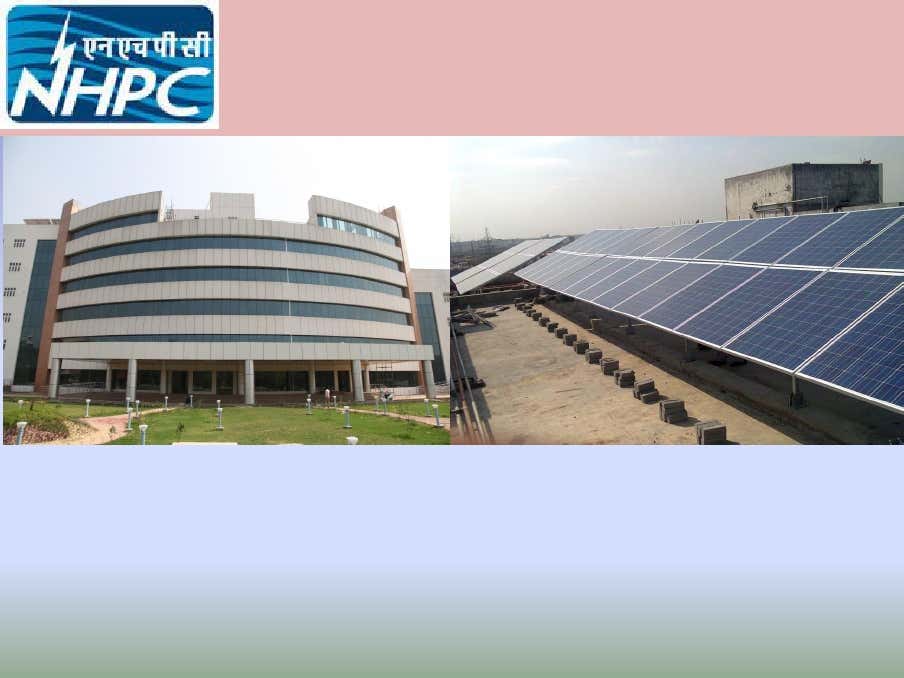
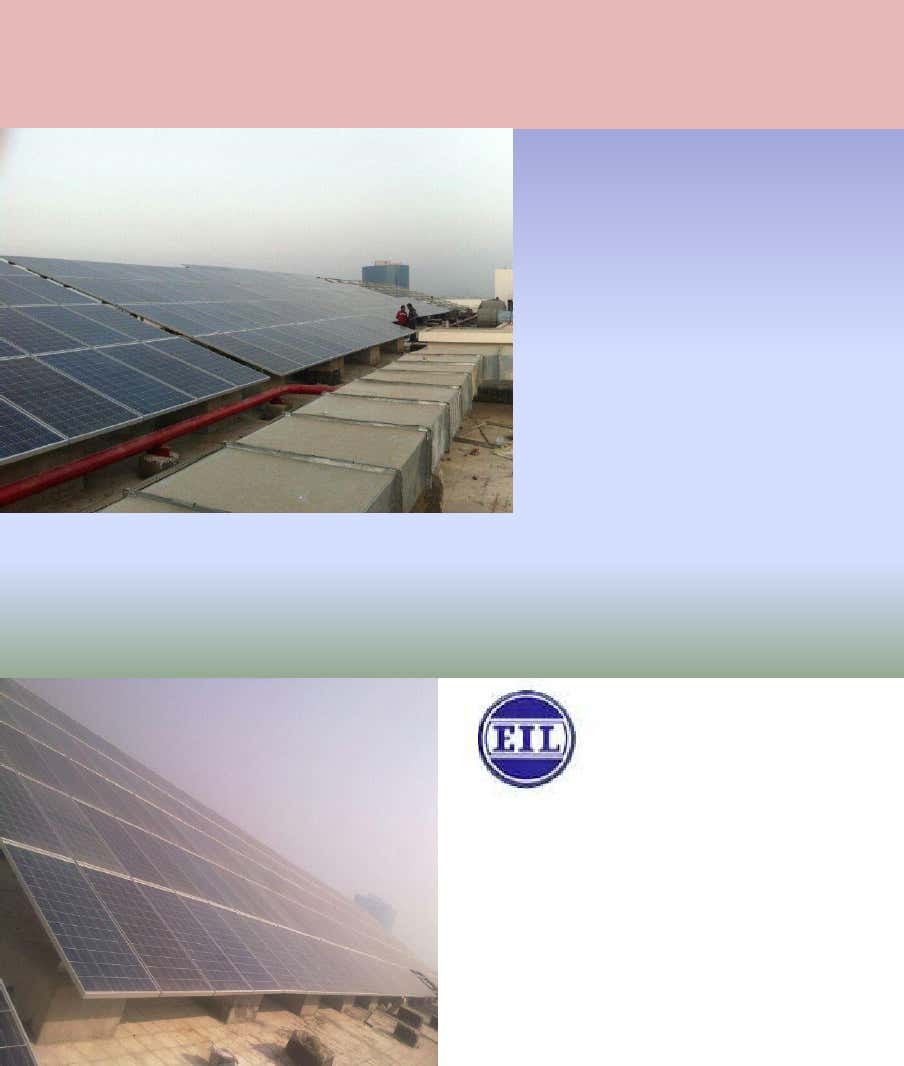
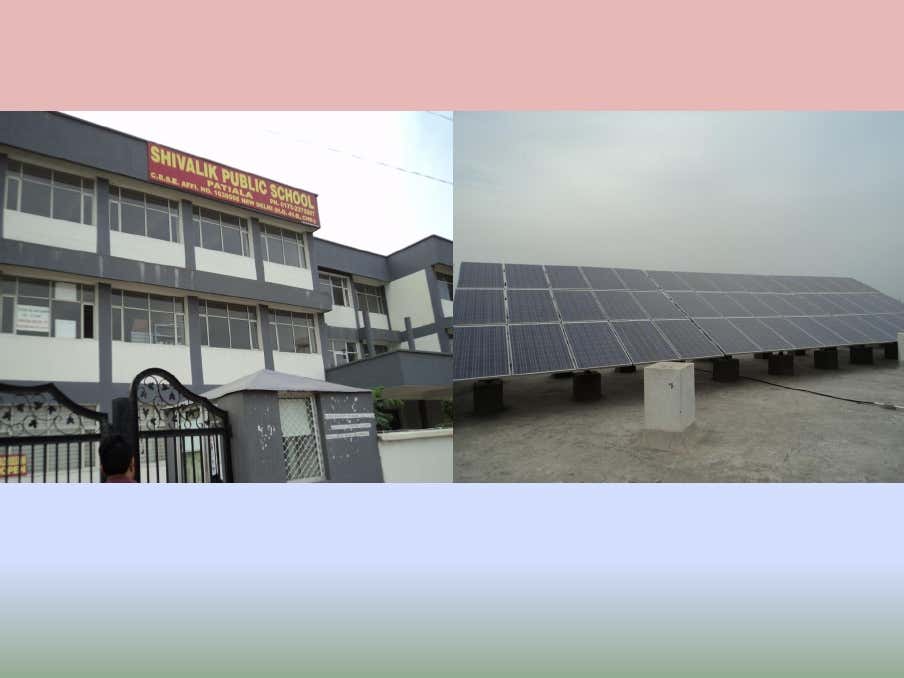
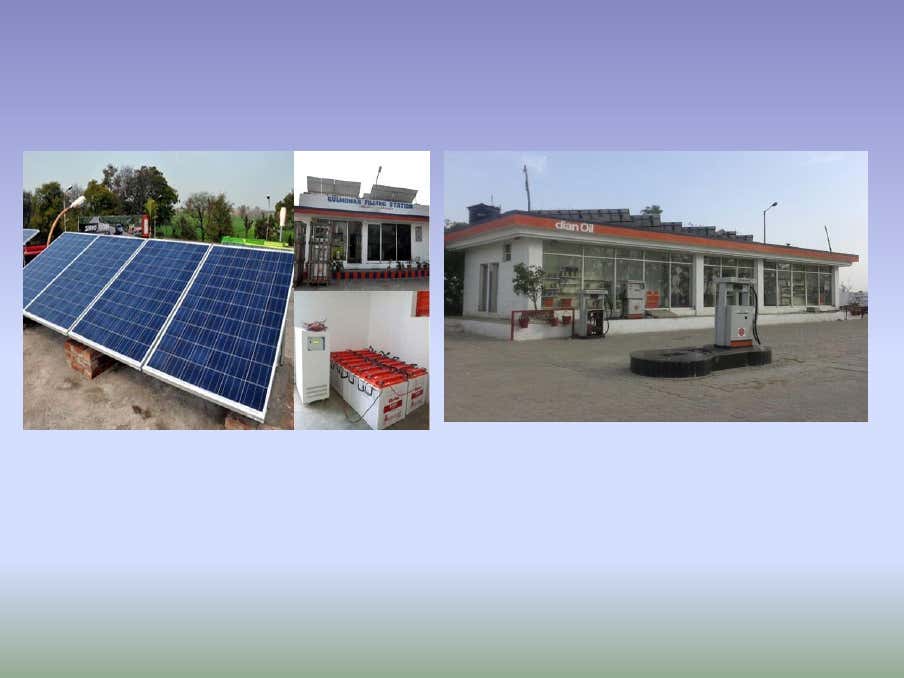
NHPC Faridabad — when a national hydro power corporation puts your solar system on its corporate roof, that is trust at the highest level. Engineers India Limited — industrial-scale rooftop solar before it was fashionable. Shivalik Public School, Patiala — panels on a school roof, children studying under sun-powered lights. Gulmohar Filling Station — a petrol pump where downtime is not an option, running on Su-Kam solar.
These are not slides I showed in Chandigarh. They are slides I could have shown — proof that the R&D story ended in real installations, not just patents on a wall.
I did not write this blog to nostalgia-trip. I wrote it because a generation of entrepreneurs is being told that companies are built on pitch decks and funding rounds. Su-Kam was built on R&D, factories, dealers, service engineers on scooters, and nights in the lab. The Chandigarh slides prove it. The project photographs confirm it. The dates are real — 24 September 2011, not some random upload timestamp years later.
If you are building something — from one shop, one idea, one refusal to accept the way things are — these slides are for you. Not as history. As evidence.
eRevolution 2011 · 24 September 2011 · Hotel Marriott, Chandigarh
🔗 Founder stories — read the series
- 📖 CE Mark & Intersolar Munich 2011
- 📖 Exporting Inverters to China
- 📖 BSF Border Solar Posts
- 📖 Why I Started the Su-Kam YouTube Channel
- 📖 Solar PCU Invented in 2005
- 📖 India’s First 3-Phase Solar System in 2006
- 📖 Baddi Factory & Tubular Gel Battery
- 📖 Kashmir Shikaras — Floating Billboards of Hope
- 📖 Brainy Eco Solar Hybrid PCU
- 📖 Colossal Solar PCU — Inverter to Power Plant
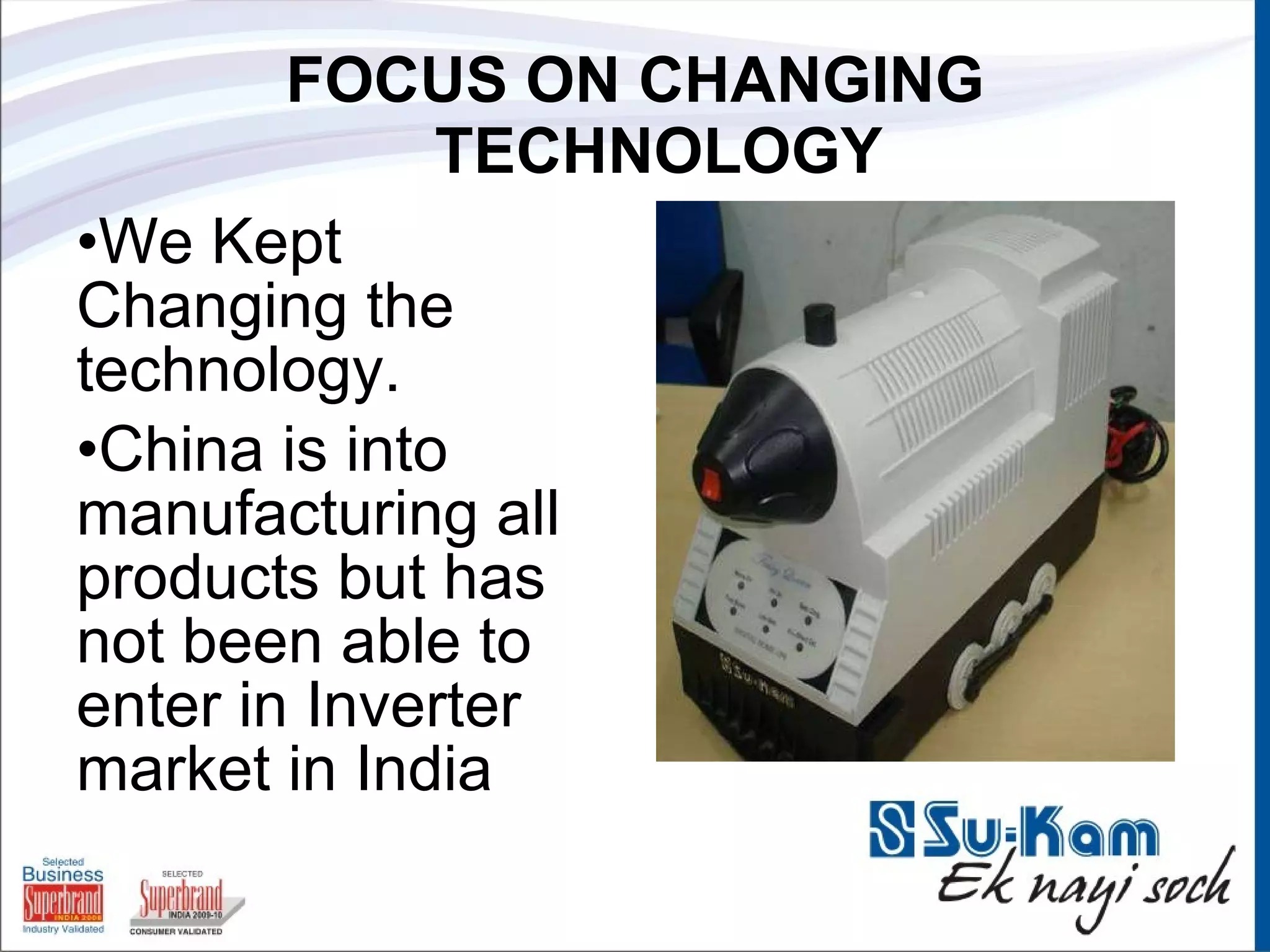
- 📖 0% Chinese Share in Inverters — India’s Pride
- 📖 Technovations at Su-Kam 2012 — SlideShare Deck
- 📖 My Story — Twelve Chapters on SolarManOfIndia.com
Kunwer Sachdev
Founder, Su-Kam Power Systems (1988–2019) and Kunwwer.ai, mentor at Su-vastika — the “Inverter Man of India” and the “Solar Man of India.” Read his story →
Sources: Primary slides from eRevolution 2011 presentation (24 September 2011) — uploaded by event organisers. Supplementary project photographs from the Su-Kam Corporate Presentation archive (Scribd). All images hosted permanently on kunwersachdev.com.