Su-Kam Launches Touch Screen Solar PCU: The Brainy Touch Story
Why a touch screen solar PCU felt like the iPhone
The touch screen solar PCU was Brainy Touch: a 2.5 kVA / 48V MPPT home solar inverter with a colour panel, built when that interface still belonged to phones.
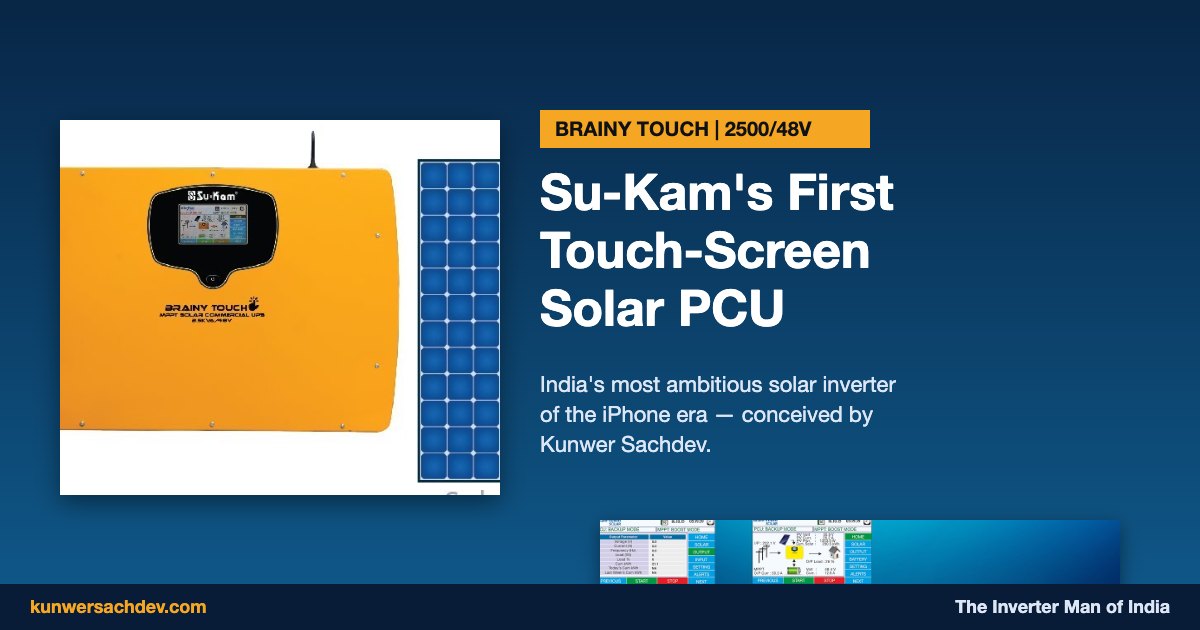
One of the most advanced products I ever conceived at Su-Kam. When Apple launched the iPhone and the world fell in love with the touch-screen, I was completely convinced that touch interfaces would not stay confined to phones — they would soon become the natural way humans interact with every meaningful electronic appliance, including inverters and solar power conditioning units. That conviction led to the Su-Kam Brainy Touch — a 2.5 KVA / 48V MPPT Solar PCU with a full colour touch-screen display, real-time energy graphics, and PC monitoring software, at a time when Wi-Fi and Bluetooth had not yet gone mainstream in India.
The iPhone Moment That Changed How I Thought About Inverters
Most inverters in India in that era still used a row of LEDs and a seven-segment display. I felt that was a generation behind where consumer electronics had already moved. If a phone could show you everything on a single intuitive screen, why couldn’t a solar PCU show you your panels, your battery, your load, your cumulative kWh — all on one beautifully designed touch interface? I was bullish that this was the future. We took the risk and started building.
The touch panel itself had to be imported from China — there was no Indian capacity for industrial-grade resistive/capacitive touch displays at that time. We integrated it with our own MPPT charge controller, our inverter, our communication board, and a desktop monitoring application that talked to the unit over a serial protocol. For India’s solar power-backup market, this was genuinely a leap.
What “Advanced” Actually Meant — Inside the Brainy Touch
This wasn’t a touch panel slapped on top of an ordinary inverter. The internal communication protocol we engineered for the Brainy Touch (SUKAM MPPT Solar PCU Communication Protocol v2.2, authored by our R&D engineers in 2014–2015) handled nine distinct command sets covering everything from instantaneous data to EEPROM data-logging, RTC synchronisation, user configuration writes and emergency shutdown/restart. The touch UI you saw on the screen was just the visible surface of an industrial-grade system underneath.
- Full MPPT charge-controller integration — bulk/boost, absorption, float, automatic and manual equalization, PV-high-voltage and PV-high-current regulation
- 15-bit real-time status flags covering mains/backup, UPS/inverter mode, day/night, overload, short-circuit, over-temperature, fuse-blown and no-load shutdown
- On-board data logging with two records per EEPROM page, configurable intervals (15/30/45 minutes or 1 hour)
- E-meter integration for cumulative input and output kWh stored as 4-byte BCD
- Configurable system priorities — Solar→Battery→Mains, Solar→Mains→Battery, pure Inverter mode, and Hybrid Grid-Tie
- Tiered alarm hierarchy — short-circuit shutdown ranked above battery-low, overload, over-temperature, backfeed and software shutdown, exactly the way industrial PCUs should behave
- CRC-protected configuration writes so the user’s settings could never be corrupted by line noise
In short, this was a properly engineered, multi-mode hybrid solar PCU with data-logging, MPPT, a real alarm hierarchy and configurable grid/solar/battery priority logic — surfaced through a touch-screen UI at a time when no Indian inverter brand was even attempting this. The video below from the official Su-Kam YouTube channel introduces the product:
How the Touch UI Actually Worked
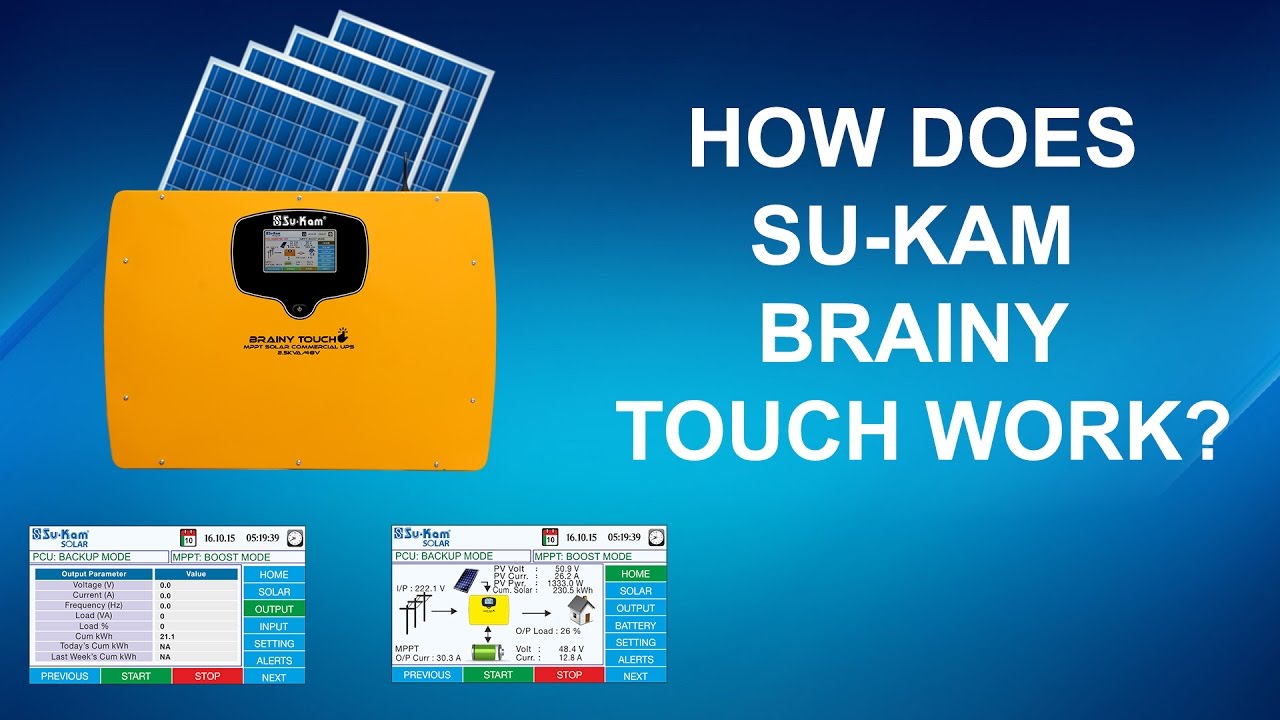
The home screen gave you instant access to Solar, Output, Input, Battery, Settings and Alerts. The solar view drew a flow diagram showing PV panels feeding the PCU, the PCU feeding the load, and the live numbers — PV voltage, PV current, PV power, cumulative solar kWh, output voltage, output current, load percentage and MPPT output current — updating in real time. The output screen tabulated voltage, frequency, load VA, load %, today’s cumulative kWh and last week’s cumulative kWh, all touch-navigable. This second video explains the working in detail:
Why the Product Eventually Failed — And Why I Still Stand By the Vision
I will be honest. The Brainy Touch did not succeed commercially. The reason was the touch panel itself. The imported touch screens we depended on had a reliability problem in Indian field conditions — heat, humidity, dust and rough handling at small-shop dealer installations were unforgiving. As field failures mounted, we made the difficult call to stop production rather than keep shipping a product whose most differentiating feature could fail. That was the right decision for the customer, even though it was painful for the team and for me personally.
What I will never forget is what happened next. Despite the technical failure of the touch panels, the demand for the product simply did not die. Dealers continued asking for it. Many of them wanted to keep the Brainy Touch on their showroom display even after we discontinued it, simply because they were proud that an Indian company — their brand, Su-Kam — had dared to build something this ambitious. That kind of dealer loyalty is something money cannot buy. It is built only through years of trust.
What the Brainy Touch Taught Me
- Be early — but own the critical component. If a single imported sub-assembly can take down your product, you do not control your destiny. Today, with Su-vastika, this lesson sits at the centre of how I think about sourcing.
- Indian conditions are unforgiving. A product validated in a lab is not the same as a product validated across 28 states, three seasons and a thousand dealer service points.
- Brand loyalty survives product failure. If you have built genuine trust, your dealers will stand by you. Su-Kam’s dealer network proved that.
- The vision was right. Touch interfaces, on-product visualisation, app- and PC-based monitoring — every modern solar inverter brand uses some version of this today. We were simply too early on the hardware reliability curve.
A Personal Note
Looking back, the Brainy Touch sits proudly alongside the chic-design home inverter, the lithium-based street light, the solar DC home system, and a few other firsts as one of the most advanced products I had the privilege of dreaming up at Su-Kam. Not every dream becomes a commercial success — but every dream of that scale moves the industry forward. That is what I told my team then, and that is what I tell young entrepreneurs now.
Related on KunwerSachdev.com
- The Dream That Touched the Screen — But Couldn’t Shine
- Innovative Vision of Kunwer Sachdev: Su-Kam’s 2007 Leap into Software and Solar Power
- First Inverter Designing Challenges in India: How Su-Kam and Kunwer Sachdev Changed the Game
- From Pioneers to Defaulters: Su-Kam, the Downfall of a 600-Crore Company
- The Birth of the Chic Inverter — How Su-Kam Redefined Safety and Style
- My Story — Kunwer Sachdev
Watch on Su-Kam’s official YouTube channel
🔗 Read the Full “My Story” Series

Founder of Su-Kam and Kunwwer.ai, and mentor at Su-vastika and several other companies — the “Inverter Man of India” and the “Solar Man of India.” Read his story →
24 products and instruments. This page is one of them. The others are here.
- Colossal overview
- Colossal 1P 10 kVA
- Colossal 3P 30 kVA
- Colossal 3P 40 kVA
- Colossal 3P 100 kVA
- Brainy Eco 1100
- Brainy Eco hybrid PCU
- Brainy Hybrid GTI
- Brainy S modular
- Here — Brainy Touch PCU
- Intelli S 40 kVA
- Falcon HBU
- Falcon Plus 1100
- Chic plastic inverter
- DT-6S charging
- Solar online UPS
- Electroscopy
- Battery life-cycle tester
- Lithium BMS
- Sun Way street light
- IoT solar monitoring
- Tubular gel battery
- Commercial solar / MPPT
- UPS charging
You must be logged in to post a comment.