India Today Named Su-Kam’s Plastic-Body Inverter Among India’s Top 10 Innovations of the Decade
In April 2010, India Today — the country’s most widely read news magazine — published its landmark feature “Spirit of India: Ignited Minds,” naming Su-Kam Power Systems’ plastic body inverter as one of India’s Top 10 Innovations of the Decade. The recognition placed Su-Kam alongside the most consequential Indian breakthroughs of the 2000s and marked a defining moment for the company and for its founder, Kunwer Sachdev. The recognition has since been documented on Wikipedia and in independent business case studies of the Su-Kam story.
Why India Today picked the plastic body inverter
Why this was a big achievement of its time
India Today’s “Top 10 Innovations of the Decade” list wasn’t a product review — it was a national editorial verdict on which Indian inventions had genuinely changed everyday life in the country between 2000 and 2010. To make that list, a product had to have moved the needle at scale: not just be clever, but actually reach millions of Indian homes and shift how people lived. The magazine was not scoring a press release. It was asking which objects had already entered ordinary rooms. The plastic-body inverter did exactly that.
At a time when India was still fighting a chronic power deficit and load-shedding was a daily reality for most households, the humble home inverter was the difference between a functioning home and one plunged into darkness for hours a day. But until Su-Kam intervened, inverters were built the same way they had been for decades — heavy metal-body units that rusted in India’s humid climate, were dangerous to handle, hard to move, and looked more like industrial equipment than a household appliance. Dealers could sell a generator story. They struggled to sell a rusting box that belonged in a factory. Plastic closed that gap: a body that would not corrode on a balcony, light enough to carry upstairs, safe enough to sit in a house.
Under Kunwer Sachdev’s leadership, Su-Kam rewrote the category
The plastic-body inverter was not a small cosmetic change. Under Kunwer Sachdev’s leadership, Su-Kam re-engineered the entire product from the ground up — the enclosure, the thermal management, the safety design, the manufacturing process, and the retail experience. The result was an inverter that was lighter, safer, corrosion-proof, better looking, easier to install, and ready for mass-market Indian homes. It shifted the inverter from being a reluctant industrial purchase to being an aspirational household product. The same first-principles habit shows up later in 6-stage battery charging and in UPS and smart charging: the box was never the whole product.
This innovation is what pushed Su-Kam from a small Delhi-based challenger to India’s largest inverter brand through the 2000s and early 2010s. It also seeded an entire generation of Indian power-electronics companies that followed the plastic-body template Su-Kam had set. As one independent Su-Kam case study puts it, the company “competed not through pricing or marketing alone, but through genuine technological advancement that solved real customer problems in India’s power backup sector.” When India Today wrote its decade-in-review in 2010, that shift was already visible in every second Indian home — which is precisely why the magazine chose to include it on the Top 10 list. Market position followed the enclosure: once the product looked like it belonged in a house, the brand could own the house. The later fights — inverter versus diesel generator, then grid-feed hybrid — sat on that same permission.
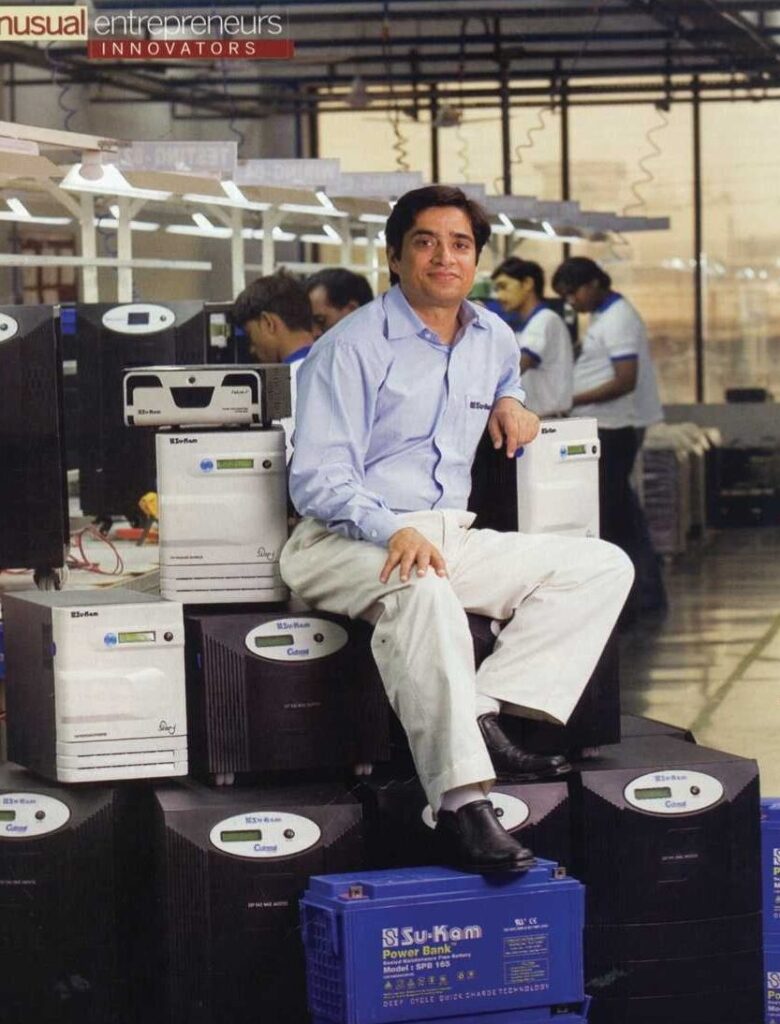
For Kunwer Sachdev personally, the recognition was validation of a decade of engineering-first leadership. Su-Kam had already been profiled by India Today for its innovation culture (including in the magazine’s “Unusual Entrepreneurs – Innovators” feature pictured above), but being placed in the Top 10 innovations of an entire decade — in a country of India’s scale and inventive ambition — was on another level. It cemented Sachdev’s standing as the person the Indian media would soon come to call the “Inverter Man of India.”
The 2009 India Today feature: battery technology and the two-year warranty
The 2010 “Top 10 Innovations” recognition built on earlier India Today coverage. In its 2009 edition (page 27), India Today profiled Sachdev, then CEO of Su-Kam Power Systems Ltd, on the company’s work in battery technology — including its integration of Deep Discharge with the Sealed Maintenance Free (SMF) system, and the launch of a range of fully sealed inverter batteries that were both safe and maintenance-free. Su-Kam offered an unprecedented two-year warranty on inverter batteries at a time when the category standard was six months to a year. It was, again, a category-first move led from Sachdev’s office. The reference is preserved in the digitised India Today volume on Google Books — India Today (2009), page 27, where a search for “Kunwer Sachdev” lands directly on the snippet.
Why this recognition still matters
Sixteen years on, the India Today decade list remains one of the most cited third-party acknowledgements of Su-Kam’s role in shaping India’s home-power story. It also stands as an early public marker of the pattern that has defined Kunwer Sachdev’s career: identifying an underserved Indian need, re-engineering the product from first principles, and shipping it at national scale. That pattern — first with inverters at Su-Kam, and today with lithium storage and solar-hybrid systems at Su-vastika — is the through-line of his work. When the founder later picked up the pen for The Times of India, it was the same instinct: explain the product in public, in the country’s language, not only in a factory.
Read the original coverage and further reference
- India Today, April 2010 — Spirit of India: Ignited Minds — Top 10 Innovations of the Decade (archived)
- India Today, 2009 print edition (page 27) — Google Books deep-link — opens directly on the Kunwer Sachdev / Su-Kam SMF battery snippet
- Business Today, 25 April 2013 — Leadership Spotlight: Kunwer Sachdev on his leadership style
- Wikipedia — Su-Kam Power Systems (references the India Today “Top 10 Innovations of the Decade” recognition)
- Brand Awareness — Su-Kam Case Study: Rise, Fall & Rebirth of India’s Inverter Empire
PR, enterprise wins & proof
Questions on the India Today plastic body inverter feature
Why did India Today feature Su-Kam’s plastic-body inverter?
The 2010 “Spirit of India: Ignited Minds” list was a decade verdict, not a product review. India Today was naming inventions that had already changed ordinary Indian life at scale between 2000 and 2010. The plastic body inverter was in millions of homes by then — which is why it sat on that list, not because of a campaign week.
What was special about the plastic body inverter design?
Metal-body inverters rusted in humidity, were heavy, and looked like factory equipment. Su-Kam re-engineered enclosure, thermal management, safety, and the retail experience so the machine could live in a house: lighter, corrosion-proof, safer to handle, easier to install. That was not a colour change. It was a new category template the rest of the industry later copied.
What did the India Today recognition actually mean?
It was a third-party, national magazine putting Su-Kam next to the decade’s other Indian breakthroughs — documented later on Wikipedia and in case studies. For Kunwer Sachdev it sat on top of earlier India Today coverage (including the shop-floor “Unusual Entrepreneurs” photograph). It did not invent the product. It recorded that the product had already won the house.
How did this change Su-Kam’s market position?
The enclosure made the brand sellable in a living space, not only a generator yard. That is the path from a Delhi challenger to India’s largest inverter brand in that era, and the permission for later fights — high-capacity inverter versus diesel, then hybrid grid-feed — on the same first-principles habit.
Did a plastic body mean the inverter was less durable?
The metal box was the fragile one in Indian weather: rust, weight, awkward handling. Plastic was chosen so the product would survive humidity and still be light enough to carry upstairs. Durability here was corrosion and use in a home, not looking like a factory casting.
Found this story worth sharing? Post it to your network — it takes one click:
You must be logged in to post a comment.