Inverters Are the Only Business Segment in India With Zero Chinese Share — and Why That Pride Has a Second Chapter
I Built the Technology. The Brand. The Patents. The International Markets.
At Re-Invest 2015 I said inverters were India’s one category with 0% Chinese share. That was true — and it was not an accident.

When Electronics Maker carried the headline — “Inverters are the only business segment in India having 0% Chinese share” — it was not a statistic I stumbled upon. It was the outcome of decades of work: creating Su-Kam technologies, building a brand dealers trusted, filing patents, opening international markets, and even working to export Indian inverters into China while others imported from there. That is a pride I carry for India.

From Selling Pens to Owning a Category
I sold pens to pay for my education. I worked in cable marketing and saw where power infrastructure was heading before most people had language for it. I built Su-Kam from a garage into a national name — the journey DNA India later told as pens to a Rs 2,300 crore company. That headline is a number. The story underneath is invention.
Plastic-body inverter when the market used metal boxes. Pure sine wave when square wave was normal. Home UPS. Solar PCU in 2005 with monitoring on screen. India’s first 3-phase solar system in 2006. Brainy Eco for the home. Colossal for the factory floor. Batteries engineered in Baddi. CE Mark and Munich. Border posts in Rajasthan. Shikaras in Kashmir. A YouTube channel teaching installers before brands knew what content meant. Patents filed. Dealers trained. Export markets opened. One invention after another — and the whole industry followed because the thought and energy behind product development was unmatched.

Those business partner meets were not ceremonies. They were how a category stays domestic. When dealers in blue shirts fill an auditorium and the Su-Kam Solar sign is on the wall, you are not selling boxes — you are building a distribution culture that does not need to import a cheaper alternative from Shenzhen because the Indian product is already better for Indian voltage, heat, and backup hours.
0% Chinese share was not luck. It was engineering nights, patents, and a brand India chose.


“Inverters stayed Indian because we built the category before China could walk in. I created the technologies, the brand, the patents, and the export markets that made it possible.”
The Paradox — Exporting Into China While India Stayed Domestic
There is a detail people miss when they read the 0% headline. While inverter shelves in India remained free of Chinese share, Su-Kam was on exhibition floors in China and Hong Kong as the only Indian inverter brand in the hall. We were not nationalists who refused the world. We were engineers who believed Indian products could win anywhere — including the factory floor that was supposed to own the category. Read that full chapter in Exporting Inverters to China. The 0% figure at home and the export ambition abroad were the same instinct: build it here, build it properly, do not depend on imports for something as fundamental as backup power.
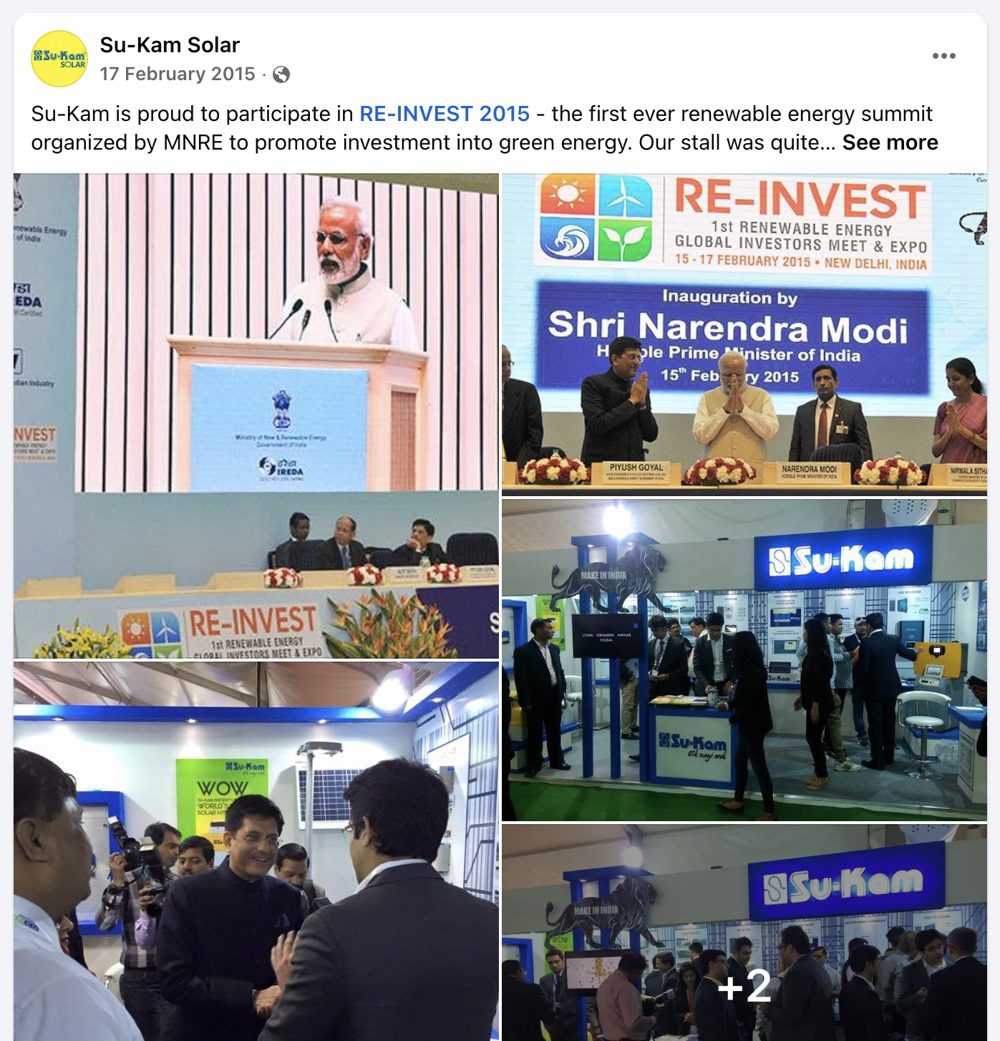
Re-Invest 2015 — What I Said on the Record
At Re-Invest 2015 in New Delhi I did not expect a government-organised show to become the platform it did. Decision makers came. We put technology on the floor that was hard to explain in a brochure — so we showed it live. I spoke about solar prospects honestly: Su-Kam was already among India’s biggest rooftop solar installers, but many installations in the market were either not working or lacked proper service because people lacked in-depth knowledge of the technology and standards.
Cost optimisation had already happened. Commercial power at roughly Rs 7 per unit could be beaten by solar with returns competitive against property investment over ten years. My growth plan was simple — install a 1 kW grid-connected project for a customer running 10 kW load, let them see the benefit on their electricity bill, and skip the theoretical lecture. Show the maths in rupees, not slides. We were hiring and training people to take that message to market because companies — not just consumers — had to carry the solar story.
For every advertisement we ran, we received hundreds of queries. That told me awareness was not the bottleneck. Execution was. Technocrat manpower was. That is why grid-tie projects like the 30 kWp installation in Bangalore — completed in five days, generating 160 units in a single day — mattered as proof, not brochure copy.
The Second Chapter — After NCLT 2018, the Market Tilted
I would be dishonest if I stopped at pride. After the NCLT proceedings in 2018, the ground shifted. I am no longer associated with Su-Kam Power Systems as of 2019. Import data since then shows inverter shelves that once had zero Chinese share tilting back toward Chinese products as domestic champions weakened and price wars favoured volume over the engineering culture we built for twenty years.
That hurts — not because I need to win every market forever, but because a category India had genuinely owned began slipping away while headlines still talked about self-reliance. The patents, the factories described in Building the Empire, the dealer relationships built in rooms like the business partner meet, the training culture on the YouTube channel — those were not abstract assets. They were the reason the 0% figure existed. When the founder ecosystem fractures, import data is the autopsy anyone can read.
What I Still Believe
Categories are not protected by slogans. They are protected by continuous invention, service depth, and founders who stay in the field training the market. India proved once that inverters could be a zero-Chinese-share segment because one founder refused to stop inventing. The import charts after 2018 prove how quickly that can reverse when domestic innovation stalls and corporate turbulence replaces product energy.
If you are an entrepreneur reading this: build the technology. File the patents. Train the dealers. Export if you can. And do not assume a category stays Indian just because it was Indian yesterday. The headline I gave in 2015 was true. Keeping it true is a daily obligation — not a trophy.
Orange for pride — what we achieved when I built Su-Kam’s technologies, brand, patents, and international footprint. Navy for truth — what happened after 2018 when imports returned. Both are one founder’s arc. Read My Story on SolarManOfIndia.com.
Related on this site
🔗 Founder stories — read the series
- 📖 CE Mark & Intersolar Munich 2011
- 📖 Exporting Inverters to China
- 📖 BSF Border Solar Posts
- 📖 Why I Started the Su-Kam YouTube Channel
- 📖 Solar PCU Invented in 2005
- 📖 India’s First 3-Phase Solar System in 2006
- 📖 Baddi Factory & Tubular Gel Battery
- 📖 Kashmir Shikaras
- 📖 Brainy Eco Solar Hybrid PCU
- 📖 Colossal Solar PCU
- 📖 Marriott Chandigarh 2011 — Innovation & R&D Talk
- 📖 Technovations at Su-Kam 2012 — SlideShare Deck
- 📖 My Story — SolarManOfIndia.com
The Inverter Man and Solar Man of India. Read his story →