
The Power Point Revolution: How Su-Kam Pioneered MPPT Technology in India and Sparked a Solar Evolution
PWM chargers wasted roughly a third of a panel’s watts. Under Kunwer Sachdev, Su-Kam built India’s first indigenous MPPT — harvesting ~96W from a 100W module — won technology patent protection for it, and turned that mastery into Solar PCUs, grid-feed, and hybrid inverters.
When solar energy began taking root in India, most systems relied on standard PWM (Pulse Width Modulation) solar charge controllers. PWM was affordable — and fatally wasteful. Controllers simply dragged the solar panel voltage down to match the battery voltage, dumping precious wattage in the process. Out of 100W produced by a module, a PWM charger might deliver only about 67W to the battery — a staggering ~33W loss.
India needed far more efficient harvesting to make green energy viable. Under Kunwer Sachdev, Su-Kam’s R&D team broke new ground. Su-Kam became the first company in India to design and manufacture advanced MPPT (Maximum Power Point Tracking) technology — and at that same moment the company won technology patent protection for the breakthrough, locking the innovation into India’s IP record and changing the solar landscape permanently.
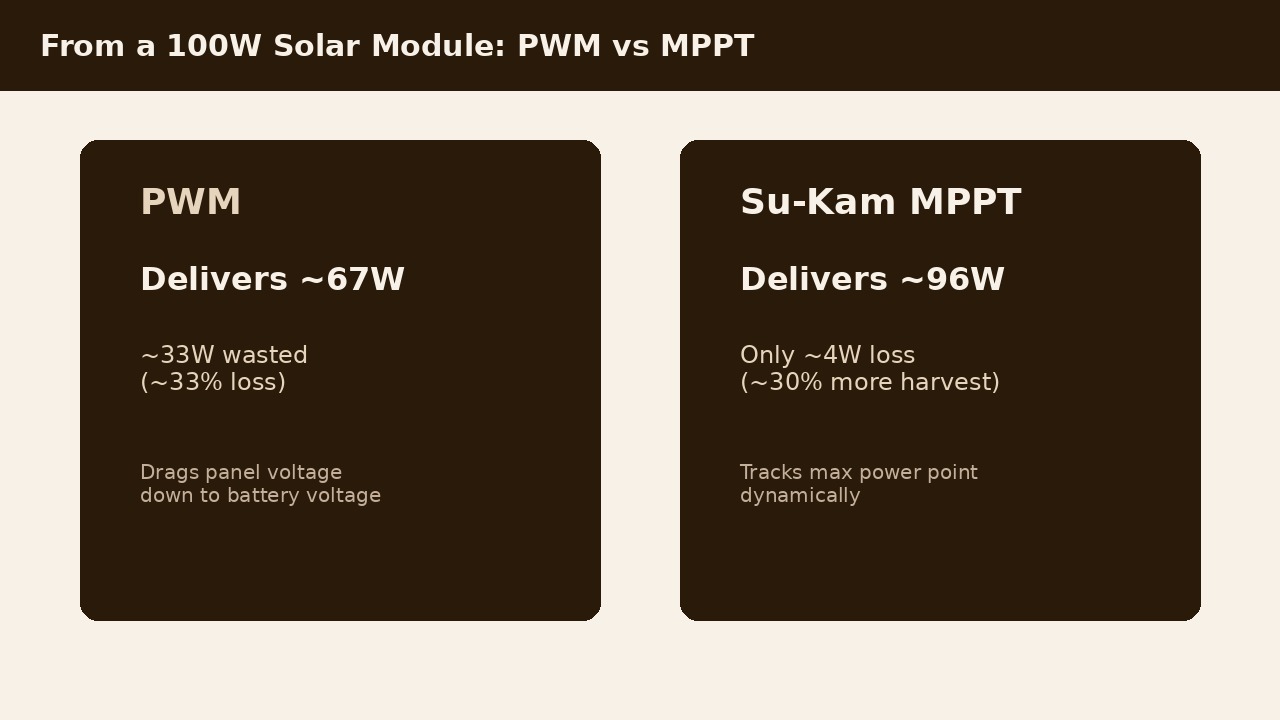
PWM path: ~67W to battery (~33W / ~33% lost)
Su-Kam MPPT: ~96W to battery (~4W lost)
Extra harvest: up to ~30% more from the same panels
1. MPPT vs. PWM: The Science of Maximum Power Extraction
Unlike PWM chargers, an MPPT electronic system continuously tracks the maximum power point of a photovoltaic module dynamically — extracting every possible drop of energy and transferring it safely to the battery.
- The efficiency leap: Where PWM wasted over 30% of panel potential, Su-Kam’s MPPT delivered an astonishing 96W from that same 100W panel, cutting power loss to about 4 watts.
- Producing more with less: Because MPPT extracts up to 30% more power from solar panels, users could achieve the same energy output with fewer PV modules — saving thousands of rupees on initial installation.

2. Advanced Features of Su-Kam’s MPPT Solar Charge Controllers
Built around a robust 16-bit microprocessor and automated system architecture, Su-Kam’s MPPT controllers — including models such as Solar-Mate and SCC40A — introduced features well ahead of their time:
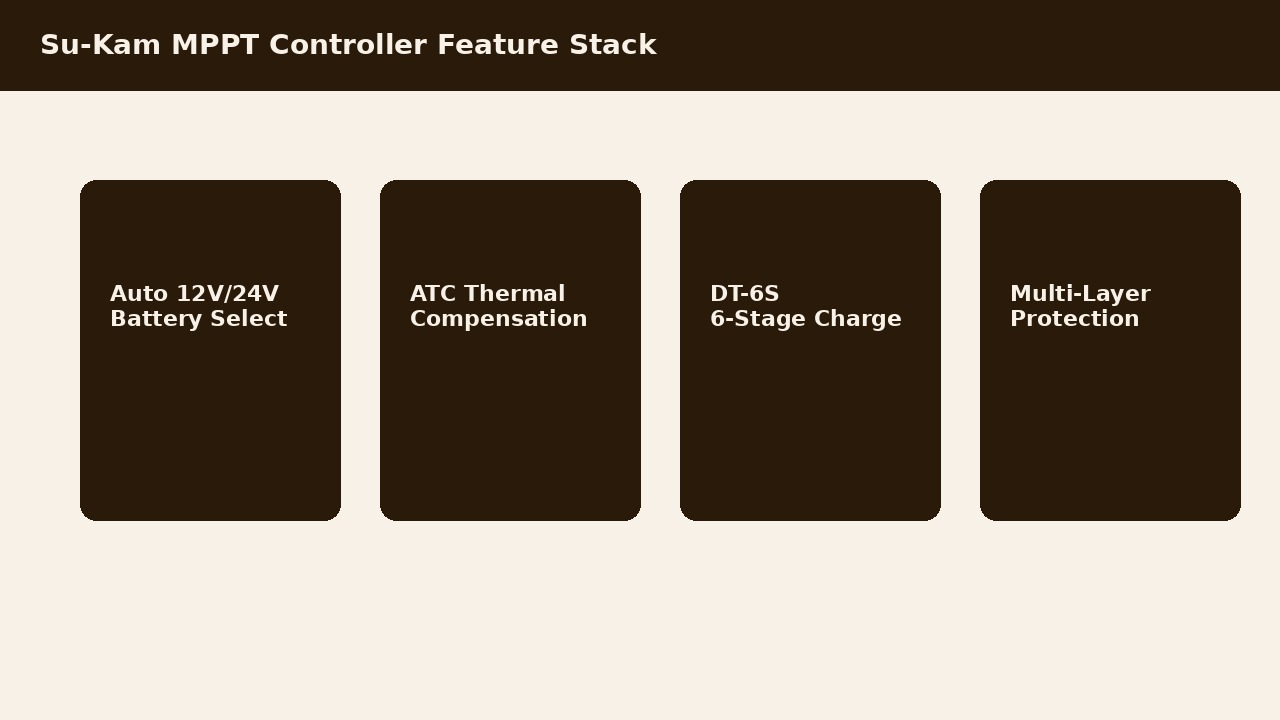
- Automatic battery selection: Automatically senses and adapts to 12V or 24V battery banks.
- Automatic Temperature Compensation (ATC): An ambient temperature sensor adjusts bulk charging voltages for real-time weather — extending battery lifespan by at least six months. (See also Part 04 — ATC.)
- Intelligent 6-stage charging (DT-6S): Multi-stage profiles (Bulk, Absorption, Float, Equalization) to optimize battery health. (See Part 04 — DT-6S.)
- Comprehensive protection: Thermal protection (throttling charge if heat-sink temperatures exceed 90°C), battery reverse protection, PV reverse indication, and output short-circuit protection.
3. The R&D Catalyst: From Charge Controllers to Grid-Feed and Hybrid Inverters
Creating India’s first indigenous MPPT technology was not a standalone product milestone — it was a technological springboard. Mastery over high-efficiency DC-DC tracking algorithms and microprocessor power conversion under Kunwer Sachdev’s leadership propelled Su-Kam into advanced Solar Power Conditioning Units (PCUs), then Solar Grid-Feed Inverters, and ultimately sophisticated Solar Hybrid Inverters.
Winning the technology patent for MPPT at that time mattered as much as the hardware. It proved Indian engineering could outperform imported alternatives — and that Su-Kam would protect the IP, not merely assemble boxes. That same inventive culture grew into a portfolio of 106 technology filings across Su-Kam, Su-Vastika, and later AI ventures. (See also: How Su-Kam came to file 77 patents in 14 years.)
MPPT charge controllers (Solar-Mate / SCC40A)
→ Solar Power Conditioning Units (PCUs)
→ Solar Grid-Feed Inverters
→ Solar Hybrid Inverters
4. Open the Circuit Diagrams: Service Abroad, Brand Abroad
Product patents and efficiency curves win press releases. What wins a brand in international markets is whether a distributor in Africa, the Middle East, or Southeast Asia can repair the box when something fails — without flying an engineer from Gurgaon.
That is why Su-Kam’s training decks carried full circuit diagrams and service schematics. They were not decoration. They were the difference between a dead inverter waiting for parts and a customer back on power the same afternoon. In the next training sessions, those diagrams were deliberately simplified so distributors — not only factory R&D — could give service to the customer, while Su-Kam’s own field engineers carried the same sheets as standard kit.
Archive service tutorials (solarmanofindia.com library). Training-deck circuit slides from the MPPT presentation will be slotted here once the deck is shared for export.
Simplified sheets for distributors + own engineers
R&D resistance overruled: firmware is the moat
Result: Brand Su-Kam trusted internationally for serviceability
Conclusion
PWM made solar cheap to install and expensive to harvest. Su-Kam’s MPPT flipped that equation — more watts from fewer panels, smarter charging, a platform that scaled into PCUs and hybrids, and a technology patent win that put Indian solar IP on the map. And when the same company chose to put circuit diagrams in distributors’ hands — against R&D’s instinct to lock them up — it proved something rarer: Indian engineering brands are built not only in the lab, but in the service bay. That is the power-point revolution.
In this series
Su-Kam Founder Series
- Part 01
Falcon HF — India’s First 4-Star High-Frequency Inverter - Part 02
TFT Touchscreen Solar PCU - Part 03
Low-Voltage Charging Challenge & Protection - Part 04
Static Bypass, DT-6S & ATC - Part 05
SOLARCON — Conversion Kit Savings Revolution - Part 06 · You are here
MPPT — India’s First Indigenous Solar Charge Controllers

Kunwer Sachdev
Founder & MD, Su-Kam Power Systems (1988–2019) and Kunwwer.ai — writing on manufacturing, insolvency, and civilizational memory. Read his story →
Found this story worth sharing? Post it to your network — it takes one click: