India’s first 100 KVA Solar PCU — and nobody believed it could be done
In 2014 we built a three-phase, 100 KVA solar power conditioning unit — a machine big enough to run a factory on the sun. No Indian company had made one before. So we didn’t just claim it. We proved it, in the field, and we took it to the people.
Colossal 3P 100 KVA / 360V Solar PCU Inverter — running 14 CNC machines on solar.
A 100 KVA machine is not a bigger inverter. It is a small power station — and we made India’s first solar one.
1 The first 100 KVA Solar PCU in India
When we set out to build a 100 KVA three-phase Solar PCU, the reaction was disbelief. A power conditioning unit at that scale — managing solar, battery and grid for a heavy industrial three-phase load — simply hadn’t been made in India. We did it in 2014, earning the “first company in India” title for a 100 KVA Solar PCU. The Colossal you see in the video is that machine: a floor-standing, three-phase, 360V-class unit with an LCD, built on Su-Kam’s IGBT-and-DSP pure sine wave platform.
2 What one Colossal can actually run
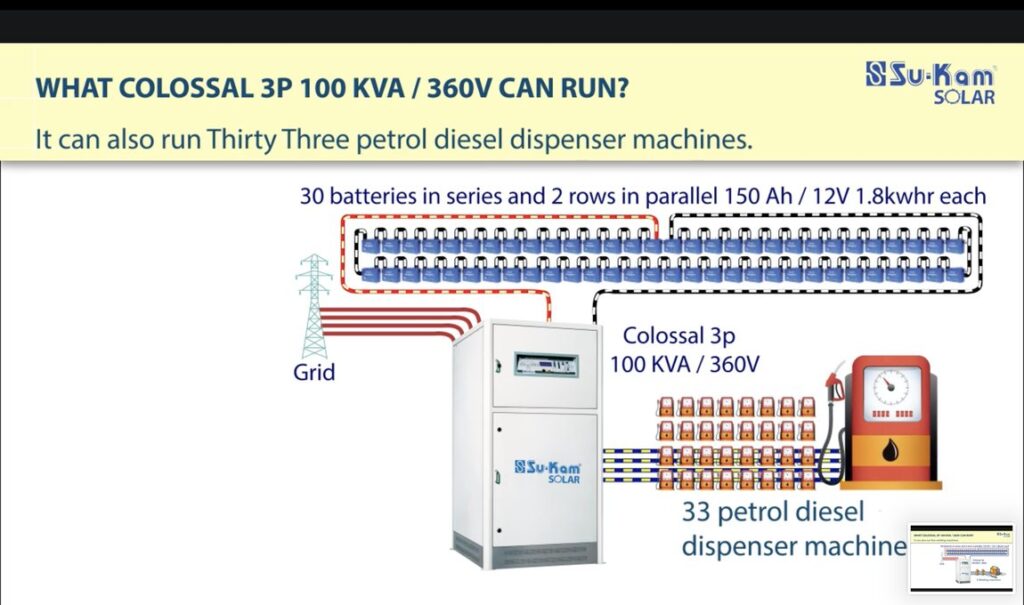
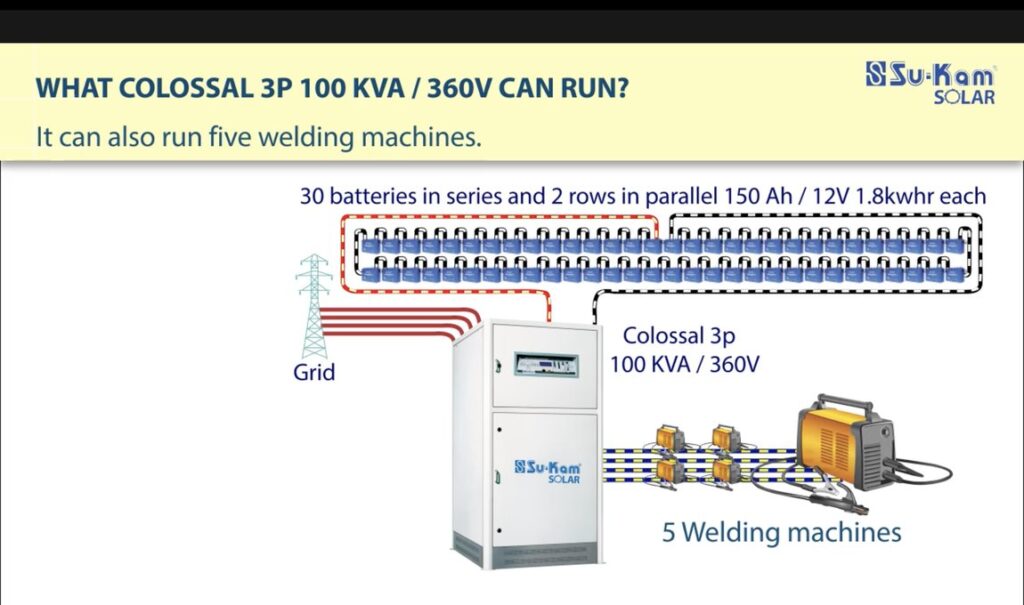
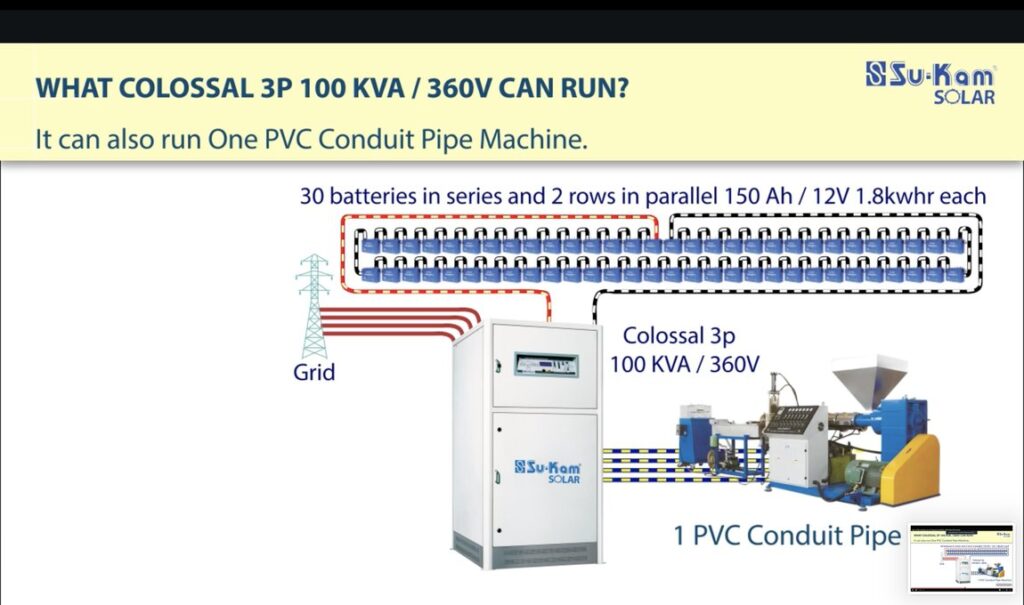
This is where a 100 KVA Solar PCU stops being a spec sheet and starts being a factory. A single Colossal 3P can independently carry entire sets of heavy three-phase equipment — the kind of loads that always meant a diesel generator:
14 CNC machines. On solar.
That is the headline the video leads with — fourteen CNC machines running on one Colossal 3P 100 KVA / 360V Solar PCU, plus the baseline facility load. A full machine shop, carried by sun, battery and grid, intelligently managed. It even runs a single PVC conduit pipe extrusion line on its own. Its single-phase sibling, the Colossal 1P 10 KVA Solar PCU, carried the same idea at a smaller scale.
3 How it works — sun first, grid as backup
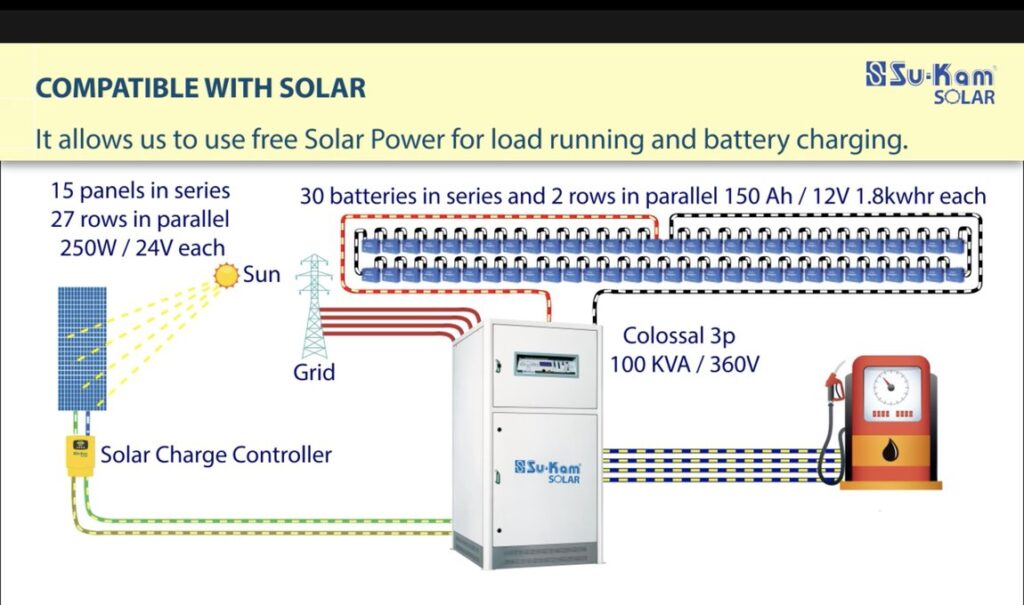
When grid power is present, the Colossal does two jobs at once: it runs the full industrial load and charges the battery bank simultaneously. The moment the grid fails, it transfers seamlessly and runs the entire load from storage. And where there is sun, it leans on free solar power first — both to run the live load and to charge the batteries — through a dedicated heavy-duty solar charge controller. A typical deployment looked like this:
Battery bank
30 batteries in series, in 2 parallel rows — 60 in total, each 150 Ah / 12V (1.8 kWh).
Solar array
15 panels in series across 27 parallel rows, using 250W / 24V panels, into the solar charge controller.
4 Built like industrial equipment
No engine, no roar — a silent power room on a factory or commercial floor.
Protects and extends the life of a 60-battery bank.
Choose backup duration by sizing the battery bank to the site.
Keeps power continuous during maintenance or sudden load surges.
5 Even my own engineers didn’t believe in it
I’ll be honest about the hardest part — it wasn’t only the market that doubted this product. When we were designing it in R&D, my own engineers and my R&D head were not convinced. They asked why we were pouring such heavy investment into developing a machine this big — how would we ever sell it in India? But once we built it, made it work and started installing real projects, they saw the brand value and the appreciation Su-Kam earned in the market. That changed their minds completely.
And there was a national reason it mattered. If we hadn’t designed the Solar PCU in India, the country would have had to import it from Europe — China was not yet fluent in the Solar PCU technology of those days. European units cost about four times the price at which we sold our Indian-made product. By building it here, we didn’t just create a machine; we made world-class solar power conditioning affordable for India — and then turned the tables entirely, exporting these units to Nigeria and Kenya. A product India would otherwise have imported from Europe was now going out into the world with a Su-Kam badge on it.
I’ll say this plainly, because it is the truth of it: the innovation of designing and building India’s first 100 KVA Solar PCU — and proving it could run a factory on the sun — is something I’m proud to take credit for.
6 Proven where it’s hardest: the Assam Rifles
Claims are cheap; deployments are not. We installed our latest high-capacity range across different locations for the Assam Rifles — remote, demanding, mission-critical sites where power cannot fail. As was the general norm in India for such government projects, the front-ending was handled by REIL (Rajasthan Electronics & Instruments Ltd., an MNRE channel partner), with Su-Kam’s Solar PCUs powering the sites. We replaced diesel at eighteen Assam Rifles outposts — the full story, with photographs, is documented there as proof. Across the Indian Army and Assam Rifles, Su-Kam’s solar deployments ran into the megawatts, with off-grid solar plants at the 100 kWp class. If a Su-Kam Solar PCU could keep systems running for the forces in the country’s toughest terrain, it could do it anywhere.
7 Power on Wheels — taking the proof to the people
Even after building it and deploying it, the disbelief lingered — people had to see a 100 KVA machine running on solar to accept it was real. So we did something no one else did: we built a demonstration truck I called “Power on Wheels.” We loaded our latest Solar PCU range onto it and took the demo to dealers, customers and sites — a working solar power station you could walk up to and watch carry a real load. It turned a claim nobody believed into something people could stand in front of.
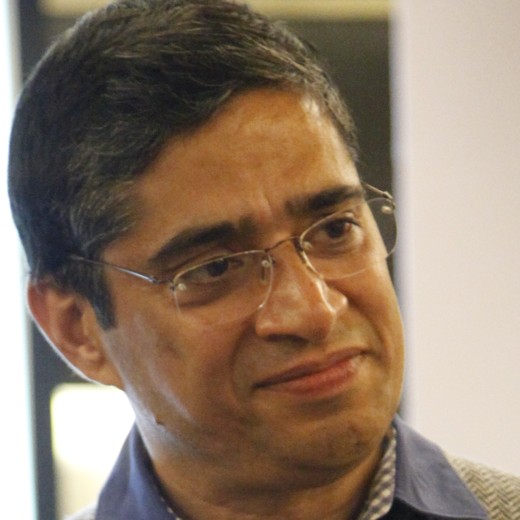
Founder of Su-Kam and Kunwwer.ai, and mentor at Su-vastika and several other companies — the “Inverter Man of India” and the “Solar Man of India.” Read his story →
Disclaimer: It is important to note that while Mr. Kunwer Sachdev founded Su-Kam Power Systems, he is no longer associated with the company as of 2019. Any information regarding his involvement in the company’s operations, strategies, or future plans reflects his tenure prior to that date. Therefore, any discussions or analyses of Su-Kam Power Systems should be considered in the context of his past contributions and not his current association with the company.