PR, enterprise wins & proof
I didn’t demonstrate solar — I commercialised it. Ten real installations, preserved from the official Su-Kam Solar Facebook page: rural India, the armed forces, and villages across Africa, all powered by technology we designed and built ourselves.
Every story here began as a moment our team shared on Facebook while it was happening — a tender won, a village lit, a plant commissioned. I’ve gathered the strongest ten and written each one again in my own words. The screenshots are real, archived exactly as posted. Browse the full collection in the Su-Kam Solar Facebook Archive, read more about my story, or explore all my essays and founder lessons.
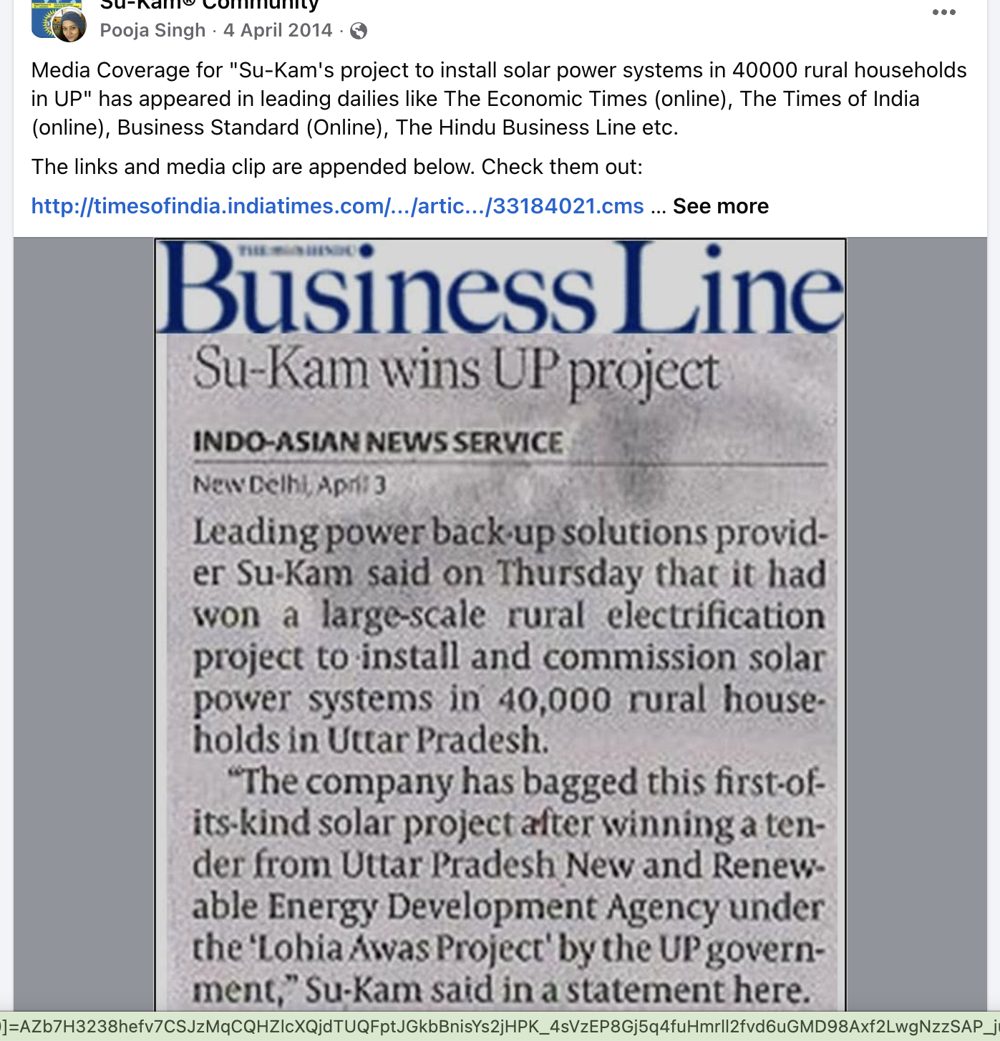
When people ask me what scale really means in solar, I point to Uttar Pradesh. Under the Lohia Awas project with UPNEDA, we installed solar power systems in roughly 40,000 rural households — homes that had waited generations for the grid and were handed light, fans and study hours by the sun instead. The Economic Times, The Times of India, Business Standard and The Hindu Business Line all carried it; one clipping read simply, “Su-Kam wins UP project.” But the headline was never the real story. The real work was standardising one engineering specification across tens of thousands of remote roofs and making every single one perform. This was among India’s earliest distributed solar deployments at that scale, and it proved solar was never a showcase — it was a practical answer for millions of families.
View in the Facebook Archive →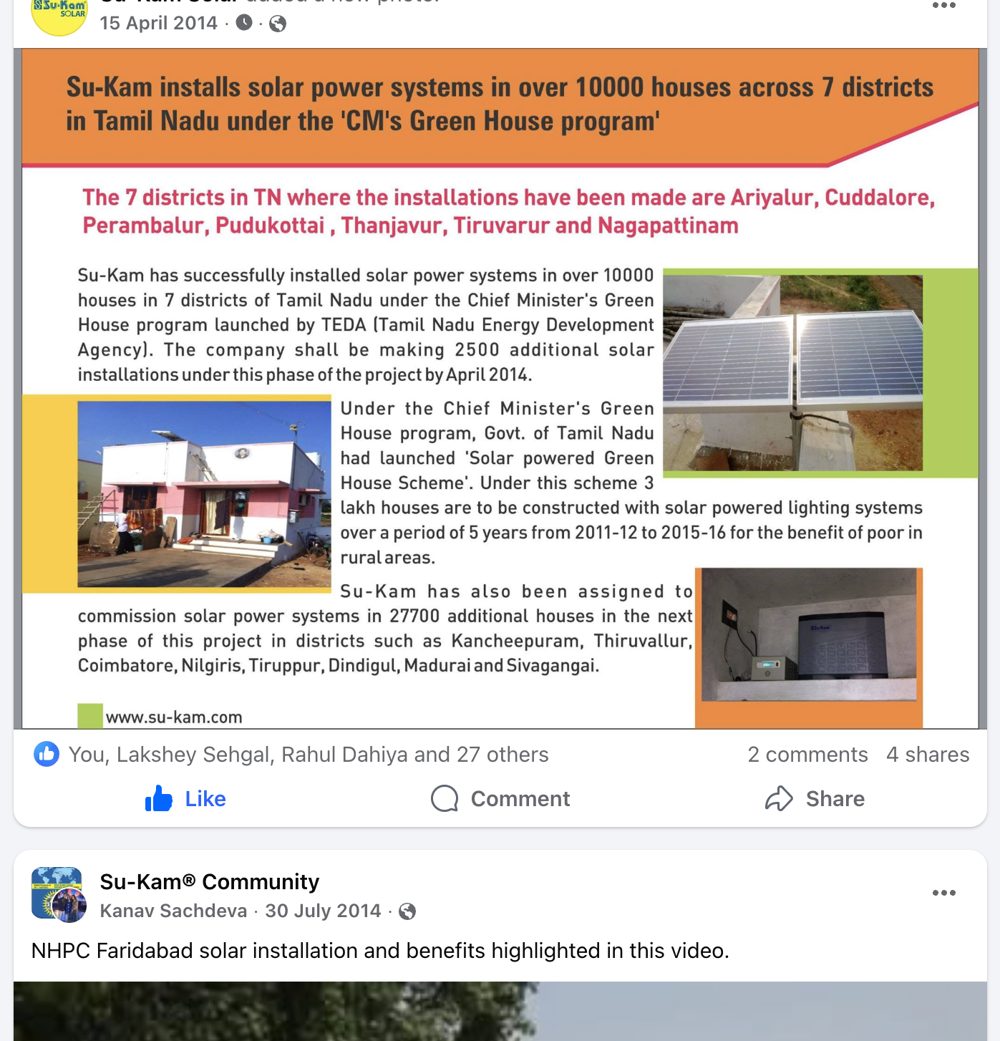
In Tamil Nadu we crossed ten thousand homes. Under the Chief Minister’s Green House programme, run through TEDA, we installed solar power systems across more than 10,000 houses in seven districts — Ariyalur, Cuddalore, Perambalur, Pudukottai, Thanjavur, Tiruvarur and Nagapattinam. What I’m proudest of isn’t the number; it’s that ten thousand roofs were held to one engineering standard. A family in a coastal village got the same quality of power conditioning as a household near the city. Government programmes live or die on consistency at the last mile, and we built our manufacturing and training around exactly that. This was solar as public infrastructure — quiet, reliable, and replicated thousands of times over without dropping the bar.
View in the Facebook Archive →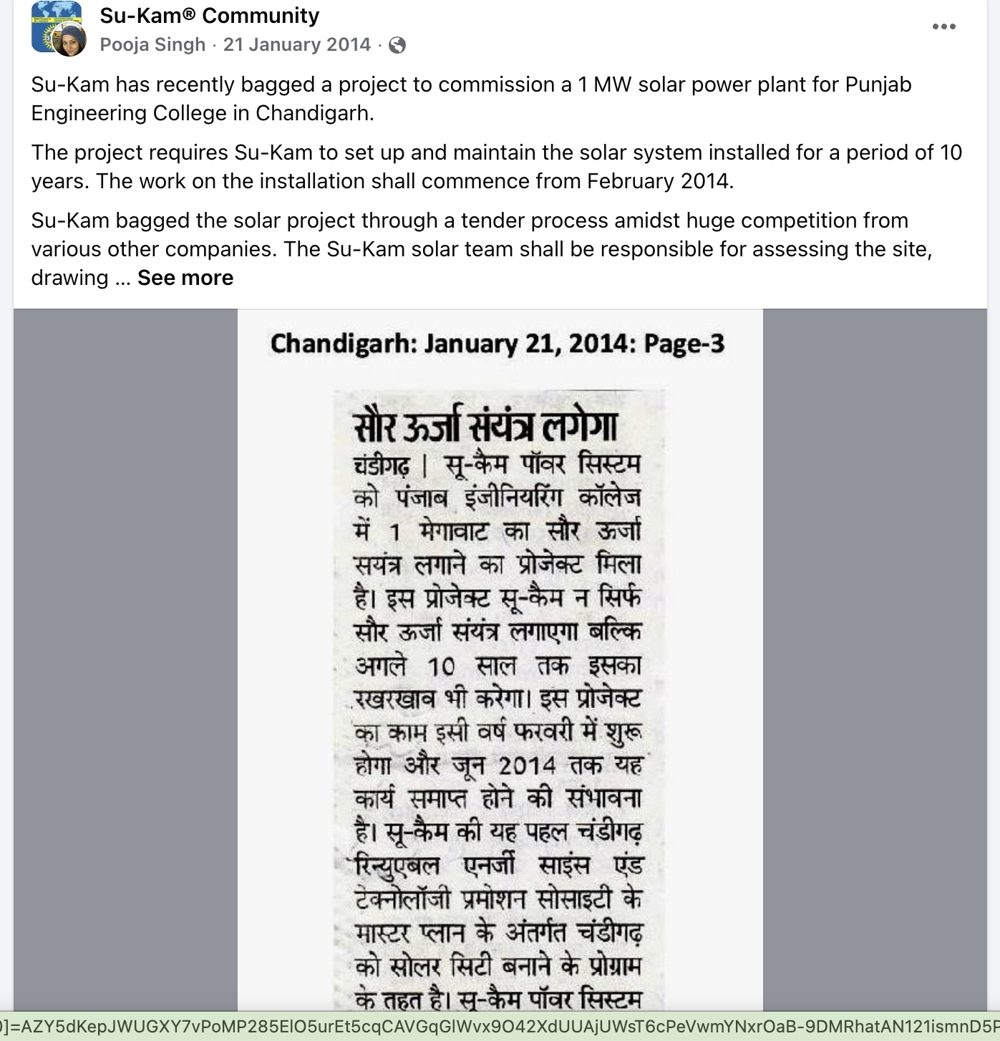
Winning the 1 MW plant for Punjab Engineering College in Chandigarh meant something different to me, because we won it on merit. It came through an open tender, against heavy competition, and it carried a commitment to set up and maintain the system for ten years. That decade-long responsibility is the line that separates a product company from an engineering company — anyone can sell a panel, but standing behind a megawatt for ten years is a different discipline. We designed the plant, commissioned it, and owned its performance. For a company that started by making inverters light enough to sit in a living room, putting up a megawatt-scale plant on a prestigious campus was proof of how far the engineering had come.
View in the Facebook Archive →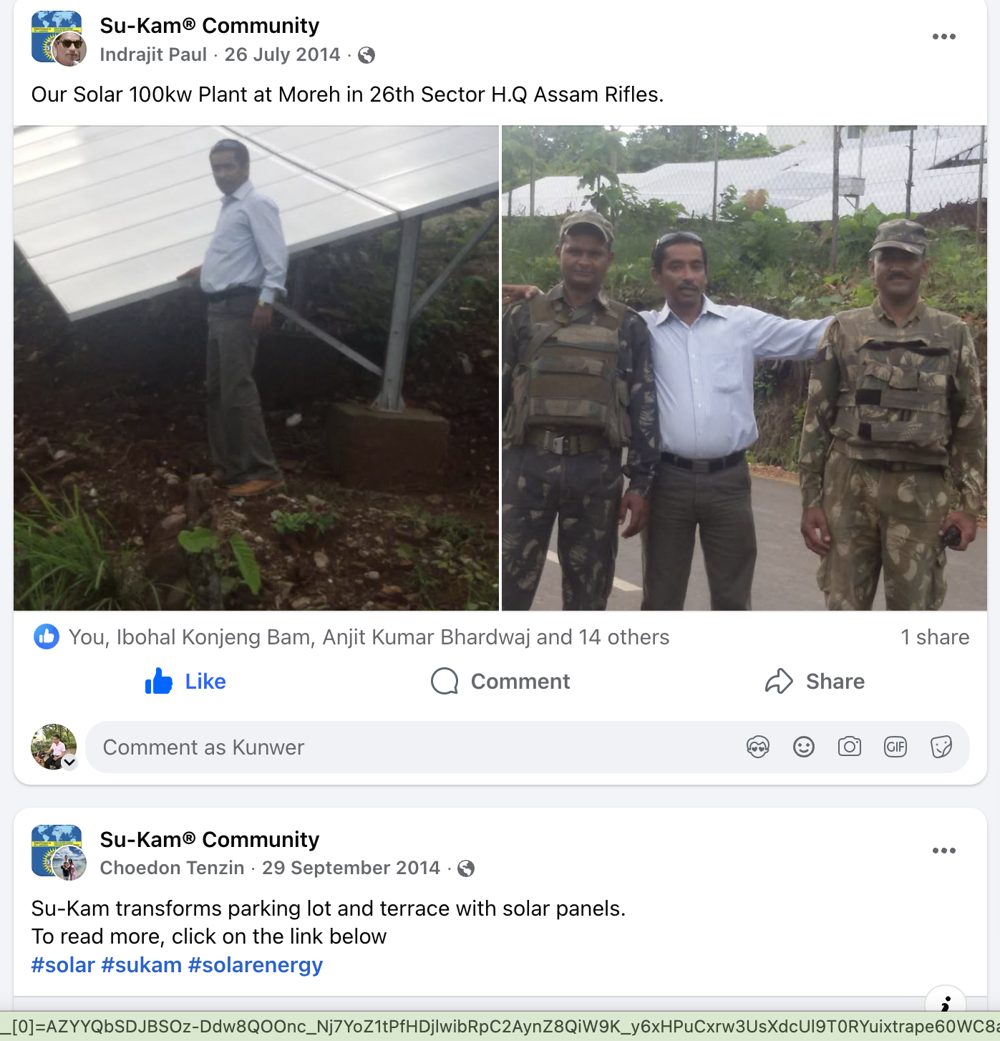
At Moreh, on the Myanmar border, we built a 100 kW ground-mounted solar plant for the 26th Sector Headquarters of the Assam Rifles — India’s oldest paramilitary force. When the armed forces choose your technology, they aren’t buying on price; they’re buying power that cannot fail in terrain where a generator and its fuel line are a liability. We delivered the array, and then we did the part that mattered just as much: we trained the Assam Rifles’ own technical team to run and maintain it, classroom sessions and all. A plant you can’t service yourself in a remote posting is no good to a soldier. This project, and the North-East work around it, is why Su-Kam became the largest solar back-up provider in the region.
View in the Facebook Archive →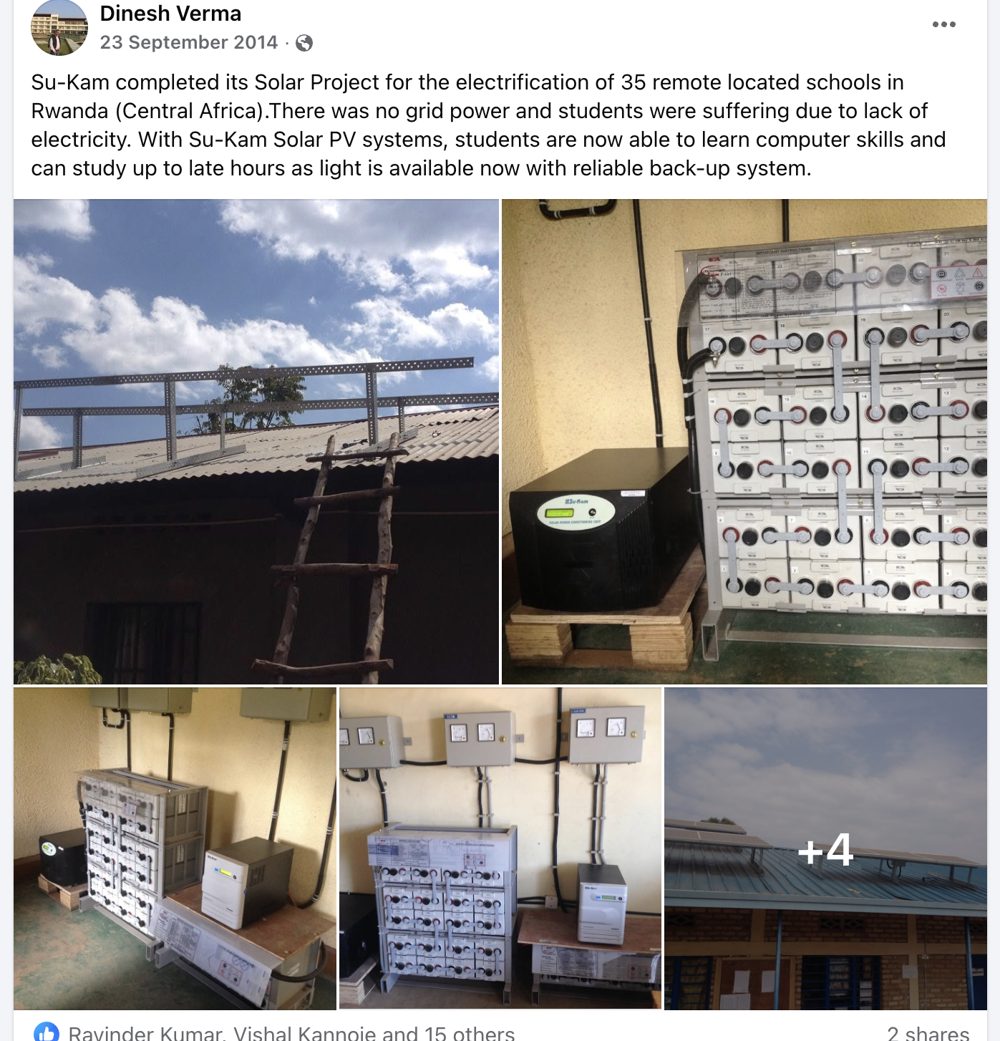
Rwanda is the project that reminds me what power electronics is actually for. We completed the electrification of 35 remote schools that had no grid power at all. Students were losing hours of learning to darkness. With our solar PV systems, those schools could finally run computer labs and keep the lights on into the evening so children could study late. We later won a 105-site turnkey solar project in Rwanda through the Ministry of External Affairs — a government-to-government job, executed by an Indian company that built its own technology end to end. But it’s the schools I think about: thirty-five buildings that had never had electricity, suddenly teaching computer skills. That is the entire point of the work.
View in the Facebook Archive →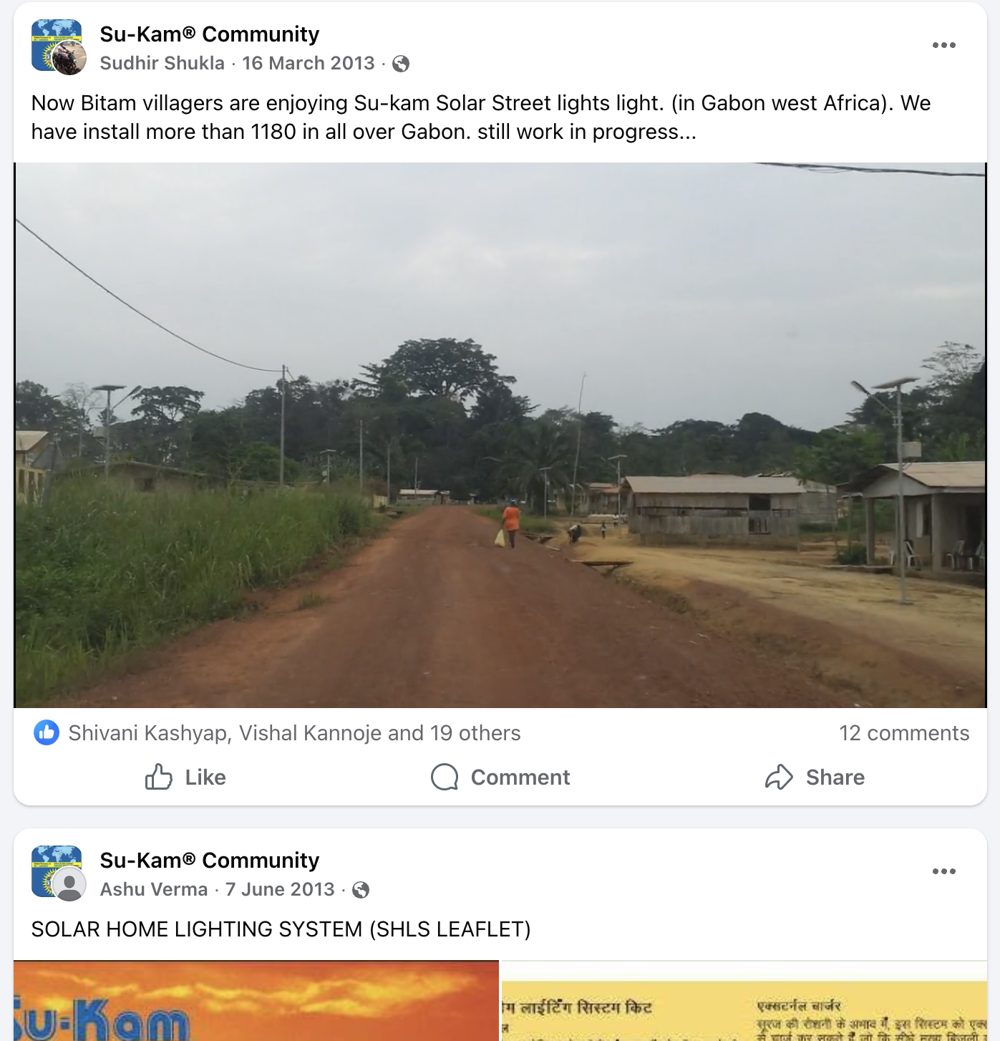
In Gabon, we lit the dark. We installed more than 1,180 solar street lights across the country — and the programme kept growing toward 2,000, reaching villages like Kango, Mouila and Bitam, some more than a thousand kilometres from the capital. I still remember the photo of a dirt road in Bitam lined with our poles: a village that had lived in darkness after sundown, now with light to walk, trade and gather by. There was no grid to extend and no diesel supply chain to rely on — just sunlight, a panel, a battery and electronics that had to survive heat, dust and distance. Indian-engineered power, designed in Gurgaon, changing how an evening felt in West Africa. Export was never just a number to me; it was streetlights.
View in the Facebook Archive →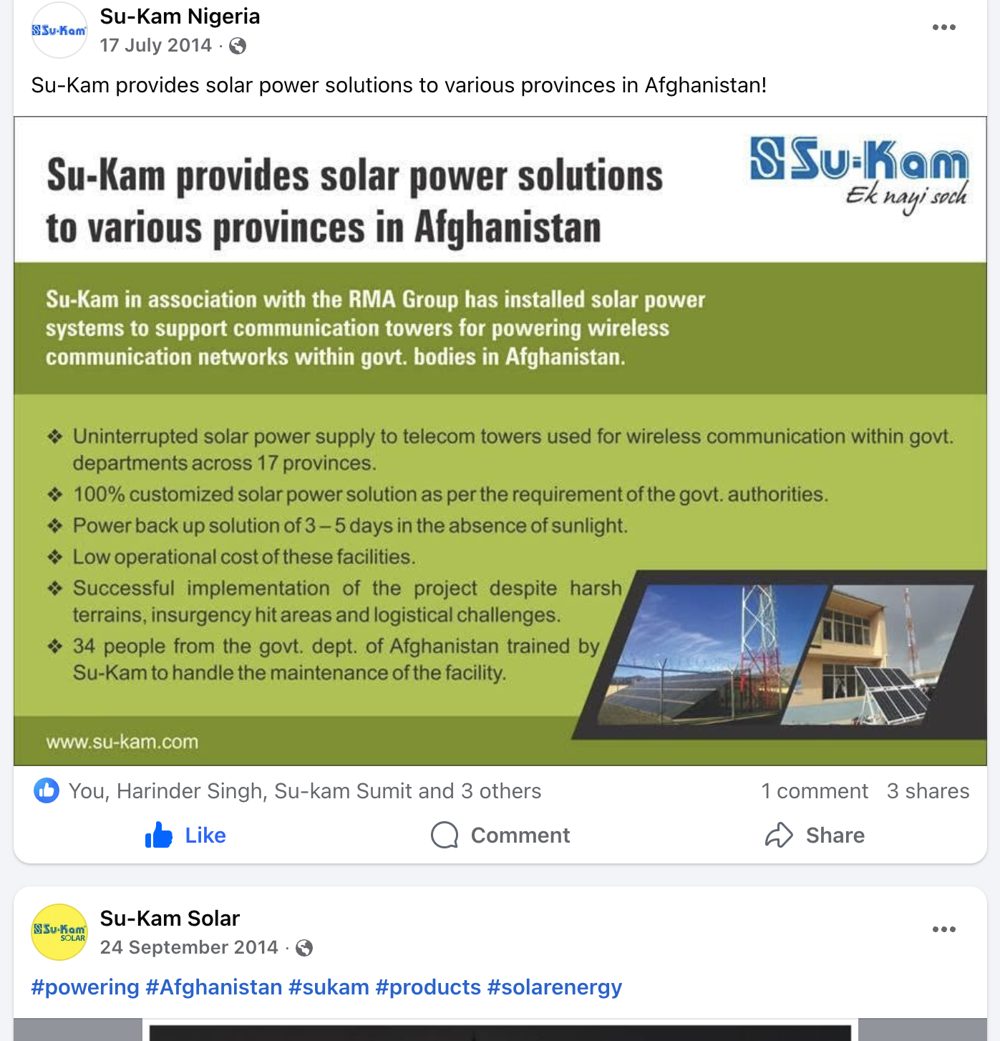
Taking Indian-engineered solar into Afghanistan was a statement of intent. Working with the RMA Group, we installed solar systems powering telecom towers and wireless communication networks across 17 Afghan provinces — and we trained 34 people from the country’s own government departments to support them. Keeping a nation connected, on sunlight, in one of the world’s most demanding operating environments, is not a job you take lightly. The systems had to be rugged, the training had to be real, and the support had to outlast our visit. That we could do this — reliably, at provincial scale — said everything about how far our power conditioning units had matured. Su-Kam PCUs were lighting up modern Afghanistan, and the photographs of rooftop arrays and local technicians at work still mean a great deal to me.
View in the Facebook Archive →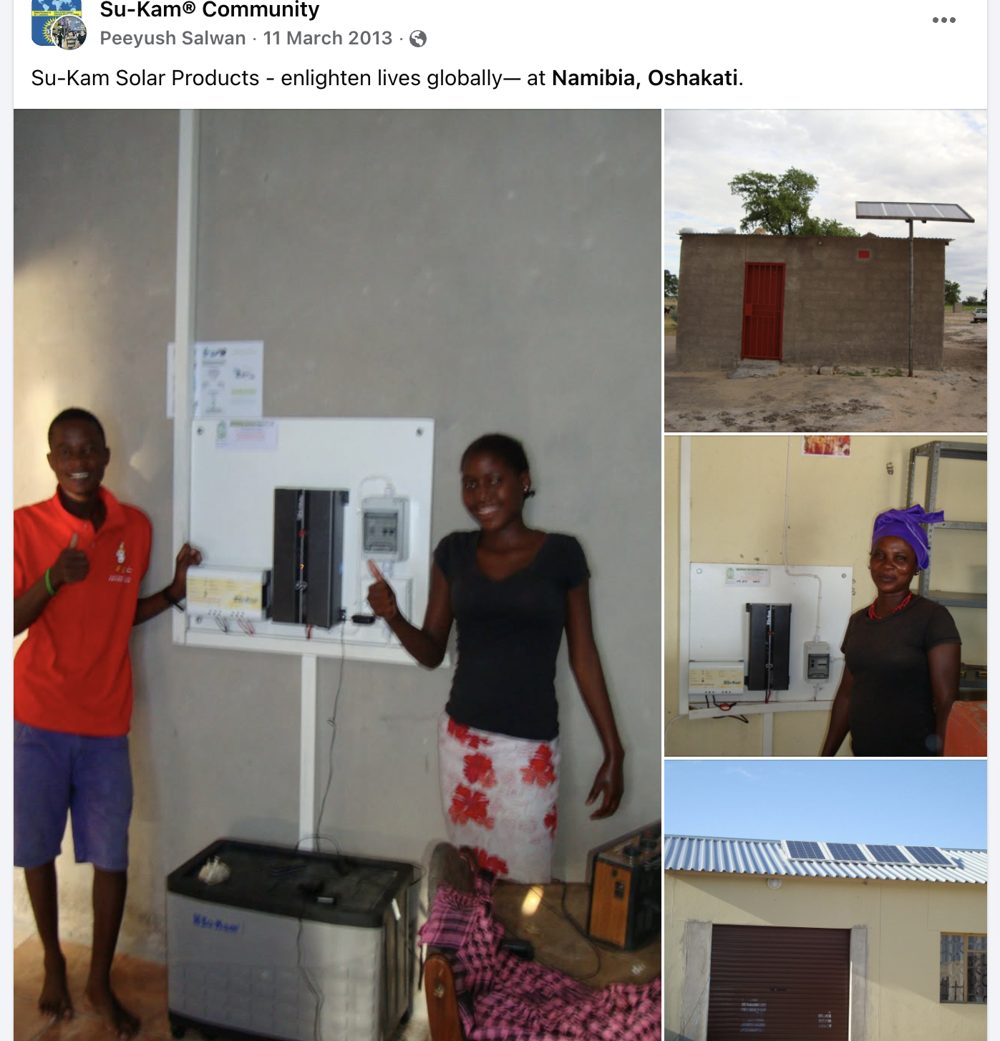
One photograph from Oshakati, Namibia, says more than any spec sheet: a smiling couple standing beside a wall-mounted Su-Kam solar inverter inside their own home, with our rooftop panels on small houses up and down the street. Power electronics designed in Gurgaon, quietly changing daily life in southern Africa. This is what I mean when I say we commercialised solar rather than demonstrating it — the product had to be simple enough to live on a family’s wall, robust enough to handle an unforgiving climate, and affordable enough to make sense for an ordinary household. When I look at that image, I don’t see an export order. I see a home that works after dark, anywhere in the world, on the same engineering we shipped from India.
View in the Facebook Archive →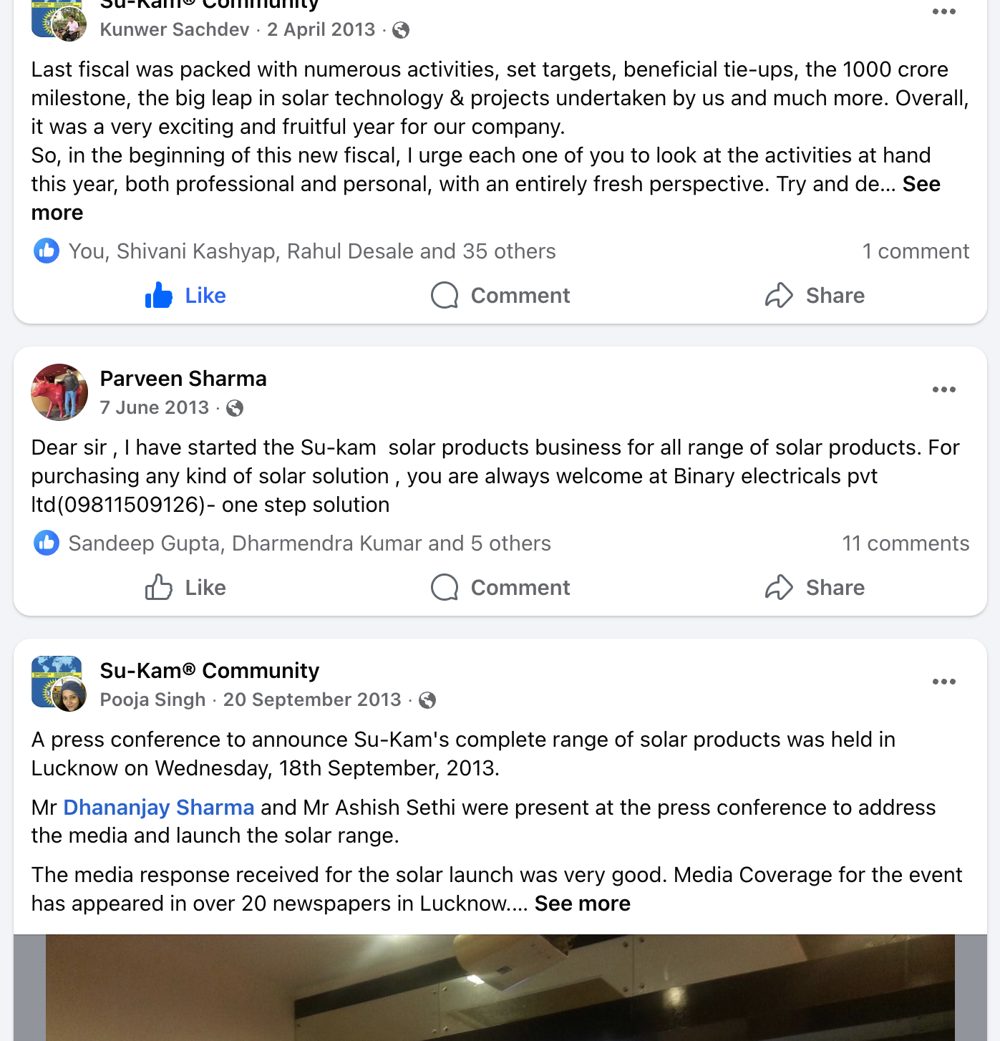
At the start of one new fiscal, I wrote to the whole Su-Kam community to mark a moment I never take for granted: “Last fiscal was packed with numerous activities, set targets, beneficial tie-ups, the 1,000 crore milestone, the big leap in solar technology and projects undertaken by us.” A bootstrapped Indian inverter company — started in a single room, with no inherited capital — had crossed a thousand crores and made its leap into solar at the same time. We would go on to peak near ₹1,200 crore by 2012–13, exporting to more than 90 countries. But I always insisted we celebrate these moments as a team, because none of it was built by one person. It was built by the people who shipped six million products and stood behind every one. The awards and recognition Su-Kam earned were really theirs.
View in the Facebook Archive →
If you want one frame that captures the founding era, it’s our 2015 scoreboard. That year we became the first Indian inverter company to earn 4-star energy ratings from the BEE; we manufactured six million power products; we were featured in a Discovery Channel documentary on solar; we distributed solar lights to hundreds of homes during the Nepal earthquake; and we were voted one of India’s most trusted brands. I shared the infographic with a simple line — “looking forward to a great 2016.” What I see in it now is range: a company that could win a government efficiency rating, run a factory at serious volume, and still rush light to disaster survivors in the same twelve months. Invention, manufacturing and conscience, in a single year.
View in the Facebook Archive →The engineering behind these projects didn’t appear from nowhere. We had built a solar DC system with grid connectivity back in 2009 — what the world now calls hybrid inverter technology. The full collection of original posts lives in the Solar Man of India Facebook archive. I’m still building today at Su-Vastika, and I write regularly about that journey — and about the harder chapters too — in my blog.
Awards and Recognition Achieved by Su-Kam Power Systems
June 13, 2026
The certifications and honours we earned — and what they actually validated about the engineering.
We Built Solar DC With Grid Connectivity in 2009 — Now Called “Hybrid Inverter Technology”
June 13, 2026
We commercialised a hybrid solar PCU years before the term became fashionable. How it worked and why it mattered.
Fair Value vs Liquidation Value Under the IBC — What I Saw Happen to Su-Kam
June 12, 2026
A ₹300 crore fair-value company sold for a pittance; banks recovered ₹8 crore. What the process really does.
IBC: A Debt Trap for Entrepreneurs — My Personal Ordeal and a Call for Reform
June 12, 2026
After 30 years of building Su-Kam, I walked through liquidation myself. What the IBC does to a founder.
Founder of Su-Kam and Kunwwer.ai, and mentor at Su-vastika and several other companies — the “Inverter Man of India” and the “Solar Man of India.” Read his story →