Grassroots & spectacle marketing
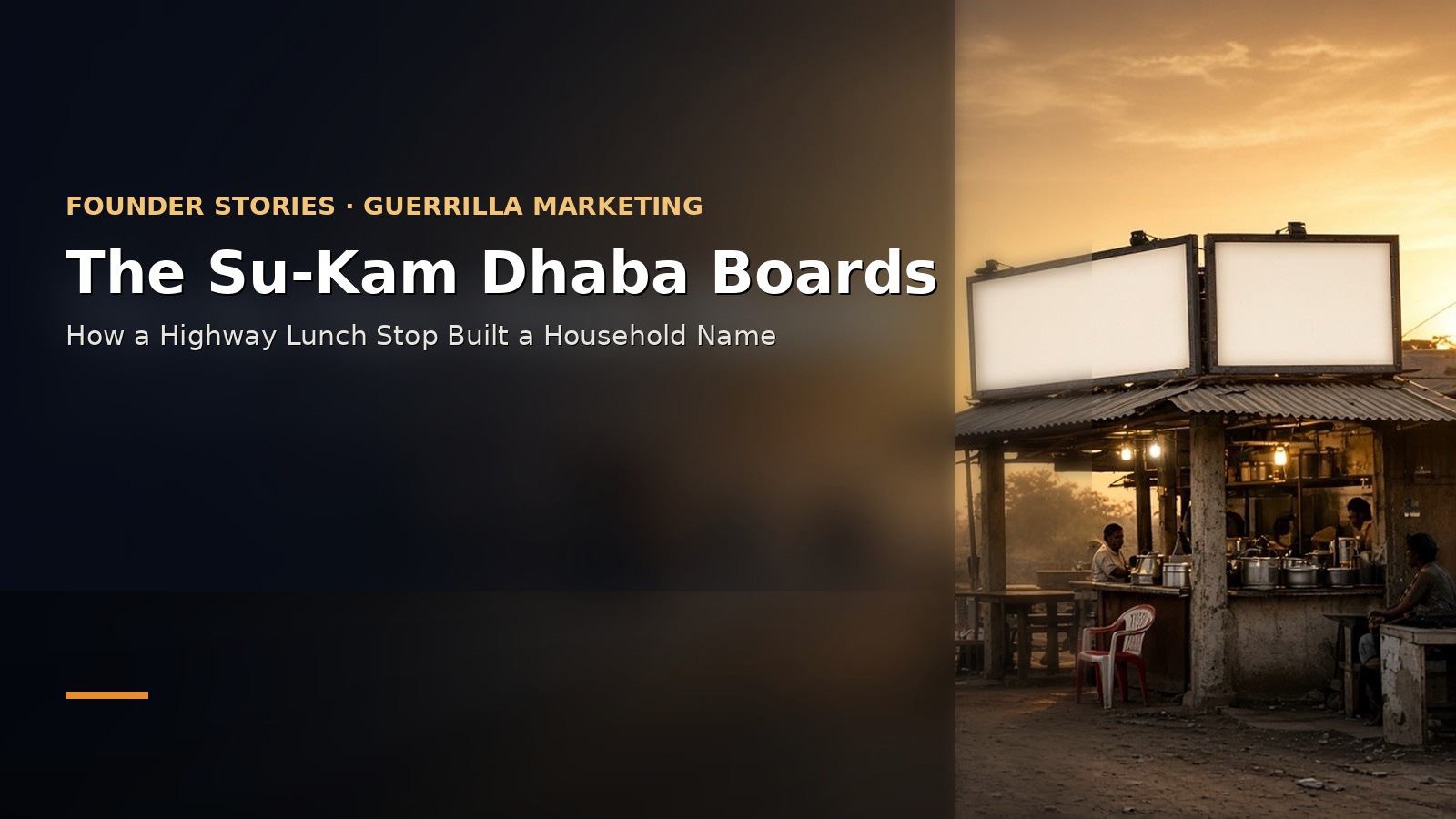
SU-KAM dhaba boards — how a 2004 highway lunch stop etched the brand into India’s roads
I was training salespeople on the road. We stopped to eat. The dhaba owner could not even put his own name on the board. That is where the idea began.
Coca-Cola owned many of those small boards. The dhaba wallah was struggling for his own name. I decided Su-Kam would give him a bigger board — with his name and ours.
I used to travel by car for dealer meetings and demos, and I often took fresh sales guys with me for on-the-job training. That was the real classroom: highway stretches, dealer counters, awkward silences, and then the order that either came or did not. Between meetings we ate at dhabas — the same places truckers, scooter riders, and family cars already trusted for tea and dal.
On one of those trips in 2004, while we were eating, I noticed something small and important. The dhaba owner was struggling to get his own dhaba name on the board. At several places, Coca-Cola effectively owned those small boards. The brand that sold cold drinks owned the wall. The man who cooked the food was a guest on his own facade.
That bothered me — and it also showed me a gap. If a multinational could rent the eyes of every highway traveller through a dhaba board, why were we, building a power-backup brand for Indian homes and shops, still thinking only in terms of dealer glow-signs and newspaper ads?
Give the dhaba wallah his name — and put Su-Kam beside it
I told my people to give the dhaba owner a big board with his name on it, along with the Su-Kam brand. Not a sticker that erased him. A board that made him proud and made us visible. We came back, designed those boards, and installed the first one on one dhaba. I spoke to the dhaba wallah afterwards. He was very happy. He thanked me. That thank-you mattered more than any agency deck, because it meant the board would be protected, cleaned, and pointed out to customers — not torn down the week after we left.
From that one installation, we started the process in a big way. Sometimes we charged dhaba wallahs; sometimes the economics were different depending on location and size. We selected board sizes according to the location of the dhaba — what worked on a tight roadside stall was not what worked on an open highway plot where vehicles approached at speed. Visibility is geometry, not only branding theory.
Haryana, Punjab, UP — then the rest of India through our people
We began these activities in Haryana, Punjab, and Uttar Pradesh — corridors we already travelled for dealers and demos. Then distributors and our employees carried the same exercise into other states. That second wave mattered. A head-office idea dies if only founders can execute it. A field system lives when a distributor in another state can repeat the conversation: board for your name, Su-Kam beside it, sized for your location, installed properly.
The brand Su-Kam, in the minds of ordinary people, was built heavily by this activity. People travelling in cars, scooters, buses — the full messy democracy of Indian roads — kept seeing the name across the journey. Not once in a festival ad. Again and again, at the natural pause points of the highway. The brand got etched into memory the way milestones do: by repetition in the places where India actually stops.
It was a great learning for me as well. Marketing school talks about reach and frequency. The dhaba taught me something simpler: stand where hunger already stops the vehicle, respect the owner of that place, and let every passing kilometre do free work for you. A board at a dhaba works while you sleep, while your sales trainee is still learning the pitch, and while a competitor is still drafting a newspaper release.
Vinod and the dhaba-board team
After the idea was proven, it needed an owner inside the company. There used to be a guy named Vinod Bansal from Haryana who was made in-charge of this function after basic training in the company. I have written his full journey — from highway dhabas to founding Satvik — here: Vinod Bansal’s story. Full alumni web: People Who Built With Me. He, along with his team — we called it the dhaba board team — made the programme successful. That is an under-celebrated kind of leadership: not a launch event, but months of permissions, fabrication, travel, installation, and follow-up with people who will never appear in a brand film.
Vinod Bansal’s team turned a lunchtime observation into an operating system. Without that, 2004 remains a nice anecdote. With that, it becomes a national outdoor network built from the bottom up — through employees and distributors who understood both the board and the dhaba wallah.
Then Airtel followed — and the dhaba wallahs had learned
Later on, Airtel followed the same strategy. By then dhaba owners had become intelligent about the value of their walls. They charged for those boards. That sequence tells the whole story of the idea: first Coca-Cola owned the small board and the owner had little voice; then Su-Kam offered dignity plus brand partnership and scaled through Haryana, Punjab, UP and beyond; then a telecom giant arrived to rent the same attention — and the dhaba wallah finally priced his real estate like real estate.
I do not claim we invented outdoor advertising. I claim we noticed, at a dining table on the highway, that Indian brand-building could live at the dhaba if we respected the owner. The rest was execution — board sizes by location, a dedicated team under Vinod Bansal, distributors who copied the method state by state, and years of travellers absorbing SU-KAM without ever opening a brochure.
This sits with our other field inventions of the era — Kashmiri shikaras, Sales Ka Bazigar, and Power On Wheels. Different stages. Same instinct: go where India already gathers, and make the brand impossible to ignore.
— Kunwer Sachdev
The sales-and-channel machine in this essay is the front half of the story told in The Manufacturing Mirage.
Founder of Su-Kam and Kunwwer.ai, and mentor at Su-vastika — the “Inverter Man of India” and the “Solar Man of India.” Read his story →
Disclaimer: Kunwer Sachdev exited Su-Kam in 2019 and is not responsible for any activity of the company since. Full disclaimer →