Grassroots & spectacle marketing
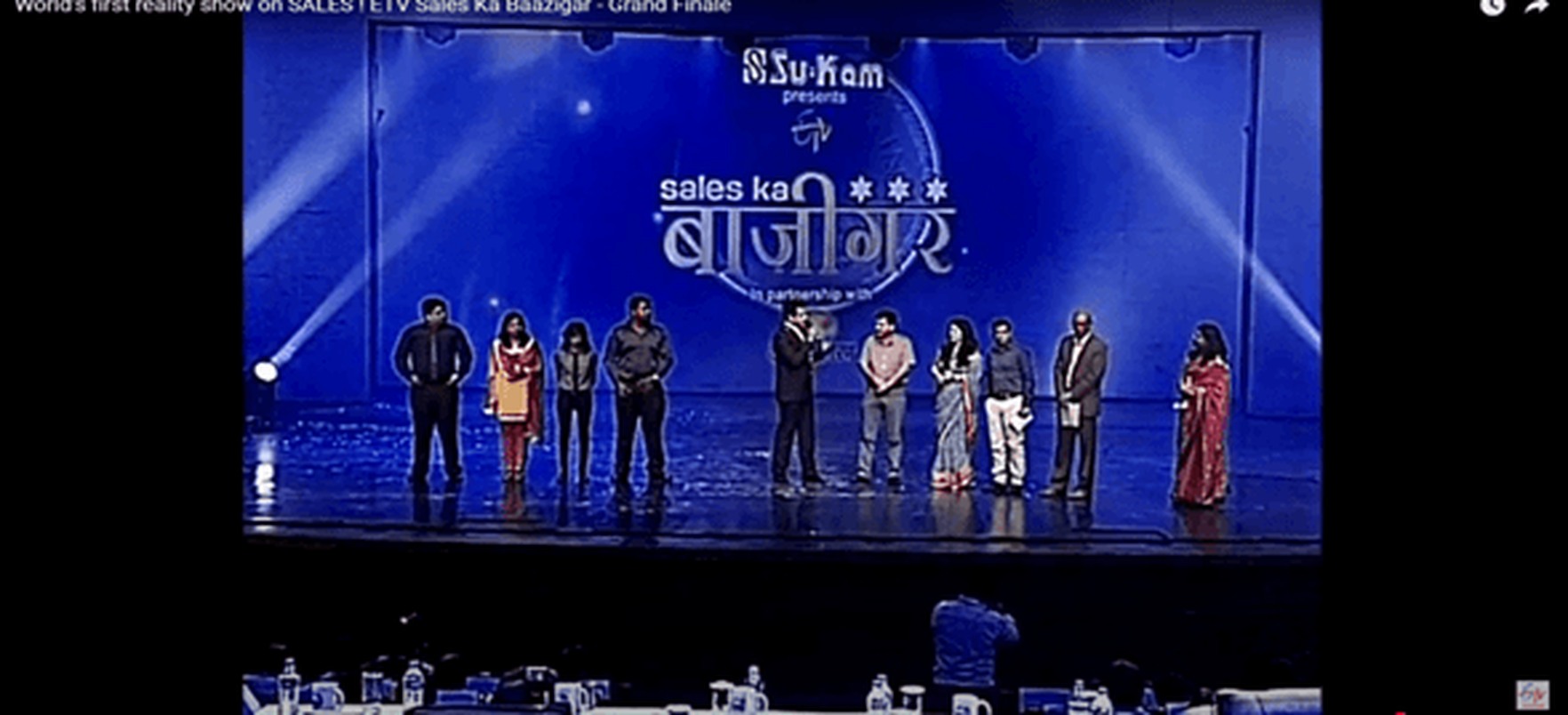
Sales Ka Bazigar — the primetime ETV show I built to find sales talent no MBA filter would hire
Grand Finale on ETV — Su-Kam presents Sales Ka Baazigar. Other companies wrote job descriptions. I produced a television show.
Most companies recruit salespeople from business schools. I looked at that pipeline and decided it was solving the wrong problem.
When a company needs salespeople, the script is usually the same: post a vacancy, ask for a degree — preferably an MBA — and interview whoever the degree sends. The résumé arrives with the right logos. The candidate speaks the language of frameworks. You hire them, put them in front of a dealer who has been selling batteries since before that candidate was born, and watch the conversation die in five minutes.
I did not believe selling was a credential. I believed it was a native talent — something you could polish, but not manufacture in a classroom. So instead of another job advertisement, I created and produced a primetime talent show on ETV: Sales Ka Bazigar.
The premise was a quiet provocation aimed at corporate India — a hunt for the best salespeople without an MBA. No business-school pedigree. No résumé of brand names. Just the raw, unteachable instinct for selling, and a national stage on which to prove you had it. The Times of India later called it a first in India: a reality show to find the best salesperson. That line still makes me smile, because we did not set out to invent a category for the newspapers. We set out to fill our own benches.
Why the usual hiring machine failed us
By the early 2000s Su-Kam’s problem was not awareness alone. We had dealers across India who brought their wives and children to our meetings — not because we served better lunch, but because I insisted the family behind the counter was part of the partnership. A happy family makes a loyal dealer. That was not HR philosophy; it was distribution math.
The bottleneck was people who could stand in that shop and earn trust. Business schools were producing marketers for FMCG and banking. Nobody was producing field sellers who could explain MOSFET protection, battery chemistry, and after-sales service to an electrician in Ludhiana — and to his son who would inherit the shop. A PowerPoint about “value selling” does not survive a load-shedding evening when the customer’s fridge has already gone warm twice that week.
Traditional hiring asked for CV keywords. Su-Kam needed people who could sit on a dealer’s floor, respect his father who started the shop, open the lid of an inverter without fear, and explain why a branded product was insurance for the dealer’s reputation — not just another box on the shelf. That skill does not show up as “3–5 years in a Marquee MNC” on LinkedIn.
I scouted the contestants myself
I did not outsource the casting. I personally scouted contestants at exhibitions and events across the country, assembling a deliberately diverse pool of people the conventional system would never have shortlisted. I watched how they approached strangers, how they handled a “no,” whether they listened before they pitched. A sales instinct reveals itself in thirty seconds if you know what you are looking for.
The format was part audition, part masterclass. Contestants had to demonstrate a product with the lid open, handle objections without discounting the brand, and show they could build repeat business — not one-off transactions. Every episode was a filter: who could represent Su-Kam in a market where trust mattered more than margin?
The show found an audience — and that audience did something useful for a power-backup company: it made Su-Kam a household name across North Indian states, in homes that had never read a line of the trade press. Popularity, in turn, drew sponsorship from major brands. Characteristically, the thing that was building our reputation was also paying for itself. That was not an accident of media planning. It was the same thrift I applied everywhere: if an idea only burns cash, it is incomplete; if it builds brand and recruits and funds itself, keep going.
It was never “just marketing”
It is tempting to file Sales Ka Bazigar under marketing and move on. I will not. The show was an argument, and the argument was personal.
I had earned the right to that belief the hard way. My own origin story runs through selling pens on the buses of Delhi long before I sold a single inverter. I had been, myself, exactly the kind of person an MBA filter would have screened out. A talent show that went looking for undegreed selling ability was, in a real sense, me building the ladder I had once needed and never been handed.
It was the same instinct as the chess-match-as-recruitment exercise at our Sports Day — standing at the edge of the room, watching not the score but the people, marking the strategists and closers nobody else had noticed. Sports Day found talent inside the building. Sales Ka Bazigar went looking for it in the entire country. Same eye. Larger stage. Live cameras instead of a sports-day hall.
When you have sold for survival, you recognise the hunger in someone else. When you have been rejected by systems that only read certificates, you become suspicious of certificates. The show was my way of saying that suspicion out loud — weekly, in living rooms, in the language of entertainment so that people who would never attend a corporate seminar still got the point.
One show. Three jobs.
In a single production I was doing three things at once:
- Recruiting — building a pipeline of genuine sales talent, identified under pressure, on camera, in front of a live audience. A far more revealing test than any interview room. Under lights, with time running and an audience watching, polish collapses and instinct remains.
- Branding — putting Su-Kam in front of millions of ordinary North Indian viewers, in their living rooms, in their language, attached to something they actually enjoyed watching. No billboard buys that kind of warmth. People do not invite a hoarding into their evening; they invite a show.
- Making an argument — telling an industry, in public, that its hiring orthodoxy was wrong: the person who could sell did not need a certificate saying so. The show was the proof, performed weekly.
Very few founders would try to solve recruitment, brand-building, and an industry-wide thesis with one television format. Fewer still would fund it, produce it, and personally scout the contestants. To me it felt obvious. If your real constraint is human quality at the last mile, why would you spend your imagination only on ads that shout at customers while your hiring process quietly rejects the people who can talk to them?
The company was built on the same conviction
The dealer network that carried Su-Kam across the country, the service teams, the regional leaders — much of that human machine was staffed by exactly the type of person Sales Ka Bazigar was built to celebrate: people with the instinct, not necessarily the credential. The show was the public face of a private conviction that ran through the whole company — the same conviction behind our HR awards: talent is widely distributed and badly measured, and a company willing to look where others would not can simply find it lying around, unclaimed.
That is why the show sat beside other field inventions of the same era: dhaba boards, dealer meetings with whole families, and the Power On Wheels van. Different formats, one thesis — brand is behaviour in the field, not a tagline in an agency deck. Highway boards caught the eye of travellers. The van took the product to the customer’s street. The television show took the hunt for talent into the same living rooms where the brand needed to feel familiar.
When digital marketing arrived later, many competitors tried to buy visibility. We had already spent years manufacturing visibility by training and selecting the humans who stood in front of the customer. Algorithms can amplify a message. They cannot replace a person who can open a product, absorb anger about a power cut, and still leave the dealer feeling respected.
Other companies wrote job descriptions. I wrote a television show — and then went and found the people those job descriptions would have thrown away. The episodes below are the archive of that experiment: auditions, mega rounds, and later shows from the ETV run. Watch them not as nostalgia, but as a hiring method you can still steal — if you are willing to look past the degree line.
— Kunwer Sachdev
Watch Sales Ka Baazigar — full episode archive
The complete ETV / Su-Kam Sales Ka Baazigar run — auditions across UP & Uttarakhand, mega auditions, and later episodes — preserved on the ETVEvents YouTube playlist (16 available videos; 2 playlist entries are no longer available on YouTube).
Playlist: Watch Sales Ka Baazigar Episodes (ETVEvents).
Episodes
The sales-and-channel machine in this essay is the front half of the story told in The Manufacturing Mirage.
Founder of Su-Kam and Kunwwer.ai, and mentor at Su-vastika — the “Inverter Man of India” and the “Solar Man of India.” Read his story →
Disclaimer: Kunwer Sachdev exited Su-Kam in 2019 and is not responsible for any activity of the company since. Full disclaimer →