THE IBC FILES · ESSAY 14
Why the Subhash Chandra Case Must Force a Rewrite of India’s Personal Insolvency Law
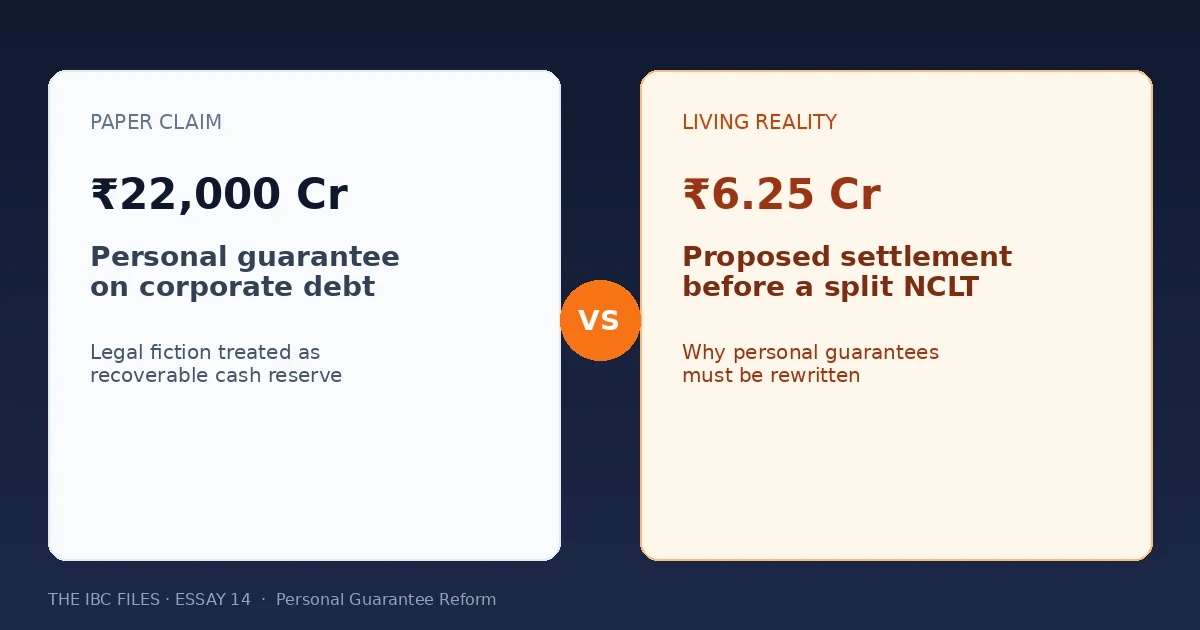
A proposed ₹6.25-crore settlement against ₹22,000 crore in claims. A split NCLT division bench. The ongoing drama around Zee founder Subhash Chandra proves that treating personal guarantees on astronomical corporate debt as recoverable cash reserves has collapsed into legal fiction. It is time to examine the original intent of personal guarantees—and fix a broken law.
Part of The IBC Files: Policy Playbook — Read companion essays: The Car and the Factory and The Home Loan vs. The Factory Loan.
∎The Endless Loop of Laws and Loopholes
Whenever an insolvency framework fails to deliver fairness, the regulatory response in India follows a well-worn script: draft an amendment, notify a circular, or add another layer of procedural compliance.
Yet creating new laws without achieving their core purpose is useless. Every new law simply creates a new loophole.
The fundamental flaw lies in misunderstanding what a personal guarantee is meant to accomplish. It was never intended as a mechanism of indiscriminate ruin—treating an entrepreneur who lost capital to market shifts the exact same way as a promoter who hollowed out a balance sheet.
The true economic and moral purpose of invoking a personal guarantee must be a forensic test of intent:
- Siphoning as an Unforgivable Crime: Did the founder engineer circular transactions, divert company borrowings into private trusts, or hide assets behind overseas shells? If funds were siphoned, that is not commercial failure—it is financial fraud. It demands rigorous forensic tracking, full personal asset attachment, and criminal prosecution.
- Genuine Business Loss as a Case for a Fresh Start: Did the business collapse due to policy upheaval, technological transition, or authentic market distress while the founder kept every rupee inside the operational entity and reinvested personal resources? If so, the system must provide a dignified exit and an unencumbered fresh start.
When the law fails to make this distinction, adding more rules does not fix the system. It merely provides sophisticated actors with fresh technicalities to exploit while penalizing honest risk-takers.
A ₹6.25-crore repayment plan against ₹22,000 crore in claims. A split NCLT division bench. The constitution of a first-ever 5-member tribunal bench, followed by immediate appeals and stays before the NCLAT.
The national headlines surrounding Zee founder Subhash Chandra’s personal insolvency proceedings are not an isolated corporate spectacle. They are the clearest warning yet that India’s personal guarantee framework under the Insolvency and Bankruptcy Code (IBC) has completely decoupled from economic reality.
To understand why the law is broken, we must ask a fundamental question:
What was the original intent of a Personal Guarantee?
Historically, in Indian commercial banking, a personal guarantee was never meant to be a substitute for sound project appraisal or physical asset security. It was designed for one specific purpose: a moral hazard check.
“If you, the promoter, divert company funds to personal accounts, bleed the business dry, or commit fraud, the corporate veil will not protect you. Your personal wealth is on the line.”
It was an anti-siphoning mechanism. It was meant to ensure skin in the game. Over two decades, Indian lenders turned that check into a rubber stamp—and under the IBC, into a lifetime sentence.
01How the US and UK Treat the Founder: The “Fresh Start” vs. Indian Civil Death
To see how abnormal and punitive India’s personal guarantee regime is, look at the two jurisdictions whose corporate laws India claims to emulate: the United States and the United Kingdom. Neither treats business failure as a crime. Both systems rest on a foundational economic truth: if you permanently destroy the entrepreneur when a business fails, nobody will ever take the risk of building a company.
The United States: Constitutional “Fresh Start” and 90-Day Discharge
Under the US Bankruptcy Code (Title 11, US Code), personal insolvency is anchored by the Supreme Court doctrine in Local Loan Co. v. Hunt: bankruptcy must give the honest debtor “a new opportunity in life and a clear field for future effort, unhampered by the pressure and discouragement of preexisting debt.”
- The founder stays in control (Chapter 11 DIP): Existing management remains as Debtor-in-Possession to run the factories and execute the turnaround under court supervision. The builder who created the enterprise is presumed best positioned to save it.
- Injunctions on personal guarantees (Section 105(a)): US bankruptcy courts routinely stay lenders from suing founders on personal guarantees while the company restructures—because hounding the founder destroys any chance of corporate survival.
- 90-day complete discharge (Chapter 7): If a founder must enter personal bankruptcy due to business guarantees, qualifying debt is completely and permanently discharged within roughly 90–120 days. The personal guarantee is extinguished forever. Creditors are permanently enjoined from contacting the founder again.
- Future income and home protected: Future earnings belong to the founder. Homestead exemptions protect the family home. The entrepreneur can incorporate, raise capital, and build again the next day.
The United Kingdom: Automatic 12-Month Discharge and Fiduciary Duty
The UK insolvency regime was deliberately modernized by the Enterprise Act 2002 to strip away the stigma of business failure and protect entrepreneurial risk-taking:
- Automatic 12-month discharge: Under Section 279 of the Insolvency Act 1986, personal bankruptcy lasts a maximum of one year. At the 12-month mark, discharge is automatic. Qualifying personal guarantees on corporate debt are wiped clean. The founder may hold directorships and launch new ventures.
- Creditor fiduciary duty & Section 212: Court-appointed Administrators have a statutory duty to rescue the company as a going concern. If an Administrator mismanages the business, starves production, or sells assets at an undervalue, they can be pursued for misfeasance under Section 212.
- The “impaired security” protection: Under British surety law (Pearl v. Deacon), if a bank takes custody of company assets and through negligence or delay allows those assets to be wasted or sold at scrap value, the personal guarantor is discharged to the extent of the value destroyed.
The Indian Reality: Eviction, Extraction, and Lifetime Persecution
- No Debtor-in-Possession: The founder is evicted on Day 1.
- No Fresh Start: India provides no time-bound discharge for personal guarantors. Part III personal insolvency is an indefinite legal purgatory of frozen bank accounts, Look-Out Circulars (LOCs), passport threats, and economic paralysis.
- Zero creditor accountability: Even when the regulatory body (IBBI Order No. IBBI/DC/178/2023) formally penalises RPs and liquidators for gross procedural misconduct, the entrepreneur receives zero debt relief.
∎The Indian Paradox: The Subhash Chandra Case
The disconnect between international fresh-start standards and Indian practice was underscored in the personal insolvency proceedings of Zee Group founder Subhash Chandra—as reported in NCLT records, media coverage, and subsequent regulatory responses.
- The Recovery Metric: As reported in The Indian Express analysis of the NCLT proceedings, Chandra submitted a personal repayment plan offering just ₹6.25 crore to settle admitted creditor claims of ₹22,006.57 crore—a recovery rate of roughly 0.03% (a 99.97% haircut), according to those reported figures.
- The Voting Architecture: Media reporting on the NCLT record stated that the proposal secured an 80.8% majority vote. The Indian Express further reported that this threshold was achieved amid significant discrepancies, including approximately 1,260 individual, unverified claims whose collective voting weight, as described in that coverage, diluted and outvoted commercial financial institutions.
- The Regulatory & Judicial Fallout: As reported from the tribunal process, a five-member special NCLT bench stayed the repayment order and restrained the alienation of assets—exposing the systemic loophole. As covered by The Indian Express on IBBI’s regulatory response, the Insolvency and Bankruptcy Board of India subsequently moved to propose tighter safeguards for personal guarantor insolvency to prevent the manipulation of creditor voting pools.
The Two Indias of Insolvency: A Comparative Study
| Dimension | Financial Engineering Case (Subhash Chandra) | Tangible Manufacturing Case (Su-Kam / Kunwer Sachdev) |
|---|---|---|
| Enterprise Nature | Conglomerate holding structures, complex cross-holdings, and inter-corporate guarantees | Core domestic electronics manufacturing: 6 automated plants, 100+ patents, 50,000 dealers |
| Asset Location & Forensics | Multi-layered corporate investments and offshore trusts; substantial past net-worth certificates | 100% of capital reinvested on the factory floor, automated machinery, testing labs, and domestic inventory |
| Forensic Audit Findings | As reflected in regulatory orders and media reports, repeated scrutiny (including SEBI show-cause proceedings) regarding alleged circular transactions | As recorded in forensic audit findings in the Su-Kam process: zero siphoning, zero diversion, and zero fraudulent conveyance |
| Resolution Proposal | As reported: ₹6.25 crore offered against ₹22,006.57 crore admitted claims (~0.03% recovery) | Complete operating enterprise, patents, and manufacturing assets surrendered to liquidation |
| Outcome for the Founder | Procedural contestation via voting architecture and tribunal stays, as reported in NCLT / media coverage | Complete loss of original company, equity, and personal assets despite absence of proven wrongdoing |
02The Legal Fiction: ₹22,000 Crore vs. Reality
Can any single human being in India personally pay back ₹22,000 crore of corporate debt from personal savings?
Of course not. Treating personal guarantees on astronomical corporate debt as recoverable personal cash reserves is a mathematical absurdity. It forces tribunals into grotesque standoffs between paper claims and fractional proposals, turning the judiciary into a theatre of the absurd. That is the Subhash Chandra case in one sentence—and it is the same architecture that crushed ordinary manufacturers.
03The Su-Kam Ordeal: The Mathematical and Moral Collapse
Consider what happened to me and Su-Kam Power Systems—an enterprise generating over ₹600 crore in annual revenue, operating plants in Gurgaon and Baddi, and holding 77 patents.
1. Locked Out of Valuation, Yet Billed for the Shortfall
When the company entered CIRP, the lenders’ own Big-4 valuers assessed Fair Value at ₹300 crore. Throughout that valuation process, I was never consulted. Big-4 valuers sat behind closed doors without shop-floor knowledge, marking brand equity and 77 patents down to zero.
If the promoter is excluded from the room during valuation, how can the law hold that promoter personally liable for a shortfall calculated from a secret, depressed figure?
2. Banned from Rescue Under Section 29A
When I saw the company deteriorating under the RP’s custody, I did not run away. I secured institutional backing—including Kotak—and tabled a ₹250-crore revival and settlement plan to repay the banks and protect livelihoods. The banks took shelter under Section 29A and disqualified the plan. The law barred me from bringing outside investment to save my own company.
If the state bans the founder from bringing outside capital to rescue the enterprise, why is the founder held responsible for the value lost after the banks allowed the company to rot?
3. The ₹40-Crore CIRP Bloodletting
When Su-Kam entered CIRP, it needed working capital to purchase raw materials and keep assembly lines moving. Did the banks invest a single rupee to keep the factory running? Not one paisa.
Instead, the IBC functioned as a parasitic extraction machine. Money was drained from the stressed company’s remaining cash flows to fund fees for the Resolution Professional, Big-4 accounting firms, forensic auditors, and armies of lawyers. In Su-Kam’s case alone, the CIRP cost was nearly ₹40 crore—money that could have revived the company, burned on administrative process.
4. Shuttered and Fire-Sold in Corona
Having starved the company of working capital, let patents lapse, and burned ₹40 crore on process costs, the lenders shut down the factories completely. Then, during the peak of the COVID-19 pandemic—at the absolute nadir of modern economic markets—they auctioned off the carcass of a ₹300-crore company for a meager ₹9 crore without my knowledge or consent.

5. Compounding Interest on Manufactured Ruin
The interest clock never stopped ticking. The banks continued to compound penal interest against the corporate debt month after month. The founder had zero control, was barred from the factory gates, and was forbidden from bringing in rescue funds. Yet after liquidating the asset for pennies during COVID, the banks added the corporate debt, the compounding penal interest, and the multi-year process losses together—and dumped the entire bill onto my Personal Guarantee.
Personal guarantees were weaponized to pursue personal assets even after the IBBI formally penalised both the RP and the Liquidator for gross procedural violations and mismanagement.
04The Question India Must Answer: Is This Fair?
In the US, the founder gets Chapter 11 DIP to save the business, and Chapter 7 provides a clean discharge in roughly 90 days. In the UK, the Administrator is legally liable for wasting assets, and personal bankruptcy ends automatically in 12 months.
In India:
- We take a running company valued by the banks at ₹300 crore.
- We ban the founder from investing ₹250 crore to rescue it under Section 29A.
- We refuse working capital, but drain ₹40 crore of company cash on Big-4 fees.
- We shut the plant and fire-sell it for ₹9 crore during Corona.
- We compound penal interest throughout the destruction.
- And then we invoke the personal guarantee to take the founder’s home, freeze personal savings, and pursue them for life.
Is it fair to make the promoter bear the entire loss—with compounding interest—for a disaster manufactured by the IBC process itself?
Until India adopts the basic legal principles of the US and UK, our insolvency law is not resolving debt—it is running a state-backed apparatus of industrial destruction. The Subhash Chandra standoff is not an exception. It is the symptom. Parliament and the IBBI must fix it.
- Decouple genuine business failure from fraud — personal guarantees enforceable only for willful default, diversion, or criminal fraud.
- Apply Section 141 of the Contract Act to CIRP — if value is destroyed under RP/CoC custody, discharge the guarantor proportionally.
- A clean discharge mechanism — a 90% corporate haircut cannot hold the entrepreneur personally hostage forever.
∎The Forensic Gatekeeper Mandate
Creating more statutes or incremental rules without addressing founder intent will not safeguard lenders or spur enterprise.
India’s insolvency framework requires a binding Forensic Gatekeeper Rule:
- Mandatory Forensic Filter: No personal guarantee should be enforced, nor should any personal resolution plan be approved, without an independent, court-certified forensic audit establishing the presence or absence of siphoning.
- Strict Bifurcation — the closing rule:
- Siphoning = crime: Where deliberate diversion or asset stripping is established, personal guarantees must be enforced to the full extent of the promoter’s global assets, with criminal prosecution and no access to statutory haircuts.
- Honest distress = fresh start: Where forensic scrutiny proves genuine business failure with clean asset custody, the guarantor must receive a structured, time-bound debt discharge and an unencumbered fresh start—aligned with the US and UK models.
Until this distinction sits at the core of the law, the IBC will remain trapped in a cycle of drafting new rules that do little more than generate new loopholes.
••Explore The Series
- Main Hub: The IBC Files: 14 Essays from Inside India’s Insolvency Code
- Companion Essay 12: The Car and the Factory: Why India Grants More Dignity to a Car Defaulter
- Companion Essay 13: The Home Loan vs. The Factory Loan: How Indian Law Protects the House
- Companion Essay 09: Personal Insolvency: The Last Straw
- Policy Dialogue: Contact Kunwer Sachdev
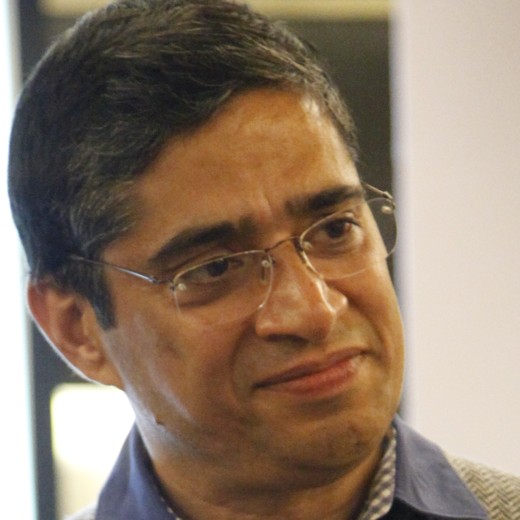
Founder of Su-Kam and Kunwwer.ai — the “Inverter Man of India” and the “Solar Man of India.” Read his story →