The AI server rooms of the future will run on DC — I proved it in 2016
Solar makes DC. AI servers, computers, LED lights and BLDC fans all run on DC inside. So why convert solar’s DC into AC, only to convert it back again in every machine — wasting power at every step? A decade ago I put my entire Su-Kam R&D building on pure solar DC, and cut the office lighting from 1,200 watts to just 408. Today the world’s hungriest machines — AI data centres — are heading exactly where we already were in 2016. It was the project closest to my heart, and the one I never got to finish.
The thing we were really chasing was simple: maximum power saving from solar. And when we looked hard at the numbers, DC turned out to be the cheapest, most efficient way to get there. So we ran the lights, the fans and the small loads of our entire R&D centre on solar — in DC, end to end — and even took the grid backup and rectified it into DC instead of using it as AC. This was one of the major experiments I thought of and built myself, and it worked.
1 The idea: stop throwing solar’s DC away
A solar panel does not produce AC. It produces raw, free DC. Yet the standard way we use solar is almost comically wasteful: we take that DC, run it through an inverter to make AC, push it around the building as AC — and then every modern appliance quietly converts it back to DC inside itself before it can actually use it. Your direct current goes DC → AC → DC, and at every step you pay a tax in lost energy and heat. I kept asking my team a question nobody had a good answer to: if the source is DC and the load is DC, why are we converting to AC in the middle at all?
2 The experiment: an entire R&D building on solar DC
We took our R&D centre and rebuilt how it was powered. The lights, the fans and the small office loads were all moved onto a native DC supply fed directly from solar. There was no inverter sitting in the middle turning DC into AC. When there was not enough sun, we did not fall back to ordinary AC mains either — we took the grid power and rectified it into DC too, so that everything downstream stayed DC, always. The whole building effectively became a single DC ecosystem running on sunshine, with the grid as a quiet DC top-up.
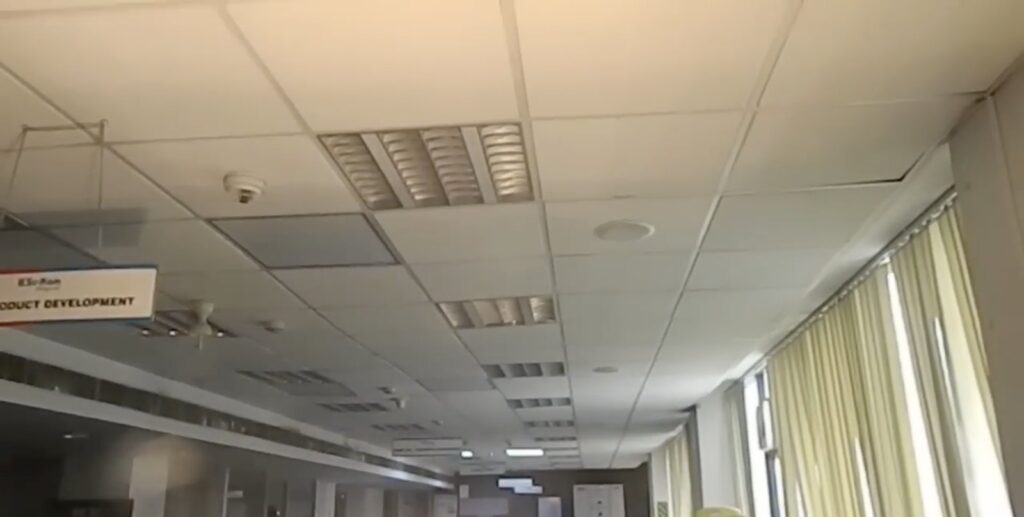
That single decision — keep it DC from the panel to the fan — is what unlocked the savings. And the savings were not small.
3 The proof: 1,200 watts of light became 408
We did a straight, side-by-side test on the building’s own lighting. First we ran the office tube lights the normal way, on AC. They pulled an input current of around 7.5 to 7.8 amperes and burned about 1.2 kilowatts — 1,200 watts — for the whole floor. Then we switched the same space over to DC-powered LED lighting. The power draw collapsed to just 408 watts: roughly three times less power — and, remarkably, the room was brighter, not dimmer. More light, a third of the electricity.
Office lighting on AC
The building’s tube lights drawing 7.5–7.8 A — and giving less light for all that power.
The same office on DC
DC-LED lighting: about a third of the power, and noticeably brighter output.
4 The hidden tax: conversion losses
Where does all that wasted power go? Into conversion. Almost every modern device — a TV, a phone charger, an audio system, an LED driver — runs internally on DC. When you feed it AC, it must first push the electricity through an SMPS or internal converter to turn AC back into DC. That conversion typically runs at only 70–80% efficiency — the missing fifth disappears as heat. Run the appliance on native DC instead and you skip those stages entirely, lifting system efficiency to 94–96%. Multiply that across every light, fan and gadget in a building, all day, every day, and the difference is enormous.
AC → appliance (with SMPS)
Every device re-converts AC to DC internally — the rest is lost as heat.
Native DC architecture
Skip the conversions; deliver DC straight to loads that already want DC.
5 The hardware behind it
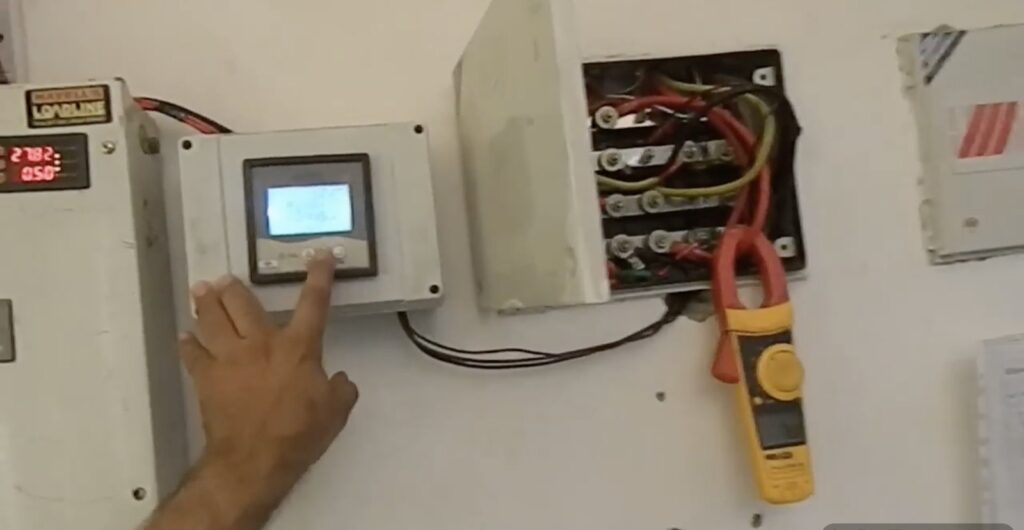
The architecture was deliberately simple, and built around a low, safe voltage. A 2.4 kW solar array on the terrace fed raw DC into a high-efficiency MPPT charge controller, which squeezed the most out of the panels — taking an input current of about 6.3 A and boosting the output to around 7.5 A. That charged a bank of four batteries wired as a 48-volt system while simultaneously running the live building load. The whole distribution grid sat at just 48 volts DC — low enough to be completely touch-safe and shock-proof for the people working inside.
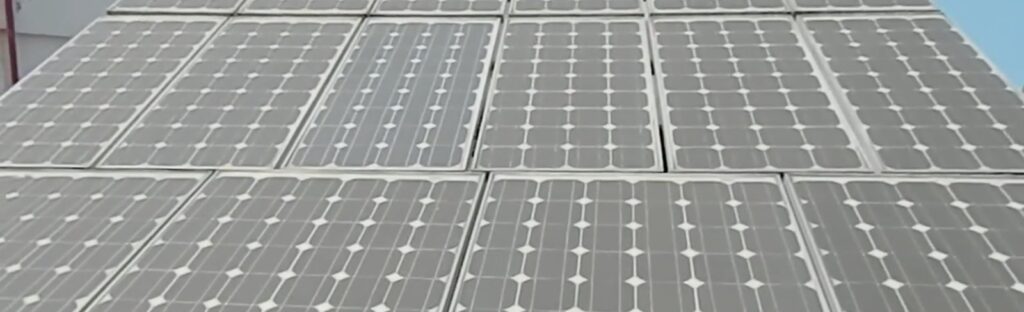
2.4 kW terrace array
Solar panels producing free, raw DC — consumed directly, never converted to AC.
MPPT charge controller
A maximum power point tracking board that lifts 6.3 A of input into ~7.5 A of usable output.
48V four-battery bank
Stores the day’s solar and powers the load at the same time — at a safe, shock-proof 48 volts.
This is the same solar-first thinking that runs through products like our Brainy Eco solar home inverter and the Brainy Hybrid GTI grid-tie inverter that uses 100% of your solar — only here we took it to its logical end and removed the AC stage altogether.
6 Was I alone? Who else has actually tried this
When people heard “a whole building running on DC,” many assumed it could not be done. But the idea is real, and a handful of serious teams around the world were chasing it at the very same time. In 2016 — the same year as our experiment — Denver’s Alliance Center retrofitted a six-storey building with a working DC microgrid. The EMerge Alliance and other groups have been pushing DC-native commercial buildings ever since, and the rise of DC microgrids is now a genuine movement. Even the world’s data centres are moving to 380V DC distribution for exactly the efficiency reasons we proved on a small scale — and national labs have documented the renewable-based DC building microgrid as a real architecture.
What is striking is how often these brave projects got cut short by circumstance rather than physics. The Alliance Center’s pioneering microgrid stalled when its core hardware vendor went bankrupt mid-project. The engineering was never the problem. The will — and the time — to finish was.
7 The world is already going DC — and AI servers are next
Look around you today and you will see the proof everywhere: almost everything already runs on DC. Your TV, your computer, every server in a data centre, your phone — all DC inside. Fans are now DC (the new BLDC motors). LED lighting is DC. The world is slowly shifting back to DC motors, and DC refrigerators and DC air-conditioners already exist — they cost more today only because production volumes are still low, not because the technology is worse. My belief was simple, and I still hold it: if solar is ever to be made truly efficient across the world, native DC is the best way to do it. Convert less, and you save more.
The biggest prize of all is the data centre. Server rooms are the great power guzzlers of the modern economy — which is exactly why the industry is already redesigning them around DC. The EMerge Alliance completed a 380V DC data/telecom standard; Lawrence Berkeley National Lab has documented 380 Vdc architectures for the modern data centre; and vendors report the efficiency advantages of 380V DC power running into double digits. The next generation of server rooms will be designed DC-first.
And I will say it plainly today, as a prediction: the AI server farms now being built — the single hungriest electrical load humanity has ever created — are going to be the biggest beneficiaries of exactly this technology. Running them on native DC is, quite simply, the biggest power saving available to the planet: skip the wasteful AC conversions on the world’s fastest-growing load and the savings are colossal. The economics of AI will eventually force it. We had already built the pieces that point the way — India’s first solar online UPS in the Intelli S, the natural backbone for running sensitive loads like servers on the sun, and a 100 KVA Colossal solar PCU that could run a whole factory on sunshine. I could see this coming from a small R&D building in Gurugram a decade ago, and I am even more certain of it now.
8 The lead India lost
For me, this R&D building was only step one. It worked, the savings were real, and the next step in my mind was far bigger: to design an entire building to run on DC only from the ground up — not a retrofit, but a structure conceived around solar DC from the first brick. That would have been a genuine saving for India: cheaper to run, more efficient, safer at 48 volts, and powered by the sun this country has in such abundance. The whole world is now moving towards DC — in homes, in offices, in data centres — and we were already there, working and proven, in 2016. I never got to take it to its conclusion. The NCLT proceedings around Su-Kam began, and that chapter closed before I could give the idea to the country. It is the same fight I keep returning to — from my open letter to BEE on making inverter-efficiency standards mandatory to my wider mission of green energy for every Indian.
9 A note from me
I have spent my life on one stubborn idea: that the most useful innovations are the ones that quietly save ordinary people money. Running a building on solar DC is exactly that kind of idea — unglamorous, deeply practical, and proven. We showed that the same office lights could run on a third of the power, that a building could be safe at 48 volts, and that you never need to throw away solar’s DC just to convert it back again. The world is arriving at this conclusion now. We were there first. I hope someone in India picks the idea back up and finishes what we started — because the future of power is DC, and there is no reason that future should not be built here.
10 More from the Su-Kam series
Intelli S Solar Online UPS
India’s first solar online UPS — the backbone tech for running sensitive loads like servers on the sun.
Brainy Hybrid GTI
The grid-tie inverter that uses 100% of your solar — and still keeps the lights on.
Colossal 100 KVA Solar PCU
India’s first 100 KVA solar PCU — built to run an entire factory on solar.
Brainy Eco 1100
The intelligent solar home inverter built for every Indian home.
Falcon Plus 1100
The low-voltage inverter India built — and China copied.
Open Letter to BEE
Why India’s inverter-efficiency standards should be mandatory.

Founder of Su-Kam and Kunwwer.ai, and mentor at Su-vastika and several other companies — the “Inverter Man of India” and the “Solar Man of India.” Read his story →
Disclaimer: It is important to note that while Mr. Kunwer Sachdev founded Su-Kam Power Systems, he is no longer associated with the company as of 2019. Any information regarding his involvement in the company’s operations, strategies, or future plans reflects his tenure prior to that date. Therefore, any discussions or analyses of Su-Kam Power Systems should be considered in the context of his past contributions and not his current association with the company.