- ← Part 1: The 1971 Fraud, Price Suppression & The Petrodollar Illusion
- ← Part 2: The $50,000 Endgame & The $40 Trillion Debt Trap
- ← Part 3: The Secret “Dark Gold” Vaults & Global Chaos
- Part 4: The Wealth Center Shifts: India vs. The Monetization Trap SERIES FINALE
🇮🇳 Indian Household Gold
🏛️ Gold Monetization Trap
🎬 Series Finale
Parts 1 through 3 traced the architecture of the post-1971 paper order: the 1971 break from gold, the $40 trillion debt trap, sovereign vault repatriation, and dark gold accumulation. Part 4 closes the arc where wealth actually lives — not in IMF spreadsheets, but in the homes of a civilization that never fully surrendered to financialized paper. India is not merely a demographic story. It is the world’s largest private bullion fortress.
The Civilizational Ledger: Western households were taught to measure prosperity in bank balances, bond coupons, and pension projections. Indian households were taught to measure it in grams passed from grandmother to granddaughter — metal that cannot be frozen, debased, or politicized by a foreign custodian.
1. The Cultural Fortress vs. The Paper Illusion
For seventy years, the Anglo-American financial model trained citizens to equate wealth with claims: fiat savings accounts, mutual funds, Treasury ETFs, and pension entitlements denominated in currencies whose purchasing power erodes by design. The system works beautifully during stable expansion. It fractures when counterparty chains break — as Part 3 demonstrated when $300 billion in sovereign reserves were frozen overnight.
India’s relationship with gold is older than any central bank. Temple endowments, wedding dowries (stree dhan), harvest-season purchases, and festival-driven accumulation are not “investment fads.” They are a civilizational risk-management protocol refined across centuries of empire collapse, currency debasement, and foreign rule.
The contrast is structural, not sentimental. Western paper wealth requires continuous institutional trust. Physical gold requires a vault, a lock, and the discipline not to swap metal for yield promises during calm years.
2. The Staggering Scale of Indian Household Gold
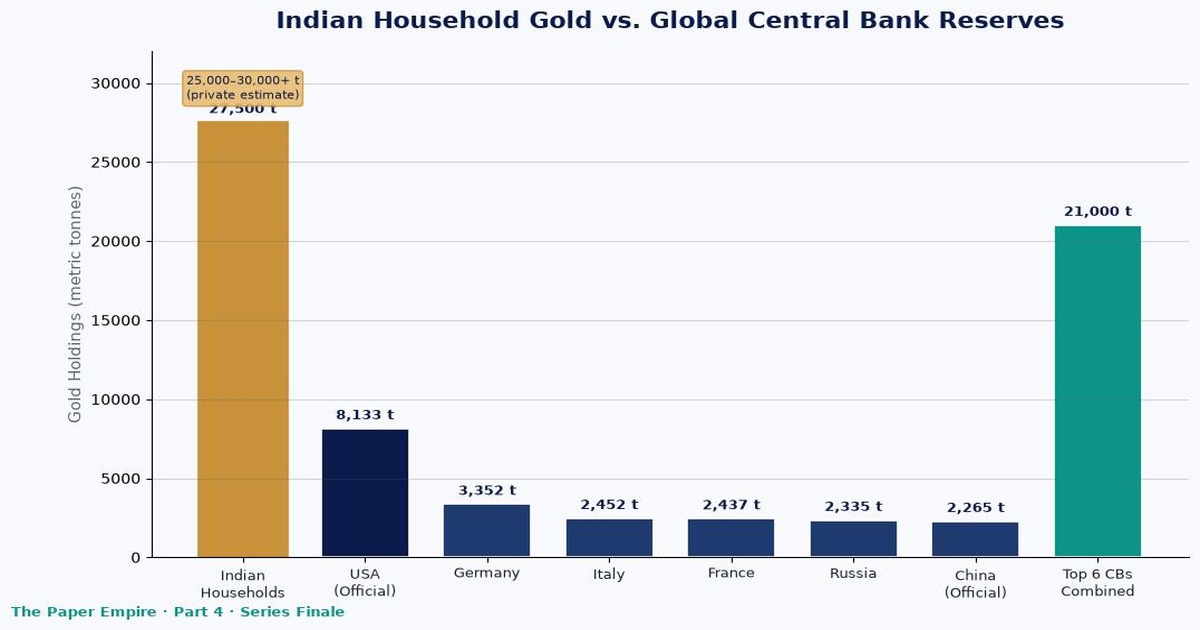
World Gold Council and industry estimates consistently place Indian household holdings between 25,000 and 30,000+ metric tonnes of physical gold. Compare that to official sovereign reserves: the United States (~8,133 t), Germany (~3,352 t), Italy (~2,452 t), France (~2,437 t), Russia (~2,335 t), and China (~2,265 t official) together hold roughly 21,000 metric tonnes. Indian households alone exceed the combined hoard of the planet’s six largest official reserve holders.
3. The Gold Monetization Trap & Paper Substitutes
Successive policy frameworks — the Gold Monetization Scheme (GMS), Sovereign Gold Bonds (SGBs), and paper gold certificates — share a common institutional objective: convert idle physical bullion into bankable, lendable, taxable balance-sheet assets.
Why Institutions Want Your Metal
Physical gold sitting in a household safe is economically “dead” from a banking perspective. Monetization schemes promise interest, safety, and patriotic efficiency — deposit your bars, earn yield, help the nation reduce bullion imports.
Why Citizens Historically Decline
GMS collections have repeatedly undershot targets. Every paper substitute introduces a counterparty. Sovereign Gold Bonds are denominated in rupees, not ounces — meaning nominal returns can look attractive while real metal exposure is partially hedged away by currency debasement.
| Dimension | Physical Gold (Sovereign Possession) | Paper / Financialized Substitutes |
|---|---|---|
| Counterparty risk | None — no issuer, no custodian required for intrinsic value | Bank, fund manager, sovereign issuer, or clearinghouse must remain solvent and cooperative |
| Liquidity during crises | High in physical markets; jewelry networks function when ATMs and exchanges fail | Conditional — gates, halts, capital controls, and sanctions can block redemption |
| Generational wealth transfer | Direct, private, culturally embedded; no probate dependency on financial infrastructure | Requires intact legal/tax regimes, nominee structures, and institutional continuity |
| Inflation / debasement protection | Ounce-for-ounce preservation; price floats against all fiat simultaneously | Partial — nominal yields often lag real inflation; currency risk on local-denominated products |
| Political / sanctions exposure | Low — metal inside border cannot be “frozen” like foreign-exchange reserves | High for cross-border claims; moderate for domestic deposits subject to policy change |
| Yield | Zero coupon — compensated by optionality, not interest | Explicit coupon/dividend, often attracting investors who underestimate tail risk |
4. The Macro Pivot: Gravity Returns to the East
Combine the threads of this four-part series and a single macro vector emerges. Part 2 showed the debt mathematics approaching terminal velocity. Part 3 showed sovereigns responding by hoarding and repatriating metal. Part 4 reveals where the largest existing stockpile already sits — in Indian homes, temples, and family vaults.
Wealth centers follow savings centers. The civilization that already holds 25,000+ tonnes in private hands starts with an asymmetric advantage no spreadsheet can replicate.
5. Series Conclusion & Actionable Blueprint
The Paper Empire was a structural audit of what happens when a global monetary order severs from metal, substitutes debt for savings, and discovers — under stress — that paper claims are conditional while bullion is not.
For Founders
- Price in currency risk. Maintain a physical or hard-asset reserve buffer, not only a cash runway.
- Diversify settlement. Treat sanctions and capital-control exposure as operational risk.
- Build real assets. Patents, factories, and energy infrastructure compound through debasement cycles.
For Investors
- Separate nominal from real returns. Measure portfolios in ounces, not only in fiat.
- Own some metal directly. ETFs have utility; they are not substitutes for allocated bullion.
- Study counterparty chains. Simplicity survives crises.
For Families
- Treat gold as insurance, not speculation. Generational optionality across regime change.
- Resist yield temptation on sacred metal. Monetization converts your fortress into someone else’s balance sheet.
- Document and secure physical holdings. Balance inheritance records with vault discipline.
The paper empire erodes through inflation, policy surprise, and the slow rediscovery that wealth is what you can hold, move, and pass on.
Found this story worth sharing? Post it to your network — it takes one click: