The 1971 Fraud, Price Suppression & The Petrodollar Illusion
The 1971 petrodollar fraud: gold convertibility ended, then gold prices were suppressed so paper dollars could rule.
August 2026 · Alternative Macroeconomics · Bretton Woods collapse · Gold suppression
By Kunwer Sachdev · Founder of Su-Kam Power Systems (1998)
This essay is about the 1971 petrodollar fraud—the default that ended gold convertibility, and the gold price suppression that followed so the dollar could keep buying the world’s goods.
For more than half a century, global commerce and personal wealth have rested on a single unspoken agreement: that unbacked paper banknotes and digital bank credits carry permanent intrinsic value.
Yet behind the curtains of modern central banking lies an existential mathematical reality: For the United States Dollar to maintain global hegemony, physical gold must be systematically managed and suppressed.
“The opening of a gold futures market in the United States would create significant volatility, which would discourage private citizens from holding physical gold.”
— Declassified US State Department Cable to London Embassy, December 1974
The 1971 Petrodollar Fraud: August 15
Picture this: August 15, 1971.
President Richard Nixon sits in the Oval Office with his economic team around him. Henry Kissinger is there. Treasury Secretary John Connally is there. Fed Chairman Arthur Burns is there. And in that room, they make a decision that will reshape global economics for the next 50 years. It’s not a decision made with great ceremony or public debate. It’s made quietly, behind closed doors, in the kind of room where the most consequential decisions always happen.
Nixon doesn’t go on television to announce the full truth. Instead, in a prepared statement, he tells the world: the American dollar is no longer backed by gold. For 27 years, since the end of World War II, the Bretton Woods system had anchored global commerce to a simple promise: $35 will buy you one ounce of physical gold. That promise is now broken.
What Nixon doesn’t say—what can’t be said in a public address—is the truth hiding beneath this announcement:
The United States has just defaulted on its obligations to the world.
But this was no ordinary default. This wasn’t Greece or Argentina announcing they couldn’t pay their debts. This was something far more profound. This was the moment when the entire post-war monetary system pivoted from a world anchored to physical gold—to a world of pure paper promises.
And from that moment forward, one truth became crystal clear to the architects of American power:
Gold had to disappear.
Not physically, of course. The Federal Reserve, the Bank of England, the central banks of Europe and Japan—they would accumulate more gold than ever before. By 1980, central banks around the world held approximately 41,000 metric tons of gold in their vaults. That gold wasn’t going anywhere. But it had to disappear from public consciousness. It had to be discredited, suppressed, pushed into the shadows of the global economy. Because if the world ever realized that the American dollar had no backing except collective agreement and the threat of American military power, the entire architecture of American financial dominance would collapse overnight.
What followed was a 50-year experiment in monetary illusion—one of the most successful deceptions in economic history.
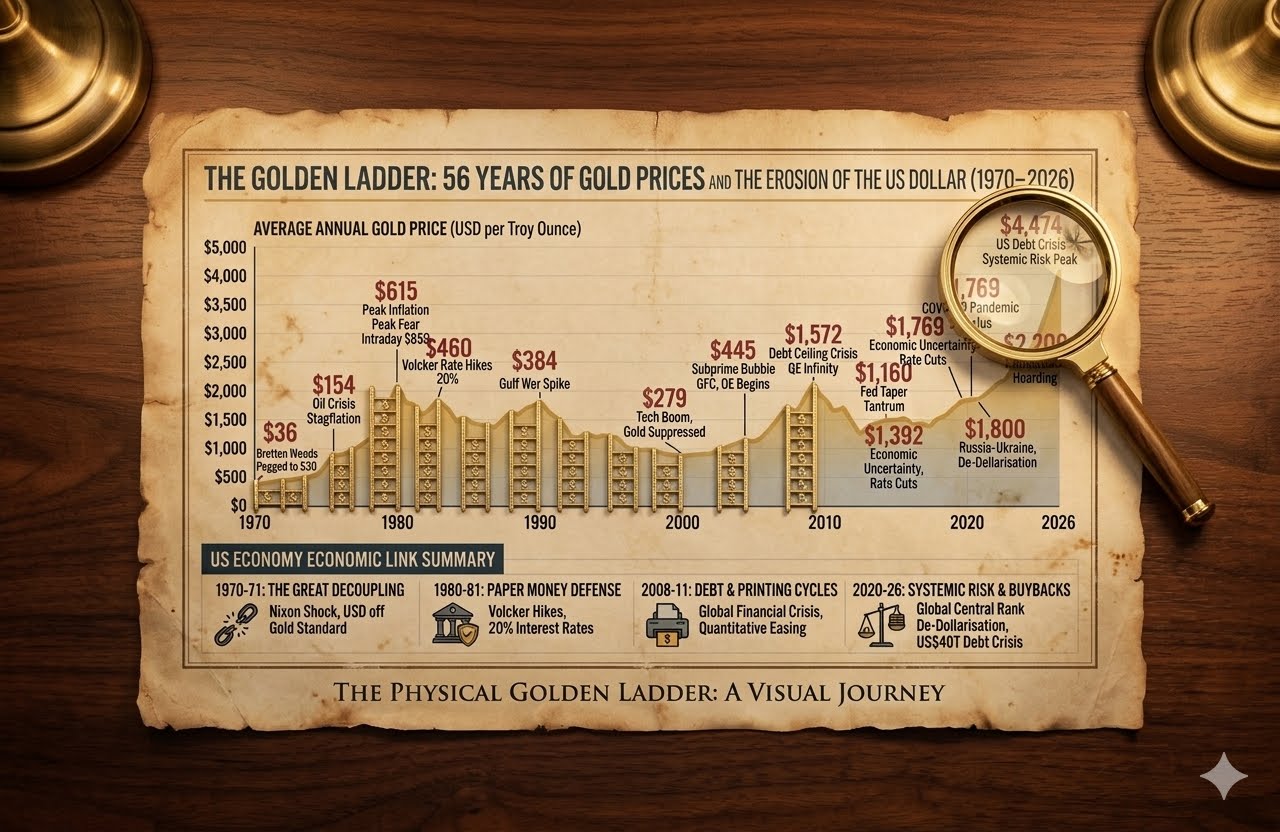
The Physical Golden Ladder: What the Image Reveals
Look at the gold chart in front of you. This is the physical record of that deception.
The image tells a story that textbooks won’t teach you. It’s titled “The Physical Golden Ladder: 56 Years of Gold Prices and the Erosion of the US Dollar (1970-2026).” But what it really shows is the mechanism of suppression—the central bank conspiracy to keep the world’s most honest money relegated to the margins of the global economy.
1970: $36 per ounce — Before Nixon’s announcement, gold was stable, constrained by Bretton Woods. The ladder hasn’t begun to climb.
1974-1980: The Suppression Era — Gold reaches $615 by 1980—a spike driven by Peak Inflation and Peak Fear as the US economy struggled under stagflation. But look at the immediate suppression: Volcker’s 20% interest rate hikes brought gold back down to $460. This was America defending the dollar through brutal monetary policy—a USA internal issue showing strain.
1990-2000: The Suppressed Decades
- Gulf War (1990): Gold touched $384—a geopolitical crisis pushing investors toward safe havens
- Tech Boom (2000): Gold suppressed at $279 despite the dot-com collapse, as the Fed flooded markets with liquidity
2008-2011: The Great Financial Crisis — Gold exploded to $1,572 as the US financial system collapsed. This was America’s internal crisis—the real estate bubble, the banking system failure, the desperate quantitative easing. Gold didn’t lie: the US economy was being destroyed from within.
2013: The Taper Tantrum — Gold crushed from $1,572 to $1,160 as the Fed explicitly talked down the price. The message was clear: gold cannot be allowed to reveal the ongoing weakness of the US financial system.
2020-2026: The Breaking Point
- 2020: $1,800 as pandemic lockdowns trigger Fed money printing
- Russia-Ukraine (2022): $1,800+ as USA loses geopolitical influence (external issue)
- De-Dollarisation (2023-2026): Central banks worldwide dump dollars, buy gold
- 2026: $4,474—US Debt Crisis, Systemic Risk Peak
The magnifying glass at the peak shows the moment the suppression fails completely. The ladder has climbed higher than ever because the world is finally asking the question that was always forbidden: Is the American dollar worth anything at all?
What the Chart Really Shows:
USA Internal Issues: Inflation (1970s), debt crises (2000s), Fed printing (2008+), unprecedented debt levels ($40 trillion)
USA External Issues: Losing reserve currency status, de-dollarisation by central banks, geopolitical decline (Russia-Ukraine, China rise), erosion of military dominance that once enforced dollar acceptance
Gold’s climb isn’t random. It’s the market’s verdict on American power—economic, financial, and geopolitical. Every spike is a moment when America’s internal or external decline became undeniable. Every suppression attempt shows central banks fighting to hide that decline.
By 2026, the ladder reaches its peak. The illusion is breaking.
Gold Price Suppression After the 1971 Petrodollar Fraud
The chart shows one final, crucial truth: the entire Petrodollar system is dependent on US economic supremacy.
The Petrodollar works like this: The world needs oil. Oil is priced in dollars. To buy oil, you need dollars. To get dollars, you buy US Treasury bonds. That recycling loop is the payoff of the 1971 petrodollar fraud. The US government takes that money, funds its military, funds its government, and prints more dollars to satisfy global demand. As long as this cycle continues, the US doesn’t need gold backing. The system sustains itself.
But the chart shows the stress fractures. From 2020 onwards, look at what happens. Gold rises. It rises because the Federal Reserve, faced with a pandemic, prints trillions more dollars. Inflation accelerates. Gold—the ancient monetary standard—starts to climb again.
By 2024, on this chart, gold has reached all-time highs above $2,400 per ounce.
Why? Because the world is beginning to lose faith. The US economy is struggling under trillions in debt. The Fed’s ability to suppress gold through financial engineering is weakening. Central banks—particularly those in China, India, and Russia—are buying gold at record rates. They’re hedging their bets. They’re preparing for a world where the dollar might not be king.
The Petrodollar system was always dependent on one thing: the ability of the United States to maintain economic and military dominance. The moment that dominance is questioned, gold becomes valuable again. The moment currencies begin to compete with the dollar, gold becomes insurance.
That chart—”The Physical Golden Ladder”—is the visual record of a 50-year conspiracy to keep gold suppressed. But it’s also the record of how that conspiracy is failing. Gold always tells the truth. It just takes time for the world to listen.
Ready for Part 2?
Explore the mathematics behind the $40 Trillion US debt trap, compounding interest costs, and why money printing can never escape the arithmetic →
Then follow the metal: central-bank dark gold vaults and de-dollarisation in Part 3, and India’s gold deposit scheme in Part 4. More on the author: Kunwer Sachdev’s story.
Found this story worth sharing? Post it to your network — it takes one click:
LinkedIn · X · Facebook · WhatsApp
Frequently Asked Questions
What exactly happened to the gold price in 1971?
In August 1971, President Nixon ended the Bretton Woods system, which had fixed the US dollar to gold at $35 per ounce since 1944. This “Nixon Shock” delinked the dollar from gold, allowing the price to float. However, rather than rising freely, powerful interests worked to suppress the gold price for decades. The official price was artificially maintained through coordinated intervention via gold sales, paper derivative flooding, and central bank coordination. This kept gold artificially low while the actual value of the dollar declined—widening the gap between the official and “true” gold price. This suppression benefited those holding massive debt loads (especially the US government) by preventing gold from reflecting true currency debasement.
See Part 2 on the $40 trillion debt trap and Part 3 on central-bank gold coordination.
Why would the US government want to suppress gold prices?
Gold is often called “real money” because its price reflects the true health of a currency. If gold prices rise sharply, it signals currency debasement and loss of confidence in the dollar. By suppressing gold prices artificially, the US government and central banks could hide currency debasement, make government debt appear more sustainable, preserve monetary control by discouraging a flight into bullion, and protect financial institutions that ran large short positions in gold futures. As long as gold prices stayed “contained,” people didn’t panic about dollar devaluation or rush to buy physical gold.
That debt-sustainability logic is the bridge to Part 2. For gold as household wealth rather than a paper hedge, see Part 4 on India’s gold deposit scheme.
What is the petrodollar system and how does it relate to gold?
After abandoning the gold standard in 1971, the US needed a new way to maintain dollar dominance. It created the petrodollar system: an arrangement in which oil was priced in US dollars, creating global demand for dollars that replaced gold’s role in backing the currency. That artificial dollar demand helped finance large deficits, print without immediate collapse, and keep geopolitical power through currency control. As nations began settling energy and trade outside the dollar, the petrodollar’s cover weakened—and with it the ease of hiding gold-price suppression and the true debt burden.
De-dollarisation is the subject of Part 3. Deficit arithmetic is Part 2.
How did the gold price suppression actually work technically?
Gold-price suppression operated through several mechanisms: paper derivative flooding (futures, options, and unbacked “paper gold” that inflated apparent supply); announced and coordinated official gold sales; the lease market, in which central banks lent gold that commercial banks could sell into the spot market; coordinated intervention when prices threatened to break higher; and a media narrative that treated physical gold as a relic. Each channel added paper or official supply without a matching public bid for bars.
How those same institutions later bought metal instead of leasing it is Part 3: dark gold vaults.
What evidence is cited for gold-price suppression?
Researchers and market participants have pointed to several strands: investigations by the Gold Anti-Trust Action Committee (GATA) into official and bank intervention; price action that repeatedly stalled near technical breakouts; gold-lease data consistent with extra supply hitting the market; public discussion—including in US policy circles—of “orderly” official intervention in bullion; testimony from metals-market veterans describing suppression tactics; and gaps between official international prices and parallel-market prices in countries with capital controls. None of this is a courtroom verdict. It is the pattern this series treats as the working explanation for why gold did not reprice the 1971 default in a straight line.
At what price would suppression end and gold revalue naturally?
There is no single magic number. Conservative illustrations put a “catch-up” band around $5,000–$10,000 per ounce if gold merely reflects long-run currency debasement. A disorderly debt restructuring can be sketched in a $10,000–$25,000 range. This series’ Part 2 $50,000 endgame is the extreme identity: gold as the unit that clears unpayable paper, not a price target for a trade. The path depends on how violently confidence in fiat breaks, and how much official metal is marked as money again.
For households that already hold metal, see Part 4.
How does the petrodollar decline affect gold prices?
As the petrodollar weakens, several gold-positive forces appear at once: less forced global demand for dollars; a return to fiscal and monetary fundamentals the oil-dollar loop had covered; a flight toward assets with no counterparty; official diversification into gold instead of Treasuries; and a rising cost of keeping a suppression regime in place. Reduced artificial dollar demand is one reason this series treats gold’s next repricing as a monetary event, not a jewellery cycle.
Central-bank behaviour in that shift is Part 3.
Should individual investors hold gold to protect against currency devaluation?
This is not investment advice. Historically, some savers have held gold as a hedge against inflation, as insurance against a weaker dollar, as an asset with no bank or Treasury as counterparty, and as a diversifier when paper assets move together in a currency crisis. Gold also pays no coupon, needs storage, and can be volatile in the short run. Allocation is a personal decision. India’s household stock and the proposed gold deposit scheme in Part 4 are about national mobilisation of metal already held—not a recommendation to buy or sell.
Disclaimer: Kunwer Sachdev exited Su-Kam in 2019 and is not responsible for any activity of the company since. All views expressed in this article are his personal analysis of macroeconomic and geopolitical trends. This analysis is educational and does not constitute investment advice. Full disclaimer →
About the Author
Kunwer Sachdev
Founder of Su-Kam Power Systems (1998), pioneer of India’s inverter and solar industry. Built the first branded inverter in India, received DSIR recognition for in-house R&D, and scaled Su-Kam to India’s leading power backup company. Exited in 2019. Now mentors founders, invests in deep-tech and clean energy, and writes about macroeconomics, geopolitics, and the future of currency systems.
📚 The Paper Empire Series Index:
← Part 1: The 1971 Fraud, Price Suppression & The Petrodollar Illusion (CURRENT)
Part 2: The $50,000 Endgame & The $40 Trillion Debt Trap →
Part 3: The Secret “Dark Gold” Vaults & Global De-Dollarisation →
Part 4: The Wealth Center Shifts: India vs. The Monetization Trap →