The Secret ‘Dark Gold’ Vaults & Global De-Dollarisation
The gold the public cannot see is the insurance policy for a post-dollar world.
August 2026 · Alternative Macroeconomics · Central Bank Gold · Global Currency Reset
By Kunwer Sachdev · Founder of Su-Kam Power Systems (1998)
In Part 1, Washington severed gold from the dollar. In Part 2, the arithmetic of the 40 trillion debt trap made $50,000 gold look less like a forecast and more like a balance-sheet identity.
Part 3 is about central bank gold hoarding—the dark gold vaults filling while the public is still told bullion is a relic.
Dark gold vaults are not a metaphor. They are the official and unofficial stockpiles that make central bank gold hoarding the mechanism of de-dollarisation.
The same institutions that spent fifty years treating gold as a “barbarous relic” are now stacking it in the dark—quietly, persistently, and at a scale the public is not meant to fully see.
This is not a hobby. It is not diversification theatre. It is an insurance policy against the failure of the dollar system they still officially defend.
De-dollarisation does not begin with a press conference. It begins in vaults.
Why Central Bank Gold Hoarding Fills the Dark Gold Vaults
Central banks do not buy a thousand tonnes of gold a year because they suddenly became gold bugs.
They buy because they can read a balance sheet.
They see a United States that must roll trillions of debt, pay more in interest than it spends on defence, and still print the world’s reserve currency as if the 1971 privilege were permanent. They saw, in 2022, that dollar reserves sitting in New York and Brussels can be frozen overnight. They saw that “risk-free” Treasuries are only risk-free if you remain politically aligned with Washington.
Gold has no counterparty. It is not someone else’s liability. It cannot be sanctioned with a keystroke. That is the entire thesis.
According to the World Gold Council, official institutions have been accumulating on the order of 1,000 tonnes a year across recent years—roughly double the pace of the previous decade. 2022 set a modern record near 1,080 tonnes. 2023 followed with another ~1,040 tonnes. The buying did not stop. It broadened.
China reports additions month after month. India has been a persistent official buyer while remaining the world’s great household accumulator. Russia spent a decade building a strategic stockpile and pulling metal onshore. Gulf states have been lifting gold’s share of reserves as they experiment with pricing energy outside the dollar. Poland and other European banks have joined the queue—proof that this is no longer a “BRICS-only” story.
When a central bank buys gold, it is sending a message it will never put in a communiqué:
“We no longer trust the paper we are still forced to hold.”
That is the signal. The scale is the proof. The years 2023 to 2026 will be remembered as the moment official gold demand stopped being a rounding error and became the mechanism of de-dollarisation.
“The dollar is our currency, but it’s your problem.”
— US Treasury Secretary John Connally, 1971
For fifty years the rest of the world absorbed that problem. Central banks are now buying the exit.
The “Dark Gold” Vaults — Hidden from Public View
What you see in IMF tables is not the whole of the dark gold vaults.
Every country publishes an “official gold reserve.” That number is a floor, not a ceiling. It is the amount they are willing to admit. It is not always the amount they can deploy.
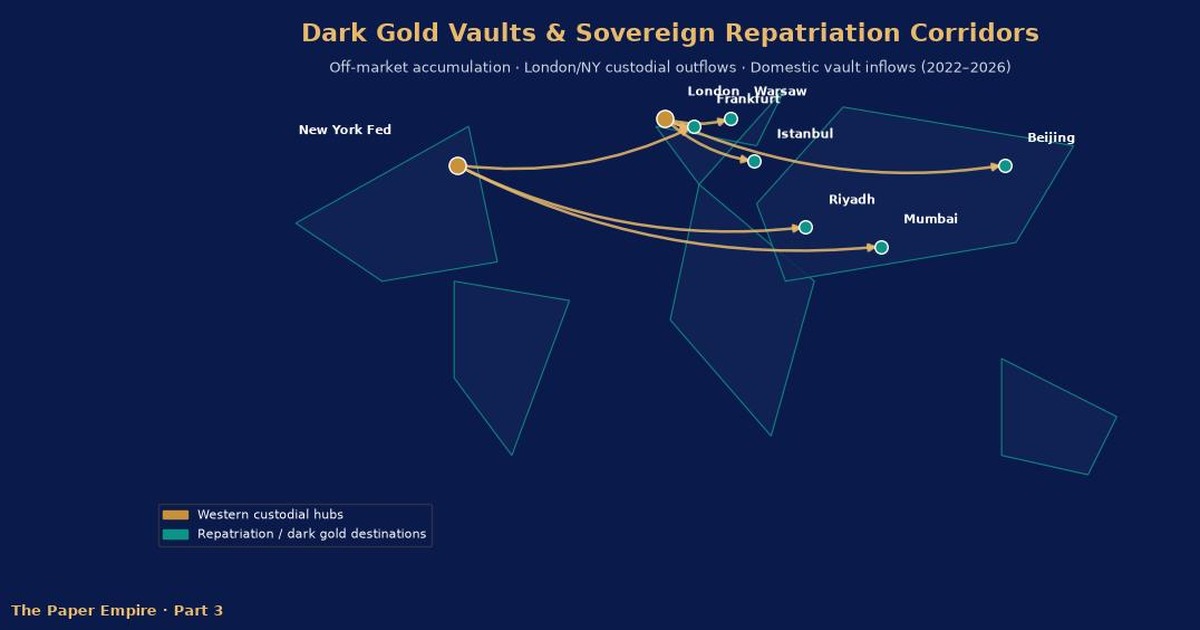
Gold sits in Fort Knox and the New York Fed. It sits in the Bank of England. It also sits in domestic vaults that never appear in a Western custodian’s ledger—People’s Bank warehouses, RBI vaults, Russian storage after repatriation, Swiss and Singaporean accounts that are legal, quiet, and deliberately boring.
Then there is the darker layer: gold purchased through state banks and sovereign vehicles that never gets reclassified as “official reserves.” Gold in military and strategic stockpiles. Gold leased, swapped, or held under another name. The World Gold Council itself distinguishes reported IMF changes from a higher estimate of total official demand that includes unreported buying.
This is why China’s true hoard is the most important unsolved number in global finance.
Beijing’s declared stock is a little over 2,300 tonnes—serious, but still a fraction of US official holdings on paper. Analysts who track import flows, mine output that never reaches the Shanghai Gold Exchange, and buying through commercial banks have long argued the real figure is two to three times the published number. That is not a conspiracy meme. It is the only way the import and production arithmetic closes.
If that is even directionally right, China is not “diversifying.” China is pre-capitalising a post-dollar settlement system.
Dark gold is the collateral. When the dollar slips from being the world’s unit of account, this metal becomes the backing for whatever comes next—whether that next system is announced as gold-backed, gold-referenced, or merely “settled in local currency with gold in the vault.”
The public will be told the new system is about “multipolarity” and “fairness.” The vaults will tell the truth: the countries that hold the physical metal will write the rules.
The Mechanics of De-Dollarisation in Real Time
This is not a 2035 story. It is a 2026 story.
De-dollarisation is not one switch. It is a sequence of pipes being rerouted while the old pipe is still in use.
First, the payment rails. After Russian reserves were immobilised, every finance ministry on earth ran the same thought experiment: if our dollars can be frozen, they are not reserves—they are a hostage. That is why you now see CIPS, bilateral local-currency lines, rupee-rouble workarounds, yuan clearing banks, and BRICS experiments that treat SWIFT as optional rather than sacred. A gold-referenced settlement layer is the logical end-state of that work: when two countries do not trust each other’s paper, they trust metal.
Second, the invoice. The petrodollar was never a treaty so much as a habit enforced by American markets and American security. That habit is cracking. Oil and gas are being sold, in growing slices, for yuan, rupees, and roubles. Each cargo invoiced outside the dollar is a small leak. Enough leaks, and the global bid for Treasuries that recycled petrodollars back into Washington begins to fade.
Third, the settlement asset. Local-currency trade still leaves a problem: who holds the residual risk? Gold is how surplus nations square the books without accumulating more of a currency they no longer want as a store of value. That is why central-bank gold and non-dollar trade are the same phenomenon seen from two angles.
Every trade settled outside the dollar does two things at once. It reduces forced demand for dollars. And it raises the monetary importance of the gold sitting in those dark vaults.
You do not need a formal funeral for the dollar. You need a thousand quiet funerals for individual dollar invoices.
That process is underway now.
“In the absence of the gold standard, there is no way to protect savings from confiscation through inflation.”
— Alan Greenspan, “Gold and Economic Freedom,” 1966
The former Fed chair said the quiet part. Central banks in the East are now acting on it.
What Happens When Central Banks Reveal the Gold
Accumulation is the silent phase. Revelation is the violent phase.
One day—not in a movie, in a press room—a major central bank will say some version of this: our currency is anchored to our gold. Here is the stockpile. Here is the rule.
It may be framed as “stability.” It may be framed as “de-risking.” It may be framed as a new BRICS unit, a gold window, or a domestic convertibility promise limited to central banks. The label will not matter.
The mathematics will.
The moment gold is restored as the reference asset for a large currency area, two things happen in the same hour:
1. Every other surplus nation races to show its own metal—because the first mover rewrites the hierarchy of reserves, and nobody wants to be the country that still holds paper against a neighbour holding bars.
2. The gold price must jump to a level that can actually back the claims. You cannot overlay tens of trillions of fiat with a few thousand tonnes at $4,000 an ounce and call it a reserve system. The price has to do the work. That is the bridge to Part 2: $50,000 gold is not a round number pulled from a conference slide. It is what you get when hidden official metal is marked as monetary again and the dollar’s unique privilege is withdrawn.
The announcement itself is a dollar event. If the world’s newest monetary rule says gold is the anchor, then the unbacked reserve currency is, by definition, the residual—the thing you sell to buy the anchor.
Overnight is not a metaphor. Markets do not wait for a ten-year transition plan. They reprice the unit of account the minute the unit of account is challenged by something that cannot be printed.
The vaults are being filled so that announcement can be made from a position of strength. That is the whole strategy.
India’s Role in This Transition
India is not a spectator in this story. India is one of the few countries that can stand in both rooms.
The Reserve Bank has been adding gold while the household still does what Indian households have done for centuries: convert surplus income into jewellery, coin, and bar. That dual stockpile—official plus family—is a strategic asset the West does not understand because it does not live in a culture where gold is savings.
China is building a parallel system. Russia is building a sanctioned system. America is defending the old system. India is building a bridge.
Rupee trade settlement, energy invoices that no longer have to route through New York, and a central bank that is accumulating metal are the same project. In a multipolar world you need a currency that East and West can both hold without feeling they have joined the other camp. The rupee is not going to replace the dollar next year. It does not have to. It has to become a serious settlement and reserve option for a slice of the global South—and gold in the basement is how you earn that option.
I built an industrial company in India through the years when the global rule was simple: export real goods, import paper dollars, hope Washington kept the system honest. That bargain is ending. The next bargain will be: export real goods, settle in a mix of local currencies, and keep gold as the silent treasury.
This is India’s opening—not as a client of the old empire, and not as a satellite of a new one. As a civilisational economy that already treats gold as money, entering a world that is about to remember why.
The West financialised gold. India never forgot it.
The Timeline to De-Dollarisation Complete
You do not need prophecy. You need a sequence.
2026–2027 — The accumulation phase completes. Central banks finish the heavy lifting of the current buying cycle. Unreported metal continues to move into domestic vaults. Non-dollar invoicing of energy and commodities becomes ordinary rather than experimental. The dollar still dominates the headlines. The pipes underneath it do not.
2027–2028 — The first revelation. A major official institution—BRICS-linked or simply desperate for monetary credibility—announces a gold window, a gold-referenced settlement unit, or an explicit backing rule. The rest of the official sector scrambles. This is the psychological break. After it, “gold is a barbarous relic” cannot be said with a straight face in a finance ministry.
2028–2030 — Price discovery goes vertical. As more claims try to sit on a finite stock of monetary gold, the dollar price of that stock is forced higher. The $50,000 level discussed in Part 2 is the beginning of that marking-to-reality, not the end. In a disorderly reset, $100,000 is not mysticism. It is what happens when too much paper chases too few bars while the old reserve currency is being abandoned.
2030 onward — A multipolar system with gold at the core. Not a 19th-century gold standard replica. A world of regional currencies, local-currency trade, and gold as the asset that settles the residuals and disciplines the printers. America remains a great power. It does not remain the unchallenged issuer of global money.
Is every date certain? No. Dates never are.
Is the direction optional? Also no. A reserve currency drowning in unpayable debt, a world that has learned reserves can be frozen, and a decade of official gold buying are not three separate stories. They are one mechanism.
The moment is now. The vaults are already filling. The only open question is which capital announces first—and whether India is holding enough metal when that day comes.
Ready for Part 4?
When the monetary centre of gravity moves, wealth moves with it. The last question is not whether gold reasserts itself. It is who captures that shift—and who gets trapped monetising the old paper:
Part 4: The Wealth Center Shifts: India vs. The Monetization Trap →
Found this story worth sharing? Post it to your network — it takes one click:
LinkedIn · X · Facebook · WhatsApp
Frequently Asked Questions
What are dark gold vaults?
In this essay they are not a metaphor. Dark gold vaults are the official and unofficial stockpiles that make central-bank gold hoarding the mechanism of de-dollarisation: IMF-reported bars as a floor, plus metal in domestic warehouses, military and strategic piles, leased or swapped gold, and buying through state banks that never gets relabelled as “official reserves.” Fort Knox and the New York Fed are the visible Western ledgers. People’s Bank warehouses, RBI vaults, Russian metal after repatriation, and quiet Swiss or Singapore accounts are the rest of the map. The public is still told bullion is a relic. The vaults are the insurance policy.
Why the dollar’s debt load forces a metal clearing price is Part 2.
Why are central banks hoarding gold if they called it a barbarous relic?
Because they can read a balance sheet. They see a United States that must roll trillions, pay more in interest than it spends on defence, and still print the reserve currency as if 1971 were permanent. They saw in 2022 that dollars in New York and Brussels can be frozen overnight. Gold has no counterparty and cannot be sanctioned with a keystroke. That is the entire thesis. The World Gold Council’s recent official buying—on the order of 1,000 tonnes a year, with 2022 near 1,080 tonnes and 2023 about 1,040—is treated here as the mechanism of de-dollarisation, not as a hobby. The communiqué will never say: we no longer trust the paper we are still forced to hold. The purchases say it.
The 1971 privilege those banks are exiting is Part 1.
How much gold is China really holding?
Beijing’s declared stock in this essay is a little over 2,300 tonnes—serious, still a fraction of US official holdings on paper. Analysts who track import flows, mine output that never reaches the Shanghai Gold Exchange, and commercial-bank buying have long argued the real figure is two to three times the published number. That is presented as the only way the arithmetic of imports and production closes, not as a courtroom fact. If it is even directionally right, China is not “diversifying.” It is pre-capitalising a post-dollar settlement system. Dark gold is the collateral for whatever is announced as gold-backed, gold-referenced, or merely settled in local currency with metal in the vault.
How does de-dollarisation actually work in real time?
Not with a press conference. With pipes. First the rails: CIPS, bilateral local-currency lines, rupee-rouble workarounds, yuan clearing, BRICS experiments that treat SWIFT as optional—because frozen reserves taught every finance ministry that dollars can be a hostage. Second the invoice: energy sold, in growing slices, for yuan, rupees, and roubles; each cargo is a leak in the petrodollar habit. Third the residual: when two countries do not trust each other’s paper, they square the books in gold. You do not need a funeral for the dollar. You need a thousand quiet funerals for individual dollar invoices. That process, this chapter says, is already a 2026 story.
The petrodollar cover story is Part 1.
What role does the BIS still play in gold markets?
This essay is not a BIS org chart. Part 2 named the Bank for International Settlements with the Fed, Bank of England, and ECB as part of the old suppression coordination—official metal released when the price threatened to run. Part 3 is the reverse of that machine: the same official world stacking bars because Treasuries proved sanctionable. Western custody (New York Fed, Bank of England) remains the visible ledger. The dark vaults are metal that does not need that ledger. If a “new system” arrives, this piece argues it will be written by who holds the physical stock, not by a Basel communiqué.
What happens when central banks reveal the gold?
Accumulation is silent. Revelation is violent. One day a major official institution says some version of: our currency is anchored to our gold. The label—stability, de-risking, a BRICS unit, a gold window—will not matter. Two things happen in the same hour: every other surplus nation races to show its own metal, and the gold price must jump to a level that can actually back the claims. You cannot overlay tens of trillions of fiat with a few thousand tonnes at $4,000 and call it a reserve system. That is the bridge to Part 2: $50,000 gold is what you get when hidden official metal is marked as monetary again. Markets do not wait for a ten-year transition plan. The vaults are being filled so the announcement can be made from strength.
Where does India sit in this transition?
Not as a spectator. India is one of the few countries that can stand in both rooms: the RBI adding gold while the household still converts surplus into jewellery, coin, and bar. That dual stockpile is a strategic asset the West does not understand because it does not live in a culture where gold is savings. China is building a parallel system, Russia a sanctioned one, America the old one. India is building a bridge—rupee settlement, energy invoices that need not route through New York, metal in the basement. The rupee does not have to replace the dollar next year. It has to become a settlement option for a slice of the global South. How policy either mobilises that household stock or monetises it into paper is Part 4.
What is the timeline to a post-dollar system?
Dates are not prophecy. The sequence in this chapter is: 2026–2027, accumulation completes and non-dollar invoicing becomes ordinary; 2027–2028, a first gold window or gold-referenced unit—the psychological break; 2028–2030, price discovery goes vertical, with Part 2’s $50,000 as a beginning of marking-to-reality and $100,000 as the disorderly case; 2030 onward, regional currencies with gold as the residual, America still a great power but no longer the unchallenged issuer of global money. Direction is treated as not optional: unpayable reserve-currency debt, frozen-reserves memory, and a decade of official gold buying are one mechanism. The open question is which capital announces first—and whether India is holding enough metal that day.
Disclaimer: Kunwer Sachdev exited Su-Kam in 2019 and is not responsible for any activity of the company since. All views expressed in this article are his personal analysis of macroeconomic and geopolitical trends. This analysis is educational and does not constitute investment advice. Full disclaimer →
About the Author
Kunwer Sachdev
Founder of Su-Kam Power Systems (1998), pioneer of India’s inverter and solar industry. Built the first branded inverter in India, received DSIR recognition for in-house R&D, and scaled Su-Kam to India’s leading power backup company. Exited in 2019. Now mentors founders, invests in deep-tech and clean energy, and writes about macroeconomics, geopolitics, and the future of currency systems.
📚 The Paper Empire Series Index:
← Part 1: The 1971 Fraud, Price Suppression & The Petrodollar Illusion
Part 2: The $50,000 Endgame & The $40 Trillion Debt Trap
Part 3: The Secret ‘Dark Gold’ Vaults & Global De-Dollarisation (CURRENT)
Part 4: The Wealth Center Shifts: India vs. The Monetization Trap →
You must be logged in to post a comment.