
The Wealth Center Shifts: India vs. The Monetization Trap
A jeweller-led gold deposit scheme is how India turns household metal into national power—if it does not sell the metal for paper.
August 2026 · Alternative Macroeconomics · India Gold Deposits · Wealth Center Shift
By Kunwer Sachdev · Founder of Su-Kam Power Systems (1998)
In Part 1, the dollar was unhooked from gold. In Part 2, US debt made $50,000 gold a balance-sheet identity. In Part 3, central banks filled the dark vaults.
Part 4 is about the India gold deposit scheme: who already owns the metal those vaults are trying to match—and whether India uses it, or monetises it away.
The West’s wealth center was built on a privilege: print the reserve currency, import the world’s goods, and call the paper an asset. That privilege is cracking.
India never had that privilege. What India has is older and, in a reset, more useful: the world’s largest private gold stock, sitting in cupboards, lockers, and temples.
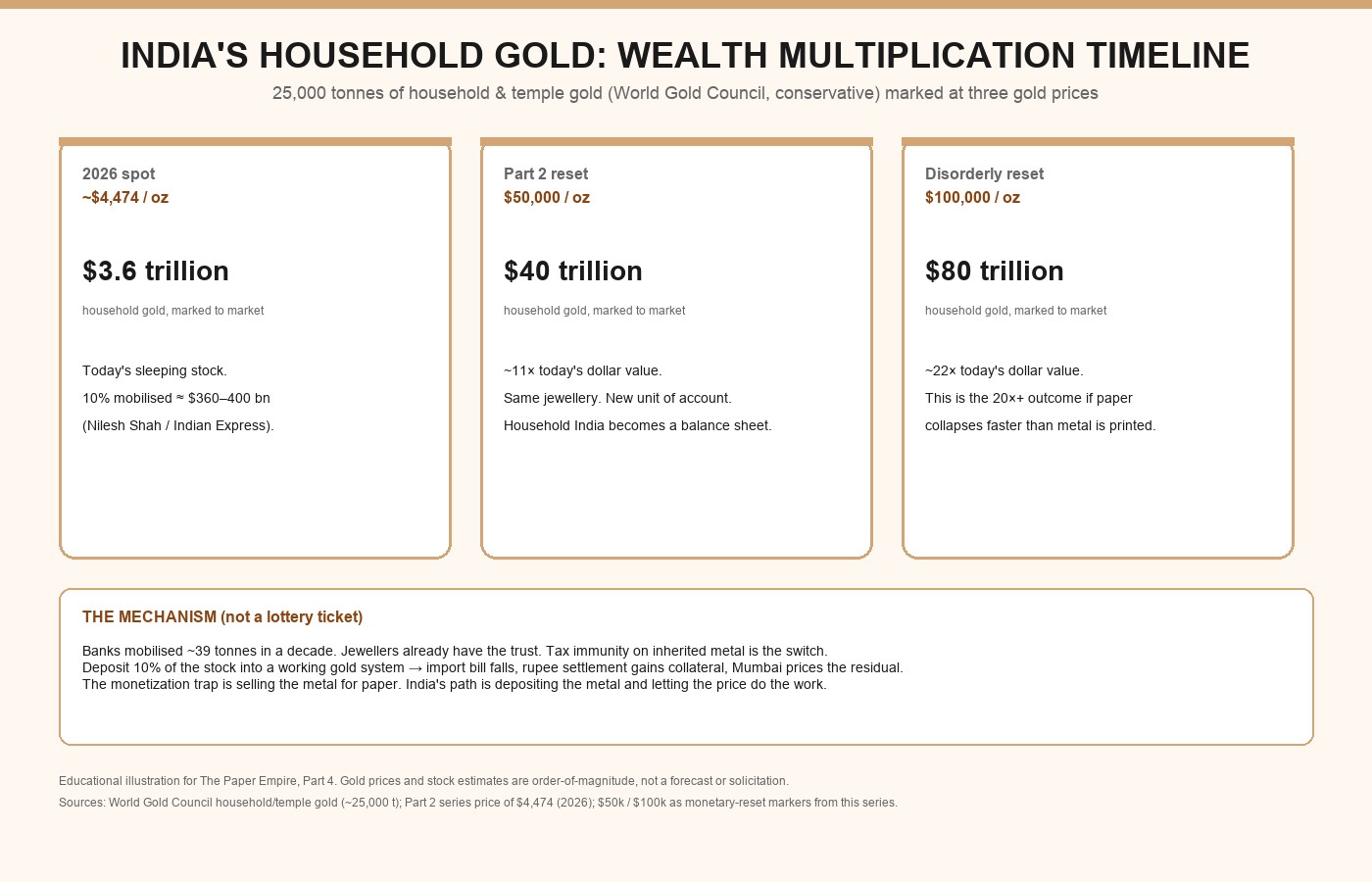
The World Gold Council’s conservative count is about 25,000 tonnes in Indian households and temples. Wider industry estimates run to 30,000–35,000 tonnes. At 2026 prices near the $4,474 marker used in this series, the conservative stock is already on the order of $3.6 trillion.
That is not jewellery. That is a shadow central bank distributed across a billion people.

The India gold deposit scheme is the policy hinge: depositing household metal into a working system instead of selling it for paper.
The $400 Billion India Gold Deposit Scheme
You do not need to monetise all of India’s gold. You need to monetise enough of it to change the country’s external accounts.
Nilesh Shah of Kotak AMC put the arithmetic in public: if even 10% of household gold is mobilised, that is around $400 billion at recent prices. The Indian Express reported the line as the government talked to jewellers about a new deposit scheme.
$400 billion is not a slogan. It is larger than a typical year of Indian gold imports. It is a current-account event. It is a rupee-collateral event. It is the difference between India arriving at a post-dollar table as a large consumer of metal—or as a large supplier of monetary gold into the domestic system.
The 2015 Gold Monetisation Scheme was supposed to do this. In roughly a decade it pulled in on the order of thirty to forty tonnes. Against 25,000 tonnes, that is a rounding error. The scheme did not fail because Indians suddenly stopped believing in gold. It failed because the front door was a bank branch, the process melted grandmother’s jewellery in a room the family did not trust, and the tax man was a rumour in every living room.
Idle gold is not idle because Indians are irrational. It is idle because the state asked them to trust a counterparty they do not marry their daughters through.
| Stock / flow | Order of magnitude | Why it matters |
|---|---|---|
| Household + temple gold (conservative) | ~25,000 tonnes | Larger than most official reserves on earth |
| GMS 2015–2025 mobilisation | ~31–39 tonnes | Banks as the front door did not work |
| 10% of conservative stock, 2026 prices | ~$360–400 billion | The number that changes imports and collateral |
| India gold imports (FY26, reported) | on the order of $70 billion | Domestic metal is cheaper than imported metal |
The 2026 Jeweller-Led Revolution
The new design is not a cleverer bank product. It is a different priest.
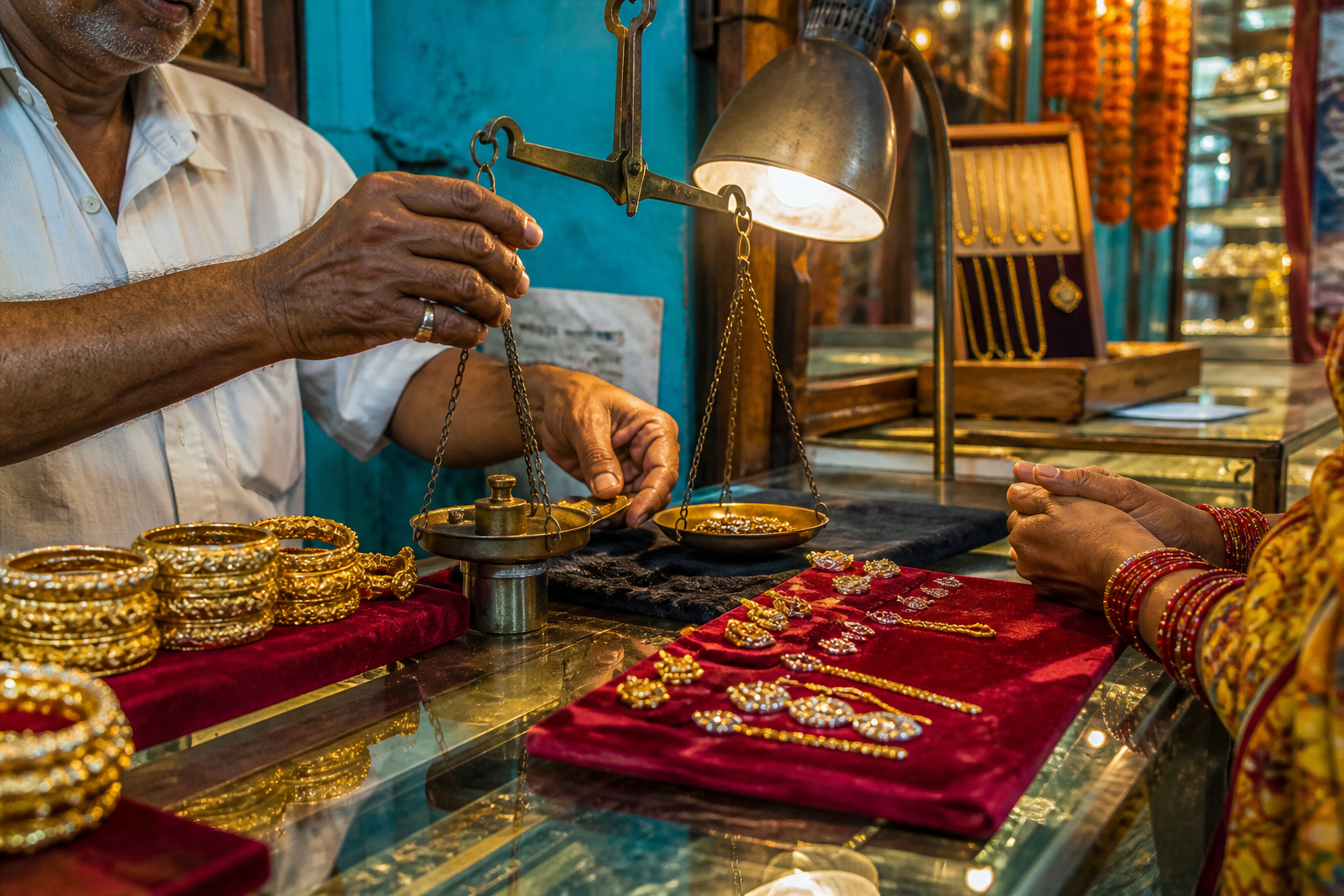
Through 2026, Delhi, the RBI, banks, and the jewellery trade have been arguing a revamp: jewellers as collection partners. The depositor walks into the shop she already uses. Purity is checked by people who already weigh her bangles. The bar then moves to refiners and banks. The jeweller earns a fee—industry talk has been in the 0.75% to 1% range. Deposits still sit in the banking system. The front end is the family goldsmith.
This is obvious to anyone who has bought a chain in Chandni Chowk, Zaveri Bazaar, or a tier-2 town. It was invisible to the 2015 scheme because the scheme was written in a language of Collection and Purity Testing Centres, not in the language of trust.
Banks failed at gold for the same reason they fail at a lot of Indian household finance: they are excellent at process and poor at intimacy. A woman will not melt her mother’s necklace in a cabin with a token number. She will discuss it with the man who sold the necklace, repaired it, and will be at the wedding.
If GMS 2.0 works, it will not be because the interest rate was 50 basis points higher. It will be because the counterparty was already inside the family’s life.
That is the 2026 revolution. Not a new metal. A new door.
“If just 10% of gold held is monetised, it would be around $400 billion.”
— Nilesh Shah, Kotak AMC, quoted in The Indian Express
Tax Immunity: The Trust Switch
Jewellers can open the door. Only tax policy can keep it open.
Ask any family why they will not deposit inherited gold and you will not hear a lecture on duration matching. You will hear: where is the bill?
Most of India’s private gold has no invoice trail that would satisfy an officer looking for a 1998 purchase. The Gold and Silver Merchants Association and others have therefore asked the Centre, in public, for clear tax safeguards on a GMS 2.0: inherited metal without bills should not become an income-tax raid wearing a deposit-scheme smile.
This is not a loophole request. It is the entire adoption curve. Interest rates and jeweller commissions are secondary. If depositing gold is treated as a confession of unaccounted wealth, the metal stays in the cupboard. If depositing gold is treated as a patriotic, documented, immunised conversion of family savings into a national stock, the metal moves.
Call it tax immunity, a deemed-source rule, a grandfathering window—the name is less important than the signal: bring the gold in, and we will not punish you for having been Indian about savings for fifty years.
Without that signal, GMS 2.0 is GMS 2015 with better interior design.
The $50,000 Effect: Wealth Explosion Without New Mines
Here is the part Wall Street still prices as a commodity story, and Indian households already live as a savings story.
If the monetary reset in Part 2 is even directionally right, the dollar price of gold is not a jewellery index. It is the exchange rate between dying paper and surviving metal.
Mark the same 25,000 tonnes three ways:
- ~$4,474 / oz (this series’ 2026 marker): about $3.6 trillion.
- $50,000 / oz: about $40 trillion — roughly eleven times today’s dollar value. No new mines. No new jewellery. A new unit of account.
- $100,000 / oz: about $80 trillion — the twenty-times outcome if the paper collapse outruns any orderly gold window.
That is the “wealth explosion.” It is not India discovering gold. It is the world discovering that the gold India already has must be re-priced if it is to back the claims now written on unpayable Treasuries.
For a family, the implication is brutal and simple. The necklace is the same necklace. In a dollar reset it becomes a larger claim on real goods. If you sold it for deposits in a failing reserve currency, you took the Western side of the trade. If you still hold grams—or hold a deposit denominated in grams—you took the Indian side.
This is why a deposit scheme that redeems in gold, not only in rupees, is not a technicality. It is how households keep the upside of the reset instead of cashing it into the trap.
How India Becomes a Financial Superpower Without Printing the Dollar
Reserve-currency status is not the only path to monetary power. Collateral is.
China is stacking official metal and building payment rails. Russia learned that New York-held reserves are a hostage. The Gulf is experimenting with invoicing. India can do something none of them can copy quickly: turn a civilisational household stock into a working bullion market with political legitimacy.
A functioning gold-deposit system does four things at once:
1. It cuts the import bill by recycling domestic metal into jewellery and industry instead of landing more tonnes at Nhava Sheva.
2. It gives rupee settlement a silent backing. Trade partners who will not hold infinite rupees will hold claims on a system that sits on gold. That is how a bridge currency is born—not by speech, by residual settlement.
3. It deepens Mumbai as a price-setting venue for physical gold in the eastern time zone, the way London set paper gold for the Western one.
4. It aligns the RBI’s official buying (Part 3) with the household’s unofficial reserve. Dual stockpile: central bank plus family. That is a superpower the Fed cannot print.
India does not need to replace the dollar next year. It needs to be the place where East and West can settle without feeling they have joined the other camp—and where the settlement asset is metal the Indian public already understands as money.
The West financialised gold. India never forgot it. Policy either honours that memory or taxes it into silence.
Fiscal Mechanics: Who Profits When the Metal Moves
The India gold deposit scheme is not charity to jewellers. It is a fiscal machine.
When idle jewellery becomes bars in the system:
The government profits first by not spending scarce dollars on as much import, and second if the design includes seigniorage-like fees, GST on making charges rather than on recycled metal, and a deeper tax base once gold is on books instead of in cupboards. The current-account saving is the headline. The quieter win is a rupee that does not have to defend itself against a $70 billion annual gold leak.
The jeweller profits from footfall, working-capital gold that is cheaper than a bank metal loan, and a commission. That is why the trade will sell the scheme if—and only if—the tax cloud is lifted.
The depositor profits if interest is real, redemption is in grams, and the $50,000 re-pricing (if it comes) accrues to the holder of metal, not to the holder of a rupee IOU that was “as good as gold” until it wasn’t.
The banks profit if they become custodians of a national gold float instead of mere importers of someone else’s bars.
Design the redemption wrong—cash only, at a managed rupee price—and the government has simply run a slow confiscation. Design it right—grams in, grams out, tax peace—and Delhi has built a domestic gold standard without calling it one.
“The monetization trap is not owning gold. The trap is being paid for it in a currency that can be printed against you.”
— The argument of this series, from 1971 to the Indian cupboard
Mumbai After London: Where the Wealth Center Moves
London became the gold market of the paper-dollar age because the metal was priced in a Western time zone, in a Western unit, under Western law.
That geography is not physics. It is habit plus plumbing.
If official gold is moving east (Part 3), if energy invoices are leaking out of the dollar, and if India runs a jeweller-fed physical market on 25,000 tonnes of household stock, then the residual trades—the ones that settle the day’s imbalance—start looking for a city that is awake when Asia is awake, and that sits on actual bars, not leased promises.
Mumbai does not need to “become London” as a slogan. It needs:
a trusted vault network; a delivery contract Indians and foreigners both use; a rupee that can be squared in gold; and a legal system that does not treat a deposit as a sting operation.
GIFT City, rupee trade settlement, and GMS 2.0 are not three stories. They are one bid to host the next wealth center. The old center printed claims. The new center will clear metal.
Countries that fail this transition will do what weak states always do in a monetary crack-up: they will monetise. They will print, freeze deposits, slap gold export bans, and force citizens to swap metal for paper “for the nation.” That is the trap in the title. It is Argentina with better branding. It is 1933 with tropical weather. It is the West’s 1971 move, run in reverse on a poorer country.
India’s test is whether it becomes the host of the metal—or another government that raids the metal.
The Trap, the Timeline, and the End of This Series
1971 was the fraud. The $40 trillion is the arithmetic. The dark vaults are the official hedge. The Indian cupboard is the popular hedge. Policy is the hinge.
2026–2028. Finish the jeweller-led design. Write the tax immunity in language a family can trust. Mobilise the first serious hundreds of tonnes—not thirty. Keep redemption in gold. Do not celebrate rupee receipts as victory.
2028–2030. If the official world begins to mark gold as monetary again, India’s household stock reprices. The families that still hold grams participate in the $50,000 identity. The families that sold into paper watch the wealth center move without them.
2030–2035. A multipolar clearing system: regional currencies, gold as the residual, Mumbai as one of the rooms where the residual is priced. America remains a great power. It is no longer the only printer of global money. India is no longer only a gold consumer. It is a gold system.
I built a company in India in the years when the rule was simple: make real things, get paid in a dollar world, hope the paper stayed honest. That hope is optional now. The metal in Indian houses is not.
The Paper Empire ends where it should have begun: not in a New York trading pit, and not in a Washington press room, but in the decision a family makes about a necklace—and the decision a government makes about whether that necklace is a crime or a reserve.

Do not monetise the gold into paper. Deposit the gold into the future.
Found this story worth sharing? Post it to your network — it takes one click:
LinkedIn · X · Facebook · WhatsApp
Frequently Asked Questions
What exactly is the India Gold Deposit Scheme (IGDS) and how does it work?
In this series, “India gold deposit scheme” means a policy of depositing household metal into a working bullion system instead of selling it for paper. The legal frame that already exists is the Gold Monetisation Scheme (GMS) of 2015: gold is assayed, melted or refined, and a deposit is booked with a bank for a stated tenure, with interest paid in rupees. It is not a walk-in savings account you can unwind any afternoon. Against about 25,000 tonnes in Indian households and temples, GMS pulled in on the order of thirty to forty tonnes. That is a rounding error, not a mobilisation.
The 2026 design under discussion is different at the front door, not at the vault: jewellers as collection partners, purity checked where families already buy, then bars to refiners and banks, with talk of a 0.75%–1% jeweller fee. Deposits still sit in the banking system. That jeweller-led GMS 2.0 is industry and government conversation as of August 2026, not a claim that every rule has been notified. How gold became the silent counterpart to paper dollars is Part 1. How official metal is stacked in the dark is Part 3.
What are the benefits of using IGDS vs. holding physical gold at home?
This is not a recommendation to move metal. Idle gold in cupboards is not idle because Indians are irrational. The 2015 scheme asked families to melt grandmother’s jewellery in a bank cabin they did not trust, with the tax man as a rumour in every living room. Physical holding keeps possession, privacy, and no bank as counterparty. A deposit scheme only beats that if redemption is in grams, tax peace is written in language a family can trust, and the $50,000 re-pricing in Part 2—if it comes—accrues to the holder of metal, not to a rupee IOU that was “as good as gold” until it wasn’t.
Cash-only redemption at a managed rupee price is the monetization trap: you were paid for gold in a currency that can be printed against you. Official vaults and household cupboards are the two stockpiles in Part 3. Policy either joins them or raids them.
How much interest or return can you earn from an India gold deposit scheme?
Coupon is not the story. GMS interest has always been a bank-set rupee rate on a gold deposit, not a promise that gold “returns 12%.” If a jeweller-led GMS 2.0 works, this essay argues it will not be because the rate was fifty basis points higher. It will be because the counterparty was already inside the family’s life. The depositor’s real return, if any, is interest that is actually paid, plus still being long grams when paper is re-priced, plus not having sold the necklace into a failing reserve currency.
The series’ $50,000 identity in Part 2 is a balance-sheet clearing price for unpayable dollar debt, not a forecast you can compound like a fixed deposit. Gold’s role after 1971 is Part 1. This is educational, not a yield comparison for a trade.
Is the India Gold Deposit Scheme safe? Can the bank go bankrupt?
A gold deposit is a claim on an institution. That is the point of this series, not a footnote. Bank-deposit insurance in India is a rupee scheme with a cap; it is not a substitute for allocated bars you can take home. A weak design—cash redemption, commingled paper, a raid dressed as patriotism—is slower confiscation. The essay’s warning is historical: 1933 in the United States, tropical branding on the same move, export bans and forced swaps “for the nation.”
Systemic risk and unpayable sovereign paper are Part 2. How states hide and move official metal is Part 3. Safety, if the word means anything, is grams in and grams out, plus a government that treats household gold as a reserve rather than a crime. Nothing here is a solvency rating of any bank.
What are the tax implications of the India Gold Deposit Scheme?
This is not tax advice, and this essay does not publish a slab-rate calculator. The binding constraint on GMS 2.0 is not TDS on a coupon. It is the missing bill on inherited metal. Most of India’s private gold has no invoice trail that would satisfy an officer looking for a 1998 purchase. Jeweller bodies have asked, in public, for clear tax safeguards so a deposit is not an income-tax raid wearing a scheme smile.
Without that signal—tax immunity, a deemed-source rule, a grandfathering window—the metal stays in the cupboard, and GMS 2.0 is GMS 2015 with better interior design. Interest and jeweller commissions are secondary. Long-horizon gold as money after 1971 is Part 1. The wealth-protection question in a debt reset is Part 2.
How does IGDS compare to buying gold from a jeweller or online?
Buying from a jeweller is how Indian families already treat gold as savings you can wear. A jeweller-led deposit scheme uses that same counterparty as the collection door, not as a substitute for owning metal. Online or “digital gold” is typically a claim on a platform’s book—closer to the paper side of this series than to a bar in a cupboard. The 2015 scheme failed at Collection and Purity Testing Centres. The 2026 argument is that the family goldsmith already weighs the bangles.
There is no recommended 70/15/15 split here. The design test is simple: does the household still have a claim in grams, or did it sell jewellery for a rupee balance? Storage and official hoarding are Part 3. Why physical metal survived the 1971 default better than paper promises is Part 1.
How does India’s gold scheme fit into global de-dollarisation and India’s monetary future?
India does not need to print the reserve currency to have monetary power. It needs collateral. Mobilising even 10% of household gold—Nilesh Shah’s public ~$400 billion line at recent prices—is a current-account event and a rupee-collateral event: less import through Nhava Sheva, a residual settlement asset trade partners can respect, Mumbai as a physical price-setting room in the eastern time zone, and a dual stockpile the Fed cannot print (RBI official metal plus the family unofficial reserve).
That is how a bridge currency is born—not by speech, by residual settlement. It is not a claim that the rupee is already gold-backed. Central-bank de-dollarisation and dark vaults are Part 3. Why the dollar’s debt load forces a metal clearing price is Part 2.
What is the future of India’s gold policy and could it expand beyond IGDS?
This series’ working timeline is policy, not prophecy. 2026–2028: finish the jeweller-led door, write tax immunity a family can trust, mobilise hundreds of tonnes rather than thirty, keep redemption in gold. 2028–2030: if official gold is marked as money again, the same 25,000 tonnes re-prices; families still holding grams participate in the $50,000 identity. 2030–2035: multipolar clearing, gold as residual, Mumbai as one of the rooms where the residual is priced.
What would wreck it is the monetization trap: print, freeze, ban, force a swap into paper. A gold-backed rupee or a gold-backed e-rupee would be a later constitutional choice, not something this essay pretends is already law. Gold-standard memory after 1971 is Part 1. The global shift of official metal is Part 3.
Disclaimer: Kunwer Sachdev exited Su-Kam in 2019 and is not responsible for any activity of the company since. All views expressed in this article are his personal analysis of macroeconomic and geopolitical trends. This analysis is educational and does not constitute investment advice. Gold-deposit policy described here includes proposals and industry reports as of August 2026, not a claim that every measure has already been notified. Full disclaimer →
About the Author
Kunwer Sachdev
Founder of Su-Kam Power Systems (1998), pioneer of India’s inverter and solar industry. Built the first branded inverter in India, received DSIR recognition for in-house R&D, and scaled Su-Kam to India’s leading power backup company. Exited in 2019. Now mentors founders, invests in deep-tech and clean energy, and writes about macroeconomics, geopolitics, and the future of currency systems.
📚 The Paper Empire Series Index:
← Part 1: The 1971 Fraud, Price Suppression & The Petrodollar Illusion
Part 2: The $50,000 Endgame & The $40 Trillion Debt Trap
Part 3: The Secret ‘Dark Gold’ Vaults & Global De-Dollarisation
Part 4: The Wealth Center Shifts: India vs. The Monetization Trap (CURRENT)