
The Illusion of the Statute: Why 80 Years of Lawmaking Replaced Justice with Extortion
For nearly eight decades, the Indian state’s answer to institutional failure has been theatrical legislation. Outside Parliament’s air-conditioned corridors, an unwritten truth still rules: the rule of law does not function on the ground.
Whenever a gruesome crime shocks the national conscience, whenever public outrage threatens political stability, the political class convenes to enact a brand-new statute or introduce harsher, non-bailable penalties.
Yet when the police operate as a rent-seeking tollbooth and the judiciary sits atop over five crore pending cases, new laws do not deter criminals. They create new instruments of harassment — weaponized against ordinary citizens — while pushing the public into the arms of local enforcers, bahubalis, and goons for basic dispute resolution.
Part 07 traced how referee institutions were realigned around the executive. This essay goes lower — to the street, the thana, and the court corridor — where the surplus of paper meets the deficit of justice.
1. “Knee-jerk jurisprudence”: solving collapse with paper
India suffers from an addiction to legislative substitution — drafting draconian laws to mask the collapse of basic investigative and judicial machinery.
- Anti-rape amendments: After brutal, high-profile tragedies, Parliament introduced capital punishment and strict minimum sentences. The real bottleneck — poorly trained police, contaminated crime scenes, thin forensic infrastructure, trials dragging eight to twelve years — remained untouched. A law promising death in theory means little when conviction rates hover under 30% and justice arrives too late to matter.
- Dowry and domestic cruelty (Section 498A): Drafted with noble intent to shield young brides from fatal violence, the statute carried non-bailable, immediate-arrest provisions. Over decades it became an instrument of systemic extortion: distant relatives and elderly parents named in FIRs to force financial settlements. The Supreme Court has repeatedly called this dynamic “legal terrorism,” yet meaningful reform stalls — political fear outweighs institutional honesty.
Knee-jerk legislation punishes the vulnerable twice: the genuine victim still waits years; the accused can be ruined through process long before a verdict.

2. The process as punishment
In a functioning democracy, the law protects the weak from the strong. In contemporary India, the legal process itself is the punishment.
Formal system (police & courts): decades of delay · bribes at every step · paper that never moves → systematic ruin.
Informal system (local muscle / thana settlement): spot decision · a 10–20% cut · immediate enforcement → instant finality.
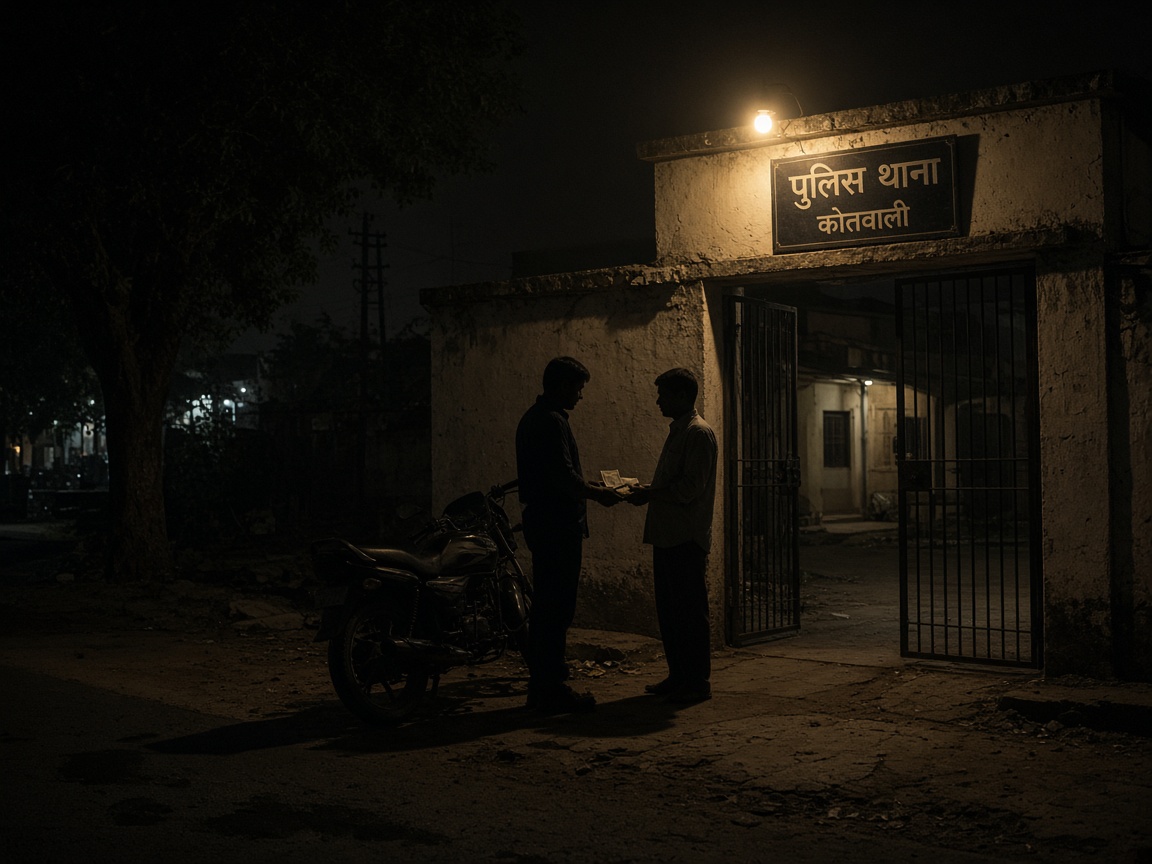
- The police as gatekeepers: The average citizen often cannot register an FIR without political influence, caste connections, or paying off the station house officer. The local thana functions less as a sanctuary of rights than as an auction house of leverage.
- The judicial black hole: With over five crore cases clogging subordinate courts and High Courts, litigation is a war of attrition. A basic property dispute, commercial default, or tenancy contest can outlive the original parties. Interim injunctions freeze for decades. When justice takes twenty-five years, victor and vanquished walk out equally destroyed.
3. Collapse into feudal enforcement: why citizens seek goondas
Because the constitutional state cannot enforce contracts or protect property in real time, society built a pragmatic parallel order: the muscle economy.
If a tenant refuses to vacate, a builder defaults on possession, or a commercial debtor refuses to honour a cheque, going to court is often commercial suicide — court fees, forty adjournments, ex-parte stays that never lift.
Instead, ordinary citizens turn to:
- The local enforcer: A payment of 10% to 20% of the disputed amount buys physical recovery. The dispute settles in forty-eight hours, not twenty years.
- The “thana settlement”: Rather than a chargesheet that feeds an endless trial, the officer acts as an extra-legal arbitrator — collecting a cut from both sides to enforce an on-the-spot compromise.
When the state abdicates timely justice, it surrenders sovereignty to the local mafia. This is the street-level twin of the democratic feudalism described earlier in the series — elected rajas above, muscle below.
4. The anti-defection farce
Nowhere is the cynical weaponization of law clearer than in the fate of the Tenth Schedule — the anti-defection law.
Enacted in 1985 by parties terrified of rampant “Aaya Ram, Gaya Ram” horse-trading of elected legislators, it was framed as a moral crusade to protect the ballot’s sanctity.
Four decades on:
- The same political class that championed the law now wields it as executive coercion.
- Instead of single defections, entire state legislatures are hollowed out by inducing mass resignations — crashing governments — while the partisan office of the Speaker stalls disqualification petitions for years.
- Turncoats finish a full term under a new banner while petitions gather dust, rendering the Tenth Schedule a dead letter in practice.
The law did not eliminate horse-trading. It raised the price of the horse and gave ruling formations legal cover to orchestrate defections under state protection — another face of the executive aggrandizement traced in Part 07.
5. The core verdict: a state without a soul
Passing a new statute costs a government nothing. Building modern forensic labs, tripling the number of judges, insulating the police from political transfers, and ending adjournment culture costs real political capital — and requires surrendering discretionary power.
The common citizen already understands what leadership refuses to admit: a country cannot legislate its way out of institutional corruption. Until the process ceases to be a weapon of extortion, newly minted penal codes and constitutional amendments remain what they have always been — an elaborate illusion that keeps the public waiting outside courtrooms that never deliver, while the real business of the country is settled by muscle in the street.
From the engineered exit of 1947 to elected satraps, from the dynasty that was to hollowed referee institutions, this series has asked what independence actually delivered on the ground. The statute book grew fat. Justice did not.
In this series
Independence of India: The Engineered Exit
Series complete · 8 essays
- Part 01
Why Britain Bolted in 1947: The Military Mutinies That Broke the Raj - Part 02
The 565 Princely States Trap: Why Immediate Consolidation Was India’s Only Defense - Part 03
The Empty Chair: Why Gandhi Fasted in Calcutta on 15 August 1947 - Part 04
The Broken Covenant: How India Made, Then Betrayed, Its Royal Bargain (1947–1971) - Part 05
Democratic Feudalism: How Elected Rajas Replaced the Maharajas - Part 06
The Dynasty That Was, and the Dynasties That Never Were: Why Only Nehru’s Daughter Inherited the State - Part 07
From Dynastic Feudalism to Executive Aggrandizement: How India’s Institutions Were Hollowed Out - Part 08 · You are here
The Illusion of the Statute: Why 80 Years of Lawmaking Replaced Justice with Extortion
Series complete · eight essays — from the engineered exit of 1947 to the illusion of the statute. Series hub →

Kunwer Sachdev
Founder & MD, Su-Kam Power Systems (1988–2019) and Kunwwer.ai — writing on manufacturing, insolvency, and civilizational memory. Read his story →
Found this story worth sharing? Post it to your network — it takes one click: