The Empty Chair: Why Gandhi Fasted in Calcutta on 15 August 1947
While Nehru spoke of a tryst with destiny under bright lights in New Delhi, the Father of the Nation sat in a riot-scarred Muslim house in Beliaghata — fasting, spinning, and refusing a national message because he had “run dry.”
On 15 August 1947, as Jawaharlal Nehru delivered his “Tryst with Destiny” speech to roaring applause in a brightly lit Constituent Assembly in New Delhi, the man universally acclaimed as the Father of the Nation was nowhere near the celebrations.
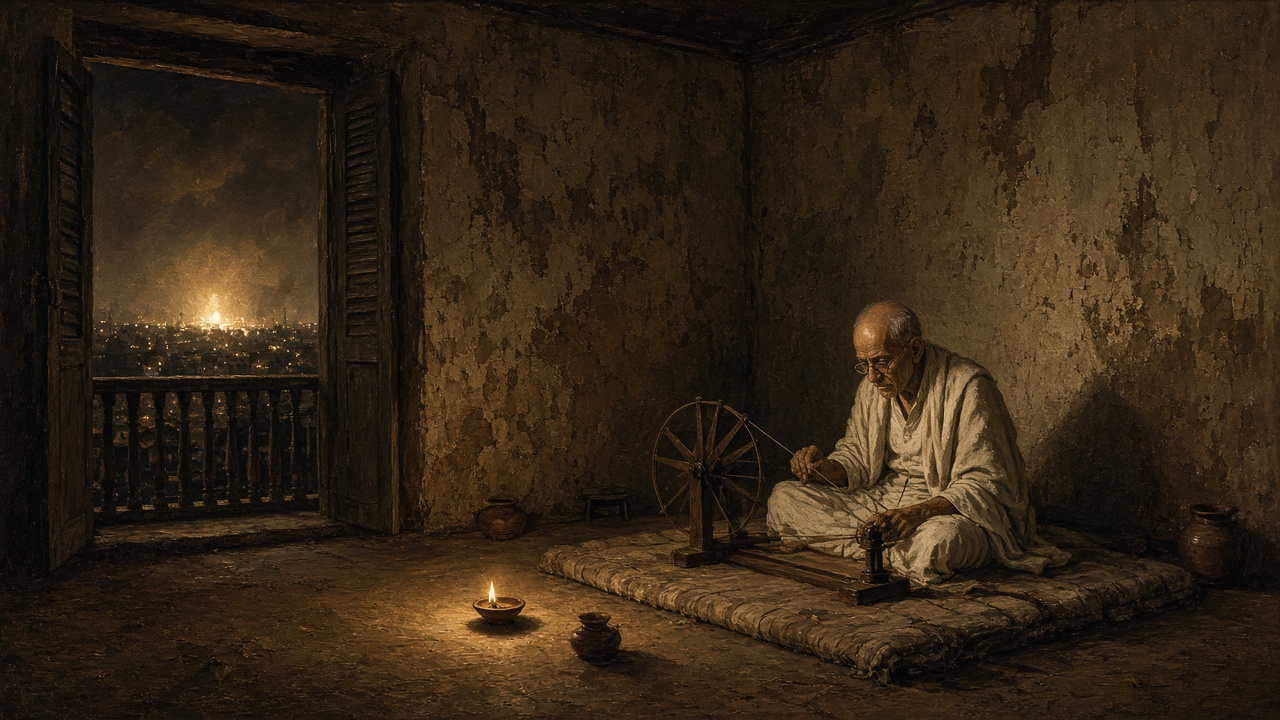
Mahatma Gandhi spent the day in Calcutta (now Kolkata), staying in Hyderi Manzil (also remembered as Haidari Mansion) — a dilapidated, Muslim-owned home in the riot-torn neighbourhood of Beliaghata. He had moved there around 13 August with former Bengal Premier Huseyn Shaheed Suhrawardy, choosing a Muslim house in a zone of recent massacre as a living argument for coexistence. He observed the day of freedom with a 24-hour fast, continuous prayer, and spinning khadi.
When an official delegation from the Department of Information and Broadcasting arrived seeking an Independence Day message for the nation, Gandhi turned them away with a curt, devastating response:
“I have run dry.”
Analyzing Gandhi’s solitary vigil in Bengal reveals a profound disconnect between the realpolitik of state formation and moral politics — and exposes how the transfer of power sidelined the very architect of India’s mass freedom struggle. It is the human coda to the engineered exit and the consolidation trap: the state was being born; the prophet was already alone.
1. The realpolitik pivot: from moral movement to state machinery
The Congress leadership — principally Jawaharlal Nehru and Sardar Vallabhbhai Patel — had spent decades as disciples of Gandhi’s moral philosophy. Yet the moment the mechanics of governing hundreds of millions materialized, a fundamental divergence emerged.
- The reality of sovereign power: Running an interim government amid administrative collapse, millions of incoming refugees, and impending bankruptcy required pragmatic compromises, police and military deployment, and territorial consolidation. Gandhi’s uncompromising insistence on absolute non-violence (ahimsa) and moral persuasion was viewed by the political executive as unworkable in a geopolitical emergency.
- The irrelevance of the saint to the state: Max Weber famously distinguished the ethic of ultimate ends (the saint’s refusal to compromise moral purity) from the ethic of responsibility (the statesman’s duty to manage consequences, including coercive power). By August 1947, Nehru and Patel had transitioned to responsibility. Gandhi remained anchored in ultimate ends. To the new Delhi establishment, he was revered as an icon — and treated, in practice, as a political liability whose presence in the capital would only complicate state policy.
2. The illusion of the “one-man boundary force”
Historical romanticism often credits Gandhi with single-handedly stopping the Bengal riots through his presence, contrasting it with Punjab’s bloodbath. Lord Mountbatten wrote to Gandhi on 26 August 1947:
“In the Punjab we have 55 thousand soldiers and large-scale rioting on our hands. In Bengal our forces consist of one man, and there is no rioting… May I be allowed to pay my tribute to the One-man Boundary Force.”
A colder reading of August–September 1947 shows a darker, more fragile reality.
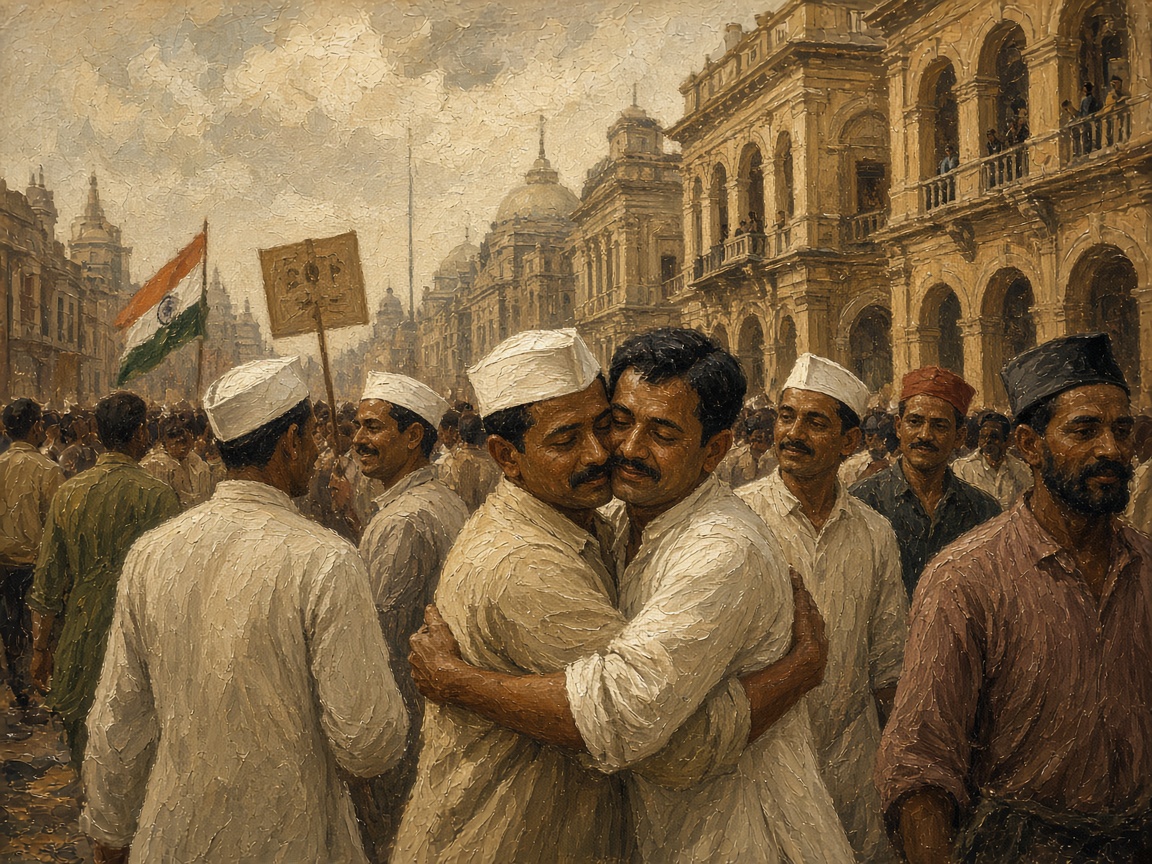
- The temporary August truce: For roughly a fortnight around 15 August, an emotional wave of fraternization swept Calcutta. Hindus and Muslims embraced in the streets. For a moment it looked like a miracle.
- The relapse: The peace was superficial. By late August, a mob attacked Hyderi Manzil — smashing windows, hurling stones, narrowly missing Gandhi. Armed rioters had no intention of stopping ethnic cleansing because a saint lived nearby.
- The fast unto death as coercion: Recognizing that speeches were failing, Gandhi launched a fast unto death on 1 September. Within about 73 hours, local gang leaders and communal cadres were pressured into gestures of surrender and peace pledges. Yet this was not systemic conflict resolution. It was moral pressure on a society that could not bear the guilt of his death. The underlying hatred remained; it was suppressed by his physical presence.
3. The seduction of power and the divide
Power did not merely disappoint ideals at the top. It commodified the communal divide at the grassroots.
- Partition as a Faustian bargain: Both the Congress high command and the Muslim League accepted the truncation of India because it offered immediate sovereign authority. Nehru and Patel calculated that a strong, centralized India with a partitioned border was preferable to a weak confederation (as under the 1946 Cabinet Mission logic) where the centre lacked real control over recalcitrant provinces.
- The scramble for spoils: In the provinces, local politicians, landlords, and opportunistic syndicates exploited the divide. Riots were not only irrational frenzy; they were systematic land grabs. Evacuee property — shops, homes, plots left by fleeing minorities in Lahore, Delhi, Calcutta, Dhaka — was seized by factions aligned with new power. Communal violence became a market.
- Marginalization of the dissident: Gandhi foresaw that Congress, having tasted state power, would degenerate into patronage and faction. His radical proposal in January 1948 — that the Indian National Congress dissolve itself into a Lok Sevak Sangh, a non-political social-service body — was quietly ignored by the leadership.
4. Why Calcutta, not Delhi or Lahore?
Gandhi’s refusal to attend Delhi’s celebrations was not an emotional sulk. It was a tactical choice born of failure to prevent Partition — and of a calculation about where the next eastern fire might start.
| Location | August 1947 dynamic | Gandhi’s calculation |
|---|---|---|
| New Delhi | Political coronation, triumph of the state, diplomatic pageantry. | A celebration of a truncated freedom that institutionalized the two-nation outcome; he refused to legitimize it with his presence. |
| Punjab | Industrial-scale slaughter, millions on the move, civil power collapsed. | He intended eventually to walk toward Punjab/Pakistan among minorities — but Bengal could combust if left unattended. |
| Calcutta (Bengal) | Memory of the 1946 Great Calcutta Killings and Noakhali; an epicenter that could trigger a wider eastern civil war. | By holding Calcutta with Suhrawardy, he tried to secure India’s eastern flank and prevent a two-front massacre. |
Conclusion: the tragic isolation of the prophet
The sight of Gandhi spinning alone in a dark room in Beliaghata while New Delhi set off fireworks marks the exact moment the Indian national movement’s moral age ended and the Indian state was born.
The political leadership did not ignore Gandhi out of simple personal malice; they outgrew him out of administrative necessity. Once independence ceased to be an agitation against an empire and became fiscal policy, military command, and border defense, the moral titan of the 1920s became an inconvenient anachronism to the state-builders of 1947.
Gandhi recognized it before anyone else: the nation had used his non-violence as a weapon of convenience against the British — and discarded it the moment the reins of the state were within its grasp.
“I have run dry.” That was not only a refused press note. It was the epitaph of a movement that had won freedom and lost its saint on the same calendar day.
In this series
Independence of India: The Engineered Exit
Series complete · 8 essays
- Part 01
Why Britain Bolted in 1947: The Military Mutinies That Broke the Raj - Part 02
The 565 Princely States Trap: Why Immediate Consolidation Was India’s Only Defense - Part 03 · You are here
The Empty Chair: Why Gandhi Fasted in Calcutta on 15 August 1947 - Part 04
The Broken Covenant: How India Made, Then Betrayed, Its Royal Bargain (1947–1971) - Part 05
Democratic Feudalism: How Elected Rajas Replaced the Maharajas - Part 06
The Dynasty That Was, and the Dynasties That Never Were: Why Only Nehru’s Daughter Inherited the State - Part 07
From Dynastic Feudalism to Executive Aggrandizement: How India’s Institutions Were Hollowed Out - Part 08
The Illusion of the Statute: Why 80 Years of Lawmaking Replaced Justice with Extortion
Series complete · eight essays — from the engineered exit of 1947 to the illusion of the statute. Series hub →
Kunwer Sachdev
Founder & MD, Su-Kam Power Systems (1988–2019) and Kunwwer.ai — writing on manufacturing, insolvency, and civilizational memory. Read his story →
Found this story worth sharing? Post it to your network — it takes one click: