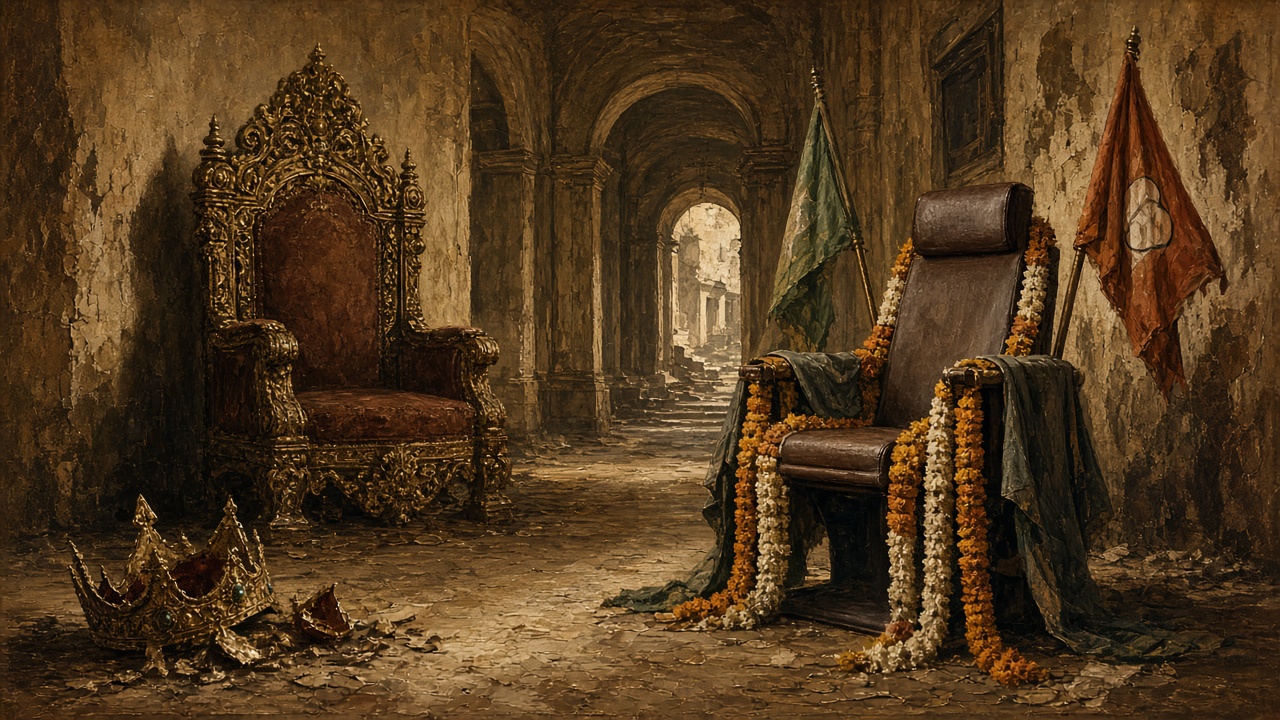
Democratic Feudalism: How Elected Rajas Replaced the Maharajas
India abolished princely titles and privy purses to kill feudal privilege. What grew in their place was often worse: elected monarchs with five-year horizons, caste armies, and public treasuries treated as family estates.
The abolition of the princely states and their privy purses — the broken covenant of Part 04 — was intended to eliminate feudal privilege and establish democratic equality. Instead, it gave rise to “Democratic Feudalism.”
Between the 1970s and 1990s, a new political class consolidated in India’s provinces: the regional Chief Ministers. Free from the check of an imperial Viceroy or the moral discipline of the early freedom fighters, these leaders leveraged identity politics, state machinery, and administrative discretion to convert sovereign democratic offices into family fiefdoms.
They did not merely rule states. They treated public departments as personal treasuries and established hereditary succession models that mirrored the very royal houses India had disarmed — and the template was first perfected at the Centre during the Emergency.
1. The “crown prince” with no portfolio (1975–1977)
During the 21 months of the Emergency, Sanjay Gandhi did not hold a cabinet seat, a parliamentary constituency, or a civil-service rank. Yet, as documented exhaustively by the post-Emergency Shah Commission of Inquiry (1978), he functioned as the de facto executive ruler of India.
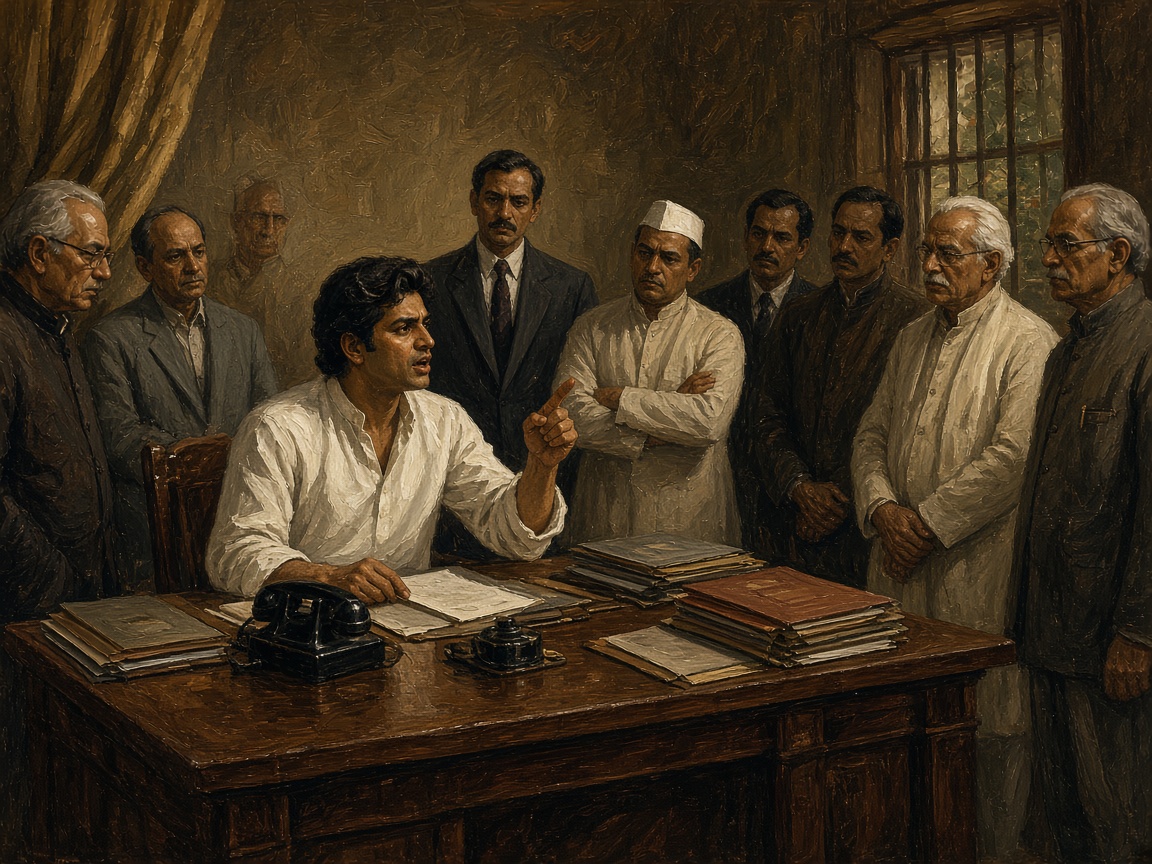
Sycophancy of Chief Ministers
Powerful state leaders did not merely consult him; they behaved like feudal courtiers.
- Chief Minister Bansi Lal of Haryana treated Sanjay like an emperor, facilitating land, machinery, and police backing as demanded.
- Chief Minister N.D. Tiwari of Uttar Pradesh was publicly photographed carrying Sanjay’s shoes at rallies — court etiquette in a republic.
- In Delhi, Lieutenant Governor Krishan Chand and DDA Vice-Chairman Jagmohan took direct oral orders from Sanjay over lunch and midnight phone calls, bypassing the Union Home Ministry.
The parallel programme
While the government promoted Indira’s official 20-Point Programme, Sanjay ran his own parallel programme (family planning, tree planting, abolishing dowry, eradicating illiteracy, and slum clearance).
- Civil servants were given quotas. Teachers and clerks were pressured — in documented cases, salaries and careers tied to producing citizens for forced vasectomies (nasbandi).
- In April 1976, when residents of Old Delhi resisted demolitions at Turkman Gate, police fired on crowds and bulldozers flattened homes under Sanjay’s insistence on “beautifying” the city — leaving hundreds injured or dead and thousands displaced to trans-Yamuna wastelands.
- When playback singer Kishore Kumar refused to sing at a Youth Congress rally, Sanjay ordered Information & Broadcasting Minister V.C. Shukla to ban Kishore’s songs from All India Radio and Doordarshan overnight.
From Rolls-Royce to Maruti: the uncontrollable heir
The characterization of Sanjay as an uncontrollable youth who acted above the rules aligns with his early path:
- Failed apprenticeship: After troubled schooling, he was sent to England for an apprenticeship with Rolls-Royce in Crewe. He never finished the program, returning to Delhi with an obsession for mechanics, fast driving, and resentment of institutional rules.
- The Maruti scandal (1970–71): When the Ministry of Industrial Development sought proposals for an “indigenous small car,” the license was awarded to Sanjay Gandhi’s newly formed Maruti Limited — despite established manufacturers bidding and Sanjay having no manufacturing experience or working prototype.
- Feudal land grab: Bansi Lal’s Haryana machinery helped acquire hundreds of acres of agricultural land in Gurgaon, displacing farmers with minimal compensation for Sanjay’s factory — state force bent to the commercial ambition of the ruler’s son.
This was the master class. The provinces learned the grammar: family first, institutions second, elections as coronation.
2. The anatomy of the “democratic raja”
Unlike the old maharajas — who at least had customary checks, dynastic pride, and some incentive to maintain infrastructure for their lineage — the new regional satraps operated under short five-year electoral horizons. Their playbook rested on four pillars:
- Subversion of the bureaucracy & police: Postings, transfers, and promotions became instruments of loyalty or outright auctions.
- Control of state resources: Land acquisition, mining, liquor, transport permits, and public recruitment became private rent-seeking monopolies.
- Caste & identity hegemony: Feudal loyalty was replaced with linguistic or caste solidarity — “our caste is in power” — shielding leaders from accountability.
- Dynastic entrenchment: Power passed to sons, daughters, and sons-in-law; parties became family-owned enterprises.
3. Regional case studies: the feudal satraps
Haryana: the Chautala dynasty (patronage via recruitment)
Haryana became a laboratory of political clientelism — from Chaudhary Devi Lal through his son Om Prakash Chautala.
- Modus operandi: State power used to bypass merit. The notorious JBT Teachers Recruitment Scam (1999–2000) saw fabricated interview lists used to hire thousands of hand-picked loyalists across districts.
- Consequence: The Supreme Court upheld convictions of Om Prakash Chautala and Ajay Chautala (2013), with substantial prison sentences. Even after conviction, the family fragmented into rival factions — dynastic succession remaining the sole political currency.
Bihar: the Lalu Prasad Yadav era (subversion of public treasuries)
In the 1990s, Lalu Prasad Yadav mobilized backwards castes and minorities against upper-caste hegemony — a historic democratization of representation. It was accompanied by institutional dismantling.
- Fodder scam (Chara Ghotala): Hundreds of crores looted via fake invoices for non-existent cattle feed and veterinary supplies through the Animal Husbandry Department (1990–97 period at the core of prosecutions).
- Kitchen-table succession: When charges forced Lalu to step down in 1997, he installed his wife Rabri Devi — with no prior administrative experience — as Chief Minister, treating the constitutional executive of a vast state as an heirloom.
- Dynastic legacy: Sons were positioned as heirs while infrastructure and law enforcement slid into what popular speech called “Jungle Raj.”
Uttar Pradesh: Mayawati & Mulayam Singh Yadav (state as private monopoly)
India’s most populous state became a rotating battlefield between personality- and clan-centric regimes.
- Samajwadi Party / Mulayam: Power centralized in the extended Yadav clan — from Chief Minister (Akhilesh) to MPs, MLAs, and panchayat heads. Law enforcement was repeatedly accused of protecting local strongmen whose muscle served booth capture and street politics.
- BSP / Mayawati: A historic Dalit assertion coexisted with vast monument spending and the NRHM scam investigations — public health money siphoned through shell companies, with a trail of dead and murdered medical officers that scarred the state’s conscience.
Tamil Nadu: Karunanidhi & Jayalalithaa (corporate warlords)
In the Dravidian south, governance did not always collapse into open lawlessness — but power became an absolute duopoly.
- DMK / Karunanidhi: Party as family conglomerate spanning politics (Stalin, Alagiri, Kanimozhi), media, and distribution — blurring state procurement and private empire.
- AIADMK / Jayalalithaa: Imperial detachment and absolute autocracy. The 1995 foster-son wedding ostentation became a national symbol; the disproportionate-assets case ended in Supreme Court conviction (2017) — abated as to her by death, while V.K. Sasikala served prison time.
Andhra Pradesh: Y.S. Rajasekhara Reddy (the quid-pro-quo empire)
Between 2004 and 2009, Andhra witnessed an industrialization of political corruption through the quid-pro-quo investment model.
- State resources — prime land, SEZ clearances, mining, irrigation contracts — allotted cheaply to industrialists.
- In exchange, those industrialists took inflated stakes in companies linked to YSR’s son, Y.S. Jagan Mohan Reddy (including media and cement ventures that later figured in prosecution narratives).
- After YSR’s death, the political brand transferred to the son — caste, welfare populism, and family legacy fused into a succession machine.
4. Feudal monarchs vs regional satraps
| Feature | Old princely states (pre-1947) | Modern regional satraps (post-1970) |
|---|---|---|
| Source of authority | Hereditary lineage and British treaties. | Caste/identity vote banks and discretionary patronage. |
| Check on power | British Residents, customary codes, local revolts. | Courts and central agencies — often blunted by political deals. |
| Public funds | Vanity mixed with lasting public works (dams, schools, civic halls). | Kickbacks, inflated tenders, fake invoices. |
| Succession | Primogeniture recognized by the Crown. | Dynastic party inheritance masked as election tickets. |
| Bureaucracy | Often capable diwans (Visvesvaraya, Mirza Ismail). | Politicized transfer-posting cartels. |
5. Why democracy failed to reach the common man
The fundamental tragedy of post-colonial Indian politics was that the form of democracy arrived without its substance.
- The patron-client trap: Where the state controlled land, jobs, permits, and rations, citizens could not afford to vote only on policy. They voted for their local “raja” because a caste patron in the Secretariat was the path to an electricity connection, an FIR, or a teacher’s posting.
- Parties without internal democracy: India runs the world’s largest national elections while almost no major regional party runs real internal elections. Tickets leave kitchen tables, not primary contests.
- The immunity of numbers: Old princes lost states because they lacked democratic legitimacy. Modern satraps learned that a consolidated 25–30% identity vote bank can survive dozens of investigations and still win the right to rule.
At least the old rajas had a praja. The land was theirs only as long as people lived under them — so vanity still mixed with schools, tanks, and civic halls. These political rajas often have no praja at all. They misuse the chair for family and rule: tickets for sons, contracts for cousins, postings for loyalists, and the public treasury treated as a private estate.
I do not see democracy for the rickshaw puller, the labourer, the kissan, or the ordinary person working on the street. A policeman can slap him on the road today, in front of all of us, because he has no rights that anyone will enforce and no one to speak for him. Democracy has reached only a few so far. We are called the largest democracy in the world, yet we are still ruled by rajas — not by the rule of law. The person is the rule of law.
By removing the maharajas we did not abolish the Raj darbars. New rajas are ruling now under the guise of democracy — beginning with a crown prince who needed no portfolio at all, and continuing through provincial satraps who learned that elections can crown a dynasty as surely as birth once did.
In this series
Independence of India: The Engineered Exit
Series complete · 8 essays
- Part 01
Why Britain Bolted in 1947: The Military Mutinies That Broke the Raj - Part 02
The 565 Princely States Trap: Why Immediate Consolidation Was India’s Only Defense - Part 03
The Empty Chair: Why Gandhi Fasted in Calcutta on 15 August 1947 - Part 04
The Broken Covenant: How India Made, Then Betrayed, Its Royal Bargain (1947–1971) - Part 05 · You are here
Democratic Feudalism: How Elected Rajas Replaced the Maharajas - Part 06
The Dynasty That Was, and the Dynasties That Never Were: Why Only Nehru’s Daughter Inherited the State - Part 07
From Dynastic Feudalism to Executive Aggrandizement: How India’s Institutions Were Hollowed Out - Part 08
The Illusion of the Statute: Why 80 Years of Lawmaking Replaced Justice with Extortion
Series complete · eight essays — from the engineered exit of 1947 to the illusion of the statute. Series hub →
Kunwer Sachdev
Founder & MD, Su-Kam Power Systems (1988–2019) and Kunwwer.ai — writing on manufacturing, insolvency, and civilizational memory. Read his story →
Found this story worth sharing? Post it to your network — it takes one click: