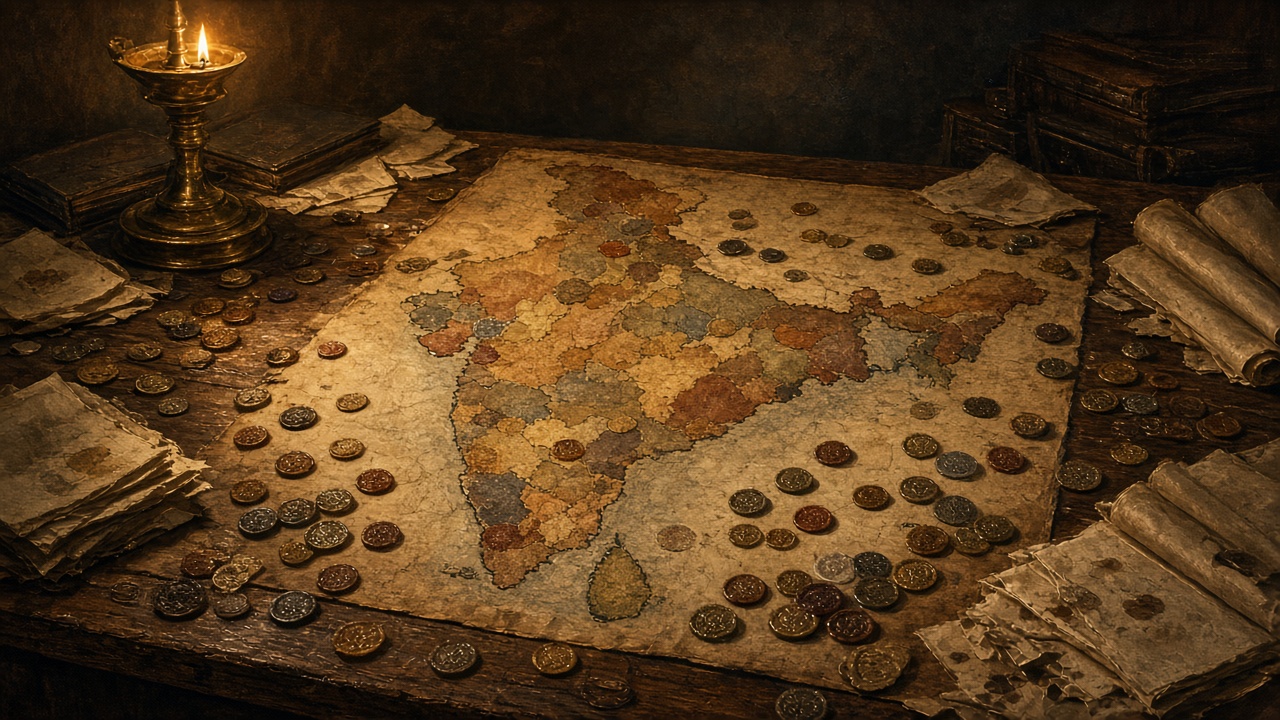
The 565 Princely States Trap: Why Immediate Consolidation Was India’s Only Defense
When British paramountcy lapsed on 15 August 1947, roughly 565 princely states were left legally free to go their own way. That was not a gift of freedom. It was a Balkanization bomb with a short fuse.
In Part 01, we named Britain’s engineered exit: military loyalty cracked, the calendar crashed, borders were sealed until after the ceremony, and the army was reconstituted under fire. The newborn Dominion of India inherited not only Partition’s bloodlands — it inherited a second, quieter catastrophe written into the Indian Independence Act.
Paramountcy would lapse. The Crown’s suzerainty over the princely states would simply end. On paper, each ruler could accede to India, accede to Pakistan, or attempt to stand alone.
About 565 princely states covered roughly a third of the subcontinent’s land and around two-fifths of its people. Many ran their own railways, stamps, currencies, and armies. If even a fraction chose independence or hostile accession, India would not be a republic-in-waiting. It would be a checkerboard of micro-sovereignties — indefensible borders, captive corridors, and foreign intrigue by invitation.
1. What Britain left on the table
British India and princely India were never the same legal animal. The provinces were Crown territory. The states were tied by treaty and paramountcy — not annexed, but controlled.
When London chose a rushed dominion exit, it did not patiently federate the princes into a finished Indian Union. It cut the imperial knot. The political consequence was immediate:
- Rulers who had never answered to an Indian electorate suddenly held the pen on accession.
- Pakistan’s geography and communal logic invited opportunistic claims (most notoriously on the Kathiawar coast).
- Any “independent” Deccan or coastal state could become a base for arms, intrigue, or permanent veto over India’s internal lines of communication.
This was not a theoretical puzzle for constitutional lawyers. It was a security emergency overlapping Partition violence, refugee columns, and a communally split army.
2. Patel, Menon, and the Instrument of Accession
On 27 June 1947, Sardar Vallabhbhai Patel took charge of the new States Department. His secretary, V.P. Menon — the civil servant who had already typed the transfer-of-power logic under impossible deadlines — became the operational brain of integration.
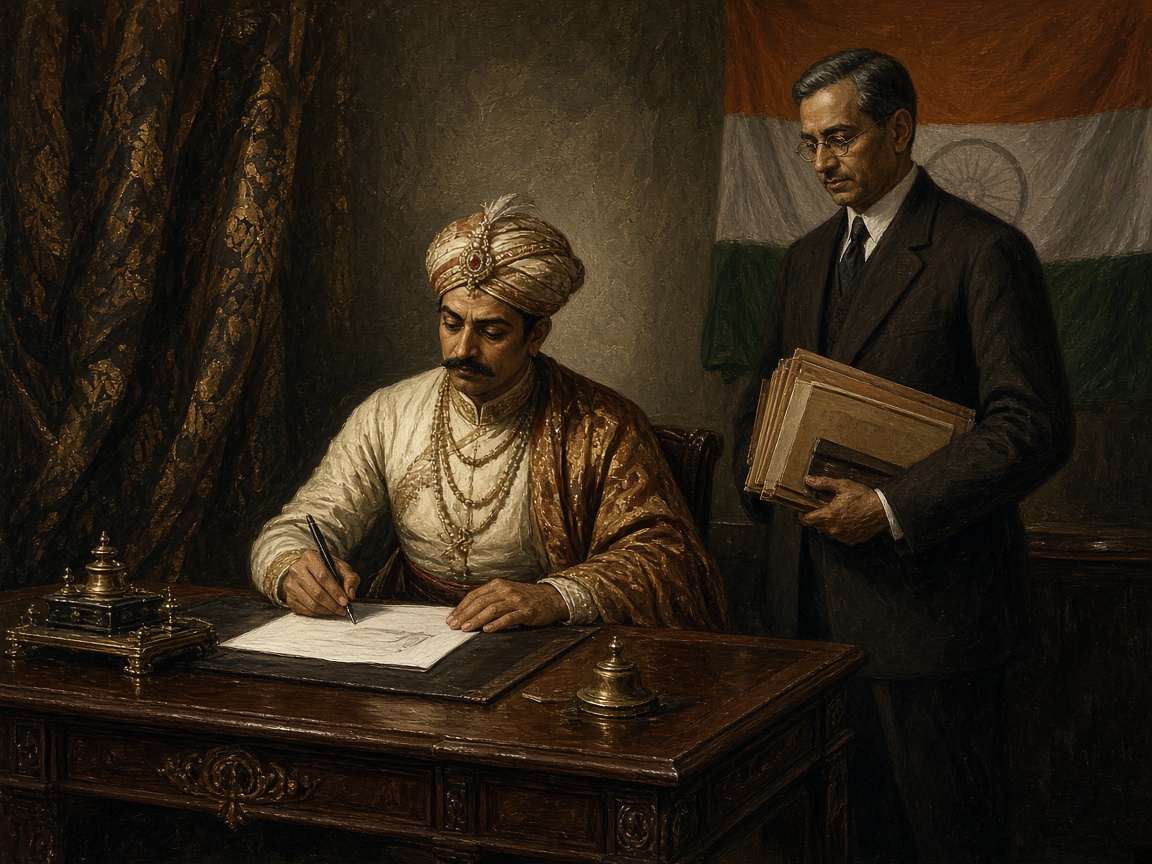
Their tool was the Instrument of Accession: a standardized legal instrument by which a ruler transferred defence, external affairs, and communications to the Dominion of India — without, at first, swallowing every internal prerogative. Privy purses and transitional dignity were used as sweeteners. Patriotism was invoked. So was the prospect of anarchy.
Mountbatten, still in the Viceregal chair through the transfer, pressed the princes hard: accession before 15 August, or isolation in a storm they could not survive alone.
The early harvest was decisive. By Independence Day, the overwhelming majority of states had signed for India. The map that could have shattered was held together by paperwork executed at wartime tempo — Menon’s hundreds of journeys, Patel’s iron insistence, and a political instinct that unity was not optional.
3. The holdouts that proved the danger
Most states fell into line. A few exposed why “leave them alone” would have been national suicide.
Junagadh
A Muslim ruler over a Hindu-majority Kathiawar state attempted accession to Pakistan — geographically absurd, strategically provocative. India responded with pressure, occupation of the surrounding reality, and a plebiscite in which the people chose India. The lesson was blunt: accession could not be a princely whim divorced from geography and population.
Hyderabad
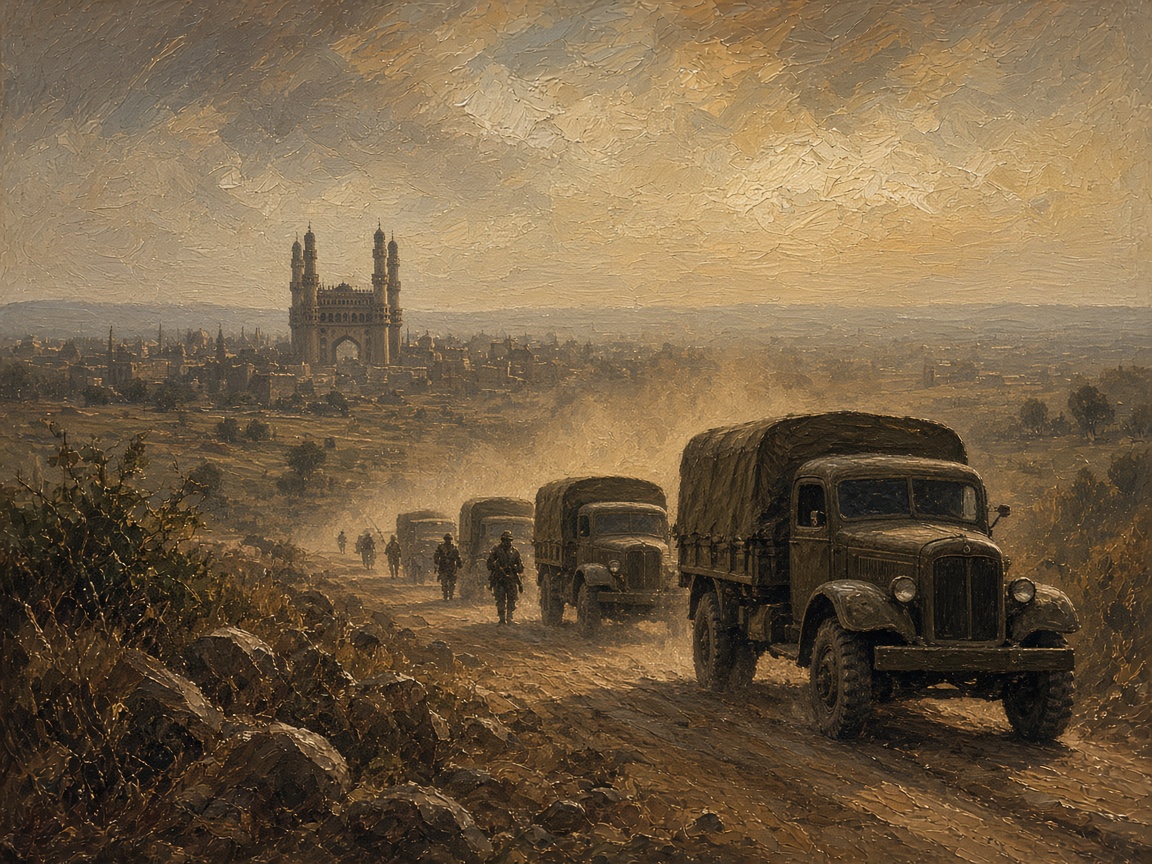
The Nizam sought independence — a vast Deccan state astride India’s belly, with its own forces and a violent Razakar militia terrorizing the countryside. Negotiations stalled. In September 1948, Indian forces moved in what became known as Operation Polo. Hyderabad’s “independence” ended in days. A sovereign pocket in the heart of India was incompatible with the Union’s survival.
Jammu & Kashmir
The Maharaja’s delay collided with tribal invasion from the Pakistan side in October 1947. Accession to India followed under fire — and opened a conflict that still shapes the subcontinent. Here the princely-states trap met the Partition trap: hesitation at the top, violence at the border, and a truncated army asked to hold the line.
4. Why speed was strategy, not vanity
Critics sometimes tell the integration story as bullying of colourful courts. That framing misses the strategic arithmetic of 1947–48:
- Defence: A state with its own foreign policy inside India’s landmass is a permanent flank.
- Communications: Rail and telegraph lines could not be held hostage to 500 customs posts of ego.
- Communal fire: Partition already proved that delayed clarity kills. Delayed accession would have multiplied Junagadhs.
- Administrative reality: Within roughly two years, hundreds of states were dissolved into a manageable set of administrative units — the prerequisite for any republic that could tax, defend, and speak with one voice.
Patel’s contempt for princely obstruction and Menon’s relentless drafting were not personality quirks. They were the only available answer to a legal time bomb London had planted on the way out.
Conclusion: consolidation as decolonization
Political independence without territorial consolidation would have been a ceremony over a corpse. The tricolour on 15 August meant little if Hyderabad could veto the Deccan, if Kathiawar could be played as a Pakistani enclave, if every raja could auction geography to the highest foreign bidder.
Immediate consolidation was not a betrayal of diversity. It was India’s defence against the last imperial gift: a map designed to fall apart the moment the Union Jack came down.
The Engineered Exit created the trap. The States Department sprung it shut.
In this series
Independence of India: The Engineered Exit
Series complete · 8 essays
- Part 01
Why Britain Bolted in 1947: The Military Mutinies That Broke the Raj - Part 02 · You are here
The 565 Princely States Trap: Why Immediate Consolidation Was India’s Only Defense - Part 03
The Empty Chair: Why Gandhi Fasted in Calcutta on 15 August 1947 - Part 04
The Broken Covenant: How India Made, Then Betrayed, Its Royal Bargain (1947–1971) - Part 05
Democratic Feudalism: How Elected Rajas Replaced the Maharajas - Part 06
The Dynasty That Was, and the Dynasties That Never Were: Why Only Nehru’s Daughter Inherited the State - Part 07
From Dynastic Feudalism to Executive Aggrandizement: How India’s Institutions Were Hollowed Out - Part 08
The Illusion of the Statute: Why 80 Years of Lawmaking Replaced Justice with Extortion
Series complete · eight essays — from the engineered exit of 1947 to the illusion of the statute. Series hub →

Kunwer Sachdev
Founder & MD, Su-Kam Power Systems (1988–2019) and Kunwwer.ai — writing on manufacturing, insolvency, and civilizational memory. Read his story →
Found this story worth sharing? Post it to your network — it takes one click: