Why Britain Bolted in 1947: The Military Mutinies That Broke the Raj
Attlee set June 1948. Mountbatten crashed the calendar to 15 August 1947. The reason was not a magnanimous transfer of power — it was the collapse of allegiance inside the British Indian Armed Forces.
For generations, imperial chroniclers framed August 15, 1947, as a magnanimous “transfer of power” — a planned, dignified imperial withdrawal guided by post-war exhaustion and moral awakening.
The declassified military cables, operational dispatches, and private war-cabinet diaries tell an entirely different story.
Britain did not depart through scheduled benevolence; it staged a high-stakes imperial evacuation. In February 1947, British Prime Minister Clement Attlee stood before the House of Commons and announced a firm departure deadline: not later than June 1948. Yet within weeks of arriving in New Delhi, the last Viceroy, Rear Admiral Lord Louis Mountbatten, shattered that timetable, dragging the departure date forward by roughly ten months to August 15, 1947.
Why did the British Empire cut and run hundreds of days ahead of schedule?
The answer does not lie in round-table conferences or non-violent moral persuasion alone. It lies in the loss of Britain’s ultimate instrument of colonial coercion: the absolute allegiance of the British Indian Armed Forces — a wartime peak force on the order of 2.5 million Indian soldiers, sailors, and airmen.
1. The broken sword: 1945–1946 military rebellion
The British Empire did not rule hundreds of millions with British soldiers alone. It held the subcontinent through an imperial administrative structure anchored by a limited British troop presence and a vast standing force of Indian soldiers, sailors, and airmen who had just fought across Burma, North Africa, and Italy during World War II.
So long as the Indian sepoy followed British orders to shoot fellow Indians, the Raj was unbreakable. Between November 1945 and February 1946, that loyalty collapsed.
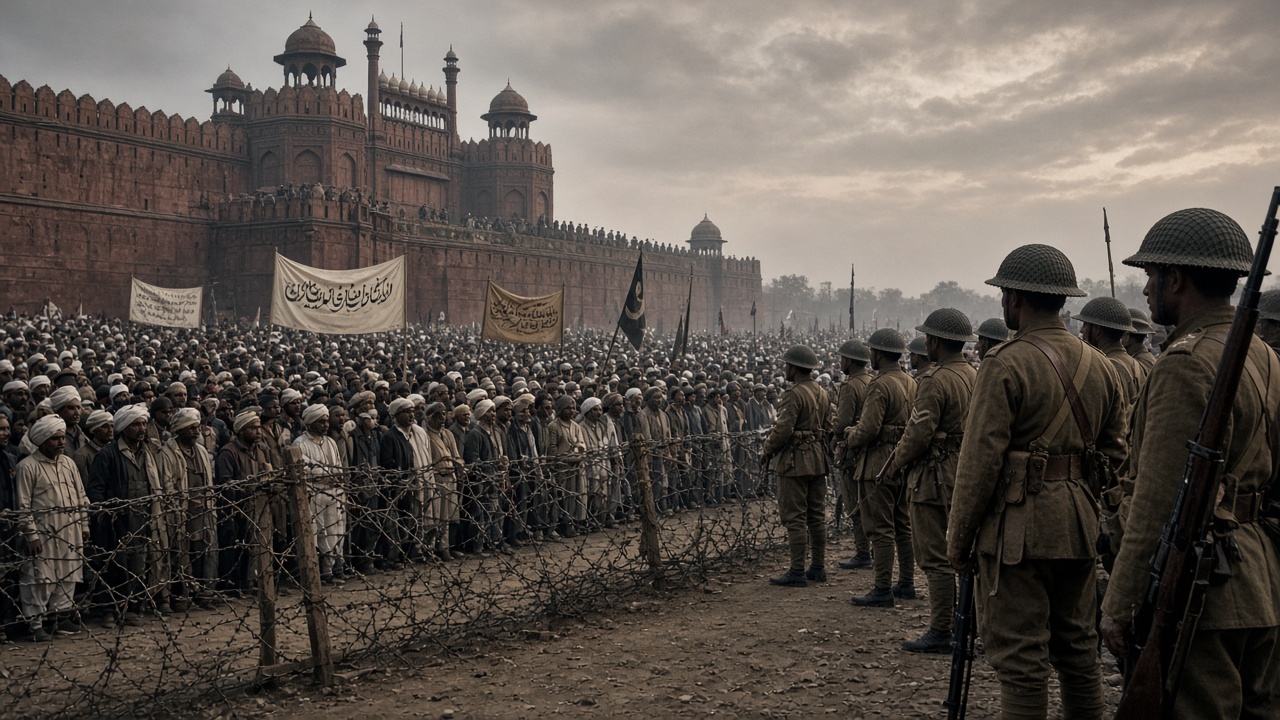
The Red Fort flashpoint (the INA trials)
In late 1945, colonial authorities placed three senior officers of Subhas Chandra Bose’s Indian National Army (INA) on public trial inside Delhi’s Red Fort: Captain Shah Nawaz Khan (a Muslim), Colonel Prem Sahgal (a Hindu), and Major Gurbaksh Singh Dhillon (a Sikh). The first showcase court-martial opened on 5 November 1945.
The British intended to make an example of “traitors.” Instead, they forged an unprecedented national consensus:
- The joint trial united Hindus, Muslims, and Sikhs across North India under a single rallying cry.
- Indian soldiers returning from Europe and Southeast Asia openly attended rallies and contributed to the INA Defence Fund.
- Intelligence landing on Viceroy Lord Wavell’s desk warned that Indian troops viewed the INA men not as deserters, but as patriots — a loyalty crisis Field Marshal Claude Auchinleck watched with growing alarm.
The Royal Indian Navy (RIN) mutiny: February 1946
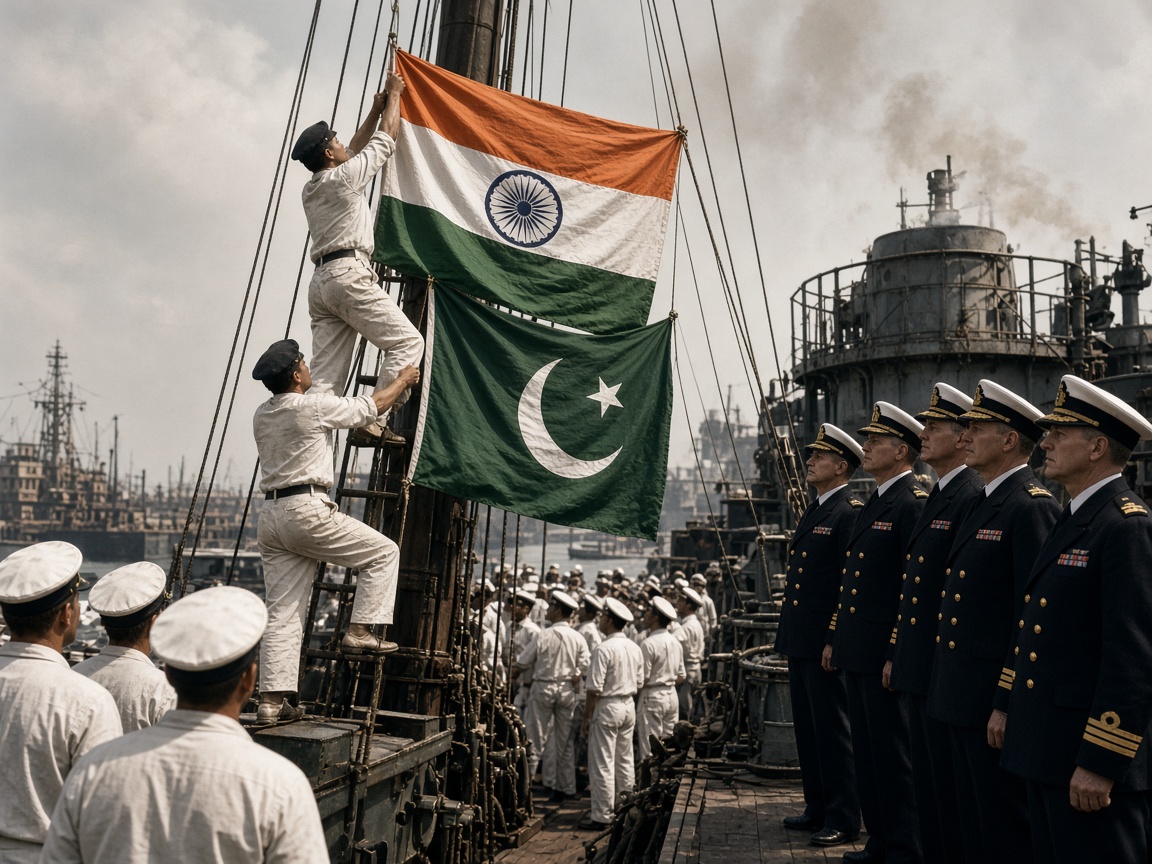
On 18 February 1946, the sparks reached the powder keg. It began on the signals training ship HMIS Talwar in Bombay harbour over atrocious rations and racial abuse. Within 48 hours, it erupted into a far wider naval uprising.
- Scale: On the order of 20,000 naval ratings across dozens of ships and shore establishments — including Bombay, Karachi, Calcutta, and Cochin — joined the rebellion.
- The death of communal division: Striking sailors lashed the flags of the Indian National Congress, the Muslim League, and the Communist Party together on their mainmasts.
- Armed standoff: Ratings trained shipboard guns toward symbols of colonial privilege in Bombay, while unrest elsewhere — including air-force and army units — deepened Whitehall’s fear that Indian forces would no longer fire on Indians.
Auchinleck’s dire calculus
The Commander-in-Chief of India, Field Marshal Claude Auchinleck, conducted an unvarnished audit of the military machinery. Across 1946 assessments and cables to London, the grim reality was clear:
- Unreliable enforcers: The Indian Army could no longer be trusted, as a matter of course, to fire on Indian civilians in a mass civil insurrection.
- Deficit of British troops: Bankrupt, reconstruction-weary Britain did not possess the financial resources or manpower to ship enough fresh British divisions to police a hostile continent.
- Evacuation risk: If synchronized military rebellion met mass strikes, British officers and families could not be guaranteed a safe exit.
Decades later, in 1956, when former Prime Minister Clement Attlee visited Calcutta, Chief Justice P.B. Chakraborty asked him directly why Britain had decided to leave so abruptly when the Quit India Movement had largely subsided by 1944.
Attlee cited, as a primary factor in that reported exchange, the erosion of loyalty among the Indian armed forces as a consequence of the INA and the naval uprisings. When asked what role Mahatma Gandhi’s non-violent movement played in that immediate exit decision, Attlee — as Chakraborty later recounted — smiled and uttered one word: “Minimal.”
(This Attlee–Chakraborty exchange is a powerful secondary recollection of a private conversation, not a Cabinet minute; it is included here as Attlee’s reported self-assessment of the military shock, alongside the operational record of 1945–46.)
2. Mountbatten’s mandate: the date crash
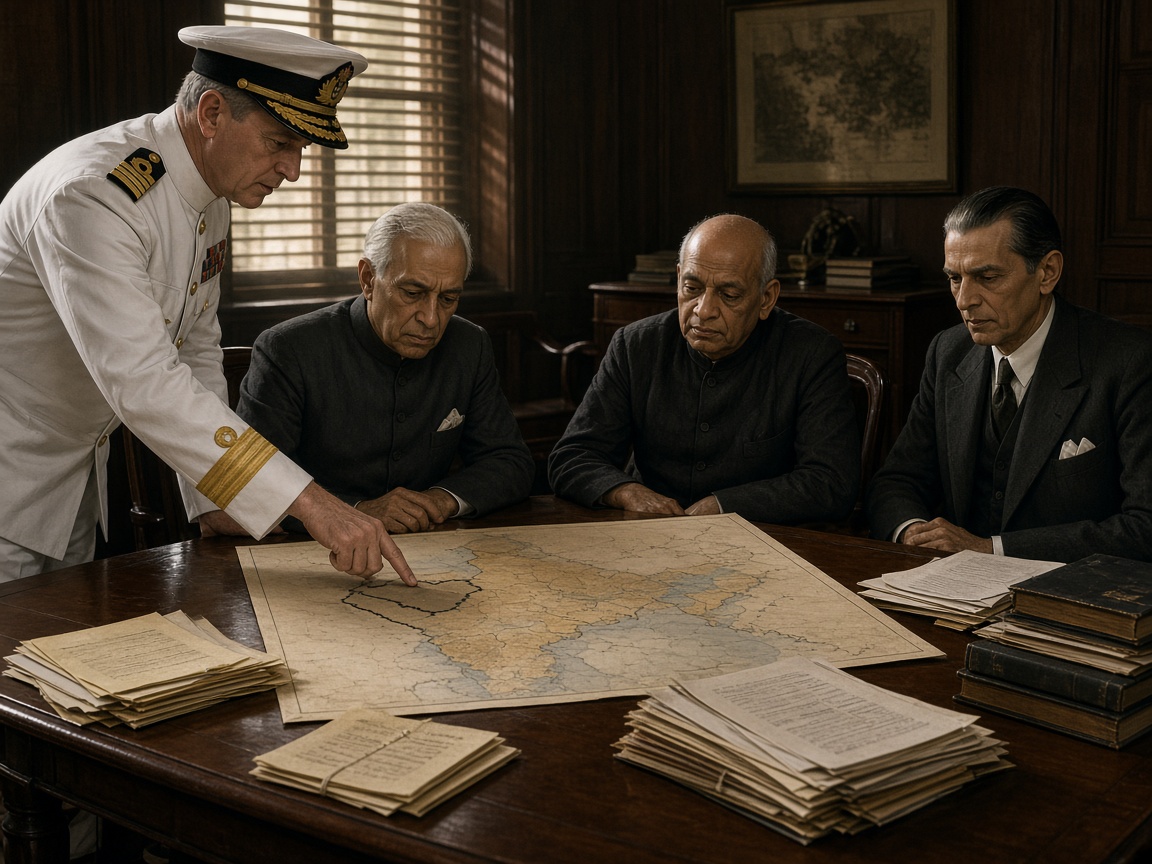
When Lord Louis Mountbatten was sworn in as the 34th and final Viceroy on 24 March 1947, his remit from Attlee was to manage a transfer of authority by June 1948.
Within weeks, Mountbatten aborted the schedule. On 3 June 1947, he declared that the transfer would take place on 15 August 1947 — collapsing a deliberate multi-month transition into an administrative scramble of roughly seventy days.
June 3 Plan → appointed day: 15 August 1947
≈ 10 months erased from the public timetable
Why compress the timeline?
- Washing Whitehall’s hands: Provincial administration was decaying — resignations, desertions, failing collection. Every week of formal British control increased moral and legal responsibility for a gathering civil storm.
- Saving British lives: An accelerating exit got imperial personnel onto troopships before communal explosions trapped them in the crossfire.
- Preempting a unified resistance: By centering the transfer around Partition, political energy shifted from confronting the occupying power to territorial jockeying among Indians.
3. The engineered vacuum: borders and broken armies
To ensure a clean departure with minimal British casualties, the imperial machinery executed two tactical maneuvers that virtually guaranteed immediate post-independence chaos for the subcontinent.
A. The Radcliffe secrecy shield
Sir Cyril Radcliffe, an English barrister who had never visited India, was allotted about five weeks to carve boundary lines across Punjab and Bengal.
- Radcliffe’s awards were ready around 12 August 1947 (Punjab/Bengal reports finalized in the days immediately before).
- Mountbatten held them back and published them on Sunday, 17 August — two full days after the Union Jack had been lowered and independence celebrated.
Why suppress the boundary awards?
Had the border been published on 13 or 14 August, the immediate communal riots would have erupted while Britain remained legally sovereign. British troops could have been compelled to step between warring factions, sustaining European casualties. By holding the maps until 17 August, the violence erupted on the watch of day-old governments. Mountbatten himself explained to London that the later the publication, the less “the inevitable odium” would react upon the British. The legal liability was outsourced instantly.
B. Dismantling the armed forces
The most destabilizing move of the transition was the reconstitution of the British Indian Army along communal lines under the Armed Forces Reconstitution Committee — even as political borders were still unsettled.
Units that had fought side-by-side for decades were split into India- and Pakistan-bound formations. Officers and soldiers were abruptly preoccupied with securing their own families’ passage across unannounced frontiers. The short-lived, undermanned Punjab Boundary Force under Major General Thomas Rees collapsed within weeks, outmatched by communal hysteria. The military instrument that might have secured an orderly population transfer had been severed by administrative decree.
Conclusion: an evacuation, not a benevolent handover
Britain did not exit India on a calculated, orderly democratic timetable. It exited because:
- The military lever snapped: The INA trials and the 1946 Royal Indian Navy mutiny proved that Indian troops would no longer reliably enforce colonial rule.
- The clock was collapsed: Mountbatten erased months from Attlee’s June 1948 ceiling to free the Crown from governing an unmanageable crisis.
- The aftermath was outsourced: By holding back the border maps and breaking the army into communal halves, the departing empire insulated itself from liability — leaving the newborn states to battle an engineered catastrophe.
When the flags changed on 15 August 1947, India inherited not just long-delayed freedom, but a deliberate institutional vacuum — one that required the immediate consolidation of over 560 princely states to prevent the Balkanization of the subcontinent.
In this series
Independence of India: The Engineered Exit
Series complete · 8 essays
- Part 01 · You are here
Why Britain Bolted in 1947: The Military Mutinies That Broke the Raj - Part 02
The 565 Princely States Trap: Why Immediate Consolidation Was India’s Only Defense - Part 03
The Empty Chair: Why Gandhi Fasted in Calcutta on 15 August 1947 - Part 04
The Broken Covenant: How India Made, Then Betrayed, Its Royal Bargain (1947–1971) - Part 05
Democratic Feudalism: How Elected Rajas Replaced the Maharajas - Part 06
The Dynasty That Was, and the Dynasties That Never Were: Why Only Nehru’s Daughter Inherited the State - Part 07
From Dynastic Feudalism to Executive Aggrandizement: How India’s Institutions Were Hollowed Out - Part 08
The Illusion of the Statute: Why 80 Years of Lawmaking Replaced Justice with Extortion
Series complete · eight essays — from the engineered exit of 1947 to the illusion of the statute. Series hub →
Kunwer Sachdev
Founder & MD, Su-Kam Power Systems (1988–2019) and Kunwwer.ai — writing on manufacturing, insolvency, and civilizational memory. Read his story →
Found this story worth sharing? Post it to your network — it takes one click: