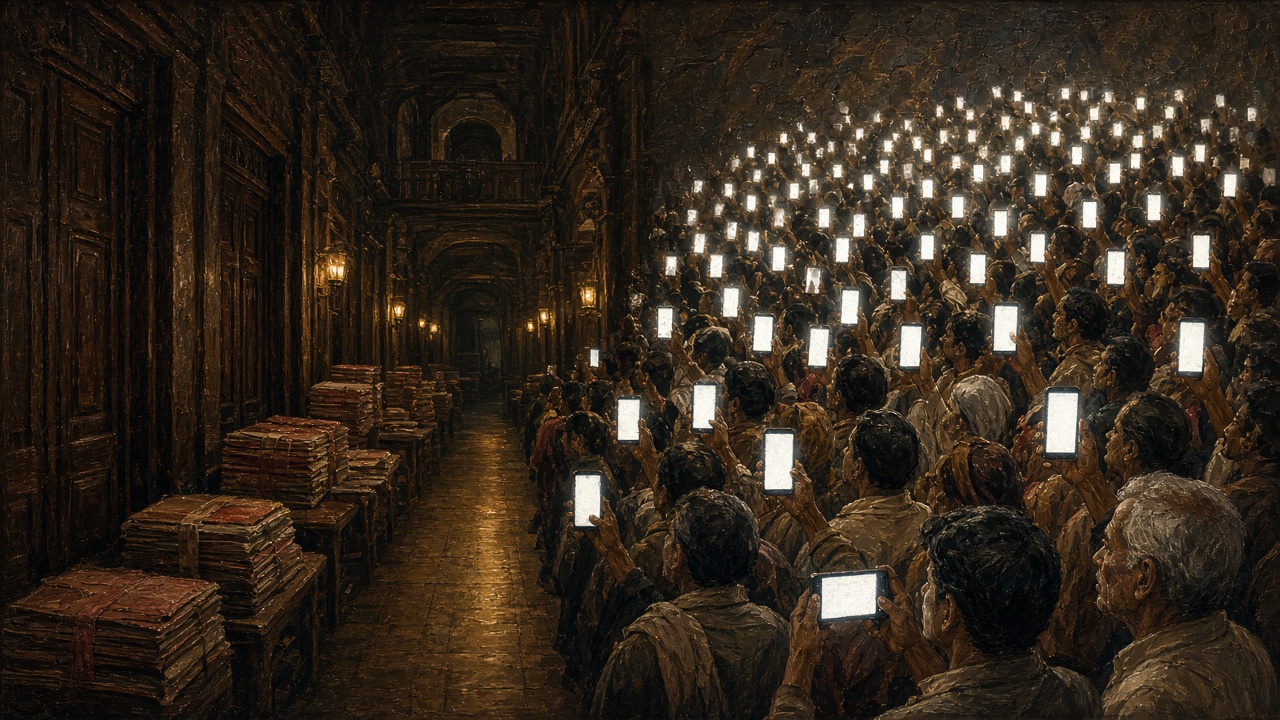
The Citizen’s Camera: How Social Media Broke the Feudal Iron Triangle
For seventy-five years, politician, babu, and judge ran a closed triangle. The smartphone did not ask permission to enter the room. It simply turned the light on.
In Part 07, we named the elite civil war over who holds the master’s gavel — Executive versus Judiciary, Collegium versus appointments, contempt as feudal shield. That fight was never about the citizen. This essay is about the force that finally put a camera in the citizen’s hand and made the triangle flinch.
For over seven decades, power in India rested on an impenetrable arrangement: the Politician made the policy, the Bureaucrat controlled the files, and the Judge settled the disputes behind closed doors.
It was a closed iron triangle.
Traditional media — newspapers, radio, and television channels — was never truly an independent fourth pillar. It relied on government advertisements for its balance sheets, press conferences for access, and broadcast licenses to stay on air. If the system stepped out of line, an editorial phone call or a tax notice was enough to restore order.
As a result, an ordinary citizen possessed zero leverage. If a traffic cop harassed you, a municipal clerk demanded an under-the-table fee, or an arrogant judge insulted you in court, your only option was to endure it. The system was entirely deaf because it controlled every microphone in the country.
Then came the smartphone and algorithmic social media.
Suddenly, the one-way monologue collapsed. The establishment, which spent 75 years insulated by colonial contempt laws, red-tape files, and press releases, is finding itself terrified of the very people it was built to dominate. What the elite dismissively labels a “digital nuisance” or “media trials” is actually the first genuine, decentralized accountability mechanism modern India has ever seen.
1. Stripping the emperor: how the lens smashed bureaucratic arrogance
The traditional Indian civil servant derived power from spatial and psychological insulation. High walls, tinted glass, red beacons, camp offices, and peons guarding mahogany doors were all designed to project awe and unapproachability. Inside that closed chamber, the bureaucrat was king.
Social media dismantled that fortress with a single feature: the record button.
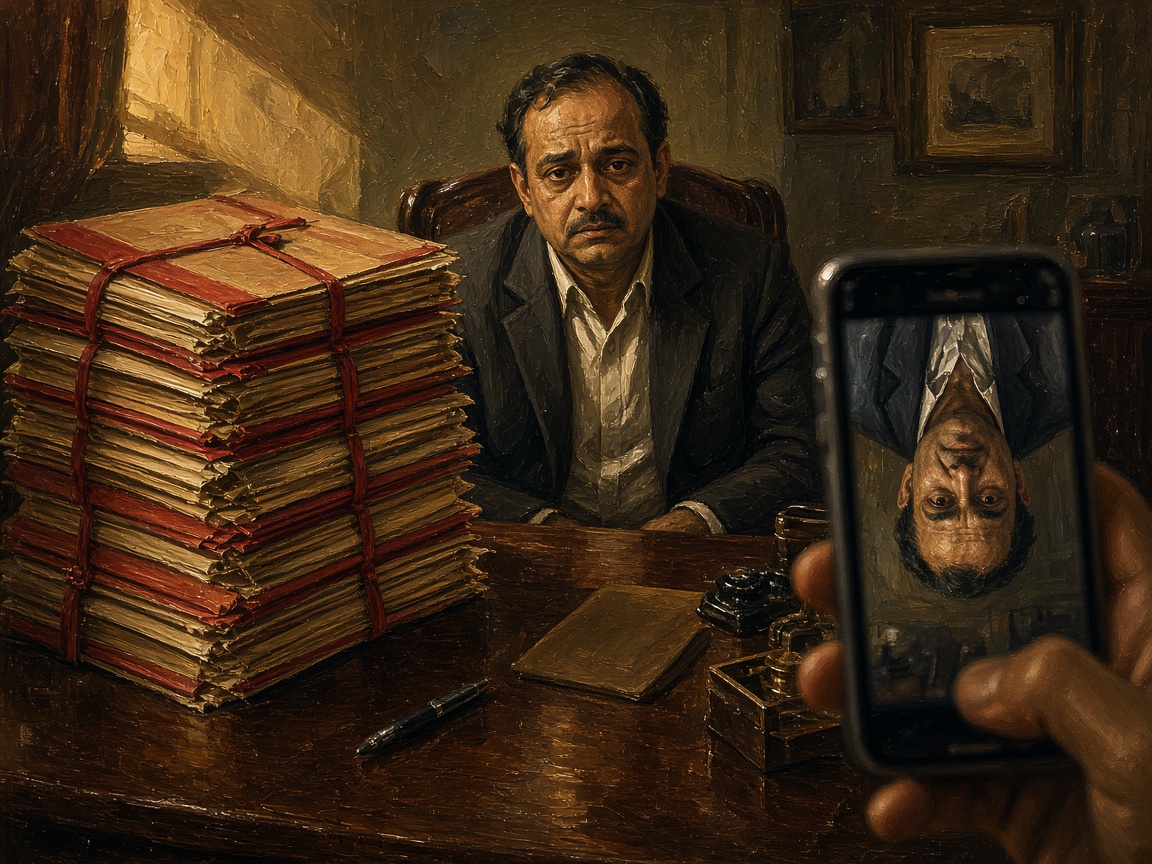
- When an arrogant District Collector slapped a citizen or confiscated a street vendor’s cart during a routine inspection, the incident historically vanished into the local ether. Today, a 30-second clip posted on X or Instagram bypasses district public relations officers, hits millions of views in two hours, and forces state chief ministers to issue immediate suspension orders before sundown.
- When government offices leave queues stagnant while clerks sit idle, citizens stream it live.
- The fear has fundamentally inverted. For 150 years, the citizen dreaded stepping into a government office. Today, the corrupt officer dreads the phone in the citizen’s pocket.
The smartphone took away the bureaucrat’s greatest weapon: the darkness of the administrative room. This is the same steel frame we named in Part 03 — only now the peon’s closed door no longer guarantees silence.
2. Live-streaming the bench: the demystification of the courtroom
Of all three arms of the state, the judiciary guarded its mystique with the most jealousy. Protected by the shield of Contempt of Court — the feudal silencer we traced in Part 07 — judges operated in an echo chamber where their every utterance, demeanor, and temperament were treated as sacred law.
Then came courtroom live-streaming and short-form video clips.

For the first time, millions of ordinary taxpaying citizens can watch High Court and Supreme Court proceedings on their screens:
- They watch how judges treat young lawyers and vernacular litigants.
- They see judges arriving late, scolding civil servants, or making off-the-cuff remarks on complex socio-economic realities they have never lived.
- When a bench makes an insensitive observation or grants an inexplicable adjournment in a high-profile case, the clip is clipped, subtitled, and scrutinized by millions across YouTube and Instagram within minutes.
The judiciary’s instinctive reaction was predictable: attempts to restrict unauthorized clipping, debates on regulating digital commentary, and warnings about “social media trials.” But the genie refuses to go back into the bottle.
When citizens can see justice being dispensed in real time, the colonial illusion of divine infallibility evaporates. The judge is finally seen for what they are: a public servant funded by citizen taxes, whose logic and productivity must withstand public reason — the same demand we made of the imperial courtroom in Part 05.
3. The end of monopolized narrative: politics without the middleman
For decades, the political class controlled the voter through controlled leaks, pliant newspaper editors, and managed television debates.
Social media shattered that editorial gatekeeping:
- A politician caught breaking traffic rules, demanding VIP protocol, or abusing airport staff can no longer rely on friends in media houses to bury the footage.
- Young voters — unswayed by legacy party loyalty or patronizing political rhetoric — demand real-time performance metrics on water supply, road quality, local jobs, and civic infrastructure.
- Promises made during election campaigns are clipped, archived, and played back directly against delivery deficits.
The political class must now govern in an era of zero latency. The old playbook of making an excuse in the assembly and waiting five years for the public to forget is dead. The digital archive remembers everything.
4. The threat vs. the opportunity: can the crowd break the cartel?
Those inside the iron triangle routinely cry foul. They argue that social media creates mob justice, spreads unverified outrage, and pressurizes institutional decision-making.
There is an element of truth to the danger of hysteria. But to mistake that friction for the core phenomenon is to miss the entire point: the establishment hates social media not because it spreads chaos, but because it breaks their monopoly on truth.
For seventy-five years, the executive, the judiciary, and the political class operated as an interwoven cartel:
- The executive delayed cases to protect bad policies.
- The judiciary protected the executive’s discretion in exchange for post-retirement perks.
- The politicians relied on the bureaucracy to extract and distribute patronage.
The citizen had no seat at the table.
Social media did not create this conflict; it simply handed a megaphone to the person who was previously locked outside the courthouse. By forcing all three institutions to react to viral public outrage, the digital street has achieved what dozens of judicial reform commissions and administrative reform committees failed to do: it made authority afraid of public scrutiny.
The evolution of power in the republic
| Dimension | Colonial & post-1947 | Managed media (1980–2010) | Digital age (today) |
|---|---|---|---|
| Information flow | One-way imperial decrees and gazettes. | Television & print; controlled by ad spend and access. | Decentralized, real-time, peer-to-peer citizen broadcast. |
| Bureaucratic armor | Absolute secrecy and red-tape files. | RTI requests that took months or years to surface. | The smartphone camera; instant viral exposure. |
| Judicial scrutiny | Contempt of Court silencer; zero public access. | Text-only law reporting by specialized legal beats. | Live-streamed court hearings dissected by Gen Z on social platforms. |
| Citizen status | Silent subject / petitioner (fariyadi). | A consumer of manufactured news. | Active auditor, broadcaster, and critic of the state. |
The real decolonization: from subjects to auditors
True decolonization was never going to come from the top down. The people who hold the keys to the bungalow, the gavel, and the ministerial secretariat will never willingly vote to dismantle their own privileges.
The real revolution is arriving from the bottom up — in the hands of a 22-year-old with a 5G connection and a camera phone.
When a society transitions from begging for accountability to documenting abuse in plain daylight, the psychology of the master and the subject is broken forever. The iron triangle of the politician, the bureaucrat, and the judge will resist, regulate, and complain about “the social media disease.”
Let them complain. For the first time in India’s modern history, the people are watching — and the rulers finally know it.
In this series
- Part 01
The Word That Robbed a Nation of Its Pride: Was 1857 a Revolt or Our First War of Independence? - Part 02
The Lingering Shadow: How Erasure of History Cemented White Supremacy, the BBC Gospel, and the Brown Sahib Monopoly - Part 03
The Steel Frame Remained: How IAS, IPS and IRS Inherited a Machine Built to Subjugate - Part 04
The Manufacturer as Criminal: How India Swapped British Plunder for the Babu’s Leash - Part 05
The Imperial Courtroom: How India’s Judiciary Kept the Master’s Gavel - Part 06
The Stolen Prime: How India’s Family Courts Sabotaged Their Own Promise - Part 07
The War for the Gavel: Why the State and the Judiciary Fight Over Control, Not Justice - Part 08 · You are here
The Citizen’s Camera: How Social Media Broke the Feudal Iron Triangle
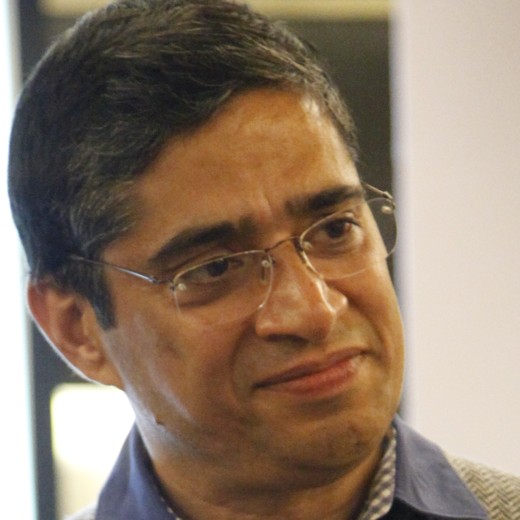
Kunwer Sachdev
Founder & MD, Su-Kam Power Systems (1988–2019) and Kunwwer.ai — writing on manufacturing, insolvency, and civilizational memory. Read his story →
Found this story worth sharing? Post it to your network — it takes one click: