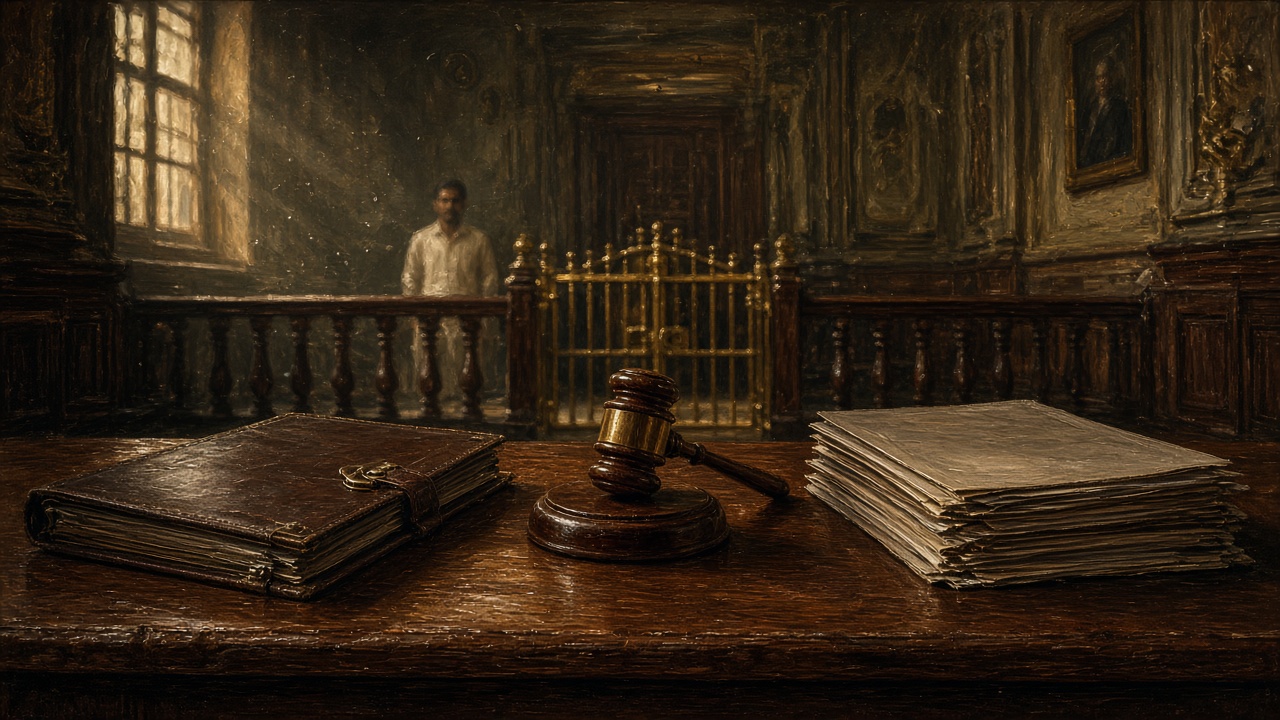
The War for the Gavel: Why the State and the Judiciary Fight Over Control, Not Justice
Whenever New Delhi erupts over Collegium files or NJAC, we are told it is a fight for the Constitution. Look closer: neither side is fighting to clear five crore cases. They are fighting over who holds the master’s gavel.
In Parts 05 and 06, we looked inside the courtroom: the imperial procedures, the broken promises, and the decades stolen from ordinary citizens. But why does this machine never get fixed? Because the two most powerful forces in New Delhi are too busy fighting over who gets to own it.
Whenever the headlines scream about an institutional crisis in New Delhi, the battlefield is almost always the same: the Executive versus the Judiciary.
We are told this is a titanic, principled war for the soul of the Constitution. The government argues for parliamentary supremacy and accountability; the higher judiciary defends its independence and the sanctity of the “basic structure.” High-voltage speeches are delivered in Parliament, biting counter-observations are made from the bench, and panel discussions unpack the latest stalemate over the National Judicial Appointments Commission (NJAC) or collegium files.
It sounds noble. It looks like democracy in action.
It is an elaborate diversion.
Neither side is fighting to make the courts swift, affordable, or accessible for the 1.4 billion citizens standing outside the gates. They are not fighting over why five crore cases are rotting in district and high courts, or why a bail hearing takes eight months, or why a commercial contract dispute outlives the business that signed it.
This is not a battle for justice. It is an unvarnished power struggle between two elite cartels fighting over who gets to hold the master’s gavel.
1. The weapon of silence: Contempt of Court and the feudal shield
Under the British Empire, the Crown’s judges were representatives of the monarch. To question their wisdom, their motives, or their sloth was considered sedition. To protect this aura of infallibility, the colonial state instituted the doctrine of Contempt of Court.
Independent India preserved this imperial weapon virtually untouched.
For decades, the Contempt of Courts Act has functioned as a silencer on the public conscience. While citizens can openly criticize the Prime Minister, question Parliament, or mock political parties, the moment anyone raises uncomfortable truths about judicial corruption, family patronage in promotions, or endless delays, the threat of contempt is wielded like a feudal stick. It created an enforced silence: no citizen, journalist, or lawyer dared to speak against the judiciary for fear of arbitrary punishment.
Yet a historic crack has appeared in this imperial facade.

For the first time in Indian history, the younger generation — Gen Z — refused to play by the rules of deferential silence. Unburdened by post-colonial awe, armed with digital transparency, and questioning every legacy institution, young citizens began openly calling out judicial delays, arcane rituals, and systemic hypocrisy across public forums.
This is a cultural and psychological break. Earlier generations were paralyzed by the colonial fear of Contempt of Court. Digital-native youth have broken that deferential spell. Instead of reflexively unleashing contempt notices to crush this vocal discontent, the higher judiciary has had to pause — taking note of emerging public scrutiny with uncharacteristic dignity and restraint rather than knee-jerk punitive contempt. The era of ruling through fear and royal insulation is running out of road.
2. The investor’s nightmare: why global capital fears the Indian gavel
India talks endlessly about becoming a global manufacturing powerhouse, pitching itself as the primary alternative to China. Delegations travel to Davos, London, and New York inviting billions in foreign direct investment (FDI).
Yet institutional investors from the developed world hit an impenetrable wall the moment they look at our legal architecture: the complete unpredictability of the Indian court system.

In mature industrial economies — Singapore, the UK, Germany, the US — contract enforcement is sacred. A commercial dispute is heard under fixed, fast-track rules. Verdicts arrive in months, governed by clear precedent. A foreign investor knows that local political connections will not bend the law.
In India, the courtroom is a wild card. Proceedings are subject to sudden interim stays, endless procedural detours, and bench-dependent whims. The open secret: an unprincipled domestic partner with deep local connections and high-fee senior advocates can tie up a dispute in litigation for twenty years.
When an Indian court can stay an arbitration award indefinitely, rewrite contracts, or drag a routine corporate disagreement into a generational war of attrition, foreign capital hesitates. Global corporations will not commit billions in high-tech manufacturing, semiconductor fabs, or long-term infrastructure if their legal remedies depend on an opaque system that can be gamed, managed, or stalled indefinitely by someone with local clout.
3. The biggest litigant in the country: the state itself
To understand why neither the political class nor the judiciary actually wants deep structural reform, look at a staggering, inconvenient reality:
The Government of India and the state governments are responsible for over 50% of all pending litigation in the country.
The state is not a neutral umpire. The state is the chronic, serial harasser of its own people in court.
- If a retired schoolteacher wins a pension dispute at the tribunal, a government law officer files an appeal in the High Court.
- If the High Court dismisses the appeal with costs, the department files a Special Leave Petition (SLP) in the Supreme Court.
- Why? Because spending public tax money on government advocates costs a bureaucrat nothing, while conceding an error requires courage. The easiest move is to keep the citizen trapped in court until the petitioner simply dies.
The political executive does not want a hyper-efficient judiciary with strict 90-day disposal deadlines. A sluggish court is the executive’s greatest shield.
As long as courts take twenty years to decide an illegal land acquisition, a wrongful tax demand, or an arbitrary administrative order, the state wins by default. Delay is not an administrative failure for the government — it is an active instrument of governance against its own citizens.
4. What the fight is actually about: control, not service
If the debate between the government and the judiciary were truly about fixing the system for the people, the agenda would include mandatory disposal timelines, personal penalties on departments for frivolous appeals, ending the British-era vacation calendar, mother-tongue proceedings, and transparent performance audits for judges.
None of these items ever make it onto the negotiating table.
Instead, the entire institutional war boils down to a single turf battle: Who gets to appoint the judges?
- The Judiciary’s position: Sitting judges want to preserve the opaque, closed-door Collegium System — a self-perpetuating club where senior judges appoint their brethren, former juniors, and legal dynasties without public criteria, minutes, or objective merit scoring. They call this “judicial independence”; in practice it is judicial insulation from accountability. The constitutional architecture of Articles 124 and 217 becomes a shield for guild privilege rather than a charter for citizen justice.
- The Political class’s position: The political masters do not want a transparent, citizen-centric appointments system either. They want a decisive seat at the table — via NJAC-style leverage or Union Law Ministry gatekeeping — so they can veto inconvenient judges, ensure pliant benches for critical political and regulatory disputes, and reward loyal legal luminaries with post-retirement tribunals, governorships, and Rajya Sabha seats.
It is a classic turf war between the ruler who wants loyal umpires and the guild of umpires who want to remain accountable to no one. The citizen in the gallery is completely irrelevant to both.
5. The unspoken collusion: quid pro quo behind the rhetoric
Despite the public sparring, the political class and the higher judiciary maintain a convenient, symbiotic ecosystem that protects each other’s privileges:
- Post-retirement patronage: The day a Supreme Court or High Court judge retires at 62 or 65, dozens of government-funded tribunals, inquiry commissions, and regulatory chairmanships open their doors. A judge who spends their final years delivering stinging rebukes to the government knows exactly which executive desk signs the order for their next bungalow and car.
- Mutual non-interference in privilege: Parliament will never pass a law holding judges legally and financially accountable for sitting on judgments for years without delivering orders. In return, the courts routinely defer to the executive on sprawling policy failures, preventive detention powers, and the unchecked discretion of the bureaucracy.
- The legal industry lobby: A massive percentage of senior politicians across party lines are themselves senior advocates. They return to the Supreme Court corridors the moment their party loses power. Why would a lawyer-politician ever reform an adversarial system that charges ₹15 to ₹25 lakhs for a five-minute mention? The longer the case lasts, the richer the legal-political class becomes.
6. What real structural reform for the common man looks like
If an independent republic actually wanted to decolonize this courtroom theatre and build a system that works for the citizen and the economy, the roadmap is clear:
A. Disarm the state’s litigation machine
Enact a strict, legally binding National Litigation Policy. If a government department loses at a lower court or tribunal on a settled matter of law, an appeal to a higher court must require personal sign-off from a senior secretary — and if the appeal is found frivolous, the litigation costs must be deducted directly from the bureaucrat’s salary, not the public treasury.
B. Independent, public judicial appointments
Scrap both the secret Collegium and the executive-dominated veto. Replace them with an open, publicly televised Judicial Appointments Commission (modeled on mature democracies like the UK), where candidates are cross-examined on their disposal track records, jurisprudential depth, and ethical standing before an independent panel including jurists, civic leaders, and lay citizens.
C. Case disposal as a mandatory KPI
Judicial promotion cannot be an automatic escalator of age and seniority. A judge’s elevation to the High Court or Supreme Court must be tied to audited metrics: How many trials did they conclude? What was their average docket age? How many times did they grant adjournments without cause? If a judge cannot manage a docket efficiently, they should not be elevated.
D. Predictable commercial courts for investment security
Separate commercial dispute resolution from general civil litigation completely. Commercial cases must have ironclad statutory deadlines — no adjournments beyond exceptional circumstances, binding arbitration enforcement within 90 days, and heavy penalties on parties attempting to use local leverage to stall global contracts.
Breaking the elite compact
For decades, the Indian citizen has been cast as an innocent bystander watching a manufactured drama between the courtroom and the ministry.
The political class claims it wants to democratize the bench, but really wants obedient judges to shield its misgovernance. The judiciary claims it is defending democracy, but is fiercely guarding its guild privileges against any form of public scrutiny.
Both claim to speak for the Constitution. Neither is speaking for the citizen whose life savings are wiped out waiting thirty years for a verdict, nor for the economic future of a nation whose growth is choked by legal unpredictability.
Decolonization will not happen by letting the executive cage the judiciary, nor by letting the judiciary remain an unaccountable aristocracy shielded by contempt laws. It will happen only when the system is stripped of its imperial majesty and forced to answer a simple democratic standard: Does it deliver justice to the ordinary citizen on time, or does it exist merely to perpetuate itself?
Until that question is forced onto the national conscience, the fight between the government and the judiciary is not our fight. It is merely two landlords arguing over the deed to our courthouse.
In this series
- Part 01
The Word That Robbed a Nation of Its Pride: Was 1857 a Revolt or Our First War of Independence? - Part 02
The Lingering Shadow: How Erasure of History Cemented White Supremacy, the BBC Gospel, and the Brown Sahib Monopoly - Part 03
The Steel Frame Remained: How IAS, IPS and IRS Inherited a Machine Built to Subjugate - Part 04
The Manufacturer as Criminal: How India Swapped British Plunder for the Babu’s Leash - Part 05
The Imperial Courtroom: How India’s Judiciary Kept the Master’s Gavel - Part 06
The Stolen Prime: How India’s Family Courts Sabotaged Their Own Promise - Part 07 · You are here
The War for the Gavel: Why the State and the Judiciary Fight Over Control, Not Justice - Part 08
The Citizen’s Camera: How Social Media Broke the Feudal Iron Triangle

Kunwer Sachdev
Founder & MD, Su-Kam Power Systems (1988–2019) and Kunwwer.ai — writing on manufacturing, insolvency, and civilizational memory. Read his story →
Found this story worth sharing? Post it to your network — it takes one click: