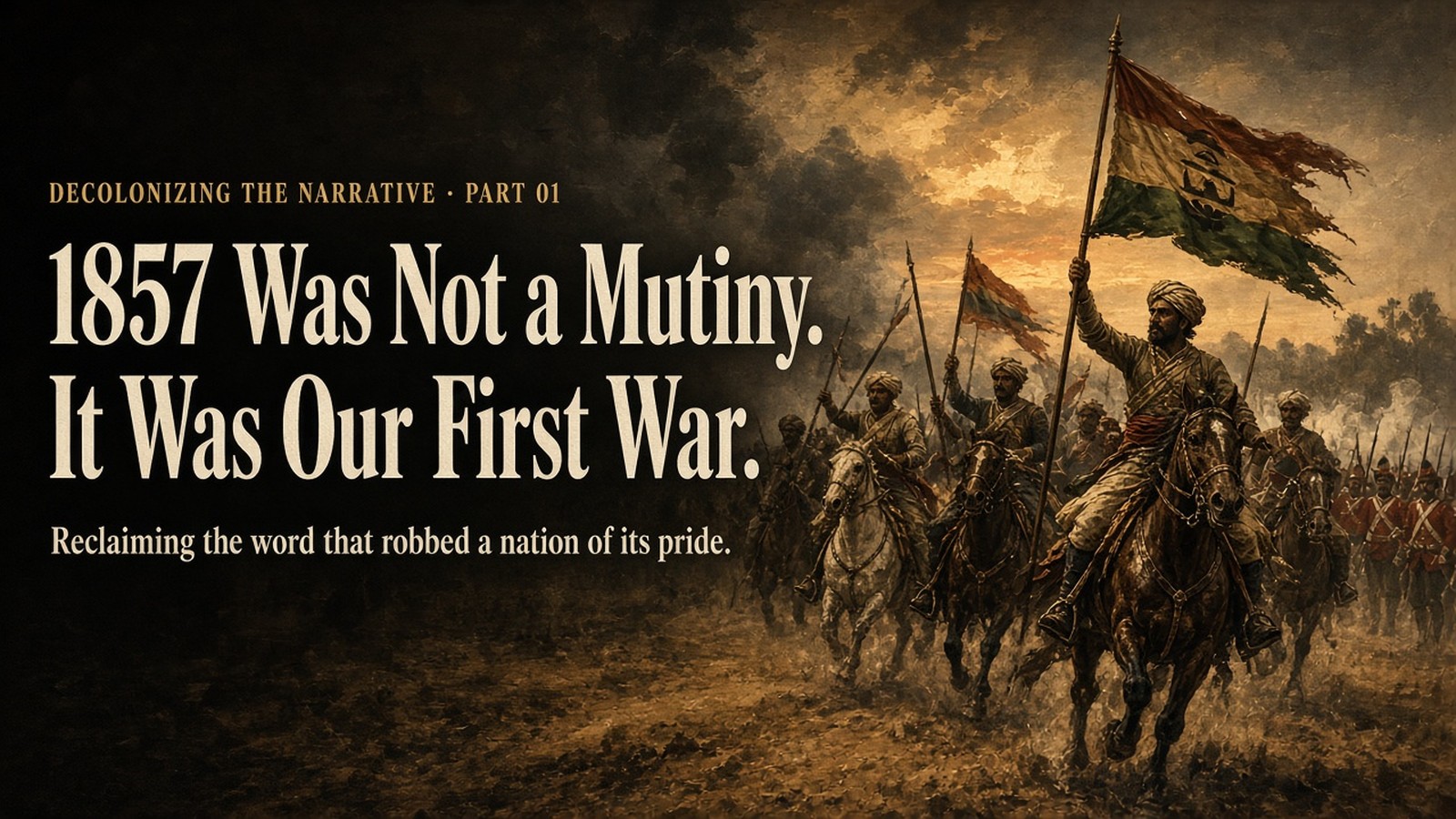
The Word That Robbed a Nation of Its Pride: Was 1857 a Revolt or Our First War of Independence?
When you teach a child that their great-grandparents were “rebels,” you teach them that their conquerors were the rightful masters.
Words are not harmless academic labels. They are mirrors. When a nation looks into the mirror of its school textbooks, it either sees the spine of an unbroken people or the bowed head of a punished subject.
For generations after 1947, Indian schoolchildren opened their history books to find the titanic events of 1857 stamped with a cold, colonial label: “The Sepoy Mutiny” or “The Revolt of 1857.”
Pause and think about what that word quietly does to the soul of a country.
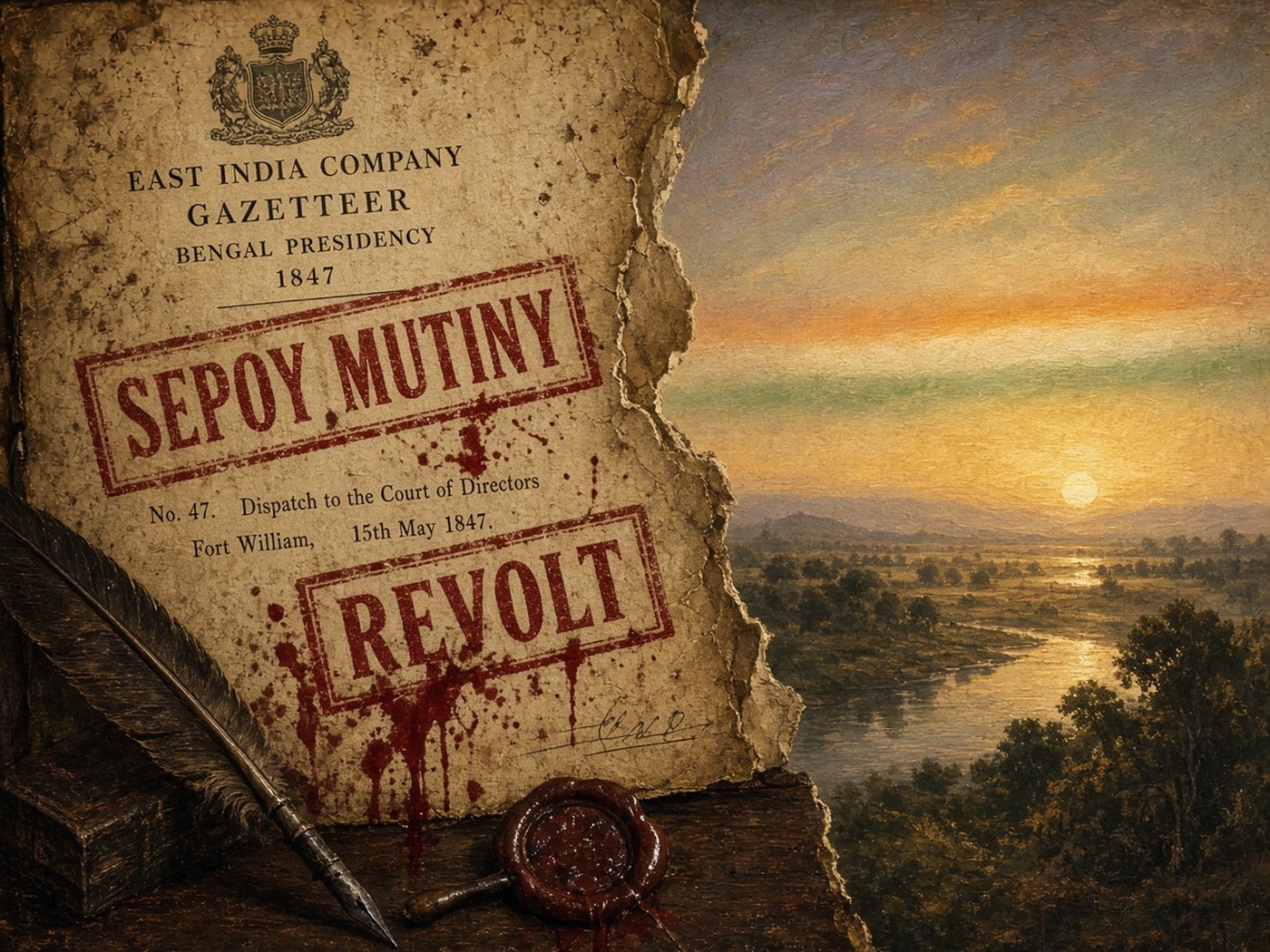
A mutiny is indiscipline. A revolt is what lawbreakers do against lawful authority. A riot. A failure of order. When we accepted that word, we subconsciously conceded the British East India Company’s greatest lie: that a foreign, predatory merchant corporation was the lawful government of our motherland, and that the men and women who bled to tear down its flag were mere lawless traitors.
How does a sovereign republic let foreign colonial bureaucrats name the martyrs who died to make it free?
The human reality: what really happened in 1857
The British told us it was all about greased cartridges — pig and cow fat — as if millions of people laid down their lives over rifle grease. That was imperial condescension at work, reducing an entire civilization’s longing for freedom to superstitious hysteria.
Look at the faces and the blood behind the ink:
- Mangal Pandey did not act out of madness; he acted out of a soldier’s shattered dignity when asked to serve an empire that held his people in utter contempt.
- Rani Lakshmibai of Jhansi rode out not to defend personal luxury, but because she refused to surrender her motherland to Dalhousie’s pen and paper. When she fought through British bayonets, she was a mother, a ruler, and a warrior fighting for the sovereign soul of her soil.
- Veer Kunwar Singh, an 80-year-old landlord from Jagdishpur, Bihar, who severed his own bullet-shattered arm with a sword and offered it to the sacred Ganga before charging back into battle against British forces.
- The peasantry and weavers of Awadh and Rohilkhand, whose names are lost to time, who were hanged from roadside banyan trees by the thousands without trial under Brigadier General Neill’s scorched-earth vengeance.
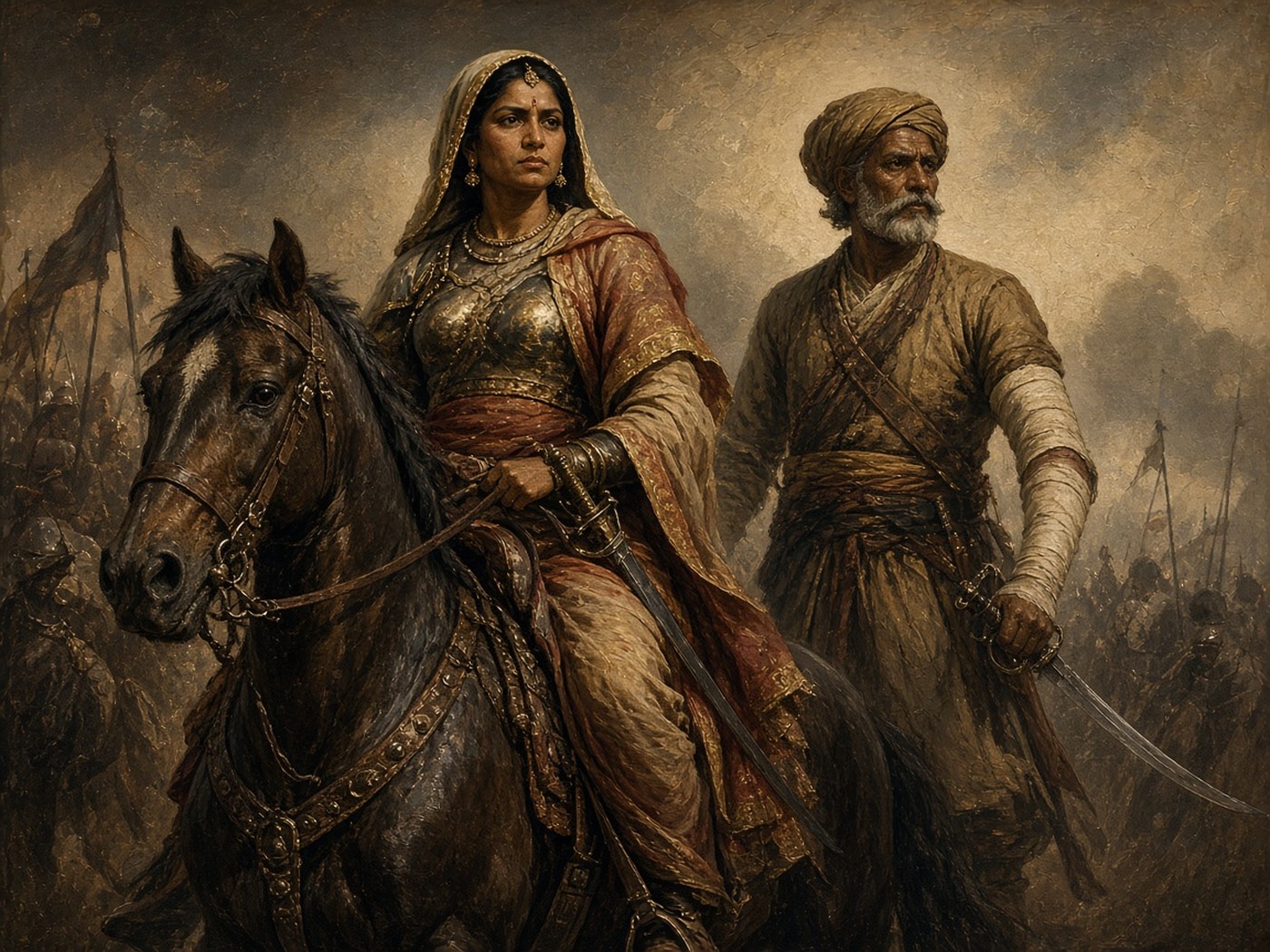
This was not a petty barracks skirmish. It was a massive, desperate, civilizational roar for Swadharma and Swaraj. It was our First War of Independence.
Yet, when independence arrived, instead of anointing these martyrs as the founding fire of our sovereignty, our official history committees hid behind academic pedantry. They argued that because 1857 had no modern constitution or democratic voting system, it was merely “feudal” and “reactive” — not a true freedom struggle.
In trying to sound intellectually sophisticated to the Western world, we stripped our own ancestors of their dignity.
How nations are built on historical pride: two contrasting lessons
Pride in history is not vanity. It is the invisible psychological concrete that holds a society together when storms hit. If your history tells you that you are weak, divided, and born to be ruled, you stay fragile. If your history tells you that your people have endured fire and built greatness, you become unshakeable.
Look across Asia to see how other nations understood this truth.
1. China: turning wounds into an unyielding shield
China suffered colonial semi-subjugation following the British Opium Wars. The British burned their summer palaces, forced opium into their cities, and carved out treaty ports.
When the modern Chinese state was forged, it did not negotiate with British terminology.
- Events the West described as “punitive expeditions” or “righteous interventions” were branded as naked imperial piracy.
- The entire era from the 1840s to 1949 was codified into the school curriculum as the “Century of National Humiliation” (bainian guochi).
- Chinese children were taught: Look at what happens when our civilization weakens and divides. Never again.
China used the memory of anti-colonial resistance — not as a dry footnote — but as emotional fuel for national unity and technological obsession. They turned their historical pain into a fierce civilizational backbone.
2. Singapore: forging shared pride from zero
If China is an ancient giant, Singapore was the opposite: an accidental nation born in 1965, abruptly separated from Malaysia, poor, resource-less, and deeply divided along Chinese, Malay, and Indian ethnic fault lines.
Colonial records depicted Singapore simply as a sleepy fishing village founded purely by the British administrator Sir Stamford Raffles in 1819.
Lee Kuan Yew and Singapore’s founding leaders realized a stark truth: a tiny city-state with no natural resources would collapse if its children felt no shared pride or common destiny.
- Dismantling colonial superiority: While Singapore pragmatically preserved English for global commerce and kept British legal systems, it radically reframed how its history was taught.
- The “Singapore Story”: Through national education, the trauma of the 1942 British collapse — when colonial forces surrendered Singapore to the Japanese without protecting the native population — was taught as an unvarnished lesson in self-reliance: No foreign empire will ever protect you.
- Equitable civic honor: History was written to elevate the sweat, resilience, and survival of coolies, dockworkers, and native migrants who survived the occupation, creating a relentless national pride that turned a third-world port into a first-world powerhouse in a single generation.
Singapore proved that a nation doesn’t even need centuries of shared past to build pride. It just needs the courage to tell its people: You are the masters of your fate.
The verdict on 1857
| What the British taught us | What sovereign India must acknowledge |
|---|---|
| “The Sepoy Mutiny” — An internal military revolt sparked by greased cartridges. | The First War of Independence — A collective civilizational uprising of soldiers, royalty, and peasantry against foreign extraction. |
| “Law and Order Restored” — The legitimate sovereign reasserting control. | Colonial Brutality — Wholesale massacres of innocent villages across northern and central India to preserve company profits. |
| “Rebels and Insurgents” | Martyrs and Freedom Fighters |
When you rob people of the pride of their martyrs, you leave them mentally colonized long after the foreign flags have been lowered.
1857 was not a revolt against legitimate authority. It was the moment India found its collective soul and fought back against an occupying force. The men and women who died in that sacred fire were not mutineers breaking the law; they were the first patriots who gave their lives so that the idea of a free India could never be erased.
It is time our textbooks, our language, and our national conscience called them by their true name.
This essay opens Decolonizing the Narrative — a series on reclaiming Indian history from the colonial lens.
In this series
- Part 01 · You are here
The Word That Robbed a Nation of Its Pride: Was 1857 a Revolt or Our First War of Independence? - Part 02
The Lingering Shadow: How Erasure of History Cemented White Supremacy, the BBC Gospel, and the Brown Sahib Monopoly - Part 03
The Steel Frame Remained: How IAS, IPS and IRS Inherited a Machine Built to Subjugate - Part 04
The Manufacturer as Criminal: How India Swapped British Plunder for the Babu’s Leash - Part 05
The Imperial Courtroom: How India’s Judiciary Kept the Master’s Gavel - Part 06
The Stolen Prime: How India’s Family Courts Sabotaged Their Own Promise - Part 07
The War for the Gavel: Why the State and the Judiciary Fight Over Control, Not Justice - Part 08
The Citizen’s Camera: How Social Media Broke the Feudal Iron Triangle

Kunwer Sachdev
Founder & MD, Su-Kam Power Systems (1988–2019) and Kunwwer.ai — writing on manufacturing, insolvency, and civilizational memory. Read his story →
Found this story worth sharing? Post it to your network — it takes one click: