The Imperial Courtroom: How India’s Judiciary Kept the Master’s Gavel
In a country where 5 crore cases clog the judicial pipeline, an ordinary citizen spends a lifetime chasing a verdict. How did the justice system of an independent republic end up treating its own citizens like colonial supplicants?
Land disputes outlive the grandfathers who filed them. Undertrials languish in prisons for years for petty thefts because they cannot afford bail, while high-powered corporate syndicates and political power-brokers secure midnight hearings and emergency injunctions within hours.
The answer lies in the founding compromise of 1947.
When the British departed, our political leadership was overwhelmingly dominated by men trained in British law. Jawaharlal Nehru was a barrister from Inner Temple; Sardar Vallabhbhai Patel was called to the Bar at Middle Temple; Dr. B.R. Ambedkar was a barrister from Gray’s Inn. They were master legal minds, but they were products of the English Inns of Court.
Instead of restructuring the judiciary to serve a vast, vernacular, impoverished population, independent India preserved the colonial courtroom as a sacred temple of imperial procedure. We kept the black gowns, the summer vacations designed for British judges escaping the tropical heat, the prohibitive English language, and worst of all, the colonial double standard: urgent justice for the ruler, indefinite delay for the ruled.
1. The two-speed court: emergency for the elite, tareekh-pe-tareekh for the citizen
During the British Raj, the legal system existed to protect the Crown’s officers, commercial interests, and imperial revenue.
- If a white planter, district collector, or British merchant faced legal trouble, courts moved with military speed.
- If a native farmer had his land seized under an extortionate revenue demand, the file was buried under arcane legal procedure. The native was meant to exhaust his resources, lose his nerve, and give up.
Independent India never dismantled this two-track reality. It merely changed who gets to cut the line.
Today, the wealthy industrialist, the senior politician, and the influential lobbyist have replaced the white colonial officer. Senior advocates charging tens of lakhs of rupees per hearing can move the highest courts at 2:00 AM, secure urgent listings, and obtain immediate stays.
Meanwhile, the farmer whose field was encroached, the small business owner whose payments were frozen, or the widow seeking her pension enters an endless labyrinth of adjournments (tareekh-pe-tareekh). The message delivered by the system is unmistakable: the court’s time belongs to those with authority; the common man must wait outside in the dust.
1b. When murder walks free: the goonda learns to rule
Delayed justice is not a clerical inconvenience. It is a training school for crime.
When a murderer walks scot-free — or walks out on bail while the case crawls for years — the message to every street tough is simple: the system can be waited out, worn down, and bought with fear. Witnesses are the spine of Indian criminal trials. Threaten them, buy them, make them vanish from the village, and the case collapses. A judiciary that depends on unprotected witnesses while adjournments stretch into decades does not deliver justice. It delivers delay as a weapon.
Once the goonda understands this machine, he does not become careful. He becomes bold. Petty intimidation grows into larger crimes. Each bail order, each postponed hearing, each hostile witness teaches him that violence is cheaper than obedience. At the end of that education, he learns the final lesson of unreformed colonial justice: the safest protection is not hiding from the law — it is entering politics, capturing patronage, and ruling from inside the system that failed to convict him.
This is how delayed courts manufacture political masters out of criminals. The imperial courtroom was built to exhaust the native. Today it exhausts the complainant — and elevates the man who can threaten the witness list.
2. What Britain built at home — and what it left us
Just as Britain reserved Sir Robert Peel’s unarmed, consensual policing for itself while inflicting the coercive Police Act of 1861 on India, it did the exact same thing with justice.
Inside the UK, the system was designed around strict case management, heavy cost penalties for frivolous delay, an independent appointments commission, and magistrates drawn from local communities. For India, the British built an adversarial, slow-grinding machine of intimidation — and after 1947, our lawyer-dominated leadership kept the colonial theatre intact.
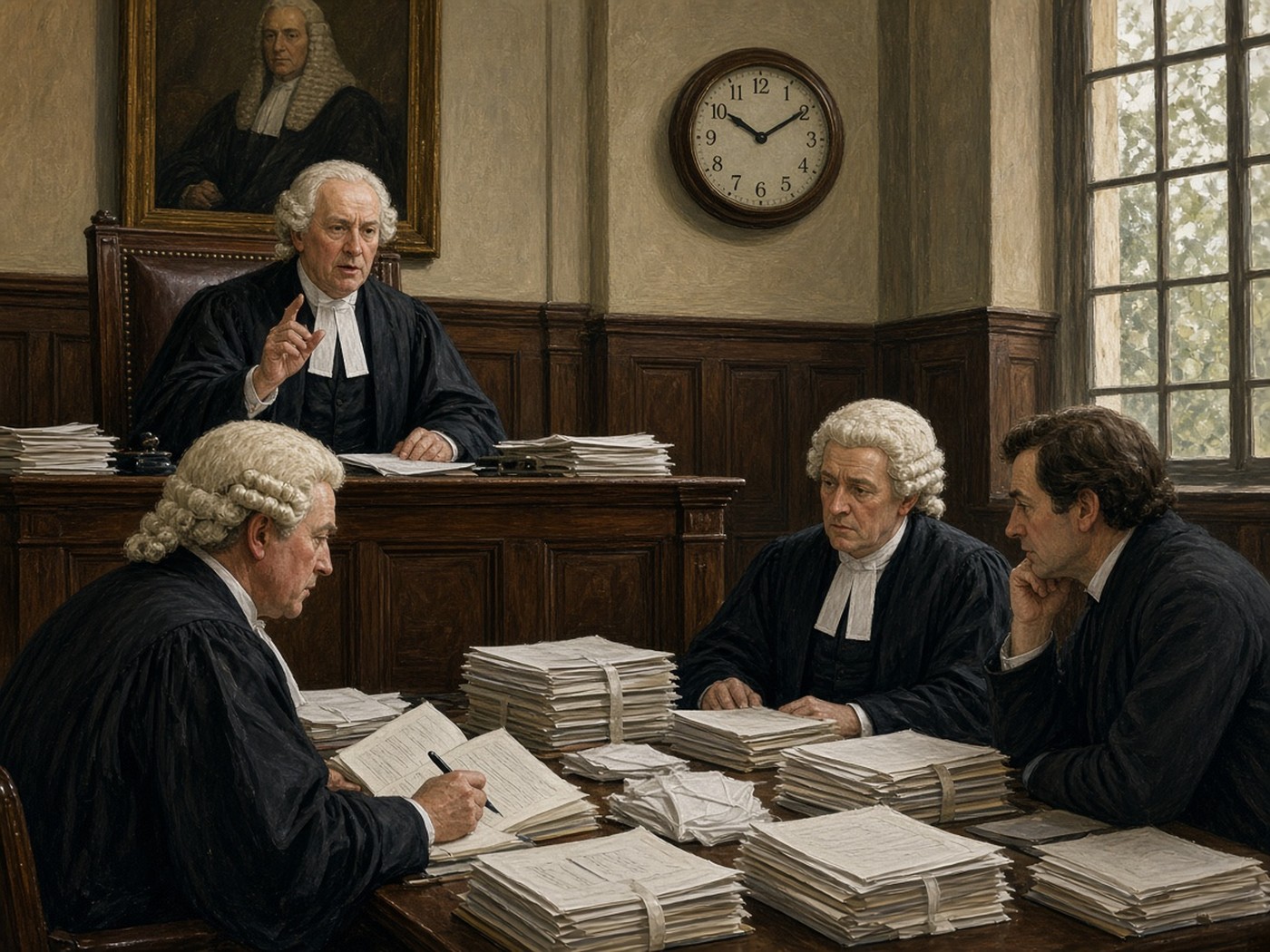
- Strict case management vs. endless adjournments: In England and Wales, under the Civil Procedure Rules (CPR), the judge actively controls the timetable. Lawyers cannot casually demand adjournments; frivolous delay attracts punitive costs. In India, tareekh-pe-tareekh is a livelihood.
- Transparent appointments vs. Collegium secrecy: The UK abolished backroom judicial appointments in 2005, creating the Judicial Appointments Commission (JAC) — including non-lawyers and lay citizens — to assess competence openly. India remains the rare major democracy where judges appoint judges behind closed doors through an unaccountable Collegium.
- Local citizen justice vs. distant priesthood: In Britain, most criminal cases are decided swiftly by Magistrates (Justices of the Peace) — ordinary, respected citizens embedded in their communities. India concentrated justice in a distant, expensive, English-speaking clerical pyramid.
3. The vacation farce in a nation of 5 crore pending cases
Nothing illustrates the lingering colonial hangover more plainly than the judicial calendar.
Under the Raj, English judges could not bear the scorching heat of May and June in the plains of Delhi, Calcutta, or Allahabad. The courts shut down for extended “summer vacations” so judges could retreat to Shimla, Darjeeling, or sail home to England. They took long winter breaks around Christmas.
Independent India air-conditioned the courtrooms, but kept the colonial vacations intact.
While ordinary government offices, hospitals, private factories, and small businesses operate 300+ days a year, the Supreme Court functions for barely 190 to 200 days. In a country drowning under an existential judicial backlog, closing constitutional courts for weeks of summer break is an institutional insult to every citizen waiting for justice.
4. Absolute power, zero metrics: the Collegium closed shop
In any functioning modern democracy, public institutions are evaluated on performance, output, and transparent criteria. In private enterprise, an executive is measured by delivery. Abroad, judicial appointments increasingly face open commissions, public criteria, or confirmation processes.
In the Indian higher judiciary, there are no objective performance metrics.
- No judgement audits: A judge’s career is never formally evaluated on the quality, constitutional clarity, or societal impact of their past rulings.
- No disposal standards: How many cases did a judge resolve? How many trials stalled under endless adjournments on their watch? No standard metric determines elevation from district bench to High Court, or High Court to Supreme Court.
- The Collegium paradox: Sitting judges appoint other judges behind closed doors — a self-perpetuating mechanism with no public record of deliberations, where uncle-nephew networks and dynasty-heavy legal lineages can thrive.
A judge can sit on the bench for years, adjourn thousands of urgent citizen petitions, write a handful of verbose judgments, and still be elevated simply because of seniority and judicial patronage.
5. Language as an instrument of subjugation
In the United Kingdom, justice is delivered in the mother tongue of the litigant. In Germany, France, or Japan, courts operate in the language spoken on the street.
In India, High Courts and the Supreme Court operate almost exclusively in English.
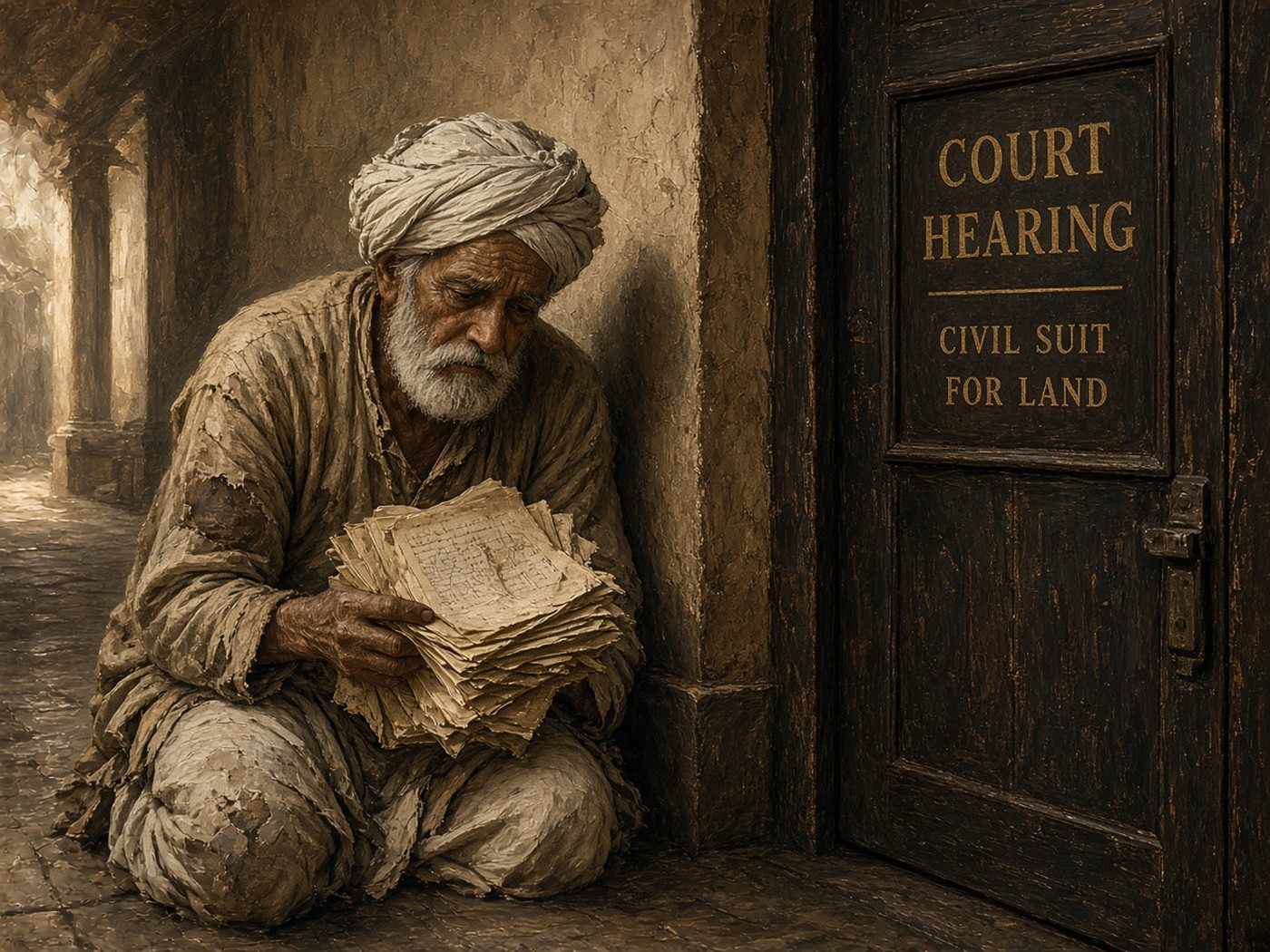
When an Indian citizen stands before a judge, the arguments about their land, their liberty, or their family are conducted in a foreign language they cannot comprehend. The lawyers speak in convoluted Victorian legalese, the judge dictates in English, and the client sits silently like a bewildered spectator at their own trial.
This is not a technical necessity; it is a colonial instrument of intimidation. It ensures that the citizen never feels like a sovereign participant in the justice system.
The colonial court vs. a democratic judiciary
| Dimension | Imperial court (British Raj) | Unreformed Indian judiciary today | A true sovereign republic |
|---|---|---|---|
| Whom it serves first | The Crown and colonial officers. | The ultra-wealthy, politicians, and the powerful. | The ordinary citizen, on equal footing. |
| Pace | Swift for the master; indefinite for the native. | Midnight emergency for elites; decades of adjournments for the public. | Fixed statutory timelines; time-bound trials. |
| Accountability | Loyalty to the Crown. | No output audits; Collegium / seniority. | Performance audits; objective evaluation (as JAC-style openness demands). |
| Language | English to maintain distance. | English in higher courts; archaic legalese. | Regional languages at all levels. |
| Calendar | Summer breaks to escape heat. | Lengthy vacations despite 5 crore backlog. | Year-round shifts like vital public services. |
Reclaiming the halls of justice
A nation where justice takes thirty years is not a nation ruled by law; it is a nation ruled by judicial attrition.
Decolonization cannot stop at changing colonial criminal codes or renaming streets. It demands taking the master’s gavel out of the courtroom:
- Abolishing the closed-door Collegium in favour of an open, transparent, merit-based national judicial commission with clear performance metrics — closer to the JAC principle Britain adopted for itself.
- Ending the colonial vacation calendar and operating courts with shift rosters so judicial machinery runs 365 days a year.
- Democratizing court language, ensuring every High Court conducts hearings and issues orders in the regional language of the state.
- Instituting strict statutory limits on adjournments, making elevation contingent on case disposal and docket clearance — the opposite of colonial tareekh-pe-tareekh.
When our freedom fighters became rulers, they respected the English courtroom too much to dismantle it. Eighty years later, the ordinary Indian is still paying the price for that reverence. It is time the court ceased to be an imperial bastion and became what the Constitution promised: the people’s house of justice.
In this series
- Part 01
The Word That Robbed a Nation of Its Pride: Was 1857 a Revolt or Our First War of Independence? - Part 02
The Lingering Shadow: How Erasure of History Cemented White Supremacy, the BBC Gospel, and the Brown Sahib Monopoly - Part 03
The Steel Frame Remained: How IAS, IPS and IRS Inherited a Machine Built to Subjugate - Part 04
The Manufacturer as Criminal: How India Swapped British Plunder for the Babu’s Leash - Part 05 · You are here
The Imperial Courtroom: How India’s Judiciary Kept the Master’s Gavel - Part 06
The Stolen Prime: How India’s Family Courts Sabotaged Their Own Promise - Part 07
The War for the Gavel: Why the State and the Judiciary Fight Over Control, Not Justice - Part 08
The Citizen’s Camera: How Social Media Broke the Feudal Iron Triangle

Kunwer Sachdev
Founder & MD, Su-Kam Power Systems (1988–2019) and Kunwwer.ai — writing on manufacturing, insolvency, and civilizational memory. Read his story →
Found this story worth sharing? Post it to your network — it takes one click: