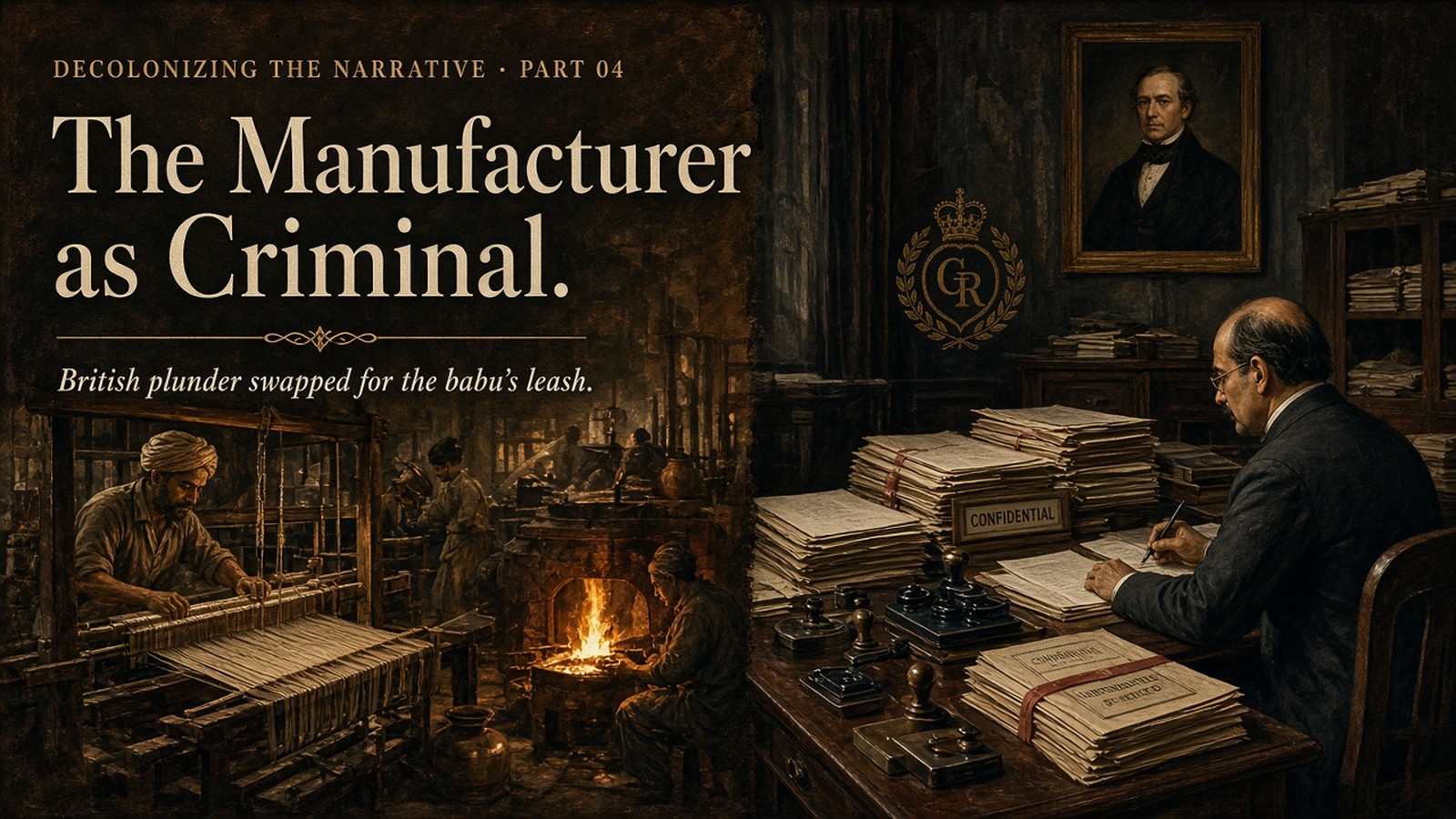
The Manufacturer as Criminal: How India Swapped British Plunder for the Babu’s Leash
When a civilization forgets how to honour the hand that makes, it does not become virtuous. It becomes a nation of petitioners.
India once clothed the world, poured bronze into living form, forged steel that travellers wrote about with envy, and sent ships across oceans with Indian cloth in their holds. That was not folklore. That was industrial memory. Then came a long schooling in inferiority: smash the loom, tax the artisan into silence, and raise a new hero — the clerk who kept the conqueror’s books.
The tragedy did not end in 1947. We lowered a flag and kept a psychology. We made the Sarkari Babu the moral centre of the republic, and the manufacturer — the man or woman who risks capital, hires workers, and turns metal into machines — into a permanent suspect.
1. The stolen pride of making things
Walk into an ordinary middle-class home when results come out.
A son or daughter clears a tier-3 government clerk exam — a stamp, a file, a chair under a fan — and the house fills with laddoos. Relatives phone. Neighbours congratulate. The child is “settled.” Safe. Respectable. The family’s honour has been redeemed by a government pay scale.
Now watch the same house when another child says: I want to put money into a lathe workshop. I want to make parts. I want to build.
Suddenly the tone changes. Warnings arrive dressed as love. You will ruin your life. Business is dirty. Officers will eat you alive. Better sit for another exam.
That is not parental caution alone. That is civilizational conditioning. We celebrate the rubber stamp and dread the factory gate. We distribute sweets for the clerk and suspicion for the builder. A nation that treats manufacturing as a fall from grace has already accepted the colonizer’s ranking of human worth: paper above production, permission above creation.
2. The colonial crime: smashed looms and the factory of clerks
The British did not merely collect tax. They broke the artisan’s spine.
India’s textile and craft economies were not “primitive cottage hobbies.” They were competitive manufacturing. The imperial response was systematic: tariffs that favoured Manchester, policies that hollowed Indian industry, and an education doctrine that produced interpreters, not inventors.
Macaulay’s project was never to raise industrial visionaries who could outbuild Birmingham. It was to manufacture a class Indian in blood, English in taste — fluent enough to administer extraction, never confident enough to replace the metropole’s workshops. The clerk became the model graduate. The loom became nostalgia. The factory floor became someone else’s destiny.
When we call this “modernisation,” we lie to ourselves. It was deindustrialisation with a Latin motto and a competitive exam.
3. The global mirror: how broken nations crowned the builder
In 1945, Germany and Japan were rubble. Cities burned. Industry shattered. Occupying armies on their soil.
They did not rebuild national dignity by worshipping the file. They rebuilt it on the shop floor.
Germany’s Mittelstand — the family manufacturers who make the world’s hidden machine parts — became a backbone of sovereignty. Japan’s Monozukuri — the pride of making things superbly — turned precision into patriotism. Engines, cameras, steel, electronics: not shameful commerce, but the recovery of self-respect after humiliation.
Singapore, smaller and poorer at birth, understood survival without romance. Lee Kuan Yew’s state did not treat the factory investor as a thief to be interrogated first. It rolled out the red carpet for manufacturing and enterprise because a tiny island that cannot make or attract will starve. The manufacturer was a partner in national life, not a defendant in a permanent economic trial.
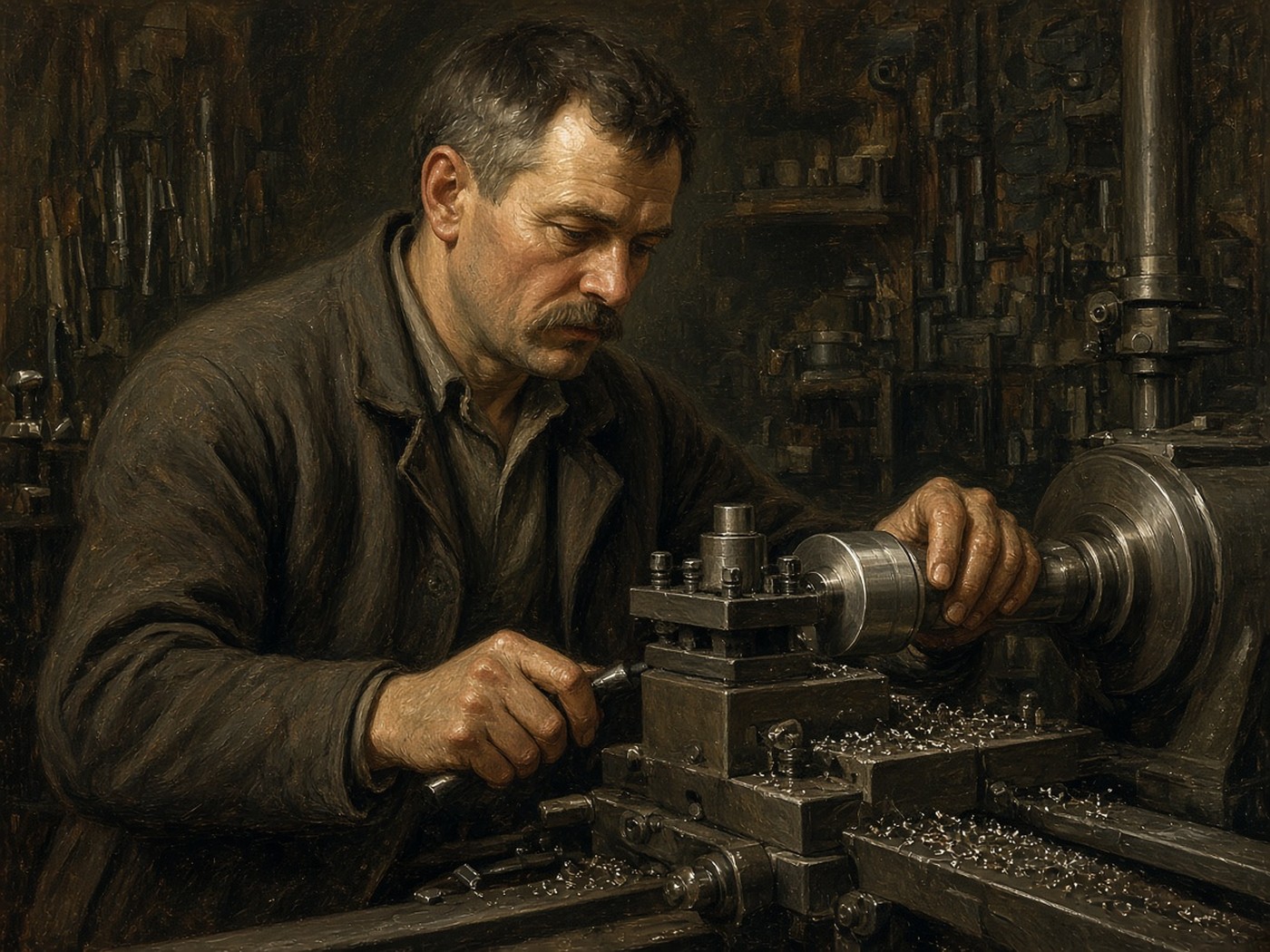
Now hold up the Indian contrast without flinching.
While post-war Germany and Japan told their children, Build, manufacture, invent — this is how we reclaim our pride, independent India told its youth, Pass an exam, get a government chair, sit with a rubber stamp, and make the factory owner beg for a permit.
That single sentence explains more about our industrial stagnation than a shelf of planning documents.
4. The post-1947 trap: babu as saint, maker as crook
Independent India kept the master’s distrust and baptized it as socialism, regulation, and “public interest.”
The imperial inspector became the socialist inspector. The License-Permit-Quota Raj was not an accident of good intentions gone wrong; it was colonial suspicion of the native producer, rewritten in the language of the Five-Year Plan. The state would decide who may make, how much, with what machine, under which stamp. The entrepreneur’s day was spent waiting outside the gate.
Anyone who has run a factory in India knows the lived reality better than any white paper.
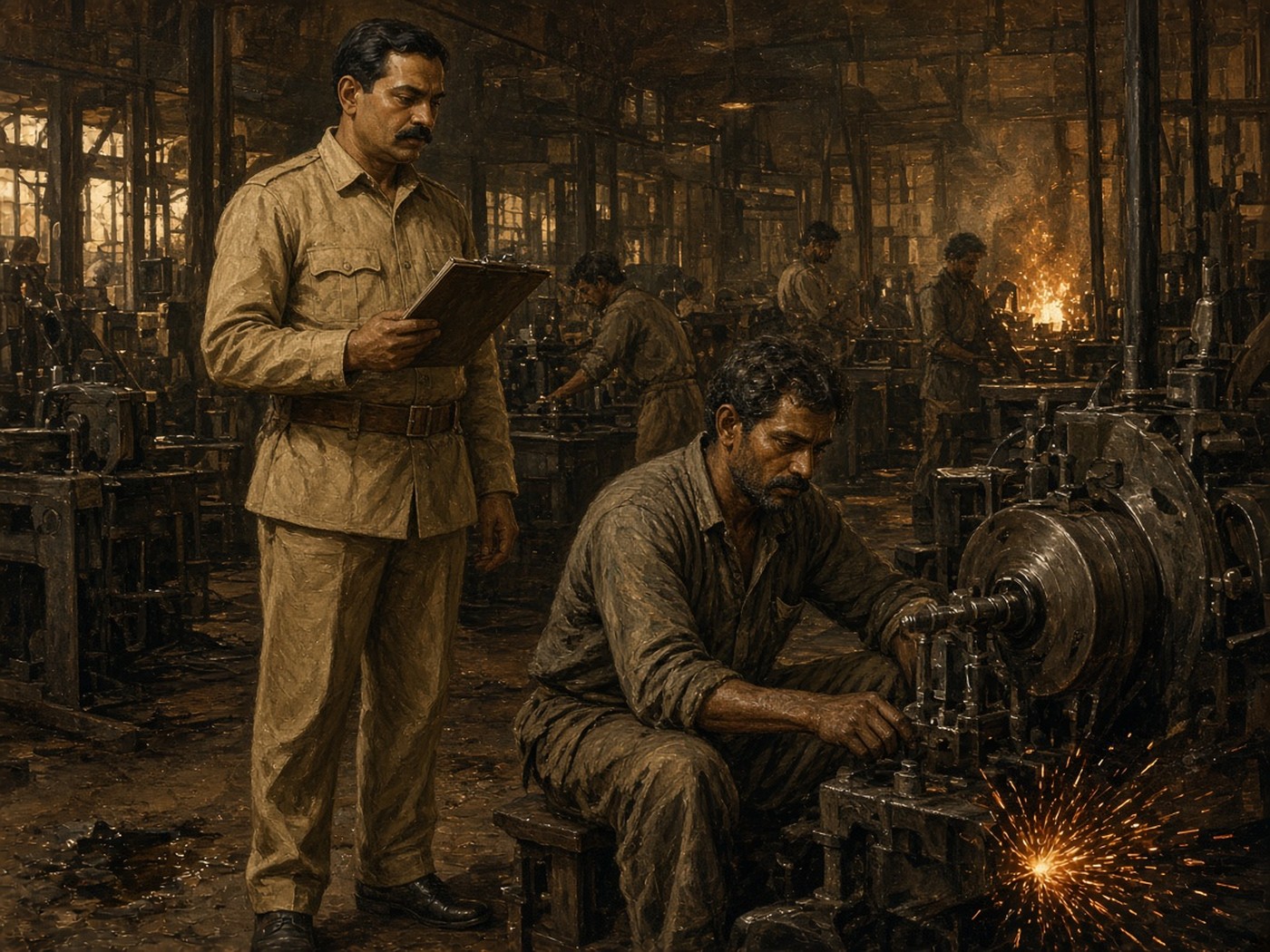
An endless parade of inspectors — boiler, labour, pollution, excise, electricity board — steps onto the factory floor. In a healthy republic, such visits would be technical audits: Is the boiler safe? Are workers protected? Is effluent treated? In India, too often the body language is feudal. The officer arrives not as a professional peer of the engineer, but as a petty landlord of the republic, eyes scanning for a technical fault large enough to threaten shutdown, power disconnection, or a “settlement.” The manufacturer’s day is spent not perfecting a product, but managing fear.
And then popular culture sealed the poison.
For forty years, Bollywood taught the same parable: the mill owner or industrialist in a silk gown, corrupt by default, hoarding grain or drugs, crushing workers, while the government officer in a safari suit arrives as the moral saint of the republic — honest, upright, the only man who can save the poor from the factory’s greed. Cinema did not invent this lie alone; it amplified a state ideology. The builder was cast as villain so the babu could be cast as conscience.
When your films, your families, and your inspectors all agree that the manufacturer is guilty until proven obedient, do not be surprised when capital flees, workshops stay small, and young talent chases government forms instead of machine tools.
This is the same steel frame we named in Part 03 — only now you see whom it was built to discipline: not the officer, but the maker.
5. The call to arms: honour the hand that makes
Real Atmanirbharta will not come from slogans printed on ministry letterheads. It will come when we reverse the moral ranking of the republic.
Decolonization is incomplete while:
- a clerk’s appointment is celebrated with sweets, and a workshop is treated as a family shame;
- the inspector behaves like a landlord, and the manufacturer behaves like a petitioner;
- cinema and curriculum still paint the industrialist as the nation’s default criminal;
- Japan and Germany’s lesson — that pride lives on the factory floor — is dismissed as “foreign,” while Macaulay’s clerk-empire is defended as “Indian administration.”
The British plundered our workshops and trained us to love their paperwork. We swapped the plunderer for the babu’s leash and called it freedom.
Until the toolmaker, the job-creator, and the industrial entrepreneur are granted the highest civic respect — and the file-pusher is reminded daily that he is a public servant, not a feudal master — India will remain a colony of its own bureaucracy.
The flag is ours. The factory floor must become ours in dignity, too.
In this series
- Part 01
The Word That Robbed a Nation of Its Pride: Was 1857 a Revolt or Our First War of Independence? - Part 02
The Lingering Shadow: How Erasure of History Cemented White Supremacy, the BBC Gospel, and the Brown Sahib Monopoly - Part 03
The Steel Frame Remained: How IAS, IPS and IRS Inherited a Machine Built to Subjugate - Part 04 · You are here
The Manufacturer as Criminal: How India Swapped British Plunder for the Babu’s Leash - Part 05
The Imperial Courtroom: How India’s Judiciary Kept the Master’s Gavel - Part 06
The Stolen Prime: How India’s Family Courts Sabotaged Their Own Promise - Part 07
The War for the Gavel: Why the State and the Judiciary Fight Over Control, Not Justice - Part 08
The Citizen’s Camera: How Social Media Broke the Feudal Iron Triangle
Kunwer Sachdev
Founder & MD, Su-Kam Power Systems (1988–2019) and Kunwwer.ai — writing on manufacturing, insolvency, and civilizational memory. Read his story →
Found this story worth sharing? Post it to your network — it takes one click: