Su-Kam Falcon Plus 1100: the low-voltage inverter India built — and China copied
In much of India, the real problem is not that the power goes — it is that when it comes back, the voltage is so low your inverter still cannot charge the battery. The Falcon Plus solved that by charging your battery to full on mains as low as 90V — and did it so well that Chinese makers copied the design.
Ask anyone in a small town or village what happens to their inverter in summer: the mains is there, the meter is running, the fan is crawling — but the inverter battery simply will not charge, because the voltage has sagged too low. So when the power finally cuts, the battery is flat. The Falcon Plus 1100 was our answer to that everyday misery.
1 The problem nobody else solved: low-voltage charging
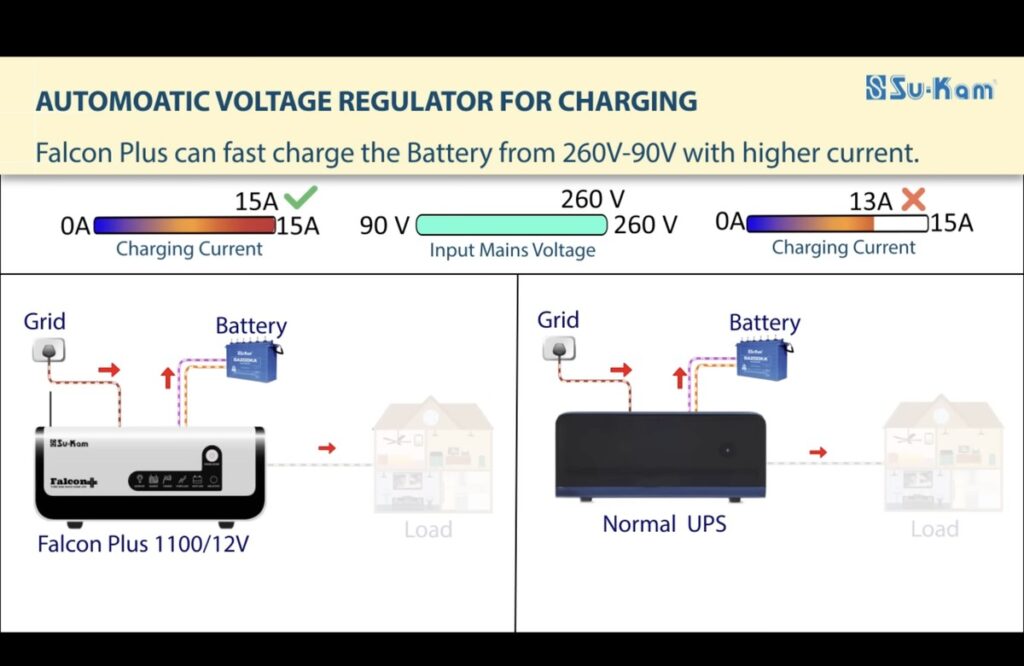
A typical home inverter needs the mains to be at roughly 130 volts or more before it will charge the battery to full. But in vast parts of India — especially in summer and in rural areas — the voltage routinely sags well below that. The grid is “on,” yet your inverter is starving. The Su-Kam Falcon Plus changed the rule: an Automatic Voltage Regulator and Fuzzy Logic charging keep it sensing the grid and charging the battery across a remarkably wide input window of 85V to 290V. It only gives up and switches to battery when the mains drops below 85V — long after an ordinary inverter has quit.
A typical inverter
Needs around 130V+ before it will charge the battery properly. Below that it stops charging and flips to battery — draining it.
Su-Kam Falcon Plus
Still steadily charging at 90V, across an 85–290V window — it only switches to battery once the mains falls below 85V.
Because the charging is governed by Fuzzy Logic, the current scales with whatever the grid can give: it fast-charges at up to 15A when the voltage is healthy, and — crucially — it keeps charging at the very bottom of the range, where an ordinary inverter has already cut off:
At 90V, the Falcon Plus still senses the grid and keeps a steady current flowing into the battery. An ordinary inverter, on that very same weak mains, has already stopped charging and flipped to battery mode — so your load is now draining the very battery you were relying on.
2 The story behind it — born at the dealer meets
This product did not start in a lab. It started in a room full of dealers. I used to travel to dealer meets across the country, and the same complaint came up again and again: “the voltage is too low, and the inverter will not charge the battery.” The fix at the time was to bolt a separate voltage stabiliser onto the inverter — but that cost extra money, and most of our customers simply could not afford it. They were being asked to pay more to solve a problem the inverter should have solved itself.
So we went back and re-engineered the charging. Our earlier inverters charged the battery at around 160V, and could just about manage down to 140V. We kept pushing until we had a machine that kept charging the battery all the way down to 90V — no stabiliser, no extra box, no extra cost. That single change took the most common complaint at every dealer meet and made it vanish.
We added a second improvement that mattered just as much: an adjustable charging-current switch. A small battery needs a small charging current; a large battery needs a bigger one. The switch let the installer match the charge current to the battery — protecting smaller batteries and charging larger ones properly. That detail turned out to be vital for exports, where the very same product had to work across wildly different conditions, battery sizes and usage habits. On top of it we built in a six-stage charger to extend battery life.
I promoted this product personally — travelling with the team and demonstrating the low-voltage charging live, because nobody believed an inverter could charge at 90V until they saw it happen with their own eyes. It became a genuine hit, especially in the export markets — the Falcon range was built for exactly the low-voltage, unreliable grids of the 90-plus countries Su-Kam shipped to, from Nigeria and Uganda to Iraq, Yemen and the UAE. It became one of our most sought-after products, and it is the product that built the Falcon brand in the market. You can read the wider journey in national coverage of the “Inverter Man of India” story.
3 When China copied our technology
There is no greater compliment in manufacturing than being copied — and that is exactly what happened. Once the Falcon Plus proved there was a real market for an inverter that charged in low voltage and looked after the battery, Chinese companies copied our technology, building their own transformer-based (low-frequency) pure sine-wave inverters with almost the same features. Today the global market is full of page after page of Chinese transformer-based pure sine-wave inverters — many built on the very approach we proved first. We had set the template; they followed it. An Indian design from a Gurugram factory became the thing the world’s largest manufacturers chose to imitate rather than out-think.
4 The standout achievement: temperature compensation
Automatic Temperature Compensation (ATC)
A battery charged perfectly at 20°C is over-charged in the cold and under-charged in the heat — and a wrongly charged battery dies young. ATC puts a temperature sensor inside the design that reads the surrounding climate and continuously trims the boost-charge voltage to match it. That one feature is what let a single design serve every state in India — and every country we exported to — whether it sat in a freezing Himalayan town, a 48°C Rajasthan summer, or a humid coastal city in Africa or the Gulf. No re-engineering per market: the inverter simply adapted itself to wherever it was switched on. For a product that had to travel the world, ATC was not a tick-box feature — it was the heart of why the Falcon worked everywhere.
5 More than just 90V charging
The 90V headline is the reason people remember the Falcon Plus, but it is a genuinely smart home UPS underneath:
Wide 85–290V input
An automatic voltage regulator keeps it charging across a very wide mains window — no stabiliser needed.
Fuzzy Logic charging
A microprocessor reads the battery’s real-time charge depth and the available grid voltage, and adjusts the charging current dynamically.
Six-stage charging
Six distinct phases — including a desulphation stage — fill the battery correctly and make it last longer. See our 6-stage DT-6S story.
ATC temperature sensor
Automatic Temperature Compensation adjusts charging to the climate — the feature that let one design serve every state and country.
Adjustable charging current
Set the charge current to the battery size — small current for a small battery, higher for a big one.
8 ms switchover & sine wave
Switches to backup in 8 milliseconds with a clean, pure sine-wave output that is gentle on every appliance.
6 Two modes in one box — the UPS switch
A computer and a ceiling fan do not want the same thing from an inverter, so on the back panel we put a small DIP switch (switch 6) that lets you tell the Falcon Plus exactly what it is protecting.
UPS Mode — for IT loads
For computers, routers, modems and servers. The changeover on a power cut is so fast your machines never reboot — you never lose work or data.
Wide UPS Mode — for appliances
For everyday household loads — TVs, fans and lights. A wider operating window keeps them running comfortably even on a shaky grid.
7 How long will it run?
The Falcon Plus pairs with almost any battery from 18 Ah to 200 Ah, so you can size the backup to your own power cuts. Running a steady 500 W load — say a few desktop computers — here is roughly how long different batteries last:
Indicative figures at a continuous 500 W load; real backup varies with the actual load, battery age and condition.
8 Starting the tough loads — a 5:1 crest factor
A refrigerator, a mixer-grinder, a vacuum cleaner or a hair dryer all draw a huge spike of current the instant they switch on — far more than they use while running. An ordinary inverter trips or shuts down at that spike. The Falcon Plus is built with a high 5:1 crest factor: for a few crucial seconds it can deliver up to five times its normal running current, jump-starting heavy motor loads like a 190-litre refrigerator without flinching.
9 Where it fits in the range
The Falcon Plus 1100 is the home cousin of our flagship Falcon HBU — India’s first 4-star high-frequency inverter — and a sibling of the solar-first Brainy Eco. Where the Brainy Eco brings solar into the home, the Falcon Plus is the one you reach for when the grid is present but weak. You can see the product on Su-Kam’s site, an independent in-depth review, and Su-Kam’s own “WOW! 90V charging” campaign, with the basics of a power inverter for background.
10 A note from me
Some of our proudest engineering went into solving problems that look small on paper but are huge in a real home. Low-voltage charging is one of those. A family in a town with a weak grid does not care about specifications — they care that the battery is full when the power goes. The Falcon Plus gave them that, it gave our export customers a machine built for their conditions and climate, and it built a brand that others tried to copy. That is the kind of quiet, practical innovation I have always cared about most.
11 Watch the Falcon Plus series
The Falcon Plus was a whole series, and we filmed it from every angle. Here are two more films from the Su-Kam channel — a home-inverter overview, and the hands-on review of the 1 kW pure sine-wave UPS that the modes, backup times and crest-factor details above are drawn from.

Founder of Su-Kam and Kunwwer.ai, and mentor at Su-vastika and several other companies — the “Inverter Man of India” and the “Solar Man of India.” Read his story →
Disclaimer: It is important to note that while Mr. Kunwer Sachdev founded Su-Kam Power Systems, he is no longer associated with the company as of 2019. Any information regarding his involvement in the company’s operations, strategies, or future plans reflects his tenure prior to that date. Therefore, any discussions or analyses of Su-Kam Power Systems should be considered in the context of his past contributions and not his current association with the company.