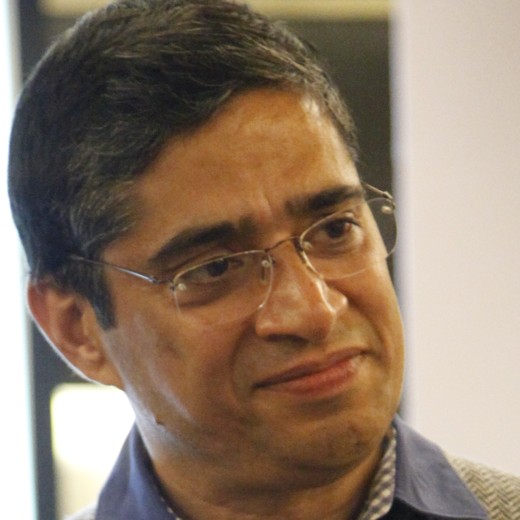
Kunwer Sachdev: The Inverter Man of India

How Su-Kam Came to File 77 Patents

The R&D Legacy  ·  Part 1

How Su-Kam Came to File 77 Patents

The conference that changed everything

In 2002, my first patent application had just been rejected.

I do not remember the exact venue of the conference, but I remember the moment. I was sitting in the audience, listening to a lecture on intellectual property rights — patents, copyrights, designs, trademarks — and the speaker was a woman who explained these things in a way I had never heard before. She made the difference between a patent and a copyright sound like the difference between two engineering choices, not the difference between two pieces of legalese. She made the procedure of filing sound like something a manufacturing company could actually do, if it took the trouble to do it properly.

I waited until her lecture was over and went up to introduce myself. I told her about my rejected patent. I told her what we were trying to do at Su-Kam. She listened carefully. And in the conversation that followed — which extended, I think, well past the time the conference organisers had budgeted for the coffee break — she did something for me that very few people in my professional life have done. She taught me a subject I did not know, with patience, without condescension, and without making me feel small for not knowing it.

Her name was Dr Shaleen Raizada. She had a PhD in Physics from the National Physical Laboratory and had begun her career as a Senior Scientific Officer at the Patent Facilitating Cell of the Department of Science and Technology, Government of India. She had set up the IP departments at Samtel and at Sun Pharma. By the time I met her, she had been working in Indian IPR for more than a decade. Two years after our meeting, in August 2004, she would go on to found Sanshadow Consultants Pvt. Ltd., which is today one of the most respected IPR consultancies in the country.

She did something for me that very few people in my professional life have done. She taught me a subject I did not know, with patience, without condescension, and without making me feel small for not knowing it. — On meeting Dr Shaleen Raizada, 2002

I do not know if Dr Raizada remembers our first meeting. I remember it clearly. I remember it because of what came after.

Kunwer Sachdev at the Su-Kam R&D Unit, Gurugram
Kunwer Sachdev at the Su-Kam R&D Unit, Gurugram — the year the first patent was filed, 2003.

The first filed patent, and a discipline taking shape

On 26 May 2003 — within a year of my conversation with Dr Raizada — Su-Kam filed its first successful patent application at the Indian Patent Office. Application number 722/DEL/2003. Title: “Digital Signal Processing Sine Wave Inverters.” It would be granted seven years later, in July 2010, as Patent No. 241612. It was the foundation patent of the company. The DSP sine wave inverter platform that came out of it would define the Su-Kam product line for the next fifteen years.

What had changed between the rejected first attempt and the successful second one? The discipline.

Dr Raizada had taught me that the strength of a patent is not in the cleverness of the idea. It is in the rigour of the documentation. A patent claim has to be supported by a working invention, with sufficient technical detail that someone skilled in the same field could read the patent and reproduce the invention. A claim that gets ahead of what has actually been built — that describes an idea instead of a working thing — is a claim that gets refused. My first patent had been refused for that reason. The second was filed differently because we had built the thing first.

Build it. Install it. Iterate it. Then file. Then launch. — The Su-Kam patent policy

This became the founding policy of Su-Kam’s R&D function. We filed only when the technology was already validated and working, with field-deployment data behind it. We also kept product launches under wraps until the patent had been filed. That sequence, taught to me by Dr Raizada in a conference room in 2002, became the basis on which Su-Kam went on to file seventy-six more patents over the next fourteen years.

Office of the Controller General of Patents, Designs & Trade Marks
Intellectual Property India — eRegistration Report
Legal Status: Ceased  ·  Date of Cessation: 26/05/2017
Patent Number 241612 Date of Patent 26/05/2003
Application Number 722/DEL/2003 Date of Grant 15/07/2010
Type of Application Ordinary Application Appropriate Office Delhi
Grant Title “Digital Signal Processing Sine Wave Inverters”
Patentee M/S. Su-Kam Communication Systems Ltd.  ·  WZ-1401/2 Nangal Raya, New Delhi-110046
Source: iprsearch.ipindia.gov.in — Verified April 2026

What 77 patents actually cost

The 77 patent applications filed by Su-Kam between 2003 and 2017 are not a vanity portfolio. Each one was preceded by validated engineering work, was filed only when that work was field-tested, and was prosecuted patiently over the long timelines the Indian Patent Office requires.

Roughly five lakh rupees in R&D time to develop and validate the underlying technology. Roughly two lakh rupees in patent attorney fees for drafting, filing, and prosecution. Roughly ten years from filing to grant under standard Indian Patent Office prosecution timelines. Across seventy-seven applications, this is more than a decade of cumulative investment in original technology — investment no other Indian competitor in our segment was making at comparable scale during the same period.

Five families of technology

The portfolio organises itself into five families.

The inverter platform itself — DSP sine wave inverters, high-frequency inverters, online UPS architectures, FPGA-based three-phase inverters, telecom-grade inverters with GSM connectivity. Each generation of the Su-Kam product line corresponds to a generation of patents.

Battery technology — battery chargers, charge equalisers, cell-protection circuits, intelligent chargers. An inverter is only as good as the battery behind it, and we invested heavily in the chemistry-adjacent engineering.

Solar — the Solarcon and Brainy Touch story. Solarcon converted any existing inverter and battery setup into a solar system without requiring the customer to discard equipment they already owned — a retrofit philosophy uniquely suited to India. Brainy Touch was Wi-Fi-enabled, smartphone-monitored solar power — what Wikipedia today records as “India’s first touchscreen solar PCU.”

Application-specific power backup — patents on power backup designed specifically for fuel dispensers, lifts, ATMs, treadmills, photocopiers, off-road vehicles. We never saw “power backup” as a generic problem. We engineered for the application.

Manufacturing intellectual property — patents on the equipment we used to manufacture our products: an automated welding machine for transformer cores, an electro-pneumatic core stacking machine, automated test rigs, high-rate discharge battery test systems. They show that Su-Kam was inventing not just products but the machines we used to make our products.

The five filings of October 2017

The most consequential patent filings in Su-Kam’s history were the last ones — five provisional applications filed in September and October 2017, on grid-tied inverter architecture, on the sharing of charging current between PV-grid and PV-load, on multifunctional power flow management, on triangulation of power backup devices for remote control, and on solar PV with transformer isolation.

These five filings were the architectural plan for what Su-Kam expected to build over the next decade. Their complete-specification deadlines fell in September and October 2018. By April 2018, Su-Kam Power Systems Limited had been admitted to the Corporate Insolvency Resolution Process. I had no role in the company from that day onwards.

What happened to those five filings, and to the rest of the portfolio, in the years that followed — that is the subject of the next blog in this series.

The team that built the patents

Seventy-seven patents are not filed by one person. The patents we filed at Su-Kam came out of an engineering team — designers, firmware engineers, product managers, test technicians, application specialists — who worked, very often, sixteen-hour days, at our R&D centre in Gurugram, on problems no one else in the country was trying to solve the way we were. Behind every patent number in this post is an engineer whose name does not appear on the public record but whose work is the reason the patent exists.

To the R&D team that made the 77 patents possible

Sanjeev Saini — who served as Director (Technical) at Su-Kam and led the technical function during many of the years that produced the most consequential patents in the portfolio. Sanjeev’s quiet, disciplined leadership shaped the engineering culture that filed those patents. Venkat Rajaraman — who has gone on to found and lead Cygni Energy, today one of India’s largest independent battery energy storage solutions companies, with a 4.8 GWh BESS gigafactory in Hyderabad inaugurated in 2025. Vijay Prakash — whose work on Su-Kam’s R&D function in the years when we were building the FPGA-based and DSP-based platforms was foundational to the products our customers know us by. Jagdeep Chauhan — who has gone on to build his own venture in the power backup industry, taking with him the discipline and the working knowledge that the Su-Kam R&D function had instilled.

And to every other engineer, technician, and product manager whose name is not listed here but whose hands and minds were on those patents — I am grateful. The 77 patents are as much yours as they are mine.

I wish each of you continued success in the work you are now doing. India needs the companies you are building.
I owe Dr Shaleen Raizada a debt I have never adequately repaid. The 77 patents that Su-Kam went on to file would not have been filed, and would not have been filed well, without what she taught me at that first conference in 2002. If this blog series achieves anything beyond putting a record on paper, I hope one of its small effects is that other Indian founders will recognise that finding the right teacher early in your business journey can change the entire trajectory of the company you go on to build.
• • •

Verify the Record

Disclaimer & Legal Notice. This post is part of a personal series documenting work executed by Su-Kam Power Systems Limited between 1988 and 2018, during which time I served as its Founder and Managing Director. Su-Kam Power Systems Limited was admitted to the Corporate Insolvency Resolution Process under the Insolvency and Bankruptcy Code, 2016, by order of the National Company Law Tribunal, Principal Bench, New Delhi, dated 5 April 2018, and was placed in liquidation by NCLT order dated 3 April 2019. I have had no role in the management of Su-Kam Power Systems Limited since the commencement of those proceedings. This blog is not published on behalf of, nor is it an endorsement of, any person or entity currently carrying on business under the Su-Kam name.

Leave a Comment

Your email address will not be published. Required fields are marked *

Scroll to Top