Venkat Rajaraman: From Su-Kam R&D to Cygni Energy
One of the people stories. Open the full alumni web →
Venkat Rajaraman,Cygni Energy,Su-Kam Nvidia engineer,FPGA inverter India,Kunwer Sachdev — People of Su-Kam — #2
The Man Who Left Nvidia for a Dream — My Story with Venkat Rajaraman
By Kunwer Sachdev | April 2026
I have always believed that a company is only as strong as the people inside it. Machines can be bought. Technology can be licensed. But the right person — someone who thinks, who creates, who pushes the boundaries of what is possible — that is not something you find in a catalogue. You find them through chance, through friends, through one phone call that changes everything.
Explore energy storage and lithium battery innovations at https://lithiuminverter.in and solar category firsts at https://solarmanofindia.com.
For founders seeking AI legal diagnostics and business co-pilots, explore Legal Shield on https://kunwwer.ai/.
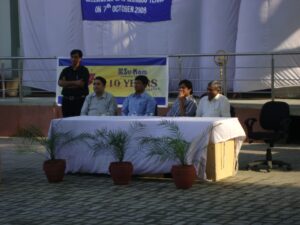
This is a series about the people who walked through the doors of Su-Kam and shaped what it became. Some of them were young and hungry. Some were already accomplished. All of them were given their first real chance in the inverter industry — by me, by Su-Kam, by the belief that India’s power story was only just beginning. Venkat Rajaraman is one of those people. And his story is one I am proud to tell.
A Phone Call from Hyderabad
It was around 2007. Su-Kam was moving fast — faster than most people expected, including perhaps me. We had built a strong business in inverters and UPS systems, and I knew the next chapter had to be built on serious research and development. We were not just selling boxes anymore. We were trying to solve India’s power problem, and that required world-class engineering at the core.
A friend of mine in Hyderabad called me one day. He said — Kunwer, I know someone you should meet. He is in the United States, working with Nvidia. He is brilliant, he is grounded, and I think he might be exactly what you are looking for.
That man was Venkat Rajaraman.
“A friend said — I know someone you should meet. He is working with Nvidia in the USA. That man was Venkat Rajaraman.”
From Silicon Valley to Su-Kam
Venkat was not just casually associated with Nvidia. He was Vice President of Engineering at PortalPlayer — a semiconductor company that had been acquired by Nvidia in early 2007. Before that, he had worked at Sun Microsystems in the United States. He held a Master’s degree in Electrical Engineering from Stanford University. This was not someone looking for a job. This was someone at the very top of the global technology ladder.
I interviewed him. I asked him hard questions. I watched how he thought. And within that conversation, I felt something I have learned to trust over decades in business — this is the right person. Not just technically. As a human being. There was a clarity about him, an honesty, a sharpness that I find rare.
I offered him the chance to come back to India, to build something that mattered, to head the Research and Development engine of one of the fastest-growing power companies in the country. He said yes. And he joined Su-Kam in 2007.
Venkat Rajaraman — at a glance
BE, Madurai-Kamaraj University | M.S. Electrical Engineering, Stanford University | Sun Microsystems, USA | VP Engineering, PortalPlayer (acquired by Nvidia, 2007) | Su-Kam Power Systems — Head of R&D, later CEO | LinkedIn Profile ↗ | Founder & CEO, Cygni Energy, Hyderabad (est. 2014)
The FPGA Vision — Ahead of Its Time
What I valued most about Venkat was not just his qualifications. It was his depth of knowledge on semiconductor chips and embedded systems — a world I was deeply curious about for Su-Kam’s future.

Around that time, FPGA — Field Programmable Gate Array — was an emerging technology that I believed could take our solar inverters and UPS systems to a completely new level. FPGAs allow you to programme the hardware itself, giving products a flexibility and intelligence that conventional chips cannot match. I saw the potential. And Venkat was the right man to help Su-Kam build on it.
Together, we worked on designing products built around FPGA technology — solar inverters and UPS systems that would have been genuinely ahead of anything available in India at that time. The designs were serious. The thinking was right. We came close.
The Work Was Real
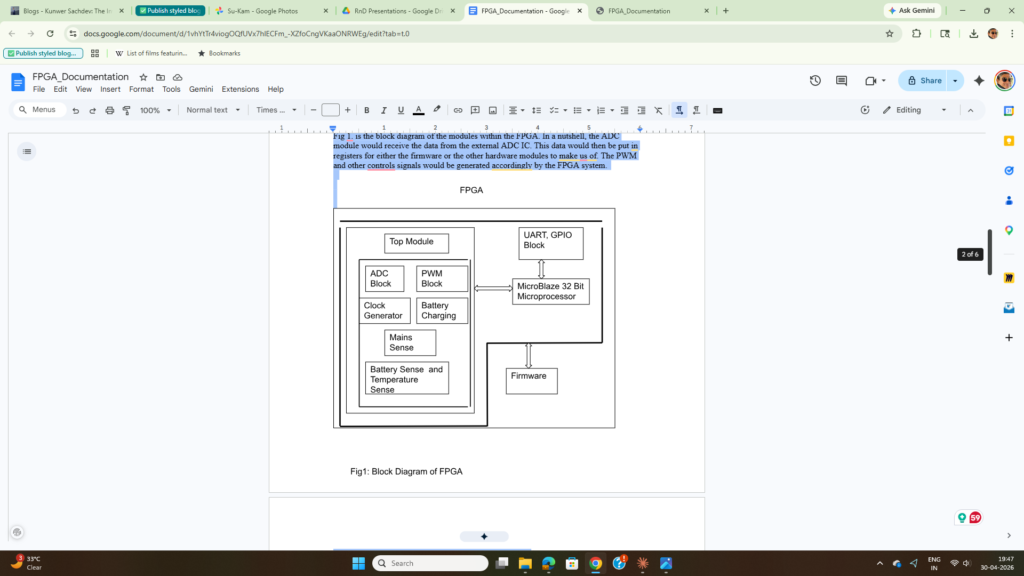
I want to show something here that most people have never seen. This is the actual block diagram from Su-Kam’s internal FPGA documentation — the real technical work that Venkat and our R&D team produced during those years.
Fig 1: Block Diagram of FPGA — Su-Kam R&D documentation
Fig 1: Block Diagram of FPGA — from Su-Kam’s internal R&D documentation. This diagram was created by Venkat Rajaraman and the Su-Kam engineering team, circa 2007–2009.
For those who are not engineers, let me explain what this diagram shows — because it tells a remarkable story.
At the centre of the design is a MicroBlaze 32-bit Microprocessor — a powerful software-programmable processor embedded directly inside the FPGA chip itself. Around it, the team designed dedicated hardware blocks for every critical function of an inverter: an ADC Block to read real-world electrical signals, a PWM Block to control the output waveform with precision, a Clock Generator, a Battery Charging module, Mains Sense to detect grid power, and Battery Sense and Temperature Sense for safety. All of this connected to a Firmware layer and communication interfaces.
In simple terms — the team was designing an inverter brain. Not buying one off the shelf from a foreign supplier. Designing it from scratch, in India, on a chip that could be reprogrammed and upgraded. If this had reached production, Su-Kam would have owned its core technology in a way very few Indian companies did — or do today.
But unfortunately, those products never made it to production. The technology was new, the manufacturing ecosystem in India was not yet ready, and the timing did not align. It is one of those chapters that I look back on with both pride and a quiet regret — pride because we had the vision and the courage to try, and regret because the world might have seen something remarkable if things had aligned differently.
“The team was designing an inverter brain. Not buying one off the shelf. Designing it from scratch, in India, on a chip that could be reprogrammed and upgraded. That was the ambition.”
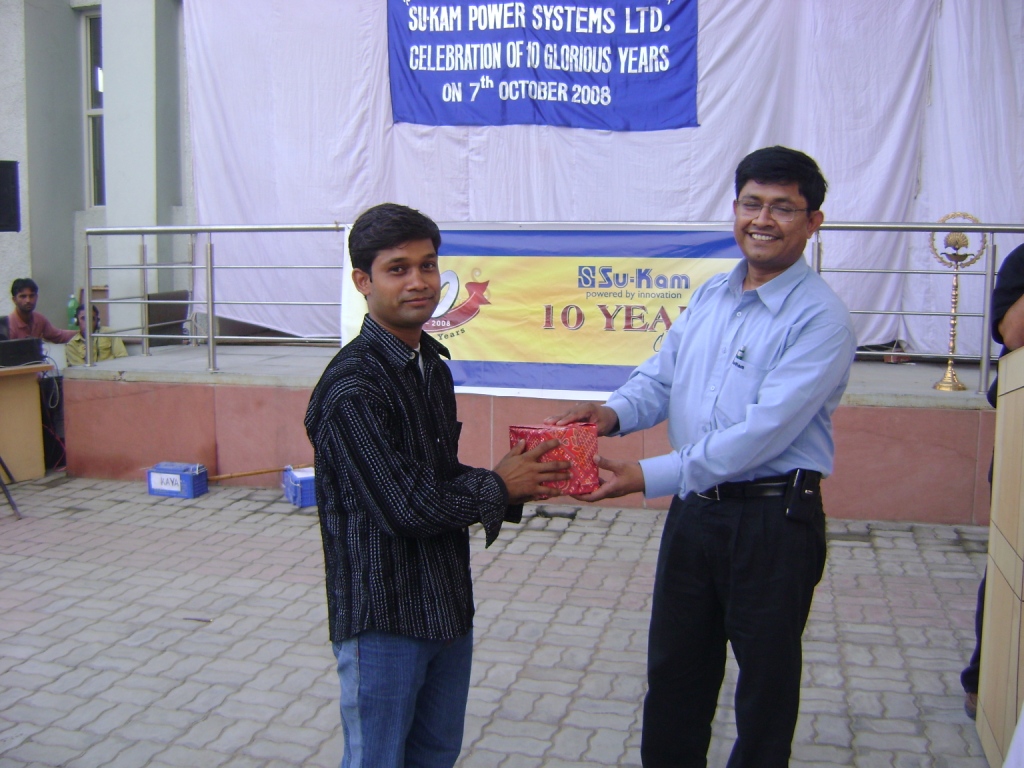
Su-Kam Power Systems — Celebration of 10 Glorious Years, 7th October 2008
Su-Kam Power Systems Ltd. — Celebration of 10 Glorious Years, 7th October 2008. A milestone moment for a team that had built something no one thought possible.
The Venkat I Knew
We became quite close over the years. When you work alongside someone in a fast-moving company, navigating growth and pressure and big decisions every day, you see who a person really is. With Venkat, what you saw was always what you got.
He was a fantastic person. A quick learner — which mattered because the inverter and solar industry in India at that time was unlike anything he had encountered in Silicon Valley. The scale was different. The constraints were different. The customer was different. He absorbed all of it rapidly and brought his global engineering discipline to bear on problems that were deeply Indian.
He was methodical in his work. Not slow — methodical. There is a difference. He did not rush to conclusions. He built systems. He created processes. He brought the rigour of world-class engineering management into our R&D function at a time when we needed exactly that.
And he was upfront. Always. If he disagreed with something, he said so — clearly, respectfully, without politics. That kind of honesty is not common in fast-growing companies where everyone is trying to please the founder. I valued it then and I value it even more in hindsight.
Su-Kam team river rafting outing — the Su-Kam family at play
The Su-Kam team at a river outing — life jackets on, hands raised in victory. Great companies are built not just in boardrooms but in moments like these.
Su-Kam Global Partners’ Meet, 5–8 August 2010, India
Su-Kam Global Partners’ Meet, 5–8 August 2010, India. Partners and leaders from across the world, gathered in front of Su-Kam headquarters — a testament to how far we had come.
What He Built After
After his years at Su-Kam, Venkat went on to found Cygni Energy in 2014 — a Hyderabad-based clean energy company focused on battery storage for electric vehicles and energy infrastructure. Today, Cygni is one of India’s leading energy storage companies, with a 4.8 GWh battery assembly plant inaugurated in Hyderabad — the kind of scale that puts India on the global clean energy map.
He is also an Advisory Committee member of the National Centre for Photovoltaic Research and Education (NCPRE) and a respected voice on EV and energy storage policy in India. The FPGA dreams we had at Su-Kam were perhaps the early seeds of a deeper conviction in him — that advanced technology, applied with discipline, can reshape how a country powers itself. Cygni is that conviction, fully grown.
I look at what he has created and I feel proud. Not because I can take credit for it — his success is entirely his own. But because I gave him his first step into India’s energy industry. And he has taken that step and turned it into something that will last for decades.
“I gave him his first step into India’s energy industry. He has turned it into something that will last for decades.”
What This Series Is About
I am writing about the people of Su-Kam because I think their stories deserve to be told. The inverter industry in India was built by thousands of hands — engineers, salespeople, country managers, technicians, thinkers. Many of them got their first chance through Su-Kam. Venkat is one of nine people I am starting with, and there are many more to come.
Each of them is now building something remarkable — in India and across the world. Each of them carries a piece of what we built together at Su-Kam. And I carry a piece of each of them with me.
Venkat — if you ever read this — I miss those days. The FPGA discussions, the late decisions, the ambition we shared for what Indian technology could become. I am proud of everything you have built. Keep going.
— Kunwer Sachdev, Founder, Su-Kam Power Systems | Founder, Su-vastika
Related Reading
- From a Malfunctioning Inverter to a National Standard: The Su-Kam R&D Story
- The Banker’s Son Who Made It to Cornell — My Story with Ishan Sehgal
- The Man I Found in Nigeria — My Story with Srinivas Pilla
- The Boy Who Became a Leader — My Story with Sunil Badesra
🔗 Read the Full “My Story” Series
Frequently Asked Questions
What is Cygni Energy's connection to Su-Kam?
Cygni Energy founder Venkat Rajaraman collaborated with Su-Kam and Kunwer Sachdev on solar microgrid and inverter innovations during Su-Kam's early solar expansion.
Founder of Su-Kam and Kunwwer.ai, and mentor at Su-vastika and several other companies — the “Inverter Man of India” and the “Solar Man of India.” Read his story →
- Vinod Bansal — Highway dhabas → Satvik spiritual ecosystem
- Jagdeep Chauhan — DSP sine-wave inverter engineering
- Sunil Badesra — Boy who became a leader → Sungrow India