Kunwer Sachdev’s Saur Energy column on the batteries that will power the energy transition — from today’s lithium-ion cells to solid-state, lithium-sulfur and the wave of new chemistries beyond them.
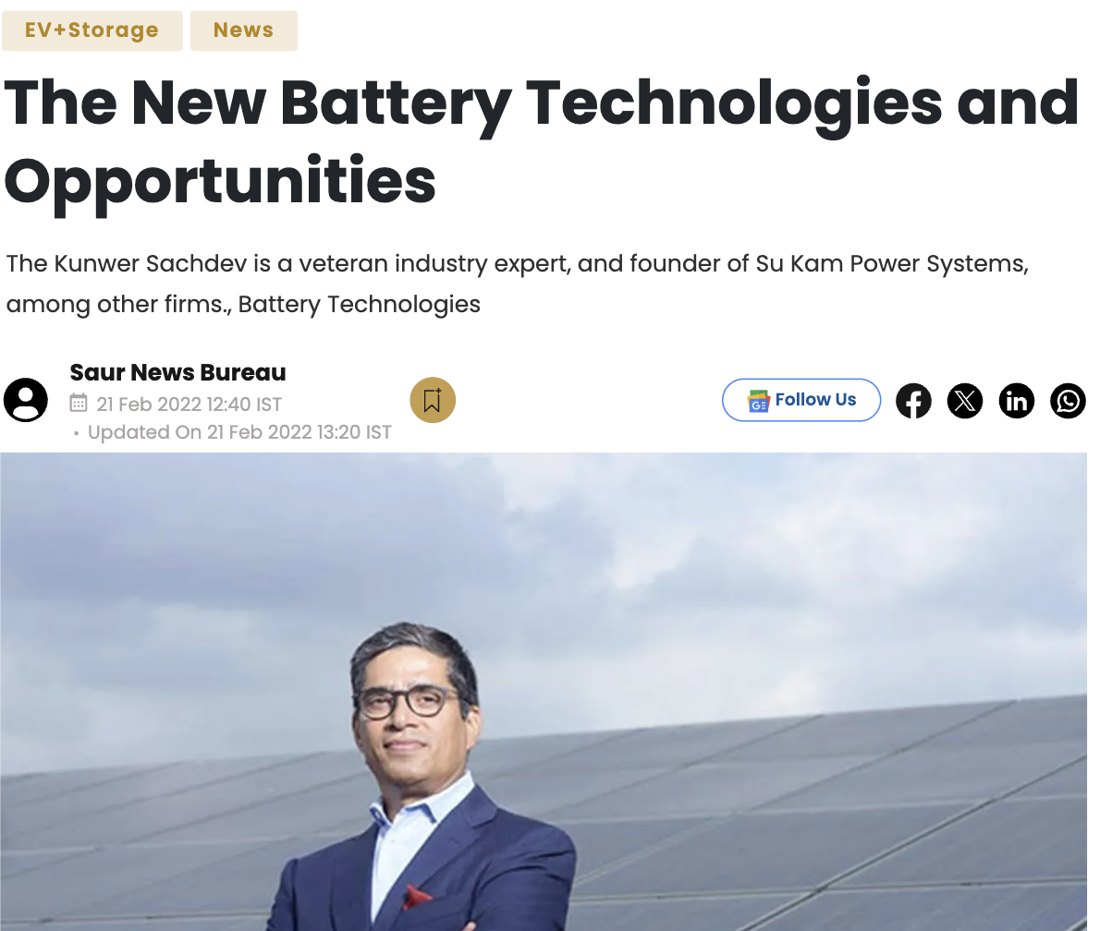

Kunwer Sachdev’s bylined piece for Saur Energy International is a short field guide to the battery chemistries that will decide how quickly the world can move off fossil fuels. The premise is simple: the shift to renewables and clean transport is now urgent, and battery technology — not solar panels, not wind turbines — is the piece of the puzzle still being rewritten in real time.
Why batteries are the pivot of the transition
Sachdev opens with the pace of change itself. Manufacturers are experimenting non-stop to make cells that are cheaper, lighter and more powerful, because the cell is the constraint. If batteries get better, electric vehicles get cheaper, rooftop solar becomes truly dispatchable, and the grid can absorb far more variable renewable generation than it does today. The move from lithium-ion to next-generation chemistries, he argues, is going to bring better energy density, longer life, real safety improvements and a definite drop in cost — all at once.
Lithium: still the workhorse, still improving
Lithium remains, in his telling, the “heart of nearly every electric vehicle” for good reason: high energy per unit mass, high round-trip efficiency, good high-temperature behaviour, long life, strong cycling and low self-discharge. Most of the elements can be recycled. Because any serious battery chemistry needs roughly a decade of field testing before it can be trusted at scale, and lithium has already cleared that bar, Sachdev expects the next wave of lithium variants to be widely adopted well before the first true solid-state cells reach volume production — especially in stationary storage and long-haul transport.
“I feel solid-state batteries will be the future and a game-changer for EVs.”— Kunwer Sachdev, Saur Energy International • February 2022
Lithium-sulfur: aviation’s quiet contender
Between today’s lithium-ion and tomorrow’s solid-state sits lithium-sulfur, made of sulfur and metallic lithium. Its energy density is roughly four times that of a standard lithium-ion cell, which is why aviation is watching it closely: an aircraft cares more about weight than almost any other buyer. The chemistry is still at prototype stage and no major drawbacks have surfaced yet. Lighter and cheaper than the current generation, Sachdev calls it a plausible next step for EV cells too — a battery that can simply store more energy in the same package.
Solid-state: the shining armour for EVs
The centrepiece of the piece is solid-state. Solid-state batteries, Sachdev writes, will be the “shining armour” for electric vehicles — not just cheaper cells, but a full change of experience. Owning a plug-in car starts to feel like owning an internal-combustion car, only better: fast charging, driving range good enough to beat ICE cars on long-distance runs, higher energy density, better safety, and cells small enough to make the vehicle lighter and roomier. And crucially, the cost-per-kilowatt-hour comes down, which is what actually decides mass adoption. His forecast: solid-state EVs go wide in the next decade — a revolutionary shift, not an incremental one.
The chemistries most people haven’t heard of yet
The last third of the piece is a tour of chemistries beyond the headlines. NanoBolt Lithium Tungsten cells use a layered nano-tube structure that gives ions much more surface area to move through, allowing far faster charging and higher charge-holding — and the multi-layered tubes can be cut to fit any lithium-ion form factor. Zinc-manganese oxide batteries already exist in single-use form; the piece flags rechargeable versions as imminent, and well-suited to large power networks because they are safer and easier to handle. Organosilicon electrolyte batteries are essentially an upgraded lithium-ion — the organosilicon solvent stabilises the ion transfer inside the cell, and Sachdev sees the chemistry combining productively with solid-state electrolytes. And gold-nanowire gel-electrolyte cells, where a manganese-dioxide-coated gold nanowire is wrapped in an electrolyte gel, showed no capacity loss and no breakage across 200,000 test cycles over three months — a durability profile no incumbent chemistry can match.
Where the piece lands
Sachdev closes on optimism grounded in the range of options on the anvil. With this much already commercial and this much more in the lab, the world can realistically expect further innovation in cell chemistry to keep unlocking cheaper, cleaner and more environment-conscious power solutions — the practical machinery of a lower carbon footprint. Batteries, in short, are no longer the bottleneck they used to be; they are the fastest-moving part of the energy transition.
‘The New Battery Technologies and Opportunities’ — Saur Energy International →