The Economic Times profiles Kunwer Sachdev in 2006 — the outsider who took an unglamorous, fragmented inverter market and built Su-Kam into a Rs 200-crore brand that Reliance had already backed.
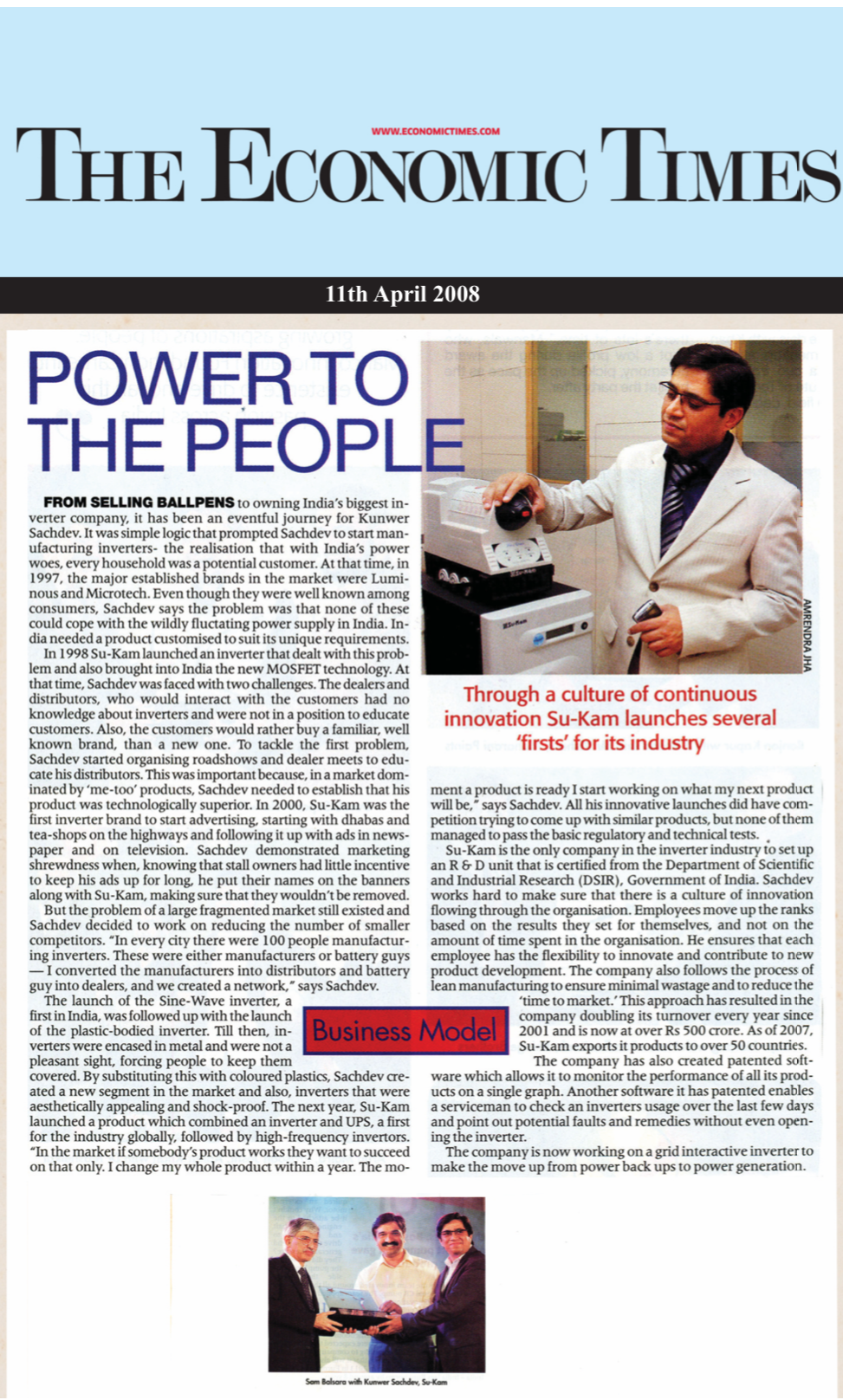
The Economic Times’ K. Yatish Rajawat profiled Kunwer Sachdev in September 2006, at the moment Su-Kam crossed the Rs 200-crore revenue mark and Reliance India Power Fund had just picked up a 20 per cent stake. The framing was simple: entrepreneurship, they say, is about turning a new opportunity into a sustainable business — but Sachdev had done something harder, spotting a window in an old, crowded, unglamorous business and turning it into a brand.
A brand where none existed
The inverter market of the late 1990s was fragmented — gensets, emergency lamps and unbranded inverters filled the space, and no one had really tried to professionalise it. Sachdev spotted the gap and built Su-Kam into what he calls a name that “represents better quality— even though our prices are higher than our competitors.” By 2005-06 the company had touched roughly Rs 200 crore in revenue, was growing at more than 100 per cent, and had just taken $10m from Reliance India Power Fund for a 20 per cent stake.
The path was not straight
ET does not skip the false starts. Sachdev opened a cable-equipment manufacturing company in the early 1990s, working with Gurgaon-based Shyam Telecom on cable-TV kit; it did not work, and he shut it in the mid-1990s to focus on inverters — at a time when inverters themselves were still a small alternative to diesel and petrol gensets. The inflection came when battery, transformer, electronics and semiconductor improvements pushed inverter capacity high enough to compete on real workloads.
“I do not come from a business family, so I was learning about the business while running it. Unlike our competitors at that time and even now, I realised very early that I needed professionals on my side and not family members.”— Kunwer Sachdev to The Economic Times • 23 September 2006
A professional culture in a family-run industry
What ET flags as Su-Kam’s deepest edge is not a product spec — it is culture. The Indian inverter industry then was dominated by family-owned, family-run companies. Sachdev built the opposite: hiring managers from Emerson and other multinationals, treating Su-Kam like a listed-scale operation years before it had to be. That, more than any single feature, is what let it out-run a distribution-heavy incumbent like Luminous.
R&D and the Baddi plant
The other differentiator ET highlights is R&D spend — a dedicated research centre in Gurgaon at a time when few Indian consumer-durables companies bothered — and a manufacturing footprint in Baddi, Himachal Pradesh, structured to capture the sales-tax and excise incentives of that hub. New entrants, both Indian and MNCs like Emerson and APC, kept arriving, but Sachdev told the paper he did not see the market opportunity shrinking; Su-Kam was already pushing beyond its northern stronghold into the west and south.
From regional player to national brand
The closing note of Rajawat’s piece is where Su-Kam was headed: emerging out of North India — the region carrying the brunt of the country’s power shortage — and turning into a company with a genuine national footprint. Read almost two decades later, this ET profile reads as the earliest print snapshot of the arc that would eventually earn Sachdev the “Inverter Man of India” label.
A powerful idea was his calling — The Economic Times →