The Su-Kam MD on why cheap Chinese modules are a false economy, why 120 patents matter in a distribution business, and why the next Su-Kam sells power — not products.
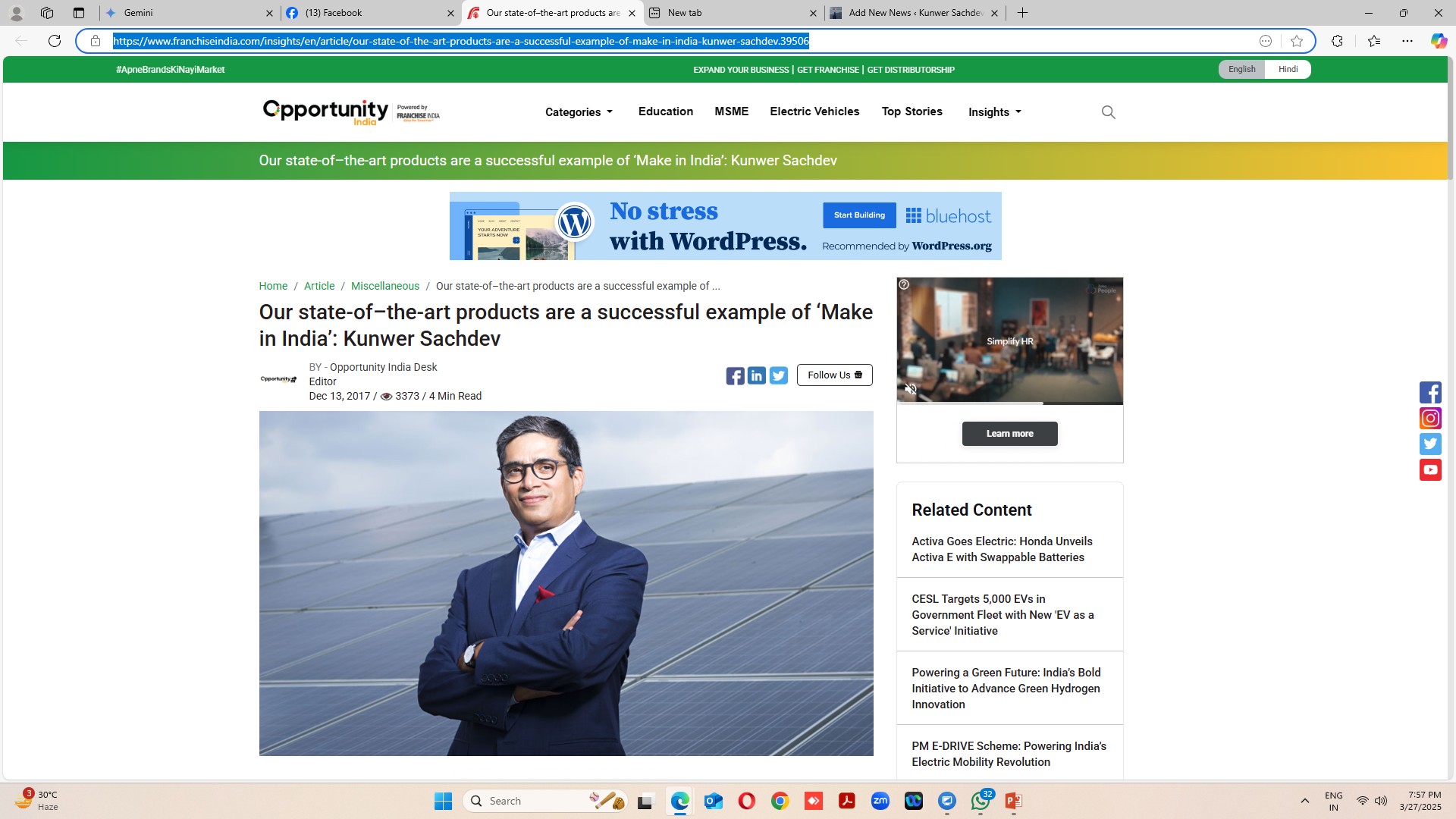
Opportunity India’s December 2017 interview with Kunwer Sachdev, Managing Director of Su-Kam Power Systems Ltd., catches the company at scale — 90 countries, 250+ products, 50,000+ channel partners, and a record 120+ patents in the power-backup and solar space. The Q&A walks through how Su-Kam picks distribution partners, how it handles Chinese pricing pressure, and what a “Make in India” solar strategy actually looks like on the ground.
Choosing distribution partners: intent, not paperwork
Asked how Su-Kam picks its 75,000+ channel partners, Sachdev is deliberately open: there is no fixed set of tick-box criteria. Anyone with a genuine desire to work in the solar segment and to promote the industry can become a partner. The network itself varies by geography — distribution has to bend to the dynamics and customer needs of each region rather than follow a template.
Cheap Chinese modules — and the hidden cost
The biggest industry threat, in his reading, is the flood of low-cost Chinese solar products. Chinese modules land in India priced 10–20 per cent below Indian equivalents. But the sticker price is only half the story: quality is materially lower, appliances downstream can malfunction, and buyers rarely get real lifecycle assurance. Su-Kam’s answer, he says, is state-of-the-art products built as a successful example of ‘Make in India’ — designed to make customer lives comfortable and hassle-free, not just cheap on day one.
“Our state-of-the-art products are a successful example of ‘Make in India’ and are designed to make lives comfortable and hassle-free for customers.”— Kunwer Sachdev, MD, Su-Kam Power Systems • Opportunity India, 13 December 2017
Why 120+ patents matter in a distribution business
Patents, in Sachdev’s view, are not an academic vanity. Su-Kam’s 120+ filings act as a legal and technical check on unethical copying — by Chinese manufacturers and other competitors alike — and force the company to keep its own engineering bar high. In a distribution- and franchise-heavy industry, IP is what protects the quality of work at the far end of the channel.
Solar awareness and Su-Kam’s training push
Government schemes have helped, but Sachdev argues that public awareness of solar is still the real bottleneck. Su-Kam runs solar training workshops nationwide, aligned with the government’s target of 100,000 MW of solar power by 2022, and in 2016 it set up a Centre for Smart Solar Energy at Manav Rachna University to train students on instrumentation, control and energy-system optimisation. A dedicated Su-Kam YouTube channel — 30,000+ subscribers at the time of the interview — extends that outreach.
Quality control: three passes, one random re-check
On quality, Sachdev walks Opportunity India through Su-Kam’s three-stage process. Every product is manually checked on the line, then re-checked through automated machines, and finally 10–15 per cent of finished units are picked at random and put back through the entire process a second time. The result is a factory floor built around inspection, not just assembly.
The road ahead: sell power, not products
The interview closes on where Su-Kam is heading. The company is designing highly efficient solar products that shorten the payback for buyers, and building conversion kits that turn a normal inverter into a solar inverter at very low cost. Its grid-tie inverters can both power the home they sit in and feed surplus power back into the grid — monetising rooftops rather than just protecting them. The bigger idea, in Sachdev’s framing: solar plus storage is the next global wave, and Su-Kam wants to be a company that sells power, not just hardware.