The Su-Kam founder’s cover story for Celerity — a manifesto for making India the “Renewable Energy Capital of the World,” one household inverter at a time.
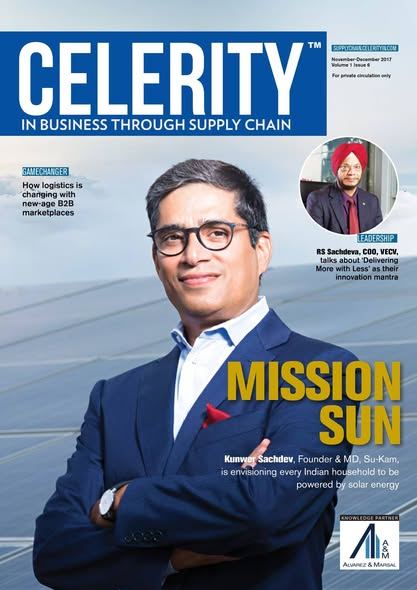
When Celerity put Kunwer Sachdev on its cover for the Nov–Dec 2017 edition, the piece was framed as a mission statement. Su-Kam’s founder had a simple, ambitious idea: India could become the world’s renewable-energy capital, and the country would get there faster if it treated the household inverter as a piece of national solar infrastructure rather than an afterthought. #MissionSun, as the story called it, was the shape of that argument.
“I innovate, therefore I am”
The article opens on Sachdev’s personal mantra — “I innovate, therefore I am” — and traces how that instinct shaped his life at Su-Kam. The goal, as he put it to Celerity, was to power every household through solar technology; the way there was product, not policy waiting. If the country wanted its solar dream to be more than a headline, it needed manufacturers willing to design the last-mile hardware — the inverters, chargers and hybrid systems that actually sit inside homes.
The numbers Celerity put on the table
The magazine grounded the case with the state of India’s grid at the time. Installed capacity had reached 330.15 GW, with renewables making up 30.8 per cent of the mix. Solar generation capacity had quadrupled — from 2,650 MW in 2014 to 12,289 MW by March 2017 — and the country was aiming at 100 GW of solar and 60 GW of wind by 2022. Sachdev’s reading of those numbers was optimistic but blunt: the ceiling was much higher than what the country was actually delivering, and the gap was operational, not technical.
“In order to realise the dream of becoming the Renewable Energy Capital of the World, the country needs to take a leadership role.”— Kunwer Sachdev, Founder & Managing Director, Su-Kam • Celerity, Nov–Dec 2017
Bring inverters under BEE ratings
One of Sachdev’s sharpest policy asks in the piece was quiet but structural: bring inverters under the Bureau of Energy Efficiency star-rating regime, the way refrigerators, air-conditioners and pumps already are. Su-Kam, Celerity noted, held the only 4-star rated inverter in the market — a fact that made his argument credible. A star-rating regime would push the whole industry to design for efficiency instead of price alone, and give households a signal they could actually trust at the point of purchase.
Solar-ready inverters and the “four-in-one” product
On the product side, Sachdev used the cover story to preview what Su-Kam was building next: solar-compatible inverters that a household could convert to a solar setup after purchase, and a combined inverter-plus-UPS with zero switchover time so that sensitive appliances never saw a glitch. The company was also readying a single unit that fused four functions — off-grid inverter, on-grid inverter, standard inverter and UPS — into one box, which Celerity flagged as a potential “paradigm shift in the market.”
Why the world buys Indian inverters
The magazine highlighted Su-Kam’s reach as evidence that the strategy travelled well beyond India. Its products were being exported to more than 80 countries at the time, with especially strong pull in African and Middle Eastern markets — regions whose grids look a lot like ours: unreliable, patchy, and desperate for reliable, well-engineered backup. If the same product line could stand up in Lagos and Dubai, it could scale at home.
The friction the mission still has to fix
Not everything in the piece was upbeat. Sachdev used the platform to name the operational potholes still slowing rooftop solar in India: complicated subsidy paperwork, net-metering approvals stretching to a hundred days, and open DISCOM opposition in states where distribution companies see distributed generation as a threat rather than an asset. His fix was the same one he keeps returning to — a single, unified, centralised clearance process, so that a homeowner willing to put panels on a roof didn’t need a project manager to navigate three departments.
A founder’s definition of success
Celerity closes the profile on the softer, personal side of Sachdev — the definition of success he lives by, and the discipline behind it. Success, in his telling, is nothing dramatic; it is “overcoming challenges… one after the other,” as a continuous, unglamorous process. And it depends, he insists, on staying physically fit enough to keep showing up: the founder’s energy, more than any single product decision, is what carries a #MissionSun-sized ambition across a decade.
‘Powered by the Sun’ — Supply Chain Tribe by Celerity →