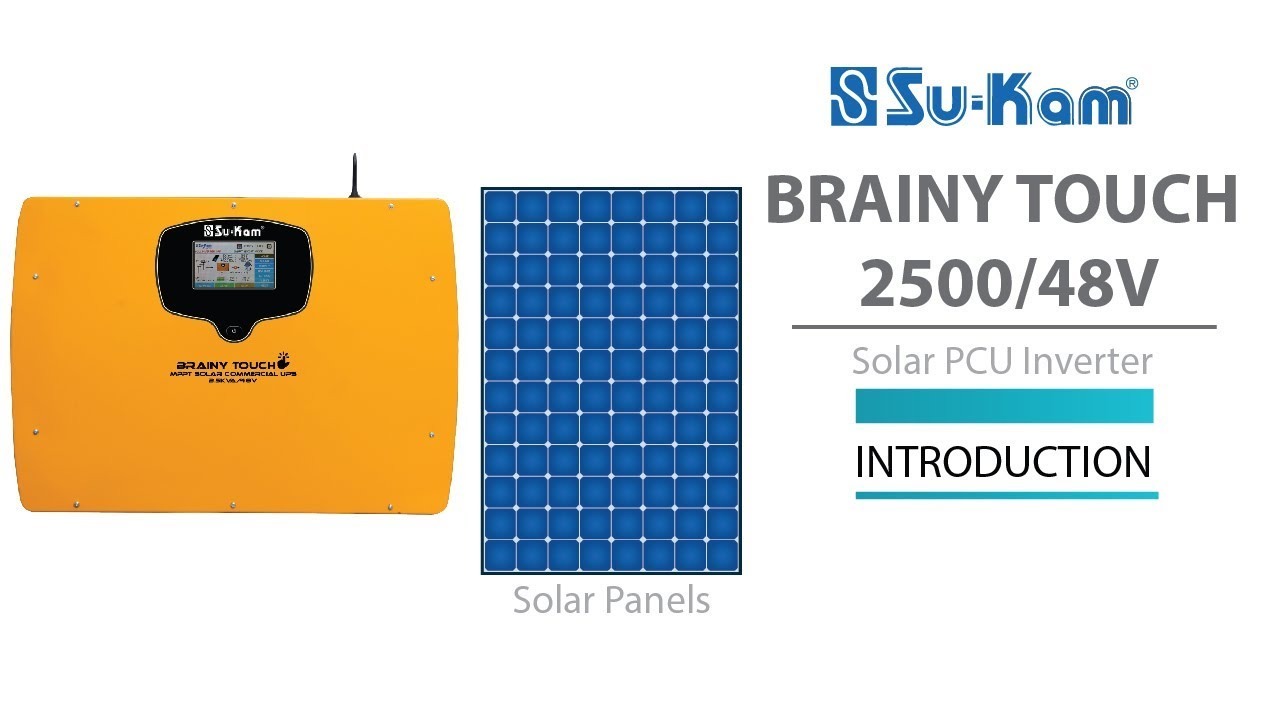
Ahead of Their Time: How Su-Kam Built a Smart, Touchscreen Solar PCU Before Touch Screens Were Common
Under Kunwer Sachdev’s leadership, Su-Kam put India’s first 4.3-inch TFT touch screen on a wall-mountable solar Power Conditioning Unit — before touch screens were even available on mobile phones. No one in the industry built that path before him. And after him, most simply imported from China and stuck on a brand.
When designing power backup and solar equipment, the industry standard for decades was strictly utilitarian: heavy iron transformers, rugged metal enclosures, and basic blinking LED lights. Under the leadership of Kunwer Sachdev, Su-Kam’s R&D team chose a radically different path. They set out to engineer a compact, wall-mountable Power Conditioning Unit (PCU) featuring a 4.3-inch TFT touch screen user interface — at a time when consumer touch interfaces were still absent even on mobile phones.
1. The Vision: Bringing Consumer-Grade Usability to Heavy Power Electronics
The goal was to transform the solar PCU from an intimidating electrical box into an intuitive digital appliance. Instead of deciphering complex LED blink codes or mechanical dip switches, users could manage system operations, configure custom priority settings for power usage, and track performance analytics directly through a vivid touchscreen display. It also introduced advanced remote tracking capabilities, enabling users to monitor system data through a mobile application interface.
- Wall-mountable design: A living-space form factor, not a utility-closet metal crate.
- 2kVA Solar PCU with 2kW MPPT solar charger: Compact power electronics packed with serious solar charging capacity.
- Advanced touch control: Full 4.3-inch TFT touch-screen operation for settings, modes, and power routing.
- User-programmable operation & power priority: Customize grid and solar priority according to regional power availability.
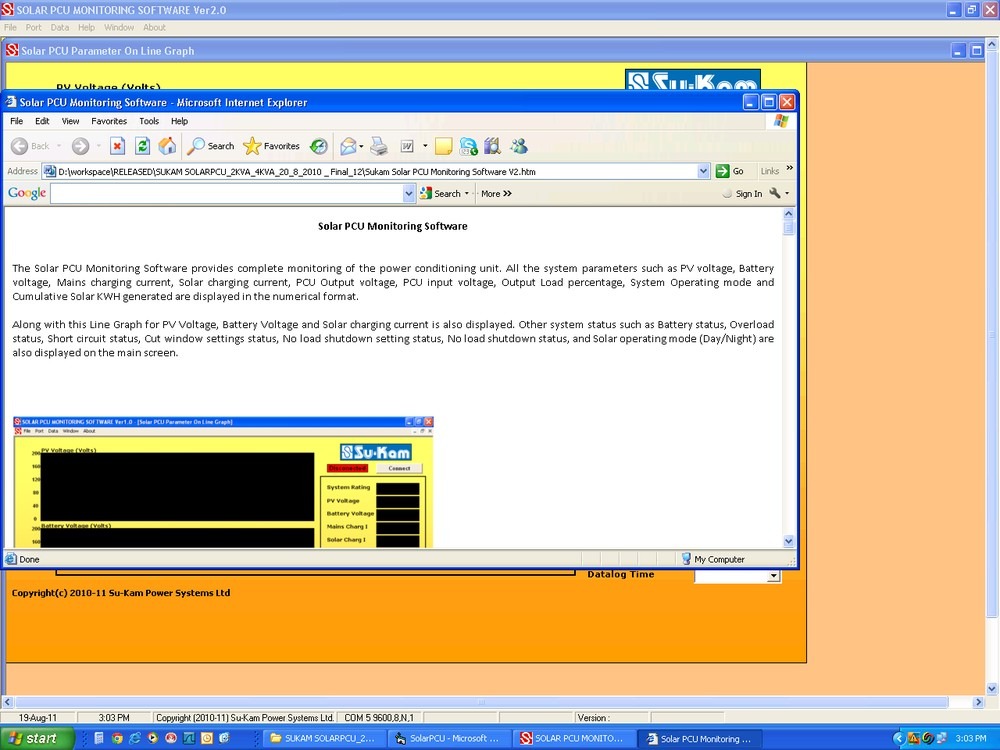
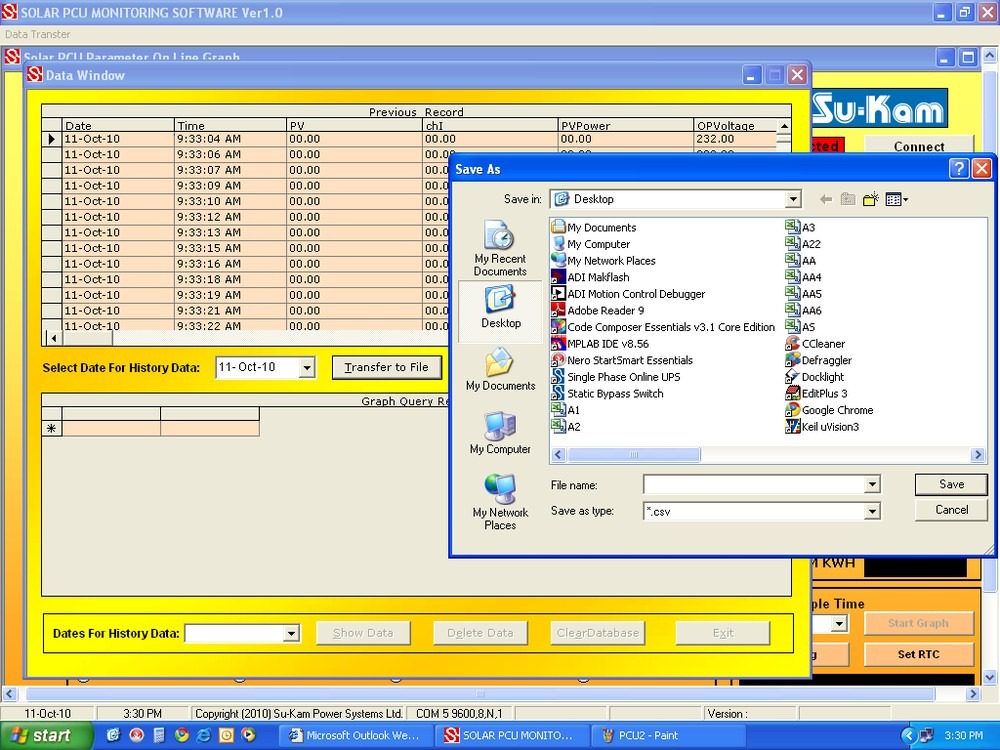
- Real-time data monitoring: Internal data logging plus performance analysis via mobile / PC application interfaces.
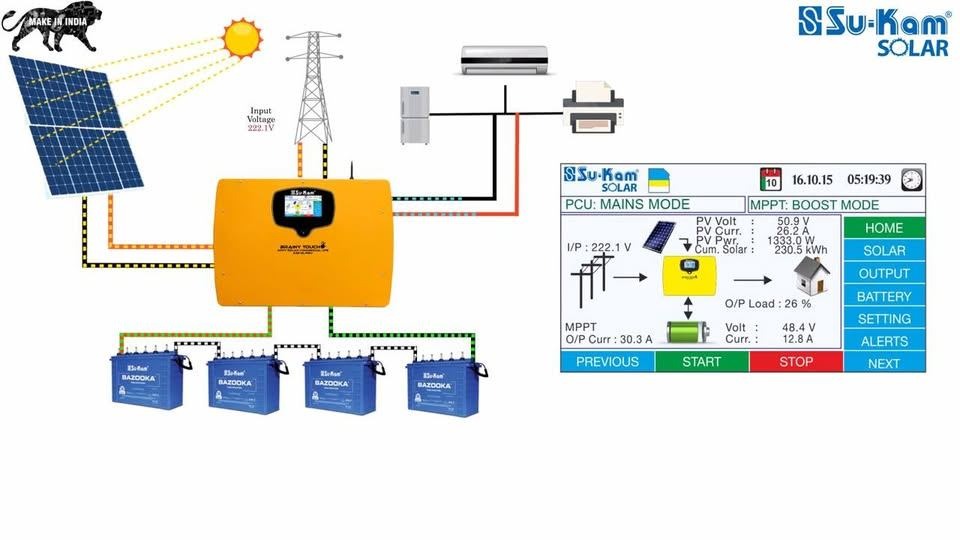
Hardware: 2kVA Solar PCU · 2kW MPPT solar charger
Form: wall-mountable
Software: touch control · power priority · mobile/PC monitoring
Industry pattern after: import-from-China + rebrand
Official product introduction from the Su-Kam YouTube archive. Open on YouTube →
2. Engineering & Development Challenges
Building a high-performance touchscreen PCU for harsh and erratic grid environments involved overcoming severe technical hurdles — the kind that never appear on a rebranded import checklist:
Thermal Management in a Wall-Mountable Form Factor
Traditional inverters relied on massive chassis airflow and open space. Packing a 2kVA solar PCU along with a built-in 2kW MPPT solar charger into a sleek, wall-mountable enclosure required advanced thermal simulation to prevent component heat-trapping.
Electrical Noise and Touch Panel Stability
Power conditioning units deal with high-frequency switching, high voltages, and heavy electromagnetic interference (EMI). Shielding a sensitive TFT touch digitizer from the electrical noise generated by high-power inverter circuits required sophisticated board-level isolation.
Microprocessor & UI Optimization
Running a responsive graphical touch interface smoothly on embedded hardware while simultaneously managing real-time power conversion, MPPT tracking algorithms, and internal data logging demanded rigorous firmware engineering.
3. Intellectual Property and the R&D Legacy
Every layer of this innovation — from the structural wall-mountable mechanical layout to the intuitive human-machine interface — was backed by rigorous in-house development. Part of Kunwer Sachdev’s broader legacy of 106 technology filings (spanning 77 at Su-Kam, 25 at Su-Vastika, and 4 personal ventures, with 24 patents granted by the Indian Patent Office), these technological milestones cemented Su-Kam’s reputation for pioneering solutions that the rest of the market followed years later — when it followed at all, and often only as stickers on imported hardware.
That is the difference between building India’s first TFT touchscreen PCU and merely branding one.
Conclusion
Long before touch screens felt inevitable on phones, Su-Kam under Kunwer Sachdev put one on a solar PCU — and owned the thermal, EMI, and firmware problems that made the claim real. No one in the industry had done it before. Too few were willing to do it after. The easiest Indian shortcut remains import-and-rebrand. The harder road — inventing here — is still the one that changes categories.
In this series
Su-Kam Founder Series
Part 02 · TFT Touchscreen PCU
- Part 01
Falcon HF — India’s First 4-Star High-Frequency Inverter - Part 02 · You are here
Ahead of Their Time: TFT Touchscreen Solar PCU

Kunwer Sachdev
Founder & MD, Su-Kam Power Systems (1988–2019) and Kunwwer.ai — writing on manufacturing, insolvency, and civilizational memory. Read his story →
Found this story worth sharing? Post it to your network — it takes one click: