India’s First Lead-Acid Battery Management System: The Su-Kam Battery Balancing Unit
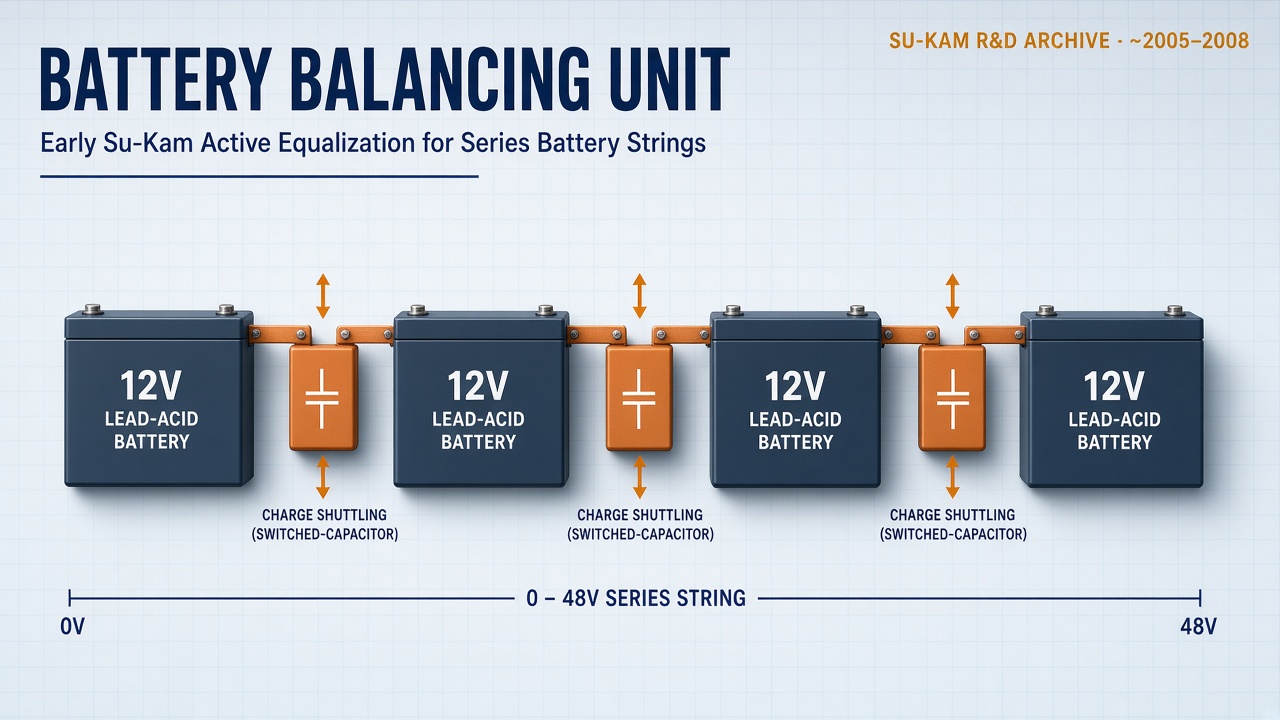
Long before “BMS” became a lithium buzzword, we designed a Battery Balancing Unit for lead-acid series strings in India — active equalization, from Su-Kam R&D, under my watch.
1. Why I am writing this
Today everyone talks about Battery Management Systems as if they arrived with lithium. In the Indian inverter market of our era, the real volume was still lead-acid — tubular and flat-plate batteries stacked in series for home and commercial backup.
I am putting this on the record under my name because this was, to my knowledge and lived experience in that industry, the first Battery Management System designed in India specifically for lead-acid battery strings — built by us at Su-Kam as the Battery Balancing Unit (BBU).
Most people remember Su-Kam for inverters and solar. Fewer remember the quieter engineering problem behind every long backup string: battery imbalance. When you put 12 V batteries in series for 24 V, 36 V, or 48 V — which we did by the millions — you do not get identical blocks. Temperature, mismatch, and ageing push charge unevenly. Once imbalance starts, it grows.
Our answer was not a brochure slogan. It was a hardware module: active switched-capacitor equalization for lead-acid series strings. This paper reconstructs that work from our internal BBU presentation archive and from the logic we lived with on the shop floor and in the field. The claim and the responsibility are mine, as founder.
2. The problem: series strings and charge imbalance
Series strings of storage batteries were — and still are — used in millions of backup systems. If the string is charged as a single unit, slight mismatches or temperature differences create unequal voltages along the string.
Once imbalance appears:
- Low batteries charge less effectively.
- High batteries charge relatively quickly and tend to sit over-stressed.
- Usable pack energy falls even when “average” voltage looks acceptable.
- The imbalance tends to grow with time.
So the need is not only “charge the pack.” The need is to ensure that when batteries sit at different power/voltage levels, balancing is done so the string delivers maximum usable energy and better efficiency.
Charge equalization cycles exist to correct that imbalance.
3. Our approach: switched-capacitor equalization
The BBU architecture we documented used a switched-capacitor approach to battery equalization.
In plain language:
- A group of capacitors shifts charge among adjacent batteries in a string.
- When those capacitors are switched back and forth repeatedly, they bring the battery voltages in an arbitrarily long series string toward equal values.
- In the ideal switched-capacitor equalizer, that equality is independent of capacitor value, switching speed, component values — and even battery chemistry.
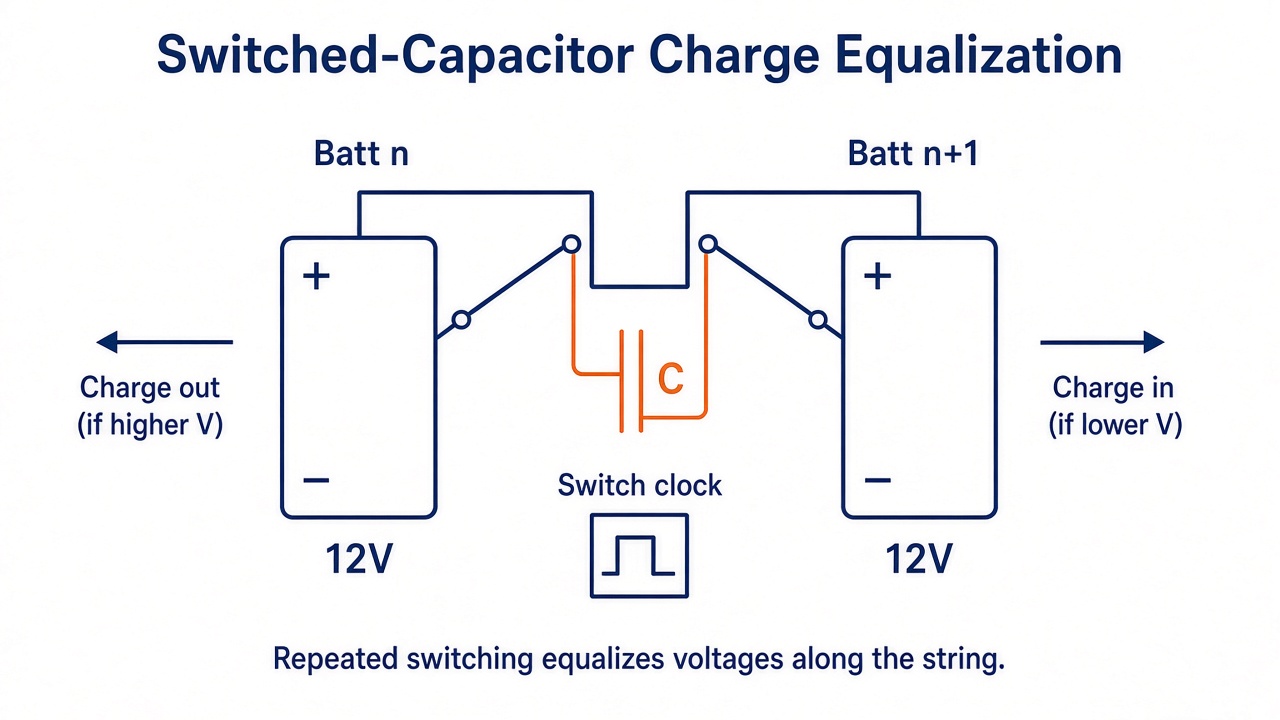
This is not passive “bleed resistor” balancing. It is active charge redistribution — moving energy where it is needed instead of only burning excess as heat.
4. Hardware interface: the 48 V wiring diagram
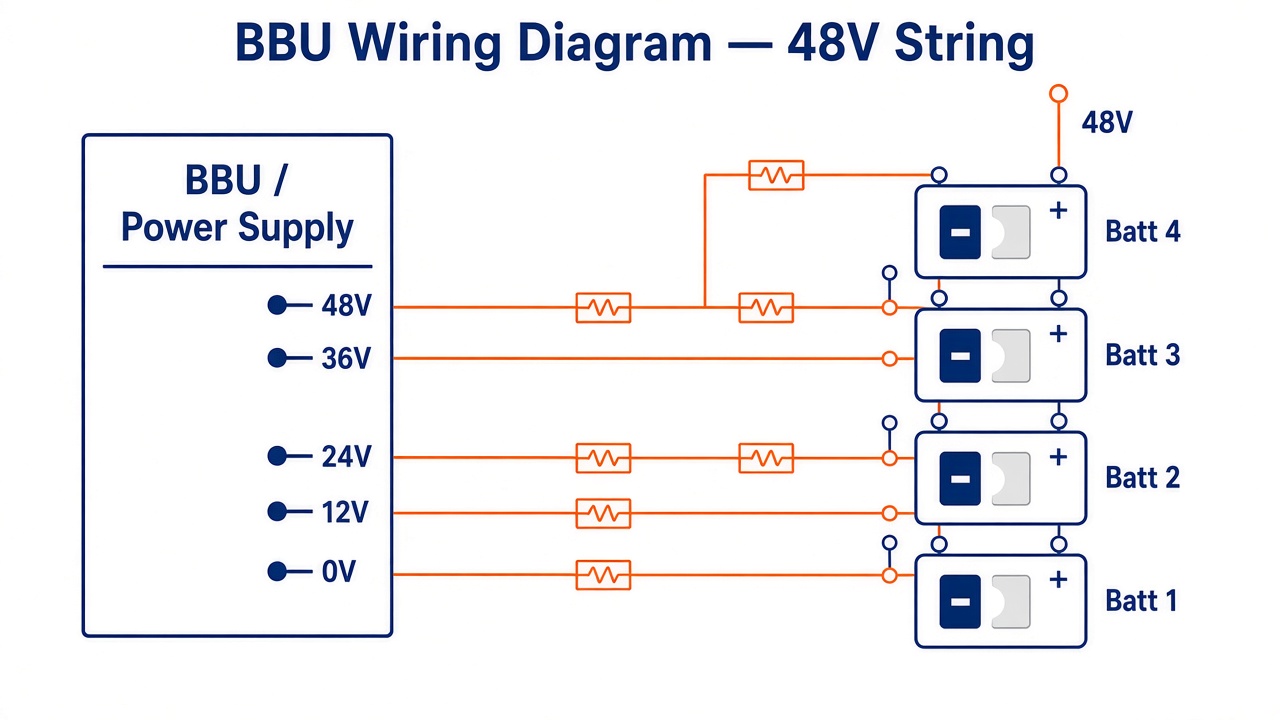
For a typical four-battery, 48 V string of 12 V blocks, the unit presented five output leads at the back:
- 0 V
- 12 V
- 24 V
- 36 V
- 48 V
Those taps map onto the series stack (Batt 1 through Batt 4). The batteries had to be connected in the proper order. The unit worked only when all batteries were connected correctly — a deliberate safety and correctness constraint, with fuses shown on the taps in the archive diagram.
Precautions (as taught to the field)
- Connect batteries in the exact order shown in the wiring figure.
- Do not leave intermediate taps open; the equalizer expects a complete string.
- Treat fuse protection on taps as part of the installation, not an optional accessory.
5. What the life-extension numbers said
The archive did not treat balancing as a theoretical nicety. It put a hard product claim on the table:
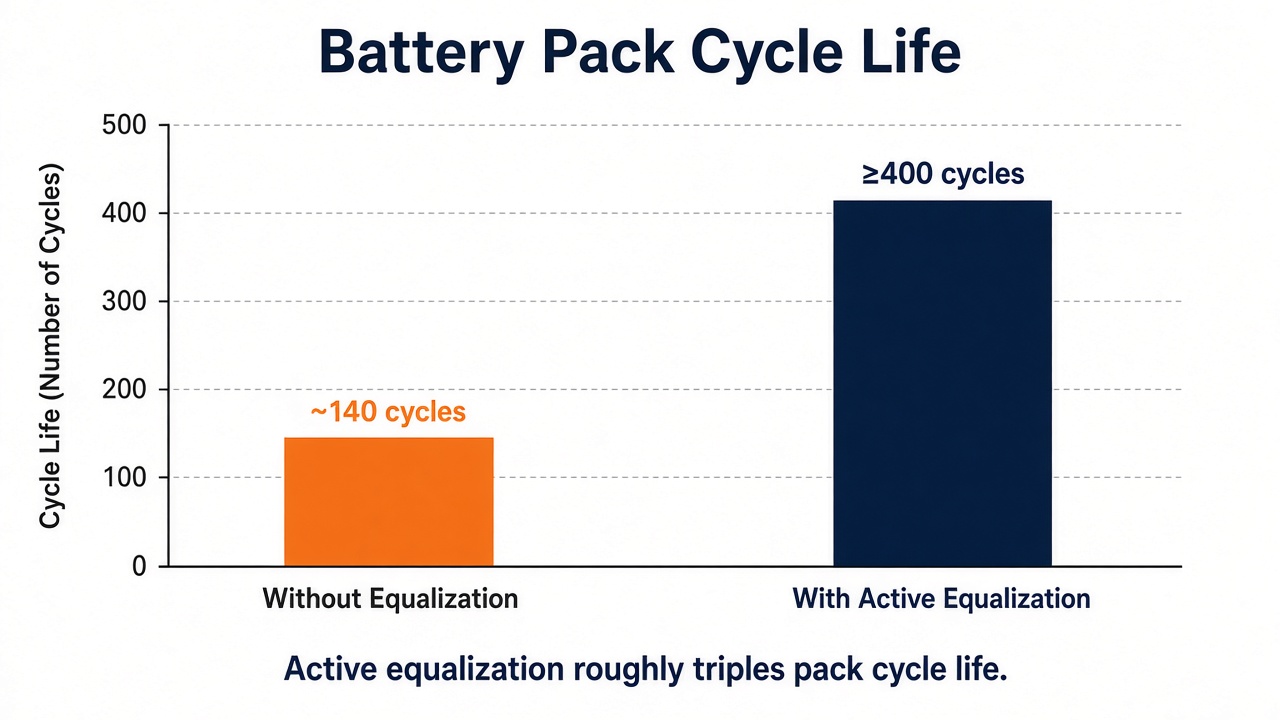
- With active equalization, a series string achieved at least about 400 cycles.
- Without equalization, the same class of pack reached only about 140 cycles.
That is roughly a tripling of cycle life for the battery pack — the overall result we stated in the BBU presentation.
Test-pack notes from the deck
- Test pack 1 — equalization in action: cell-to-cell variation held to about 12 mV.
- Test pack 2 — without equalization: variation began to drift up after about 13 cycles.
Those two observations are the heart of the product argument: without balancing, drift appears early; with balancing, the string stays tight and the pack lives longer.
6. Why this mattered for Su-Kam — and for India
An inverter is only as trustworthy as the battery string behind it. In India’s heat, irregular charging, and deep-discharge culture, imbalance was not a lab curiosity — it was a warranty and reputation problem. Designing BMS thinking for lead-acid series strings, at that time, meant we were solving the chemistry India actually used — not waiting for a later lithium fashion cycle.
By building a BBU around switched-capacitor equalization, we were trying to protect:
- the customer’s usable backup time,
- the dealer’s service load,
- and the brand’s claim that a Su-Kam system was engineered as a system — not only as a box that makes AC from DC.
This sits in the same tradition as other early Su-Kam R&D bets: see the product and the failure mode together, then invent the module that attacks the failure mode.
7. Limits of this note (honest archive note)
This note is reconstructed from the internal Battery Balancing Unit – Presentation PowerPoint (file metadata: created around 2005, last saved around 2008). The costing slide in that deck did not yield usable numbers in text extraction. Schematic photographs from the original slide masters were not fully recoverable as separate engineering drawings; figures here include archive-faithful reconstructions for wiring, principle, and cycle-life claims.
A later revision should add:
- any surviving BBU PCB / product photos from the R&D archive,
- exact part naming / SKU if we can recover it,
- and a clearer date stamp for when BBU entered the market versus when it remained an R&D / field module.
8. Closing
Battery management is often marketed today as a lithium-era invention. We were already fighting string imbalance in the lead-acid backup world — because physics does not wait for chemistry fashion.
The BBU was our answer then: India’s early lead-acid Battery Management System from Su-Kam — move charge, equalize voltages, and buy back cycle life. That is the technical paper I wanted on the record under my name.
9. Related media and filings
- Su-Kam YouTube (BMS / battery life): How to increase battery life? Battery management system (BMS) — embedded above.
- IPO / archive record: Application 1899/DEL/2008 on this site’s Innovation Archive; public abstract also indexed at QuickCompany.
- Companion product essay: Su-Kam DT-6S six-stage charging — charger-side battery life work from the same era.
- Innovation Archive family: batteries / equalizers / BMS filings under Energy Storage & BESS.

Founder, Su-Kam Power Systems (1988–2019) — the Inverter Man and Solar Man of India. Read his story →
Disclaimer: Kunwer Sachdev exited Su-Kam in 2019 and is not responsible for any activity of the company since. Anyone dealing with Su-Kam does so solely with its current management. Full disclaimer →
Data note: Cycle-life and millivolt figures above are taken from the Su-Kam BBU presentation archive cited in this note. They are historical R&D claims from that document, not a present-day certified lab report. Patent citation: Indian application 1899/DEL/2008 (filed 11 Aug 2008; not granted).