Twenty Days Before He Died, Kalam Lit Up Two Villages With Us
Kalam Su-Kam village solar electrification — Series · Project 03 · Off-Grid Mini-Grids
By Kunwer Sachdev — Founder, Su-Kam Power Systems · April 2026
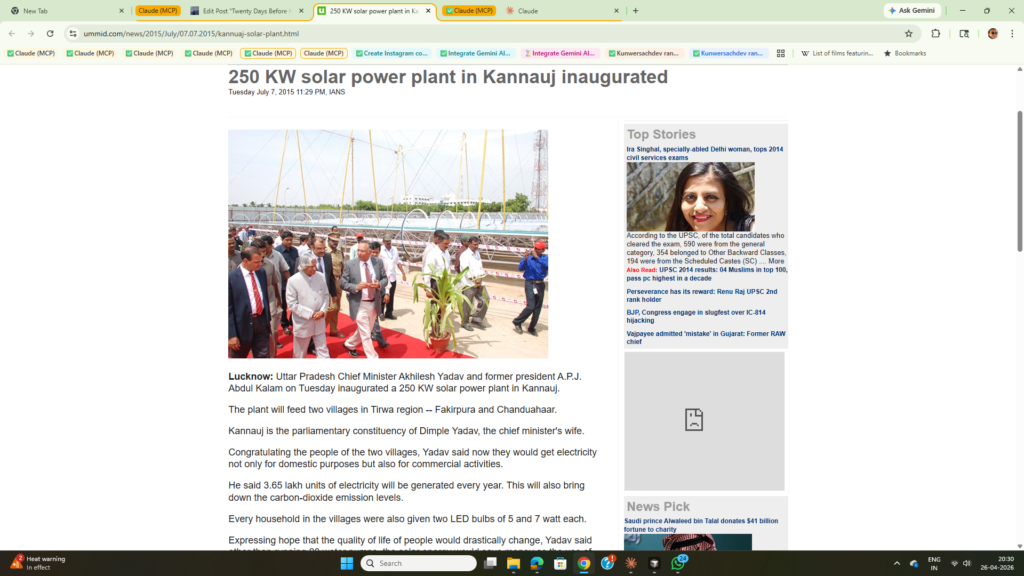
On 7 July 2015, Dr. APJ Abdul Kalam — physicist, missile man, and former President of India — travelled to a village called Fakirpura in Kannauj district, Uttar Pradesh, and inaugurated a 250 kilowatt off-grid solar mini-grid that Su-Kam had built. Twenty days later, on 27 July, he died. It was one of the very last public engagements of his life — and to the best of the available public record, it makes the Kannauj plant the first solar mini-grid project in India ever to be inaugurated by a former President.
What is a mini-grid, and why did it matter then?
This is the question that has to be answered first, because the achievement does not make sense without it. Most Indian readers in 2026 grew up with electricity. Their phones charge from a wall socket. Their fans turn on with a switch. The grid is invisible to them, the way water in a tap is invisible to most people in a city. So when you say “we built a mini-grid in 2015,” the natural response is: a small grid, sure, but what’s the big deal?
The big deal is what existed in Fakirpura and Chanduahaar before we arrived: nothing. No grid. No poles. No wires. No switches. No lights after sunset. Children studied by kerosene lamp. Women cooked in smoke. Old people went to sleep at six in the evening because there was nothing else to do once the sun went down. This was not 1965. This was 2015 — sixty-eight years after Independence, in a parliamentary constituency held by the wife of the Chief Minister of India’s largest state.
A mini-grid is what stands between that condition and the condition most readers take for granted. It is, technically, a small-scale electricity generation and distribution system that operates independently of the national grid. Power is generated at one central plant — in this case, 250 kilowatts of solar panels feeding a battery storage bank. From that central plant, low-voltage distribution lines run out across the village, into individual homes, into street lights, into water pumps, into schools and clinics. It is, in every functional respect, a real electricity grid. It just happens to serve two villages instead of two cities.
The three models of rural electrification
Grid extension — the conventional approach. Run high-voltage transmission lines from the nearest sub-station out to the village. Cost-effective when villages are close together and the terrain is flat. Hopeless when villages are remote, scattered, and small. Successive Indian governments had been promising grid extension to villages like Fakirpura since the 1970s. The poles never came.
Standalone home systems — a small solar panel and battery for each individual house, powering one or two LED lights and a fan. Useful where households are spread across great distances. Limited because it cannot power productive uses — water pumps, milling, cold storage — that require shared infrastructure. (This was the architecture used in our 50,000-household UP rollout under Lohia Awas Yojana, covered in a separate post in this series.)
Mini-grid — a centralised generation plant, usually solar with battery backup, feeding a local distribution network. Combines the dignity of “real” electricity (lights, fans, refrigeration, productive uses, street lighting, communal infrastructure) with the practicality of decentralised generation. Was, and remains, the right architectural answer for villages too remote for grid extension and too dense to be served by isolated home systems.
In 2015, mini-grid technology in India was still in its early days. A handful of pilot installations existed — in Bihar, in West Bengal, in Chhattisgarh — most of them built by NGOs, foreign-funded development organisations, or state utilities. Private Indian inverter companies executing tendered mini-grid contracts at the 250 kW scale were, in 2015, almost unheard of. The Kannauj plant put Su-Kam in that small group.
The contract
In 2015, the Uttar Pradesh New and Renewable Energy Development Agency (UPNEDA) commissioned Su-Kam to design, install, and commission a 250 kilowatt off-grid solar mini-grid for two villages — Fakirpura and Chanduahaar — in the Tirwa region of Kannauj district. Kannauj was at the time the parliamentary constituency of Smt. Dimple Yadav, then a sitting Member of Parliament and wife of the Chief Minister of Uttar Pradesh, Sh. Akhilesh Yadav. The project’s total budgeted cost was approximately ₹6.15 crore, including civil works, electrical and mechanical installations, distribution lines, and household wiring.
- Capacity: 250 kW off-grid solar with battery storage
- Households electrified: 450, comprising approximately 2,000 people
- Project value: ₹6.15 crore
- Designed annual generation: 3.65 lakh units
- Other infrastructure powered: 60 LED street lights, 15 submersible water pumps, two schools, a training centre, a healthcare facility, and the village’s small commercial establishments
Off-grid was not a stylistic choice. The grid had not arrived. There was nothing to tie into.
What the press did not cover
The press coverage of the Kannauj inauguration is what survives in the public record. The execution that preceded the inauguration is not. It deserves to be.
Building an off-grid solar mini-grid in rural Uttar Pradesh in 2015 was not, in the main, an engineering problem. It was a political problem. The moment word spread that two specific villages — Fakirpura and Chanduahaar — were going to receive 24-hour electricity from a project that adjacent villages would not, the project became a magnet for every form of pressure rural India is capable of generating.
Adjacent village leaders demanded inclusion in scope. They were not part of the tender. We could not include them. The tender specified the load, the household count, the geographic boundary, and the budget. UPNEDA had specified them, the state government had approved them, and Su-Kam was contractually bound to deliver against them. Adding villages mid-execution would have collapsed the project’s economics, voided the maintenance plan, and, frankly, opened the door to demands without end.
So the answer was no. And the response to that no, on more than one occasion, included intimidation. There were calls. There was pressure exerted through political intermediaries. There were the kinds of veiled and not-so-veiled implications about what could happen on remote project sites that anyone who has worked on rural infrastructure delivery in India will recognise. None of this was unique to Kannauj. It is the texture of doing this work in India. It is also the part founders almost never write about, because it is uncomfortable, because the people who applied the pressure are usually still in their positions, and because settled industries find it embarrassing to admit the conditions of their unsettled origins.
I am writing about it because the record deserves it. Su-Kam did not yield. We delivered exactly what the tender specified, to the villages the tender specified, on the schedule the tender specified, at the budget the tender specified. The plant was commissioned on time and the inauguration went ahead on 7 July 2015, precisely because we held the line on contract scope from start to finish.
The day Kalam came
I should be honest about one thing first. I did not get to meet Dr. Kalam personally that day. I was in the audience. I did not exchange words with him, I did not shake his hand, and there is no photograph of the two of us together. The Su-Kam team had built the plant; I was there as the founder of the company that had built it; but the inauguration was a state event, and I sat in the rows where state events are watched, not in the rows where photographs are taken.
I am putting that on the record because most founders’ essays would, at this point in the story, finesse the question. They would imply a closeness with the great man that did not exist. I am not going to do that. What I have, instead of a personal exchange, is what I heard him say from the dais, and what I have thought about ever since.
What he actually said
Kalam was overwhelmingly pro-solar. This much, anyone who watched his career would have known. What I had not fully absorbed before that day, and what I absorbed sitting in the audience listening to him, was a more specific position: he believed Indian solar should grow without leaning on government subsidies. Solar, in his view, should stand on its own technical and commercial merits. The point of the technology was not to extract a perpetual subvention from the Indian taxpayer. The point was to be cheap enough, reliable enough, and well-engineered enough to be the obvious choice — without anybody having to be paid extra to choose it.
This was a remarkably sophisticated position for 2015. The conventional wisdom of the Indian solar industry at the time — including, frankly, parts of my own thinking at that time — was that subsidies were a structural necessity. The capital cost of solar was high. The cost of capital was high. The price of solar power was higher than coal-based grid power. The argument was: subsidies bridge the gap, capacity gets built, scale brings costs down, and eventually the gap closes. This is, to be fair, what actually happened. By 2024, solar tariffs in India had fallen below thermal tariffs, and subsidies became less central to the economics.
But Kalam, in 2015, was already articulating where the destination should be: an Indian solar industry that did not need props. He was not naive about the transition. He understood that early-stage technology adoption requires support. What he was insisting on was the destination — and the destination, he said, was a solar industry that competed on engineering and economics, not on policy.
India should do more solar without the government subsidy.
— Dr. APJ Abdul Kalam, in substance, at the inauguration of the Kannauj mini-grid, 7 July 2015 (writer’s recollection of remarks).
It is a sentence that, in 2015, sounded almost contrarian. It is a sentence that, in 2026, looks like the entire policy direction the Indian solar industry has actually travelled.
The team’s pride
I do not want to single out individual members of the Su-Kam team in this post, because the people who actually built the Kannauj plant numbered well into the dozens, and I would only be able to do justice to a few of them. But what I want to record is the collective fact of what they had done. They had executed an off-grid mini-grid in two remote UP villages, on time, under political pressure that would have caused a less determined organisation to stall, against a deadline that was set by a former President’s calendar, and they had pulled it off.
When Kalam stood at the dais and spoke about solar — when the villagers of Fakirpura and Chanduahaar listened to a former President of their country speak from a platform that ran on Su-Kam’s solar plant — that was the moment the team’s months of work paid off. It was a quiet kind of pride. Most of the team was not in the photographs either. Most of them were behind the dais, monitoring the plant, watching for any technical issue that could embarrass us during the inauguration. They did their jobs. The plant did its job. Nothing went wrong. That is the highest compliment you can pay a working installation on its inauguration day.
Twenty days later
On the evening of 27 July 2015, Dr. Kalam was delivering a lecture at the Indian Institute of Management, Shillong. He collapsed mid-sentence. He never regained consciousness. He died that night.
Two days later, the Uttar Pradesh government announced that the state’s technical university — the UPTU — would be renamed in his honour. It is now Dr. A. P. J. Abdul Kalam Technical University, the largest technical university in India by enrolment. Akhilesh Yadav, in announcing the renaming, specifically cited Kalam’s recent visit to Kannauj as evidence of his “great affection for the state.”
I have always thought it slightly strange that the Kannauj solar mini-grid — one of the very last things he chose to do with his time — is not better known.
He gave us his second-to-last working day. The least we owed him was a working plant.
What happened to the plant
This is the part of the story I do not enjoy writing, but it is part of the public record and it would be dishonest to leave it out.
In July 2022, on the seventh anniversary of Dr. Kalam’s death, Sh. Akhilesh Yadav publicly tweeted that the Kannauj solar plant had fallen into disrepair and was no longer functioning. He requested the state government to restore it. The tweet was widely reported. I do not know the technical reasons for the failure. I do not know what maintenance contracts were honoured or breached after Su-Kam’s role concluded, or after the company’s insolvency in 2019. I have not had operational visibility into the plant for many years.
What I do know is that in 2015, when it was inaugurated, it worked. It generated power. It electrified Fakirpura and Chanduahaar. And the man who cut the ribbon believed, on the evidence of his own eyes that day, that India’s villages could be electrified by the sun — and that, in time, they could be electrified by the sun without the government having to pay extra to make it happen.
Why I am telling this story
The history of Indian solar will be written, eventually, by people who were not in the field in 2015. They will tell the story through gigawatt numbers, capacity-addition charts, and policy timelines. Those things matter. They are not the whole story.
The whole story includes a 250 kilowatt mini-grid in Tirwa tehsil that, for the first time in the lifetime of every villager in Fakirpura and Chanduahaar, made electricity a daily fact of life rather than a promise made at election time and never kept. It includes an 83-year-old former President who believed the work was important enough to be present for, and who used the platform to advance an argument — solar without subsidy — that the country has, mostly, gone on to prove right. It includes a small Indian inverter company — Su-Kam — that took a UPNEDA tender most of its larger competitors did not want, navigated political pressures most companies would have folded under, and delivered what it had committed to deliver.
That work happened. The press from the time documents it. The man who inaugurated it spent his second-to-last working day on it. None of that goes away.
The verified record
- Business Standard, 7 July 2015 — “Kalam inaugurates mini solar plant in Dimple Yadav’s constituency” (full project details: ₹6.15 crore cost, off-grid 250 kW, 450 households, 60 LED street lights, 15 water pumps, Su-Kam attribution): business-standard.com
- Business Standard (IANS), 7 July 2015 — “Kalam, Akhilesh inaugurate solar power plant” (parallel coverage, 3.65 lakh units annual generation, two-village scope): business-standard.com
- Ummid News (IANS), 7 July 2015 — “250 KW solar power plant in Kannauj inaugurated”: ummid.com
- Business Standard (IANS), 31 July 2015 — “UP Technical University renamed after Abdul Kalam” (links the renaming to the Kannauj visit): business-standard.com
- The Print (PTI), 27 July 2022 — “Repair solar plant inaugurated by Kalam in Kannauj: Akhilesh to UP govt” (subsequent operational status): theprint.in
- UPNEDA — Uttar Pradesh New and Renewable Energy Development Agency: upneda.org.in
- Council on Energy, Environment and Water (CEEW) — research on solar mini-grid adoption in rural India: ceew.in
Founder of Su-Kam and Kunwwer.ai, and mentor at Su-vastika and several other companies — the “Inverter Man of India” and the “Solar Man of India.” Read his story →
You must be logged in to post a comment.